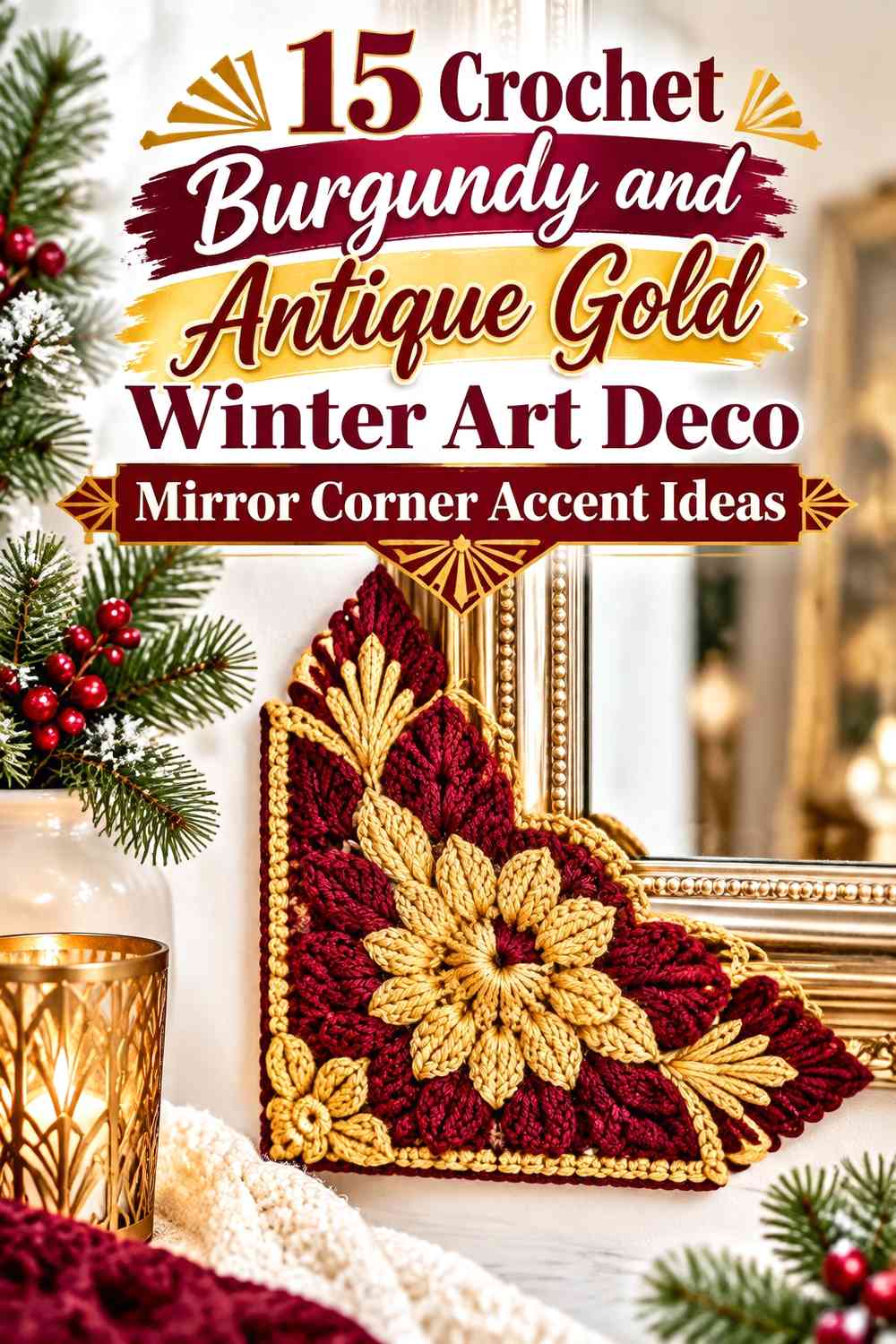

Burgundy and antique gold are well suited to an Art Deco-inspired crochet mirror accent because the two colors can divide structure from ornament. Burgundy can provide the deeper visual anchor along the mirror frame, while antique gold can pick out fan rays, diamond points, stepped edges, and small decorative centers.
A corner accent does not need to cover the entire mirror frame. In fact, concentrating the crochet in one or two corners can make geometric shapes easier to read and prevents the textile detail from competing with the reflective surface. A single fanburst, a pointed diamond, or an asymmetric floral-and-leaf cluster can provide enough decoration.
The tutorials below teach crochet motifs, appliqués, borders, and corner techniques that can be adapted into mirror-frame accents. They do not all demonstrate decorating a mirror. Plan attachment separately for your particular frame, keep crochet off the reflective glass where possible, and use a mounting method appropriate to the frame material. The burgundy and antique gold palettes are independent editorial adaptations rather than claims about the creators’ original colors.
Quick List
- Burgundy Sunburst and Antique Gold Ray Crochet Art Deco Mirror Corner Accent
- Burgundy Diamond and Antique Gold Frame Crochet Mirror Corner Accent
- Antique Gold Triangle and Burgundy Stepped Crochet Art Deco Mirror Accent
- Burgundy Fan and Antique Gold Arc Crochet Mirror Corner Accent
- Burgundy Lace Grid and Antique Gold Corner-Motif Crochet Mirror Accent
- Burgundy Frame and Antique Gold Shell Crochet Mirror Corner Accent
- Antique Gold Scallop and Burgundy Outline Crochet Mirror Corner Accent
- Burgundy Geometric Edge and Antique Gold C2C Crochet Mirror Accent
- Burgundy Rose and Antique Gold Spiral Crochet Mirror Corner Accent
- Antique Gold Leaf and Burgundy Stem Crochet Art Deco Mirror Accent
- Burgundy Leaf Pair and Antique Gold Vein Crochet Mirror Corner Accent
- Burgundy Rosette and Antique Gold Outline Crochet Mirror Corner Accent
- Burgundy Mandala and Antique Gold Ring Crochet Art Deco Mirror Accent
- Antique Gold Starburst and Burgundy Frame Crochet Mirror Corner Accent
- Burgundy Puff Medallion and Antique Gold Petal Crochet Mirror Corner Accent
Let Burgundy Anchor the Mirror While Antique Gold Defines the Geometry
Art Deco-inspired decoration usually benefits from clear edges and repeated directional lines. On a crochet mirror accent, burgundy can carry the broader shape while antique gold identifies the geometry that should be noticed first.
For example, a burgundy fan can use antique gold only on its outer rays. A burgundy diamond can have a narrow antique-gold frame. This gives the gold-colored yarn a specific structural purpose instead of scattering it evenly through every stitch.
The reverse can also work. An antique-gold motif becomes more graphic when a burgundy border separates it from a pale or metallic-looking mirror frame.
Plan Burgundy and Antique Gold Around One Mirror Corner First
Before repeating the accent on several corners, test the visual weight in one. A large burgundy motif can make a small mirror feel asymmetrical if the remaining frame is completely bare, but that asymmetry may be exactly what you want for a decorative statement.
If you prefer balance, use one larger corner treatment and a smaller echo in the diagonally opposite corner. Repeat either the burgundy outline or antique-gold detail rather than duplicating every element at full scale.
Keep the reflective area in mind as well. Broad crochet that extends far over the glass can reduce the usable mirror surface, while a compact motif attached to an existing frame preserves more reflection.
1. Burgundy Sunburst and Antique Gold Ray Crochet Art Deco Mirror Corner Accent
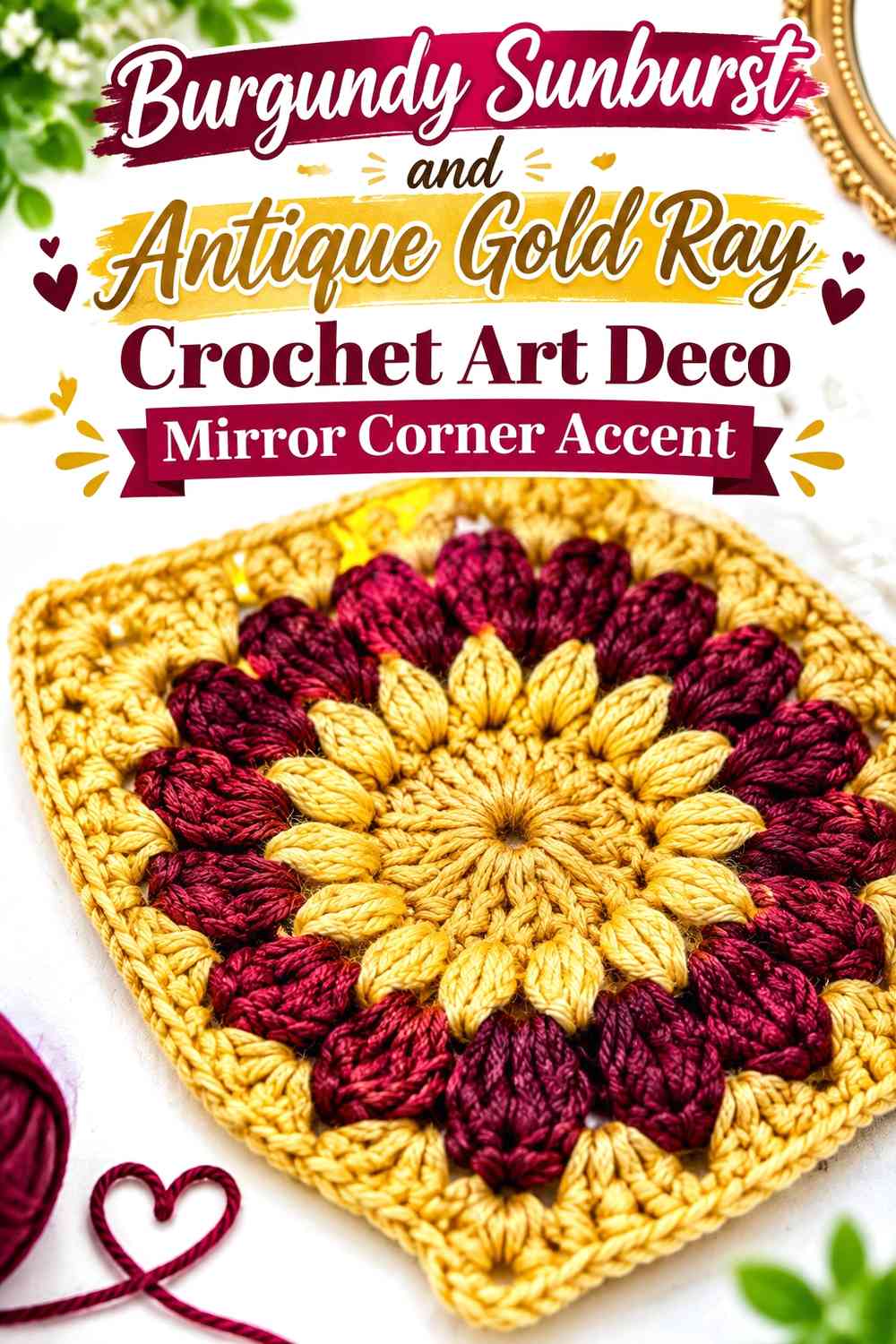
A sunburst motif translates naturally into Art Deco styling because its lines radiate from a central point. Position the center near the mirror corner and let the rays open outward along the frame. Burgundy can carry the main circular structure while antique gold highlights the outward-moving sections.
Burgundy Should Form the Main Crochet Sunburst Center
Keep the inner motif predominantly burgundy so the accent has enough dark visual weight to hold the corner. A continuous center also prevents the radial design from becoming a collection of disconnected gold-colored lines.
Antique Gold Can Emphasize Burgundy Sunburst Rays
Place antique gold on one or more outer rounds or selected radiating sections. The lighter color is most useful where the motif expands toward the frame edges, because those lines strengthen the fanburst effect.
Burgundy Can Return Around the Antique Gold Outer Edge
A narrow burgundy finish can contain the lighter rays and connect the accent back to the main frame area. This is particularly useful when the mirror frame itself is light.
Creator Credit: Bella Coco
2. Burgundy Diamond and Antique Gold Frame Crochet Mirror Corner Accent
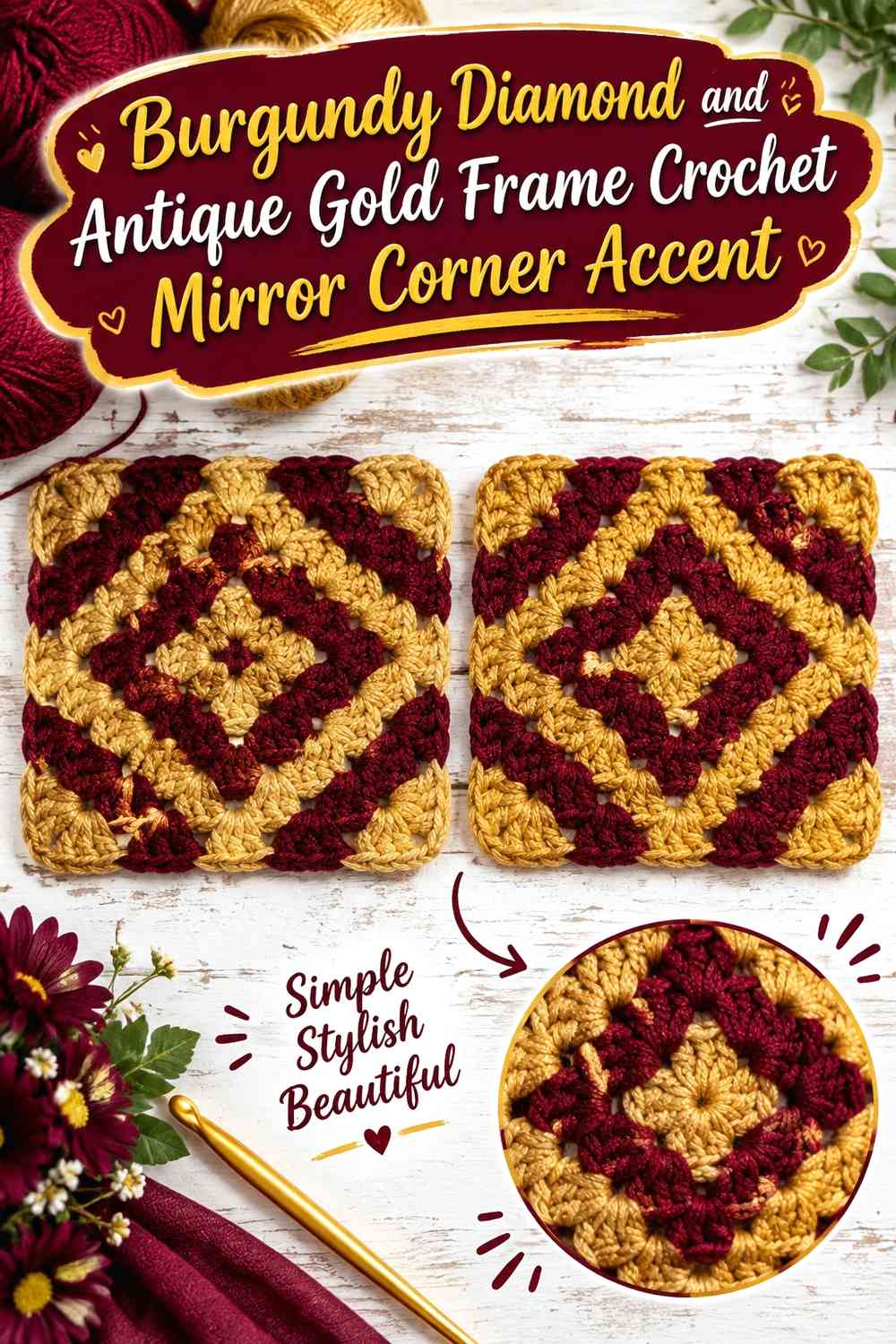
A diamond motif creates a sharper geometric direction than a round sunburst. Set the diamond diagonally so one point aims into the mirror corner, then use burgundy across the main shape and antique gold around the outer edge.
Burgundy Gives the Crochet Diamond Its Strongest Art Deco Shape
Keep the interior largely burgundy so all four points remain visually connected. Too many alternating colors inside a relatively small diamond can weaken the crisp outline.
Antique Gold Can Frame the Burgundy Diamond Points
A pale gold-colored outer round emphasizes the angular perimeter and separates the diamond from a dark wood or painted frame.
Burgundy Can Extend Beyond the Antique Gold Diamond at One Corner
A short burgundy tab or secondary point can visually connect the motif with the mirror frame without requiring a full border around the glass.
Creator Credit: Creggy’s Crochet
3. Antique Gold Triangle and Burgundy Stepped Crochet Art Deco Mirror Accent
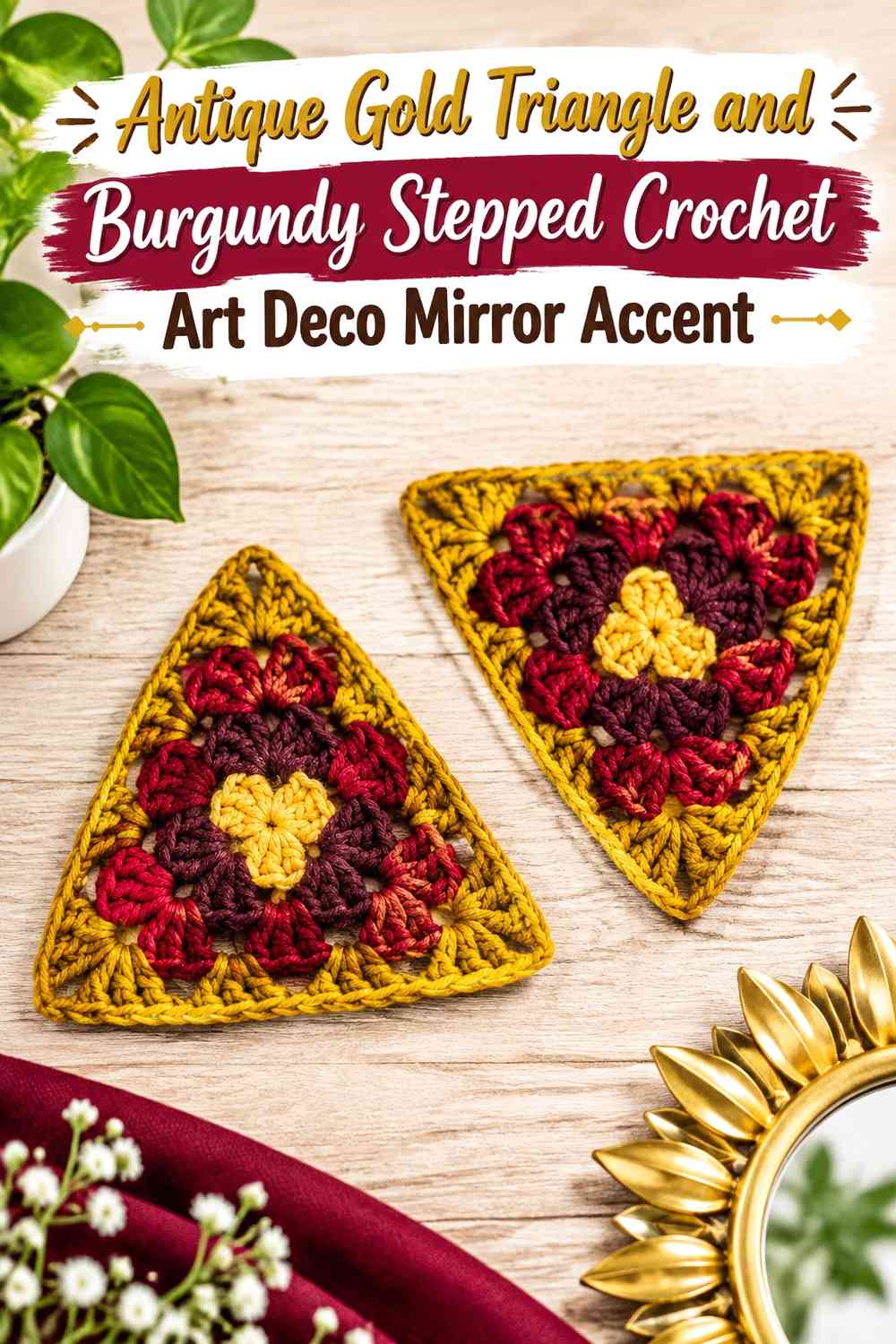
A triangular motif can sit directly into a right-angled mirror corner. Antique gold can fill the central triangle while burgundy creates a darker stepped or layered treatment around its outside edges.
Antique Gold Can Make the Crochet Triangle the Main Corner Focal Point
Use the lighter shade across most of the triangle so the geometric shape remains visible against a dark frame or wall.
Burgundy Can Create a Stepped Frame Around Antique Gold
Add burgundy along the two sides that follow the mirror corner. Repeating short angular sections creates a more architectural effect than surrounding the triangle with a soft rounded border.
Antique Gold Should Stay Visible Between Burgundy Corner Layers
Do not let the dark framing become so broad that the gold center shrinks into a minor detail. The pale triangle should remain the feature that catches the eye first.
Creator Credit: Patronarte
4. Burgundy Fan and Antique Gold Arc Crochet Mirror Corner Accent
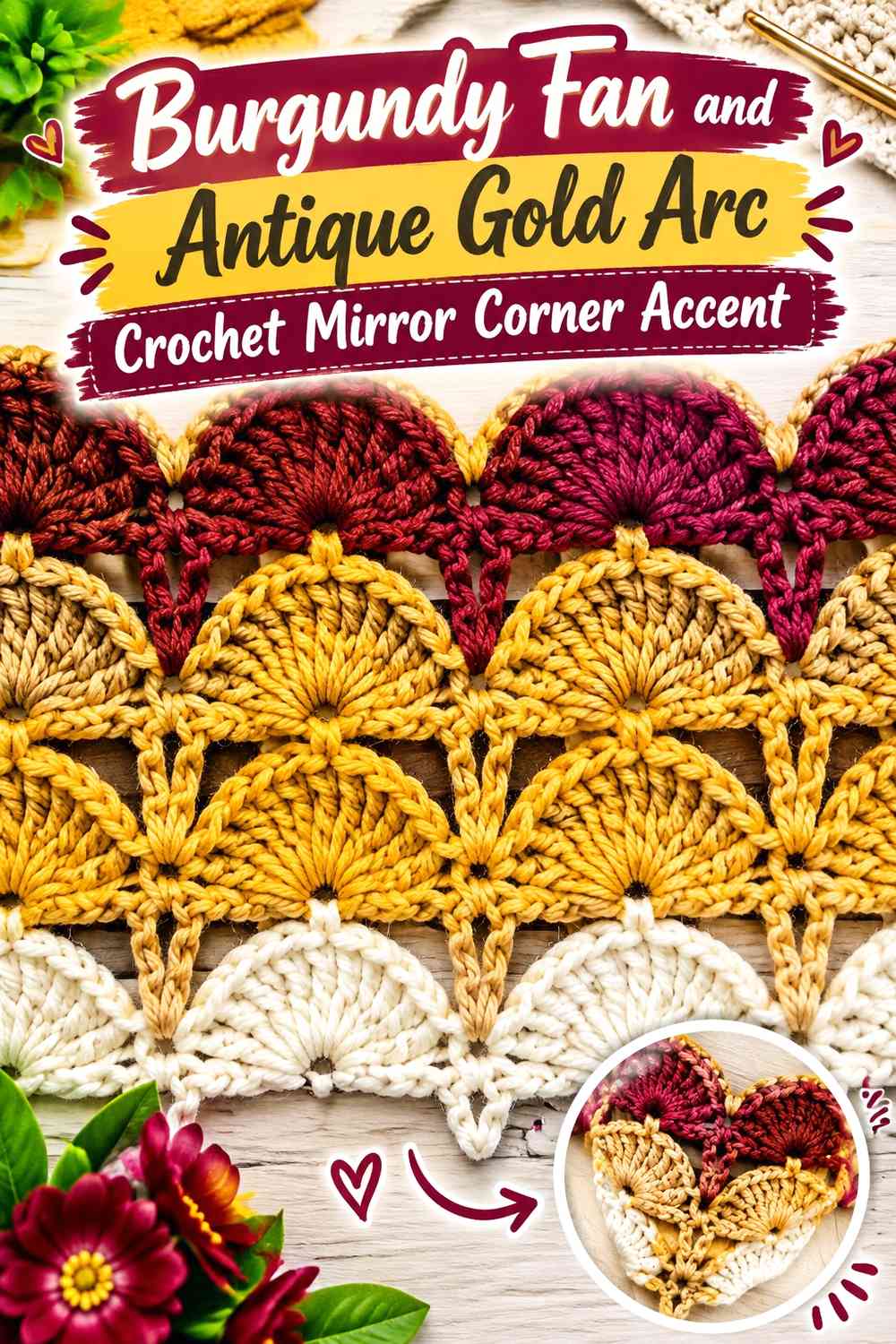
A large crochet fan can be positioned so its narrow base begins at the mirror corner and its curved edge spreads outward. Burgundy provides a strong base color, while antique gold can trace the fan’s upper arcs.
Burgundy Should Carry the Main Crochet Fan Sections
Use burgundy through most of the radiating fan so its lines remain connected from the narrow corner point to the broader outer edge.
Antique Gold Can Highlight the Burgundy Fan’s Widest Arc
Place antique gold near the outer curve or on selected fan rows. Concentrating the lighter shade at the widest point increases the sense of expansion.
Burgundy Can Ground an Antique Gold Fan Edge at the Mirror Corner
Keep the narrow base burgundy even if the upper portion becomes gold-heavy. The darker base creates a stronger visual attachment to the corner.
Creator Credit: naztazia
5. Burgundy Lace Grid and Antique Gold Corner-Motif Crochet Mirror Accent
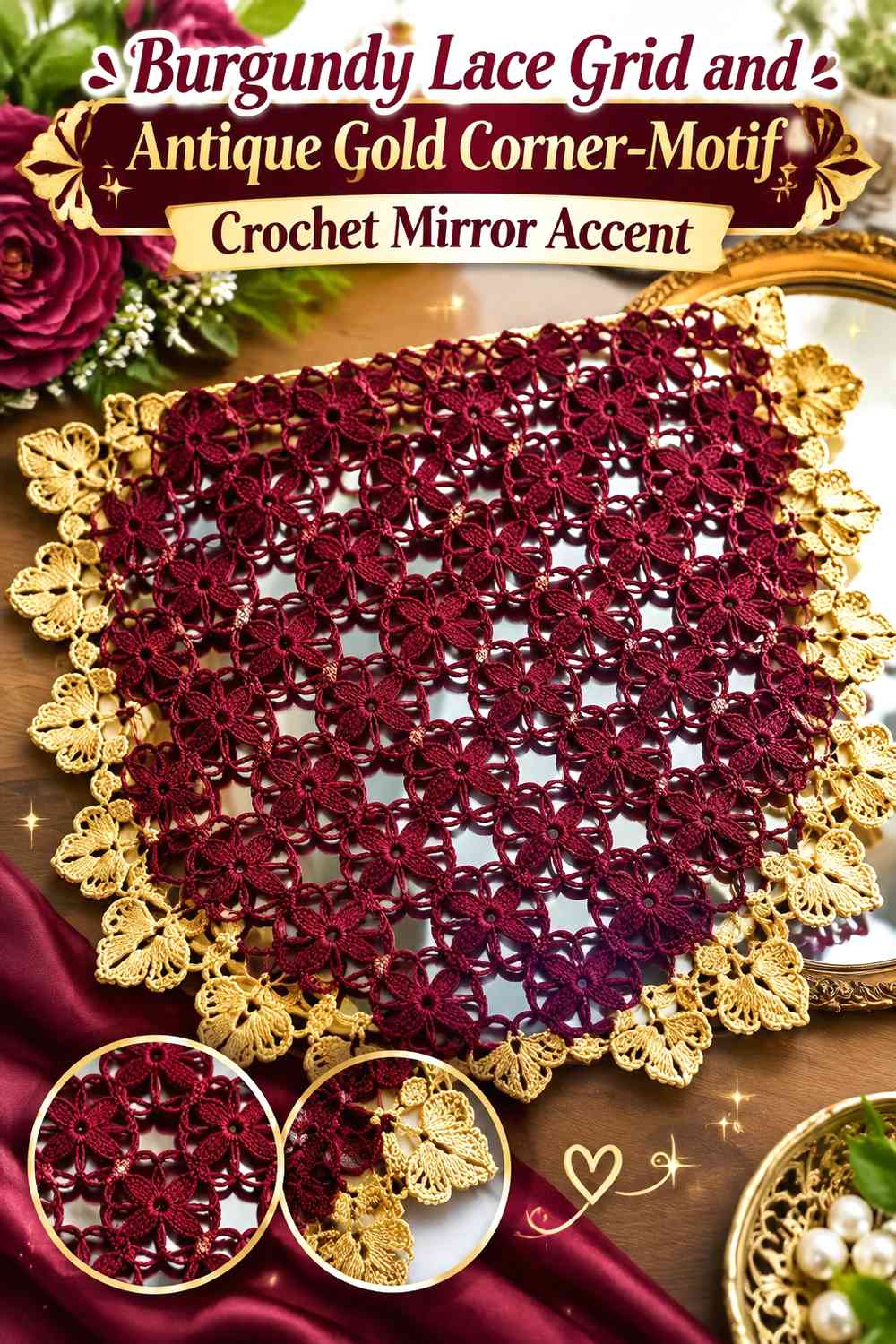
A lace corner motif can create a more delicate Art Deco interpretation. Use burgundy through the joining or grid sections and antique gold in the central decorative shapes that sit closest to the mirror corner.
Burgundy Can Give Antique Gold Crochet Lace a Clear Framework
Keep burgundy on the connecting lines so the openwork does not disappear against the background. Darker joining areas also help separate individual pale motifs.
Antique Gold Should Concentrate at the Burgundy Mirror Corner
Use the lighter shade in one prominent corner motif instead of repeating equal gold details across a long border. This keeps the design focused on the requested accent rather than turning it into a complete mirror surround.
Burgundy Can Extend the Antique Gold Motif Along Two Frame Edges
Short lengths of burgundy lace running away from the corner can make the accent look integrated without covering the entire frame.
Creator Credit: Crochet Swan
6. Burgundy Frame and Antique Gold Shell Crochet Mirror Corner Accent
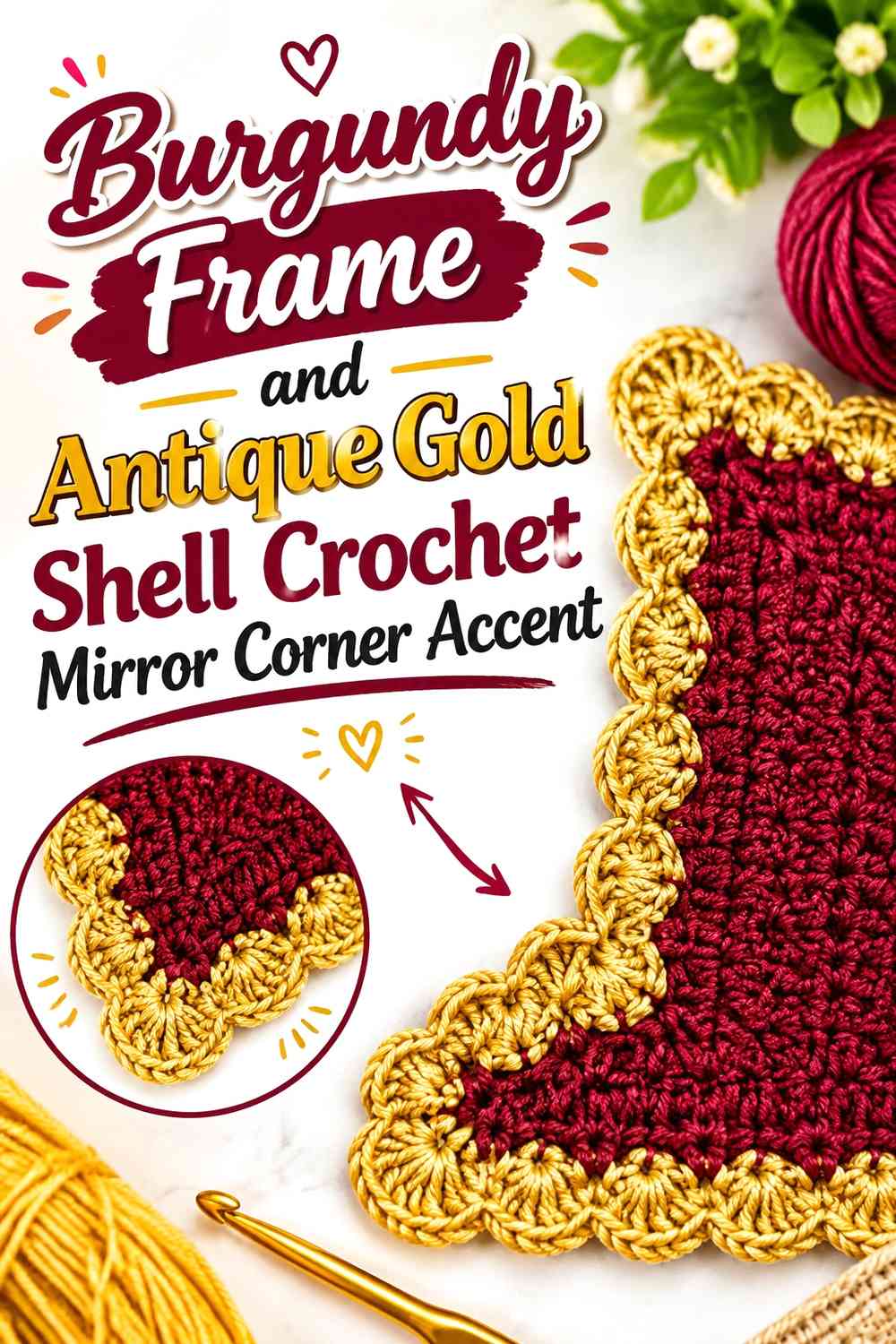
Shells can be arranged around a corner to create repeated fan-like shapes. Keep the foundational edge burgundy and make selected shells antique gold for a restrained geometric border.
Burgundy Should Define the Crochet Corner Before Antique Gold Shells Begin
Use the dark shade along the base edge that follows the mirror frame. This creates a clear structural line beneath the decorative shells.
Antique Gold Shells Can Create Repeated Fans Along Burgundy
Place the lighter shells at the corner or in a short run extending from it. Repetition turns the rounded shapes into a deliberate design rhythm rather than an isolated scallop.
Burgundy Can Separate Antique Gold Shell Groups
If several gold shells sit beside one another, small burgundy divisions can keep each fan shape readable.
Creator Credit: Haakinformatie & Free-Crochet-Patterns
7. Antique Gold Scallop and Burgundy Outline Crochet Mirror Corner Accent
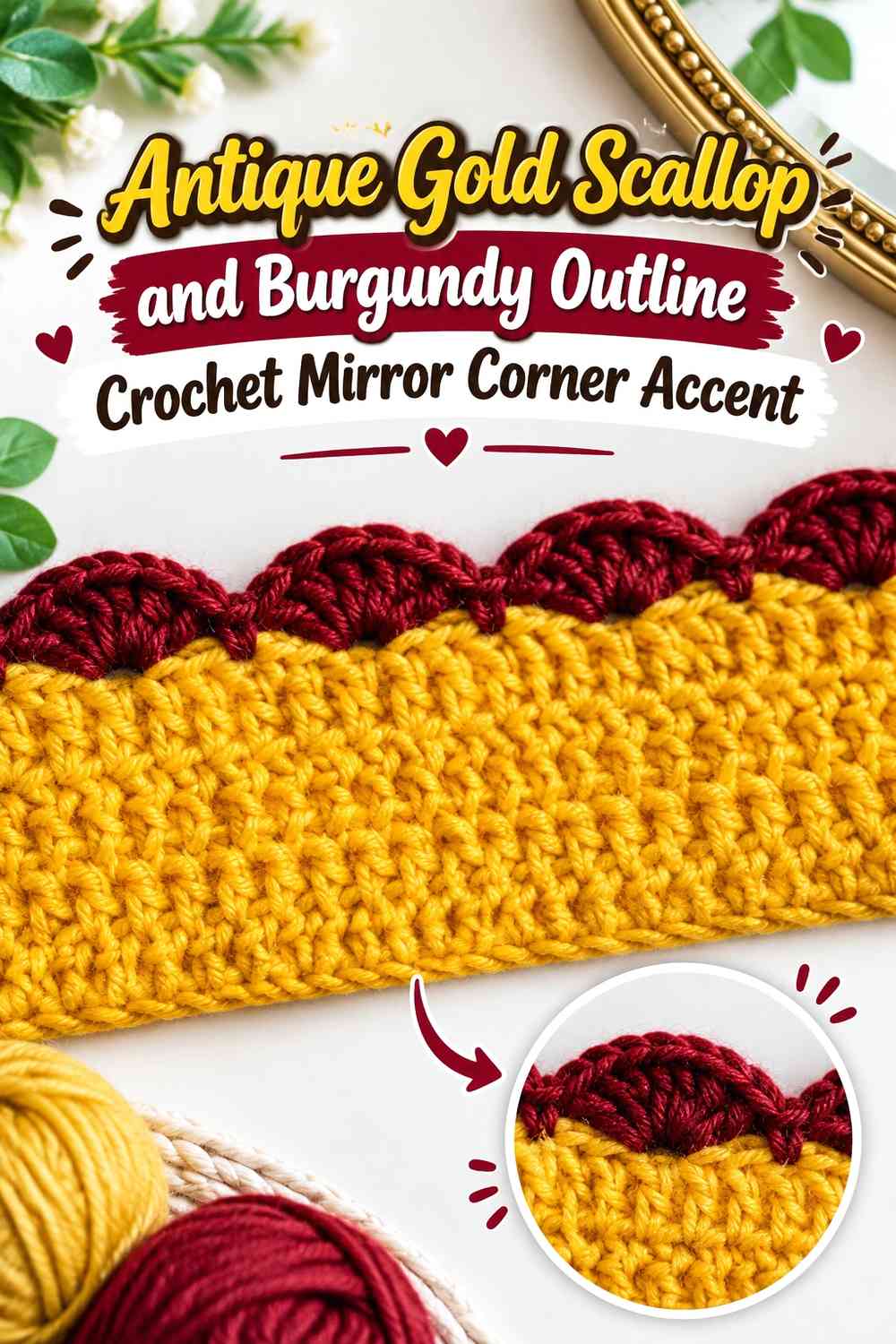
This version reverses the previous hierarchy. Antique gold carries the decorative scalloped edge while burgundy outlines or supports it.
Antique Gold Can Keep the Crochet Scallops Light Against Burgundy
Use the gold-colored yarn across the rounded outer edge so each scallop is easy to distinguish. This works particularly well when the mirror frame itself is dark.
Burgundy Should Trace the Antique Gold Corner Base
A narrow burgundy foundation beneath the scallops gives the pale border a strong attachment line and prevents the gold edge from visually floating beside the frame.
Burgundy Can Strengthen One Antique Gold Corner Scallop
Make the corner itself darker or give the largest shell a burgundy center. This creates a stronger focal point where the two frame edges meet.
Creator Credit: Crochet with Clare
8. Burgundy Geometric Edge and Antique Gold C2C Crochet Mirror Accent
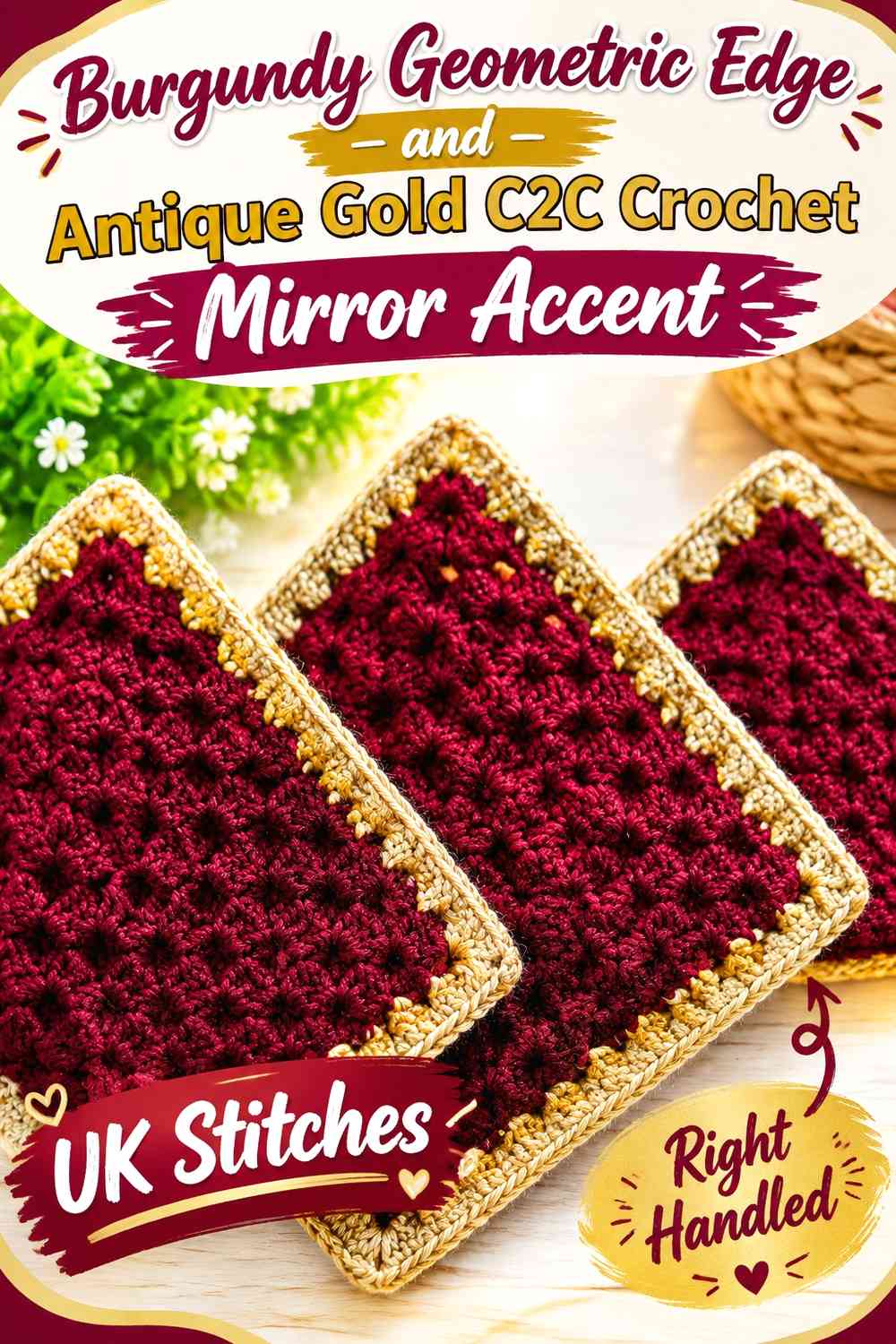
A corner-to-corner border provides small block-like units that can be used to build stepped Art Deco geometry. Keep most blocks burgundy and introduce antique gold near the corner point or in a controlled diagonal.
Burgundy C2C Blocks Can Create a Stepped Crochet Mirror Edge
Use burgundy to build the primary geometric line along two adjacent sides. The block structure naturally produces a more angular result than soft lace.
Antique Gold Can Mark a Diagonal Through Burgundy Blocks
A short gold diagonal can lead the eye toward the mirror corner and suggest the layered chevrons often associated with geometric decorative styling.
Burgundy Should Surround Antique Gold C2C Highlights
Keep enough burgundy on both sides of the pale blocks so the accent remains a dark-framed corner rather than an equal two-color checkerboard.
Creator Credit: Wendy Poole Handmade
9. Burgundy Rose and Antique Gold Spiral Crochet Mirror Corner Accent
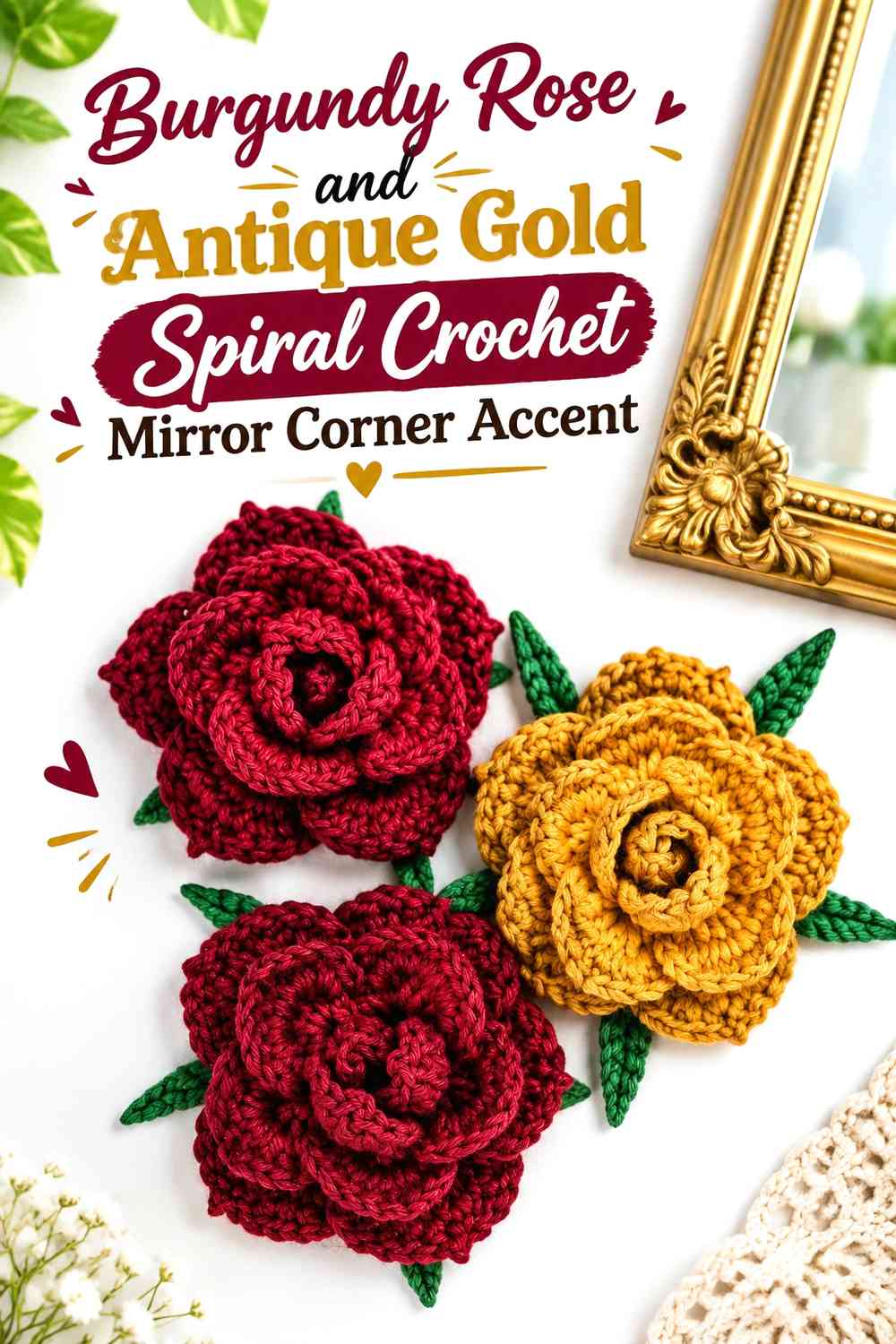
A rose is less geometric than a diamond or fan, but it can still fit an Art Deco-inspired arrangement when treated as a compact sculptural centerpiece surrounded by straight or radiating lines. Use burgundy for the petals and antique gold for a small spiral or frame around the flower.
Burgundy Should Keep the Crochet Rose Visually Dense
Use burgundy across most petals so the flower reads as one sculptural accent. Splitting every petal between two colors could make the bloom unnecessarily busy.
Antique Gold Can Trace the Burgundy Rose Spiral
Place the lighter shade at the center or along a small outer coil. This draws attention to the rose’s rotation without requiring a fully gold flower.
Burgundy Roses Work Better With Controlled Antique Gold Geometry
Pair the floral accent with a simple gold triangle, short ray, or narrow corner line. A second elaborate floral border would weaken the Art Deco direction.
Creator Credit: Happy Patty Crochet
10. Antique Gold Leaf and Burgundy Stem Crochet Art Deco Mirror Accent
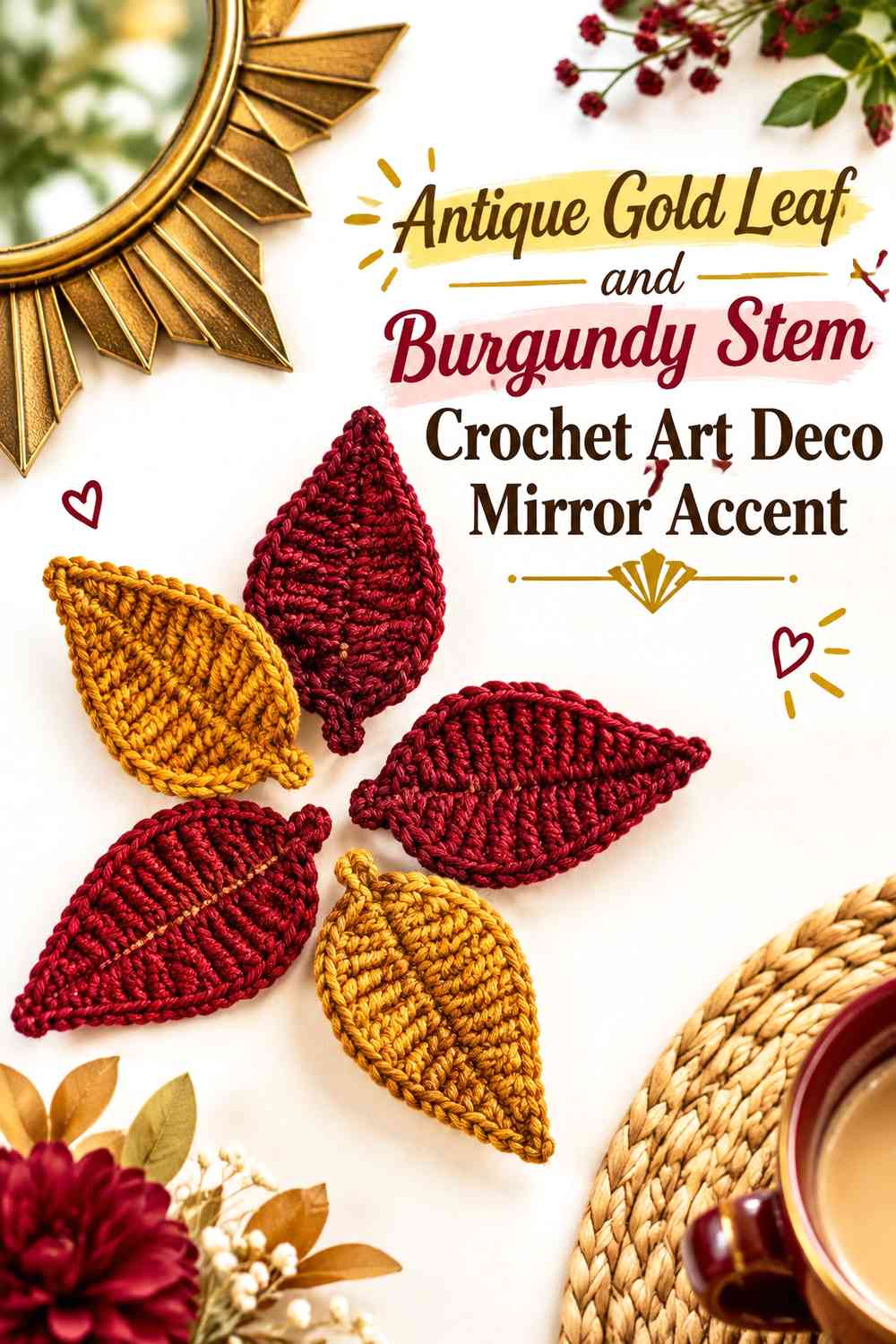
A pointed leaf can become a spear-like Art Deco element when positioned diagonally from a mirror corner. Antique gold makes the leaf the light focal point, while burgundy can define its central line and attachment area.
Antique Gold Should Emphasize the Crochet Leaf’s Long Point
Use the pale shade across the main leaf so its tapered shape remains obvious. Positioning the tip away from the corner creates a strong directional line.
Burgundy Can Give the Antique Gold Leaf a Dark Central Axis
A burgundy stem or nearby narrow detail adds structure without breaking the leaf into several color sections.
Burgundy Can Repeat Behind an Antique Gold Leaf Pair
If two leaves form a symmetrical V-shape, use burgundy at their shared base to visually lock them into the mirror corner.
Creator Credit: Jess Crafting
11. Burgundy Leaf Pair and Antique Gold Vein Crochet Mirror Corner Accent
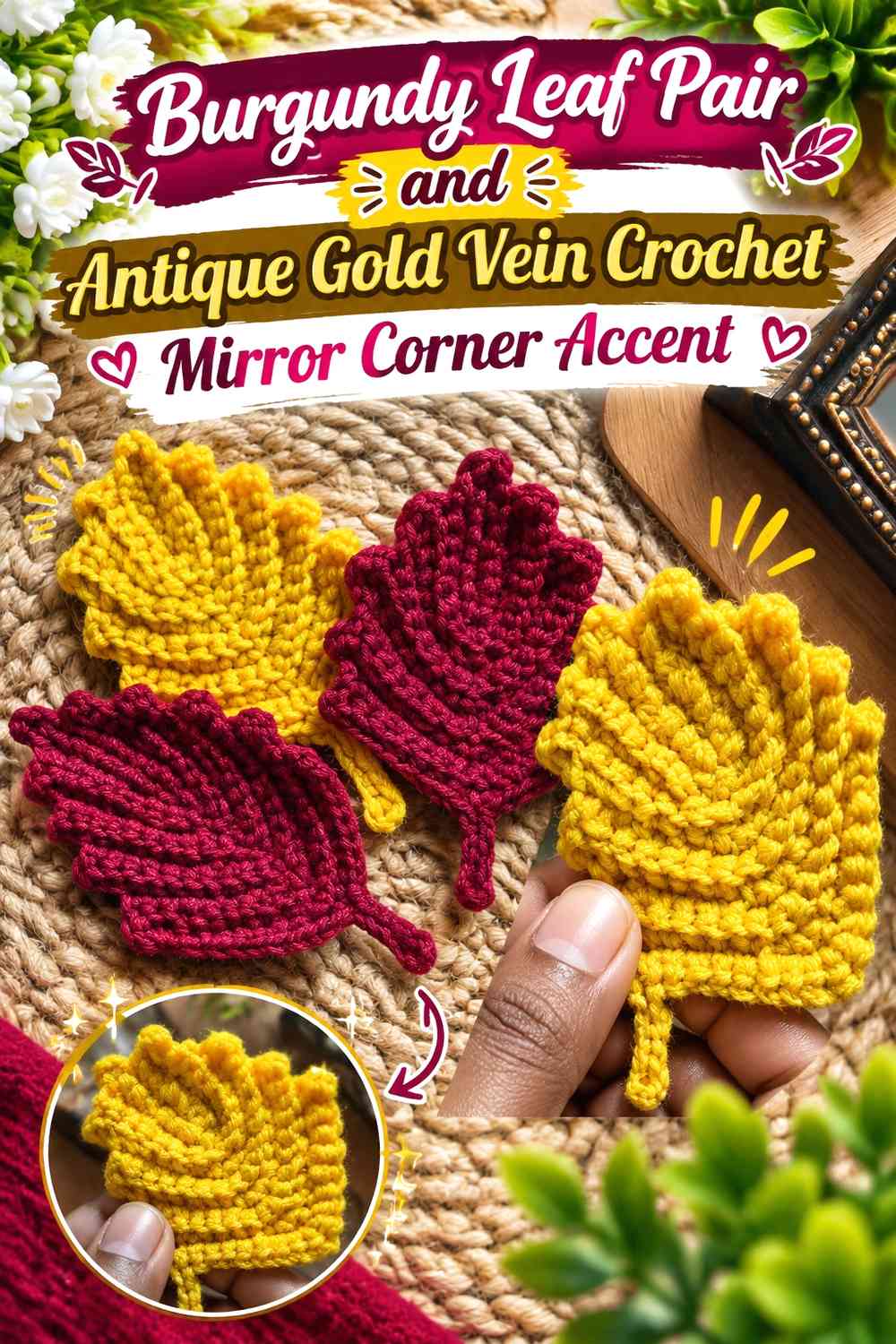
Reverse the previous idea by making the leaves burgundy and reserving antique gold for the smallest directional details. A pair of dark leaves can create a pointed corner flourish without introducing a large amount of light color.
Burgundy Leaves Can Create a Strong V-Shaped Crochet Corner
Arrange two leaves so their tips extend along or away from the adjacent frame edges. The repeated dark shapes create a clear symmetrical corner treatment.
Antique Gold Can Mark the Burgundy Leaf Center
Use the lighter shade for a narrow vein, connecting line, or small base detail. The color should reinforce the direction of the leaf instead of filling half the surface.
Burgundy Needs Space Around Antique Gold Leaf Details
Keep the gold accents small enough for the leaves to remain primarily burgundy. That dark dominance separates this idea from the antique-gold-leaf version.
Creator Credit: Made by Yuma
12. Burgundy Rosette and Antique Gold Outline Crochet Mirror Corner Accent
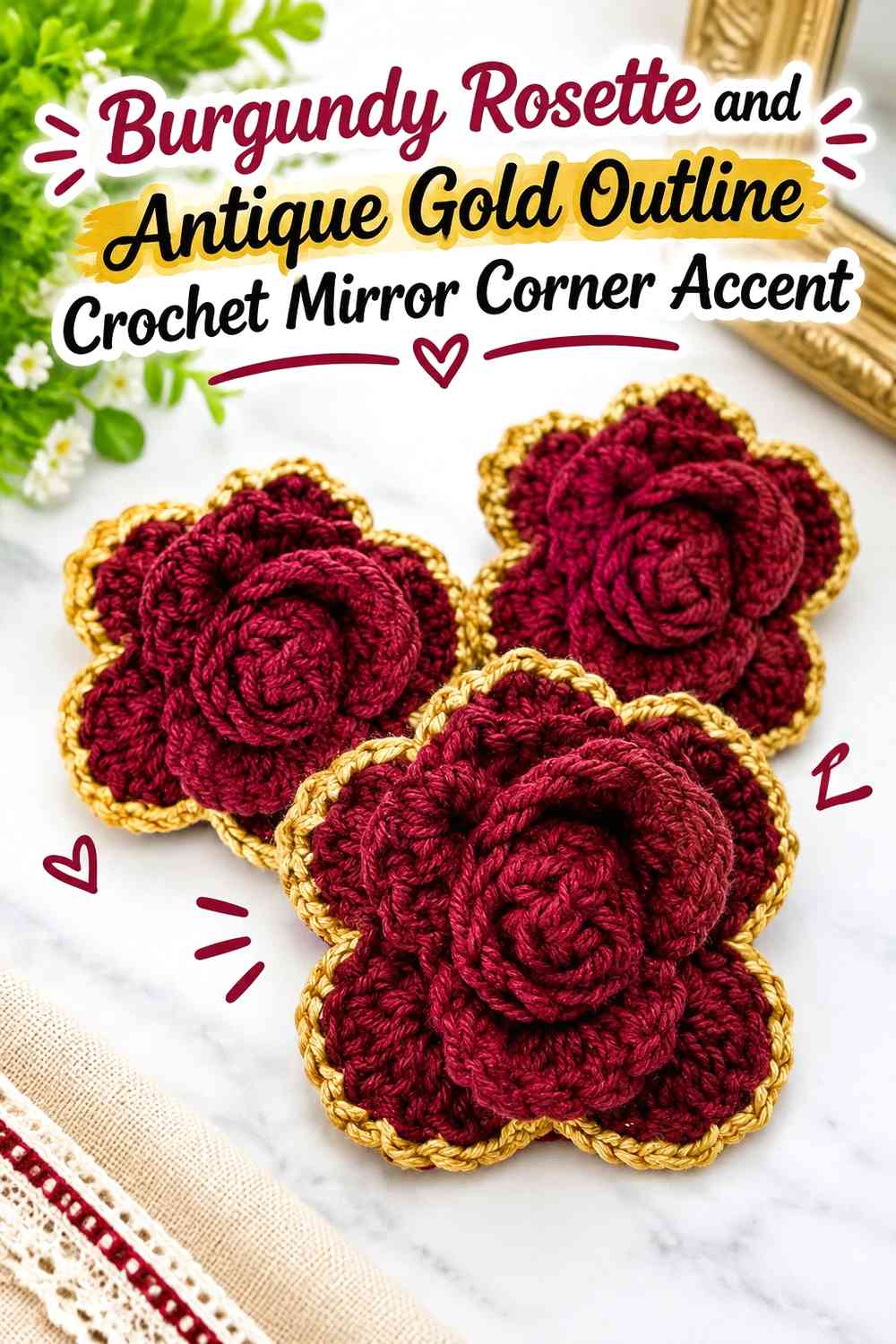
A rolled rose or rosette can work as a compact corner medallion. Make the bloom burgundy, then use antique gold in a separate outline, leaf, or small geometric support around it rather than attempting to recolor every petal.
Burgundy Gives the Crochet Rosette a Deep Winter Focal Point
Keep the flower predominantly burgundy so its dimensional layers remain coherent. The darker tone works particularly well when the surrounding accent is comparatively flat.
Antique Gold Can Frame the Burgundy Rosette Without Hiding Its Petals
Use a narrow gold ring, small leaves, or straight corner lines beside the flower. Leave enough burgundy visible around the petal edges for the rosette shape to remain distinct.
Burgundy Can Connect the Antique Gold Frame Back to the Mirror
A short dark line beneath the floral medallion can act as a visual base and keep the gold outline from seeming detached.
Creator Credit: Hectanooga1
13. Burgundy Mandala and Antique Gold Ring Crochet Art Deco Mirror Accent
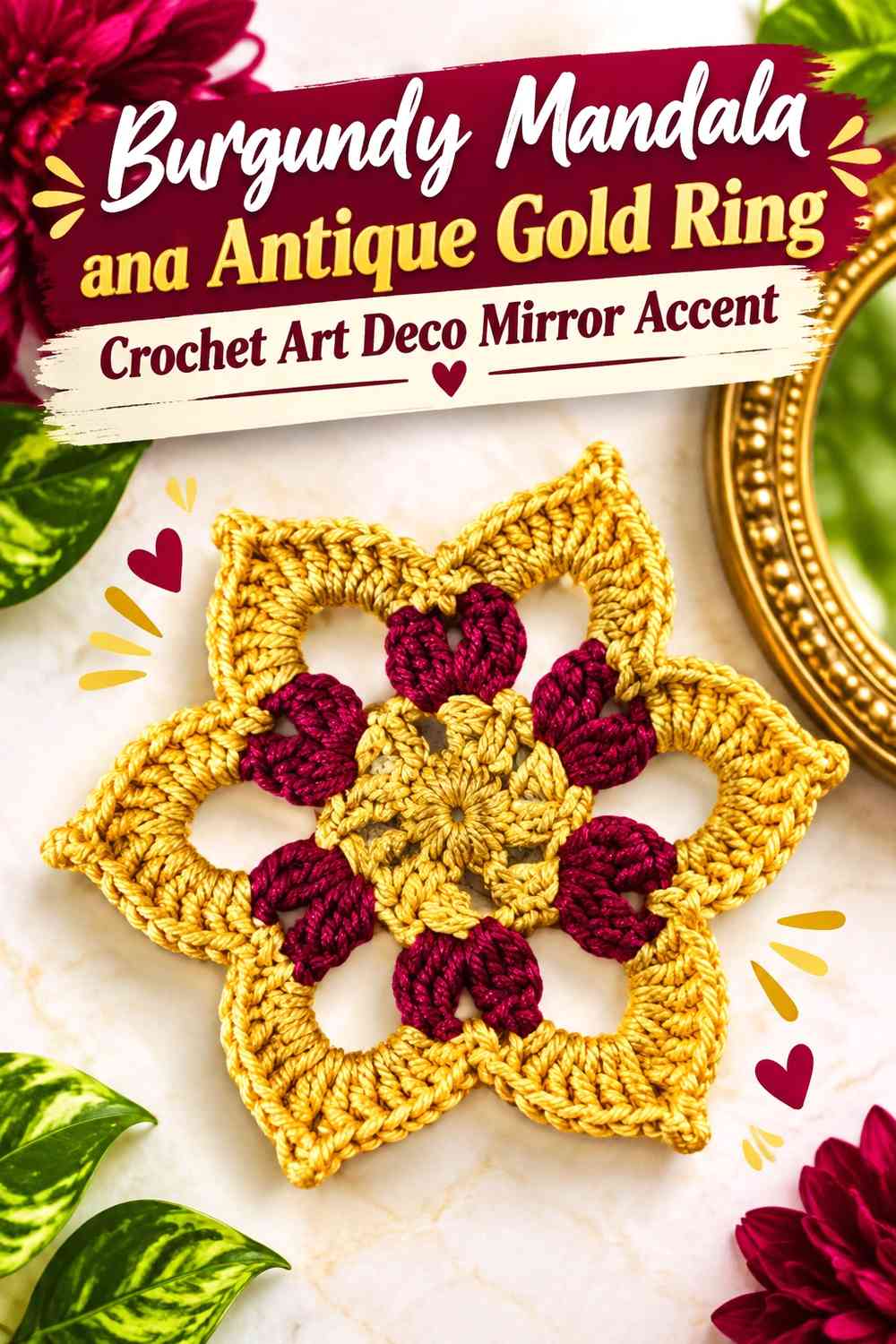
A compact mandala can become an Art Deco medallion when the color placement is simplified. Use burgundy through most of the center and antique gold in one strong ring or repeated radial section.
Burgundy Should Dominate the Crochet Mandala Center
Keep the inner circles dark so the medallion has enough visual weight to sit at a mirror corner without looking like a pale doily fragment.
Antique Gold Can Create One Clear Ring Through Burgundy
A single gold-colored ring is more graphic than several alternating narrow rounds. It also echoes circular Art Deco medallions while keeping the palette controlled.
Burgundy Can Turn an Antique Gold Mandala Edge Into a Corner Point
Extend one burgundy section outward or mount the medallion against a dark triangular backing so the round motif relates more clearly to the angular mirror corner.
Creator Credit: Andrea Quinteros
14. Antique Gold Starburst and Burgundy Frame Crochet Mirror Corner Accent
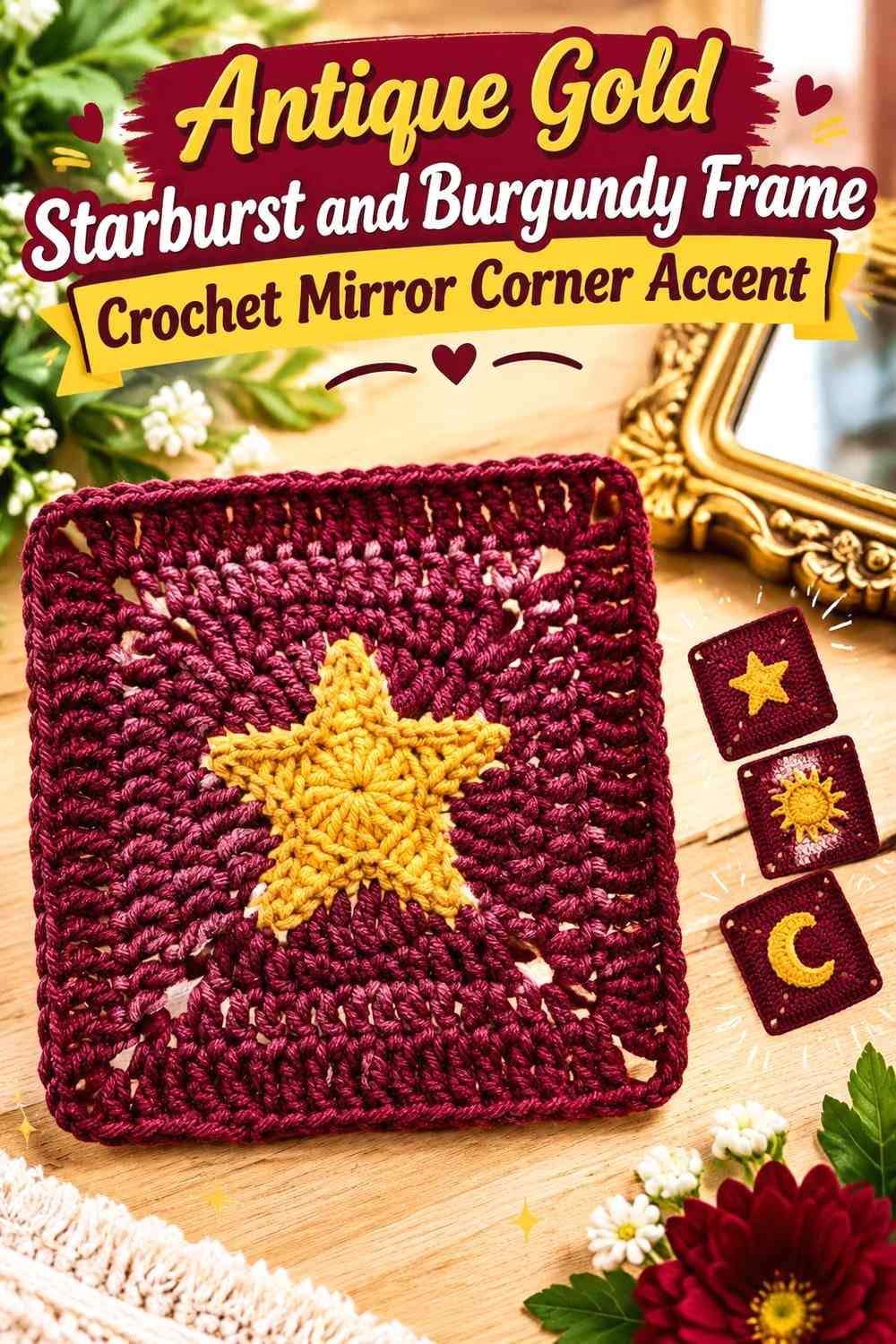
A pointed star motif provides another strong geometric option. Antique gold can carry the star itself while burgundy frames or partially encloses it at the corner.
Antique Gold Points Can Create an Art Deco Crochet Starburst
Use the lighter color across the points so their direction remains easy to follow against a dark frame or burgundy backing.
Burgundy Can Contain the Antique Gold Star at the Mirror Corner
A burgundy square, triangle, or partial border behind the star prevents the pale motif from appearing isolated.
Burgundy Should Separate Antique Gold Points From a Gold-Toned Frame
If the physical mirror frame already has warm metallic coloring, a burgundy outline becomes particularly useful because it creates a dark boundary between the crochet star and the frame.
Creator Credit: Örgü İşleri
15. Burgundy Puff Medallion and Antique Gold Petal Crochet Mirror Corner Accent
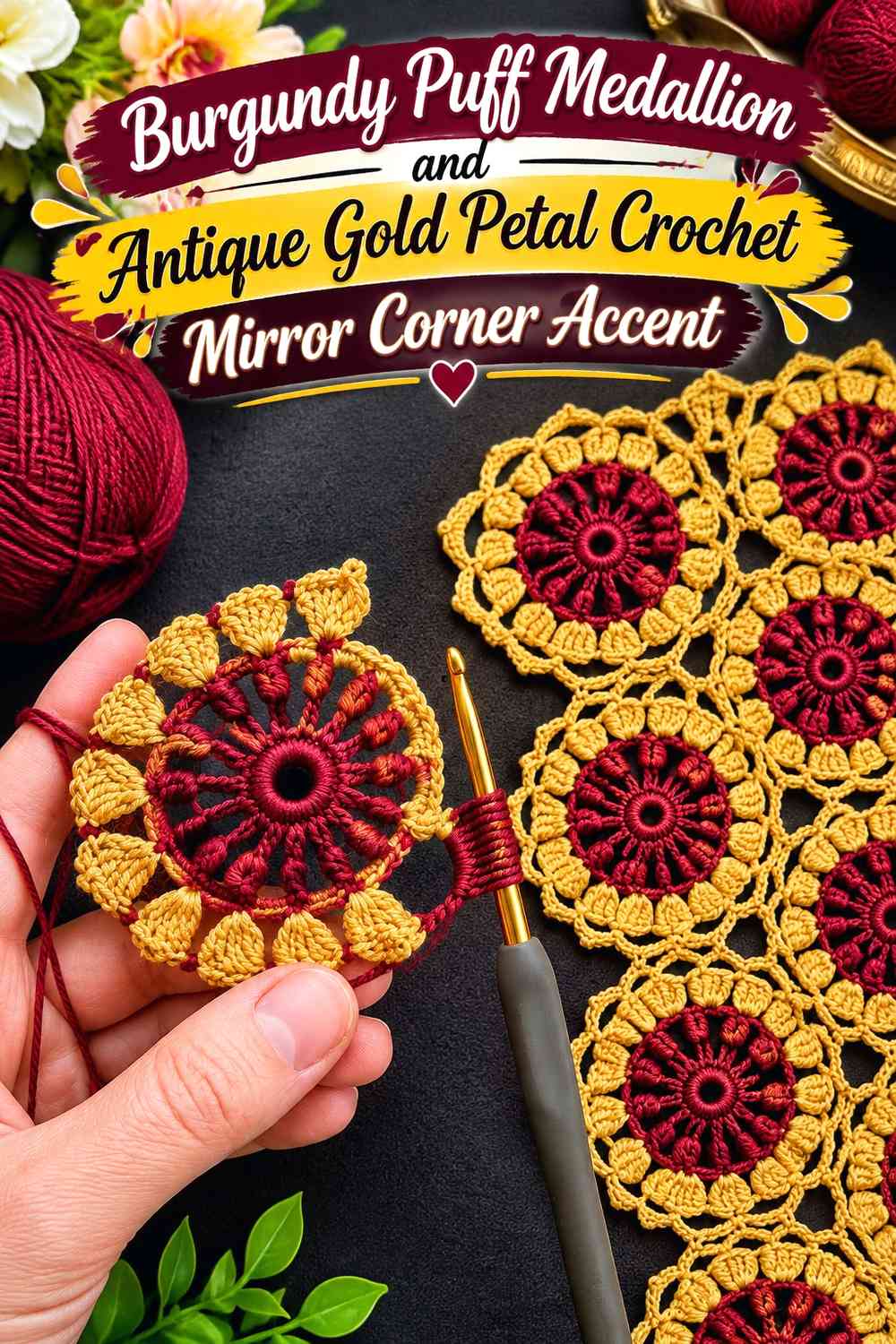
For the final idea, use a floral motif with raised texture but organize the colors in a strict radial arrangement. Burgundy can occupy the center and alternate structural areas, while antique gold defines the outer petals.
Burgundy Should Anchor the Crochet Puff Medallion Center
A dark central section keeps the motif from becoming entirely pale and gives the surrounding petals a strong visual starting point.
Antique Gold Petals Can Radiate From the Burgundy Center
Use the lighter color consistently around the outer motif. Repeated pale petals create a controlled radial effect that fits the fan-and-sunburst language used throughout an Art Deco-inspired mirror accent.
Burgundy Can Square Off an Antique Gold Floral Edge
Add burgundy around selected outer spaces or mount the motif into a darker angular corner treatment. The contrast between round petals and straight framing makes the accent feel more architectural.
Creator Credit: Knitting World
Which Burgundy and Antique Gold Mirror Corner Accent Should You Choose?
For the strongest geometric Art Deco direction, start with the sunburst, diamond, triangular, C2C, mandala, or starburst concepts. Their lines, points, and repeated angles make the style readable even when the crochet accent covers only a small section of the frame.
For a softer vintage interpretation, fan stitches, shells, roses, rosettes, and pointed leaves introduce curves without abandoning the dark burgundy-and-gold hierarchy. Keep the surrounding framing relatively angular if you still want the overall accent to read as Art Deco rather than purely floral.
Choose a burgundy-dominant corner when the mirror needs a deep winter accent and antique gold should function mainly as definition. Choose an antique-gold-dominant motif when you want the decorative element to stand out against a burgundy backing or darker frame.
For a small mirror, one concentrated motif is usually enough. A larger frame can carry a primary corner piece plus a smaller repeated detail in the opposite corner without requiring a complete crochet border.
Conclusion
Burgundy and antique gold can create an Art Deco-inspired crochet mirror accent through strong color hierarchy rather than metallic effects or complicated multicolor work.
Use burgundy to establish the main corner shape, frame, dark leaf, floral center, or geometric backing. Reserve antique gold for the elements that need definition—rays, points, fan arcs, diamond borders, petals, or one deliberate medallion ring.
The mirror itself should remain part of the composition. A compact accent that follows the frame corner often gives the geometry more impact than covering a large area of reflective glass.
Use the credited tutorials for the motif, border, or edging construction they demonstrate, then adapt the burgundy and antique gold placement and mounting arrangement to the proportions and material of your mirror frame.
Frequently Asked Questions
Should Burgundy or Antique Gold Dominate an Art Deco Crochet Mirror Accent?
Burgundy is useful as the dominant shade when you want a deep winter frame with antique gold picking out geometric details. Antique gold can lead when the motif itself should become the main focal point, provided burgundy still gives it enough dark separation.
Which Crochet Shapes Work Best for a Burgundy and Antique Gold Art Deco Mirror Corner?
Fans, sunbursts, diamonds, stepped triangles, stars, pointed leaves, and compact medallions all lend themselves to directional corner placement. Floral motifs can also work when paired with more controlled angular framing.
Should Antique Gold Yarn Outline Every Burgundy Crochet Detail?
Not necessarily. Outlining everything can weaken the hierarchy and create too many light lines. Antique gold usually has more impact when it emphasizes only the main rays, points, border, or focal motif.
How Can I Keep a Crochet Mirror Corner Accent From Covering Too Much Glass?
Keep the largest part of the crochet over the existing frame and let only small points or decorative edges project inward if desired. Testing the motif against the mirror before mounting helps you judge how much reflective area remains usable.
Can I Put Burgundy Crochet Accents on More Than One Mirror Corner?
Yes. One large corner accent can be paired with a smaller diagonal repeat, or the same geometric detail can appear in all four corners. Repeating only part of the first motif often creates better balance than using four equally elaborate accents.
How Can I Make Antique Gold Stand Out From a Warm-Toned Mirror Frame?
Place burgundy directly between the antique-gold crochet and the frame. A dark outline, backing section, or border prevents similar warm colors from visually merging.
Do I Need Metallic Yarn for an Antique Gold Crochet Mirror Accent?
No. Antique gold describes the intended color role here, not a required fiber finish. Choose a muted warm gold or golden-beige shade that gives the contrast you want against burgundy, and judge the actual yarn beside the mirror frame before committing to the full accent.