

Dusty lavender and eggshell white create a soft winter palette for a crochet hoodie without making the garment visually flat. Dusty lavender can carry the main body panels and sleeves, while eggshell white can brighten the hood opening, cuffs, hem, front bands, and delicate lace trim.
A lace-trim hoodie needs more color planning than simply adding a decorative border to a finished sweater. Lace has open spaces that reveal the garment underneath, so a pale eggshell trim can disappear against an equally pale body, while a dark trim can become much heavier than the rest of the hoodie. Placement around the face, wrists, and lower hem also changes how much of each shade is visible when the garment is worn.
The credited tutorials below teach crochet hoodies, hooded sweaters, and hooded cardigans. The dusty-lavender, eggshell-white, and lace-trim treatments are independent color adaptations unless those features happen to appear in the original project. Use each creator’s tutorial for its construction method and treat the lace placement as a separate decorative decision.
Quick List
- Dusty Lavender, Eggshell White, and Silver Gray Crochet Winter Hood-Lace Hoodie
- Eggshell White, Dusty Lavender, and Deep Plum Crochet Winter Cuff-Lace Hoodie
- Dusty Lavender, Eggshell White, and Charcoal Crochet Scalloped-Hem Hoodie
- Eggshell White, Dusty Lavender, and Icy Blue Crochet Face-Frame Lace Hoodie
- Dusty Lavender, Eggshell White, and Soft Blush Crochet Sleeve-Lace Hoodie
- Eggshell White, Dusty Lavender, and Mushroom Taupe Crochet Front-Edge Lace Hoodie
- Dusty Lavender, Eggshell White, and Midnight Navy Crochet Graphic-Lace Hoodie
- Eggshell White, Dusty Lavender, and Pale Sage Crochet Pocket-Lace Hoodie
- Dusty Lavender, Eggshell White, and Pewter Crochet Banded-Lace Hoodie
- Eggshell White, Dusty Lavender, and Oatmeal Crochet Tonal-Lace Hoodie
- Dusty Lavender and Eggshell White Two-Color Crochet Winter Lace-Trim Hoodie
Decide Where Dusty Lavender and Eggshell White Meet the Lace
The hood opening is usually the most visible place for lace because it frames the face and continues around a large curved edge. If the hoodie body is dusty lavender, eggshell-white lace there can create a clear light border without requiring white across the entire garment.
Cuffs and hems behave differently. A lace cuff repeats at both wrists, so even a narrow eggshell-white treatment can become visually important. A lace hem spans the full garment width and can therefore make a small accent shade look much more dominant than expected.
Choose one primary lace location first, then repeat the same color in smaller details elsewhere rather than decorating every available edge.
Keep Eggshell White Lace Visible Against Dusty Lavender Crochet Texture
Lace visibility depends on more than hue. Raised stitches, ribbing, and dense sweater textures can create shadows that make dusty lavender appear deeper, while open lace allows the underlying garment or clothing beneath it to affect how the color is perceived.
Work a small trim sample against the actual hoodie fabric before committing to a full hood or hem. If eggshell white lacks enough definition, a restrained silver, pewter, plum, or charcoal boundary can help. If the contrast is already strong, another outline may only make the delicate trim look heavier.
Repeat Dusty Lavender and Eggshell White Across the Hood, Cuffs, and Hem
A lace detail feels more integrated when its color appears somewhere else on the garment. An eggshell-white hood edge can connect to white cuffs or a small hem repeat, while dusty-lavender lace on a white hoodie can echo lavender pocket edging or sleeve bands.
The repetitions do not need to be equal. One substantial lace feature plus one or two smaller color echoes is often enough to connect the hoodie from top to bottom.
1. Dusty Lavender, Eggshell White, and Silver Gray Crochet Winter Hood-Lace Hoodie

Dusty lavender can dominate the body and sleeves, eggshell white can form the lace around the hood opening, and silver gray can create a restrained line between the two. This arrangement puts the brightest color close to the face while leaving most of the garment in the softer lavender field.
Dusty Lavender Should Carry the Main Crochet Hoodie Panels
Use dusty lavender across the broad front, back, and sleeve surfaces so the garment has one continuous visual foundation. Large lavender areas also give the open eggshell-white hood trim enough contrast to remain recognizable.
Avoid breaking every body panel with silver-gray bands. The hood lace already provides a strong decorative transition.
Eggshell White Can Make the Dusty Lavender Hood Lace More Visible
Place eggshell white directly around the hood opening or along the outermost decorative trim. Because the hood frames the upper garment, even a relatively narrow lace section can have substantial visual impact.
If you repeat white elsewhere, keep the secondary areas smaller—such as the cuffs or a narrow lower finish.
Silver Gray Should Separate Dusty Lavender and Eggshell White Sparingly
A fine gray boundary can help when the two main shades are both pale. Use it immediately inside the lace edge rather than adding gray throughout the body.
Its job is to clarify the transition, not become another major hoodie color.
Creator Credit: Joyceline Kay
2. Eggshell White, Dusty Lavender, and Deep Plum Crochet Winter Cuff-Lace Hoodie

Eggshell white becomes the main hoodie color in this version, dusty lavender forms broad secondary areas, and deep plum gives the lace cuffs a darker finishing point. The stronger wrist contrast makes the lace visible without requiring a dark border around the entire garment.
Eggshell White Can Keep the Crochet Hoodie Body Light
Use eggshell white across most of the torso so dusty lavender receives more attention when it appears on sleeves, pockets, or hood sections.
A light main field also allows darker plum details to remain small without disappearing.
Dusty Lavender Should Connect the Eggshell White Body to the Lace Cuffs
Place lavender through a substantial part of the sleeves before the cuffs begin. That transition prevents the plum-edged lace from appearing abruptly attached to an otherwise all-white garment.
Lavender can also repeat around the hood to connect the upper and lower parts of the sweater.
Deep Plum Can Define Dusty Lavender and Eggshell White Cuff Lace
Keep plum on a narrow outer edge, small lace repeat, or final cuff boundary. Dark colors gain visual weight quickly at both wrists because the detail is repeated symmetrically.
Use plum as punctuation rather than a full sleeve color.
Creator Credit: BCNcrochet
3. Dusty Lavender, Eggshell White, and Charcoal Crochet Scalloped-Hem Hoodie
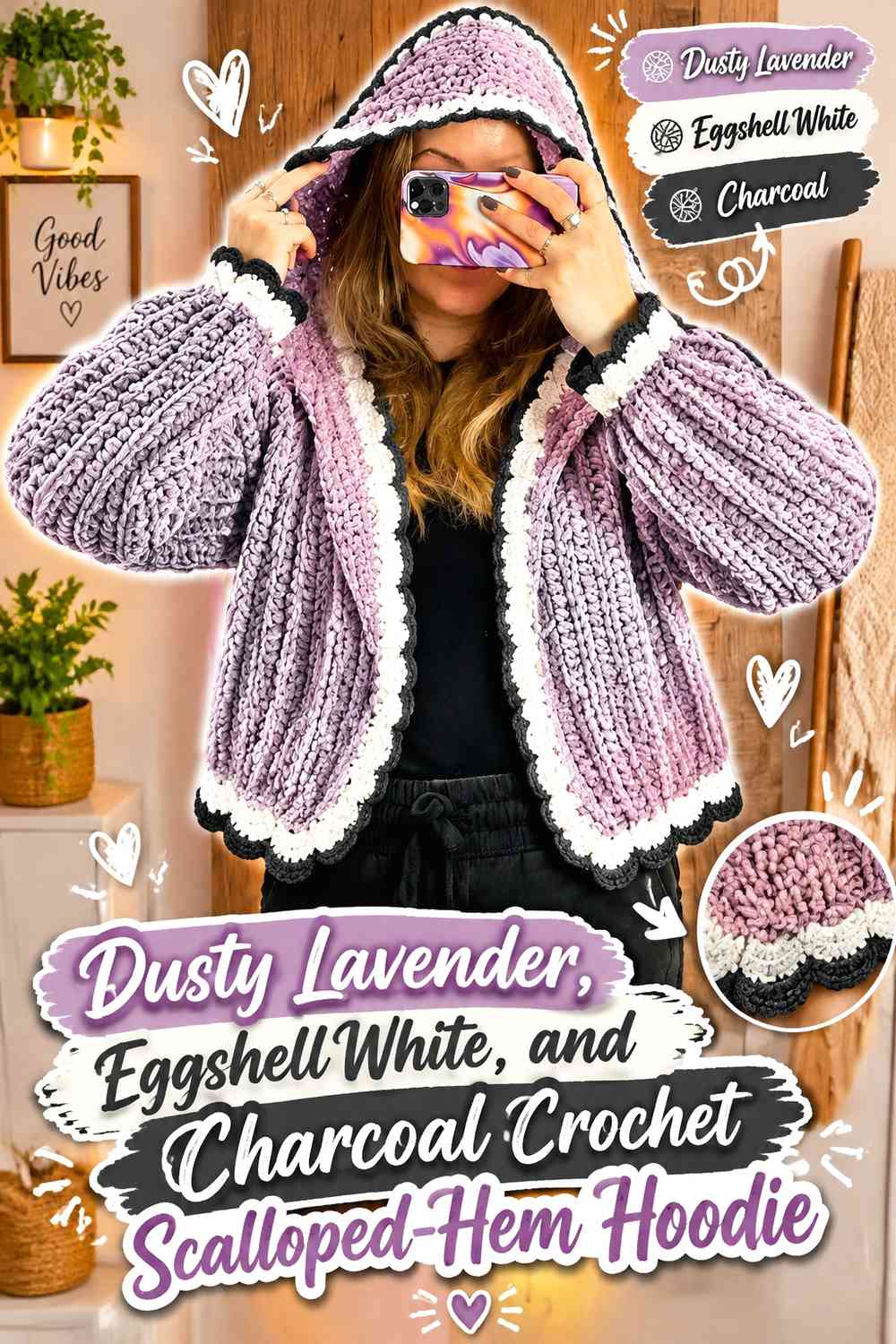
This palette concentrates the lace along the lower edge. Dusty lavender can dominate the garment, eggshell white can create the scalloped hem, and charcoal can define only selected points along that pale border.
Dusty Lavender Should Stay Continuous Above the Eggshell White Hem
Keep the main body lavender almost to the bottom so the lace has a clear starting point. Introducing multiple stripes immediately above a scalloped edge can make the lower portion of the hoodie feel unnecessarily busy.
A broad lavender field lets the curved white border become the feature.
Eggshell White Can Give Dusty Lavender a Lighter Scalloped Finish
Use white through the primary scallop or lace band. Since the trim stretches across the entire hoodie width, it does not need to be especially deep to become visually important.
Check how the hem falls when the garment is worn, since long open lace can appear different once it hangs vertically.
Charcoal Should Outline Eggshell White Rather Than Compete With Dusty Lavender
A fine charcoal line above or below the lace can create stronger separation when needed. Avoid using it on the hood, cuffs, hem, and sleeves simultaneously.
Keeping charcoal concentrated preserves the softer lavender-and-white winter direction.
Creator Credit: lerugi crochets
4. Eggshell White, Dusty Lavender, and Icy Blue Crochet Face-Frame Lace Hoodie

Eggshell white can dominate the body while dusty lavender and icy blue concentrate around the hood. This creates a cooler winter face frame without spreading three pale colors evenly across every panel.
Eggshell White Should Give Dusty Lavender Enough Open Hoodie Surface
Keep most of the torso white so lavender remains a deliberate contrast rather than one of many alternating pale sections.
A white body also allows the hood treatment to receive more attention without requiring decorative lace across the hem.
Dusty Lavender Can Define the Eggshell White Hood Opening
Use lavender immediately inside or outside the lace trim so the pale white border does not disappear into the main sweater.
A continuous lavender line usually works better here than small scattered motifs because the hood edge already has a clear curved shape.
Icy Blue Should Stay Smaller Than Dusty Lavender Around the Lace
Use icy blue on one narrow edge, selected lace points, or a small cuff repeat. Giving blue the same width as lavender around the entire hood can dilute the main dusty-lavender-and-eggshell palette.
Creator Credit: Dana B
5. Dusty Lavender, Eggshell White, and Soft Blush Crochet Sleeve-Lace Hoodie
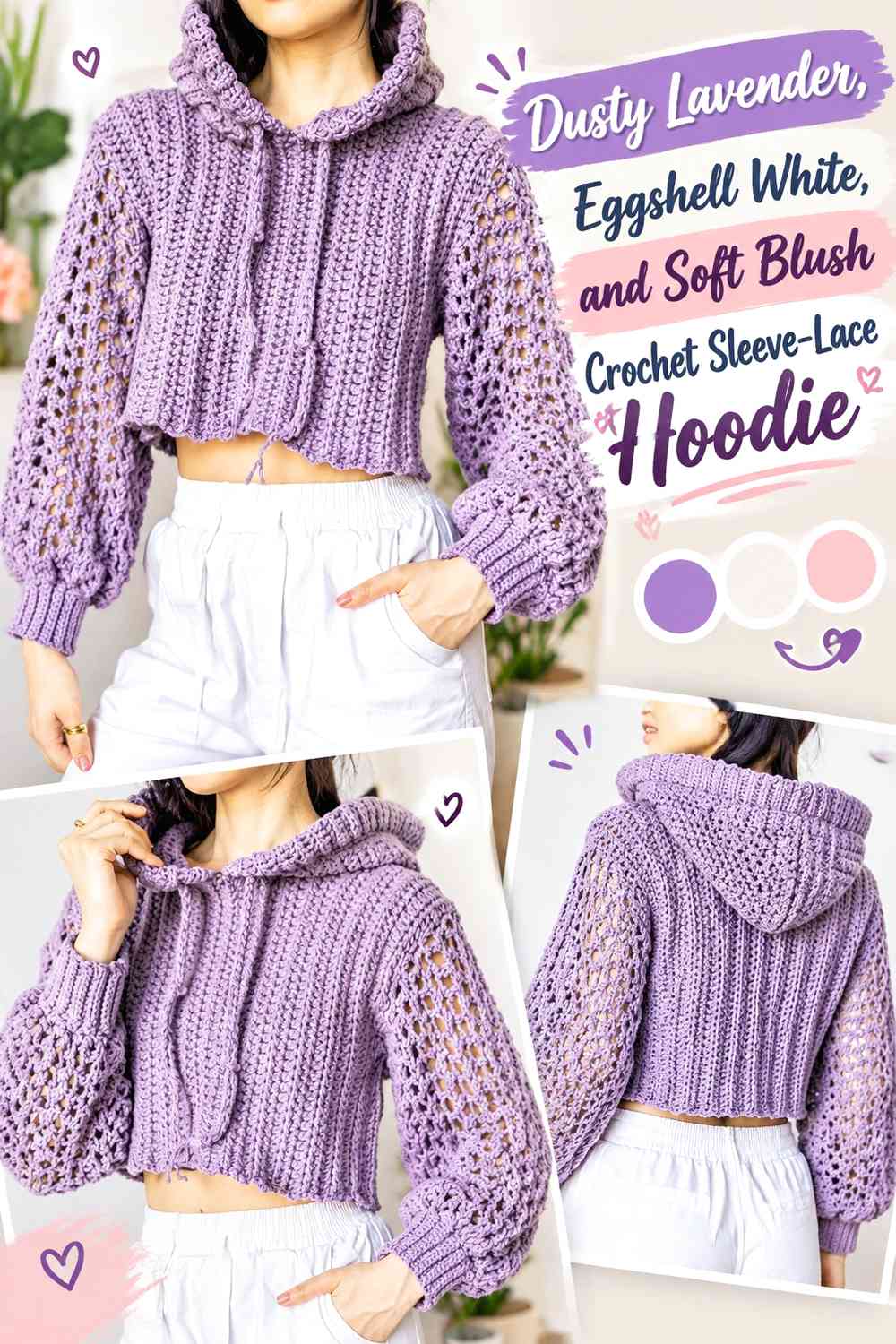
Soft blush adds a restrained warm note to the otherwise cool winter palette. Dusty lavender can carry the hoodie body, eggshell white can form the sleeve lace, and blush can appear in a limited transition above the cuffs.
Dusty Lavender Should Keep the Eggshell White Sleeve Lace Grounded
Use lavender continuously through most of each sleeve before moving into the lighter decorative area. That gives both wrists the same clear transition and prevents the lace from looking detached from the sweater.
Eggshell White Can Form the Main Dusty Lavender Sleeve Trim
Let white carry the most open part of the lace. Because both sleeves repeat the detail, keep the trim depth proportional to the rest of the garment rather than allowing the cuffs to become the largest white areas.
Soft Blush Can Bridge Dusty Lavender and Eggshell White Gently
Use blush as one narrow band or selected lace row between lavender and white. Its warmer direction softens the transition without replacing either main color.
Avoid repeating blush throughout the body if the purpose is specifically to highlight the sleeves.
Creator Credit: TCDDIY
6. Eggshell White, Dusty Lavender, and Mushroom Taupe Crochet Front-Edge Lace Hoodie

This scheme uses lace along the front edges of a hooded cardigan or jacket-style construction. Eggshell white can dominate the body, dusty lavender can form the lace border, and mushroom taupe can define the lower edge or pocket area.
Eggshell White Can Keep Dusty Lavender Front Lace Easy to Follow
A pale solid body provides a simple field behind a colored vertical trim. Dusty lavender can run from the lower front toward the hood without competing with stripes or multiple body colors.
That continuous line can help visually connect the cardigan opening to the hood.
Dusty Lavender Should Repeat From the Eggshell White Front Edge to the Hood
If lavender appears only on the lower front border, it may look unfinished when the eye reaches the neckline. Carry a smaller amount around the hood or into the cuffs so the color has a clear route through the garment.
Mushroom Taupe Should Stay Secondary to Dusty Lavender and Eggshell White
Use taupe at pocket edges, a narrow hem, or another small structural location. A muted neutral can soften the white body, but large taupe panels would shift attention away from the lavender lace.
Creator Credit: brianna sipp
7. Dusty Lavender, Eggshell White, and Midnight Navy Crochet Graphic-Lace Hoodie

Midnight navy creates the strongest dark contrast in this collection. Dusty lavender can remain the body color, eggshell white can carry the lace, and navy can appear as a very narrow outline or repeated structural detail.
Dusty Lavender Needs Broad Panels Beside Midnight Navy
Keep lavender across most of the hoodie so the dark accent does not visually consume the softer palette. Even a small navy edge can appear prominent when it repeats around the hood or cuffs.
Eggshell White Can Buffer Dusty Lavender From Midnight Navy Lace Details
Place white between lavender and navy where the transition feels too abrupt. A white lace band with a narrow navy finish creates a clearer three-level value progression than placing deep navy directly over every lavender edge.
Midnight Navy Should Frame Eggshell White Without Outlining Every Dusty Lavender Detail
Choose one or two strategic locations, such as the hood and cuffs. Avoid carrying navy around every seam, pocket, and hem unless a strongly outlined garment is intentional.
Creator Credit: Shyler crochets
8. Eggshell White, Dusty Lavender, and Pale Sage Crochet Pocket-Lace Hoodie

Pale sage introduces a muted green accent while eggshell white keeps the body light. Dusty lavender can define the hood and pocket trim, while sage appears only as a smaller botanical-feeling winter accent.
Eggshell White Should Keep Pale Sage From Competing With Dusty Lavender
Use white across most of the garment and give lavender the larger decorative role. This leaves sage enough visual space to function as a third accent rather than another equal body color.
Dusty Lavender Can Outline Eggshell White Crochet Pockets With Lace
A lavender lace edge around patch pockets or the upper pocket opening adds decoration at a functional point that remains visible on the body.
If the pockets are small, use a restrained lace depth so the decorative trim does not overwhelm their shape.
Pale Sage Can Echo Dusty Lavender Near the Eggshell White Hood
Repeat sage in one narrow hood or cuff detail to connect it to the pocket area. Keep lavender more prominent so the requested main palette remains obvious.
Creator Credit: chacha crochet tuto
9. Dusty Lavender, Eggshell White, and Pewter Crochet Banded-Lace Hoodie

Pewter creates a medium-dark neutral rather than the sharper contrast of black or navy. Dusty lavender can dominate the hoodie, eggshell white can form the lace bands, and pewter can identify selected boundaries between solid fabric and open trim.
Dusty Lavender Can Carry the Main Hoodie Texture Above Eggshell White Lace
Keep the body and most sleeve areas lavender so the garment’s stitch texture remains easy to see. Repeated white lace bands should be spaced rather than stacked closely together.
Eggshell White Should Remain Wider Than Pewter in the Crochet Lace Bands
Use white for the main decorative section and pewter for a narrow adjacent line. If both colors have equal width, the band can begin to look striped rather than lace-trimmed.
Pewter Can Define Dusty Lavender Without Making the Winter Palette Too Dark
Place it at the cuff transition, hood edge, or lower band. A medium-dark neutral gives the pale colors definition while remaining quieter than black.
Creator Credit: AC Crochets
10. Eggshell White, Dusty Lavender, and Oatmeal Crochet Tonal-Lace Hoodie

Oatmeal produces the quietest neutral variation in the collection. Eggshell white can dominate the garment, dusty lavender can supply the main colored trim, and oatmeal can soften transitions around the hood and hem.
Eggshell White Can Keep the Crochet Hoodie Light Without Losing Dusty Lavender
Use eggshell across most of the body and sleeves, then let lavender appear on the lace edge and selected structural details. Because the two main shades differ clearly in hue, the lavender does not need to occupy a large percentage of the garment.
Dusty Lavender Should Carry More Lace Than Oatmeal
Give lavender the primary decorative role around the hood, cuffs, or lower edge. Oatmeal should remain a quieter companion color rather than dividing the lace equally.
Oatmeal Can Soften the Eggshell White-to-Dusty Lavender Transition
Use oatmeal as a narrow interior line when a direct lavender-to-white edge feels too crisp. Its muted warmth can make the overall palette look more layered without adding another strong hue.
Creator Credit: İlmek İlmek Crochet
11. Dusty Lavender and Eggshell White Two-Color Crochet Winter Lace-Trim Hoodie

The final version removes every supporting color and relies entirely on dusty lavender and eggshell white. Because there is no gray, plum, or other separator, the placement of the two shades becomes especially important.
Dusty Lavender Can Lead With Eggshell White Crochet Hood Lace
Use dusty lavender across the main body, sleeves, and perhaps the pocket, while eggshell white forms the hood edge and a smaller repeat at the cuffs.
This is the simplest way to make the lace visible without introducing a third shade.
Eggshell White Can Lead With Dusty Lavender Lace at the Hood and Hem
Reverse the hierarchy for a lighter garment. An eggshell-white body with lavender lace around the hood and lower edge gives the decorative color a clear path from top to bottom.
Avoid adding tiny alternating lavender-and-white details everywhere; larger color zones make the lace easier to read.
Dusty Lavender and Eggshell White Should Repeat Unequally Across the Hoodie
Whichever color dominates the body should also occupy the larger visual share overall. Let the supporting shade repeat in two or three related places rather than trying to divide the hoodie exactly in half.
Creator Credit: Crafty with Jackie
Which Dusty Lavender and Eggshell White Lace-Trim Hoodie Palette Should You Choose?
For the softest winter direction, choose the oatmeal, silver-gray, icy-blue, pale-sage, or two-color versions. These keep the overall value range light and let the lace texture provide most of the visual variation.
For stronger definition, deep plum, charcoal, midnight navy, or pewter can help separate eggshell-white lace from a pale body. Use those darker shades in small areas because hood edges, cuffs, and hems already repeat across large portions of the garment.
Soft blush adds the gentlest warm shift, while mushroom taupe gives an open-front or cardigan-style hoodie a more neutral finish.
If you want the lace to be the clear focal point, choose one primary location—hood, cuffs, front opening, or hem—and keep the remaining trim simpler. If you prefer a quieter sweater, use dusty lavender and eggshell white alone and rely on the difference between solid crochet and open lace for contrast.
Conclusion
Dusty lavender and eggshell white can create a winter crochet hoodie that feels decorative without requiring a complicated palette. The key is deciding which part of the garment deserves the lace emphasis.
A dusty-lavender body gives eggshell-white lace a naturally lighter frame around the face, wrists, or hem. An eggshell-white hoodie puts more emphasis on lavender trim and can make even a relatively narrow decorative edge noticeable. Silver and oatmeal produce softer transitions, while plum, charcoal, navy, and pewter create stronger boundaries.
Plan the hood, cuffs, hem, pockets, and front edges together. Repeating a trim color in a few connected locations usually makes the lace look integrated rather than added after the fact.
Use the credited tutorials for their original hoodie, hooded-cardigan, or hooded-sweater construction guidance. Where the tutorial does not include lace, treat the lace trim as an independent adaptation and check that the chosen edge works with the garment construction before committing to the full finish.
Frequently Asked Questions
Should Dusty Lavender or Eggshell White Be the Main Color of a Crochet Lace-Trim Hoodie?
Either can dominate. Dusty lavender creates a more colored garment and gives eggshell-white lace stronger light contrast. Eggshell white produces a lighter hoodie and allows lavender trim to become the primary decorative color.
Choose the dominant shade before deciding which color belongs on the hood and cuffs.
Where Should Eggshell White Lace Go on a Dusty Lavender Hoodie?
The hood opening, cuffs, lower hem, pocket edges, and front opening are all useful locations. Choose one main lace area first, then repeat smaller amounts of eggshell white elsewhere to connect the garment.
How Can I Keep Eggshell White Lace Visible on an Eggshell White Hoodie?
Use dusty lavender immediately beside the lace or make the decorative section lavender instead. Another option is a restrained gray, plum, or other darker separator between the white body and white lace.
Color placement should clarify the texture rather than forcing the entire garment into a third color.
Can Dusty Lavender Lace Be Used on an Eggshell White Crochet Hoodie?
Yes. A lavender lace edge can be especially effective around the hood because the colored trim remains visible against the pale body.
Repeating a small amount of lavender at the cuffs or hem can help connect the hood treatment to the rest of the garment.
Should the Lace Trim Match the Crochet Hoodie Cuffs?
It can, but exact matching is not required. A hood may use the full lace treatment while the cuffs repeat only its color or a simplified edge.
This keeps the decorative idea consistent without making every garment edge equally elaborate.
How Can I Tell if Dusty Lavender and Eggshell White Have Enough Contrast?
Work a small sample in both the hoodie texture and intended lace texture. Compare the colors from normal viewing distance and, if useful, in grayscale.
If the lace disappears, increase the difference in lightness, enlarge the trim, or introduce a narrow separator around the most detailed section.
Can Lace Trim Be Added to Any Crochet Hoodie Tutorial?
A hoodie tutorial can provide the garment construction, but decorative lace must be compatible with the edge where you want to place it. Hood openings, cuffs, hems, and front bands can differ in construction and stretch requirements.
Follow the original tutorial for the hoodie itself and treat the lace border as a separate adaptation rather than assuming one trim will suit every edge.