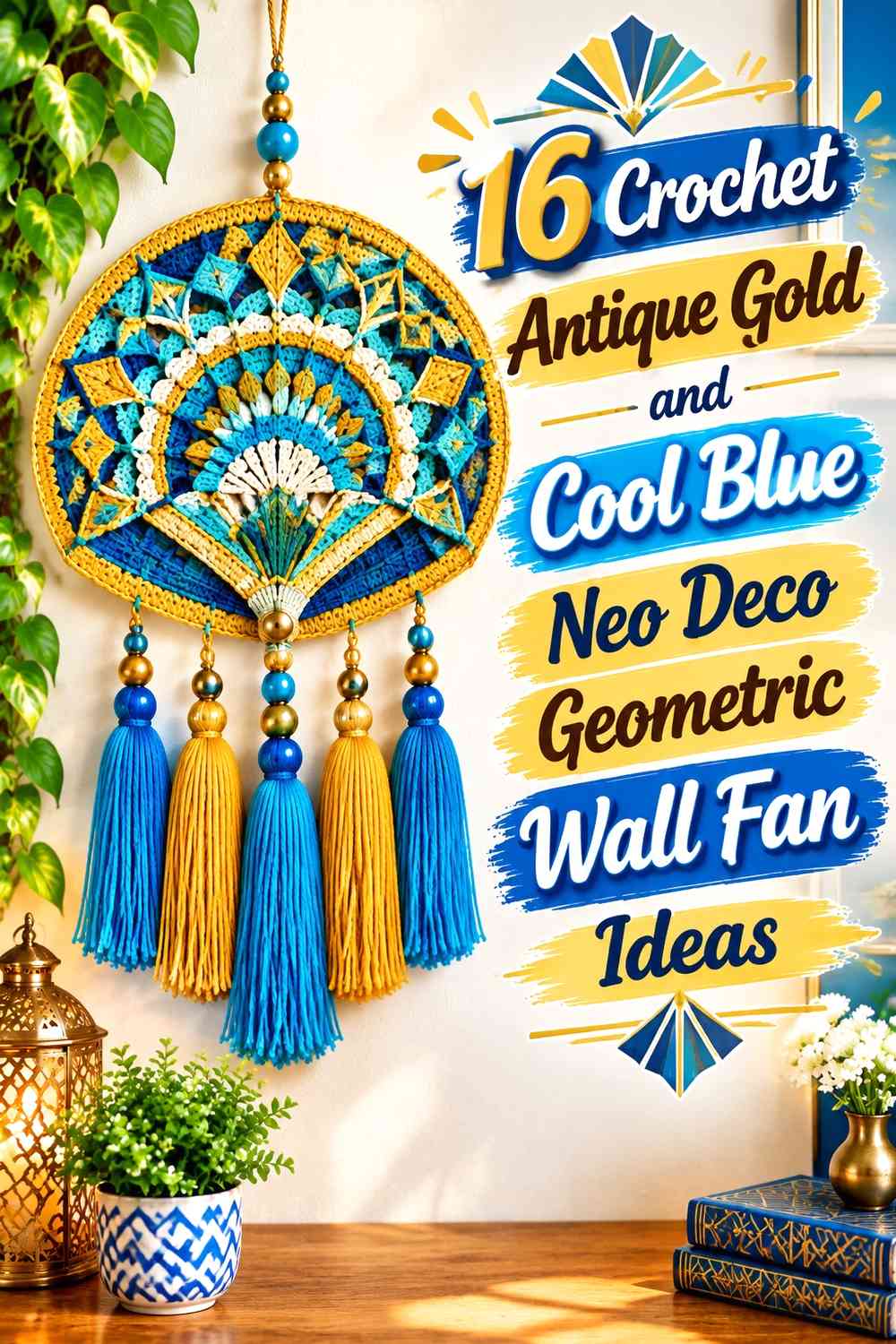

Antique gold and cool blue give a crochet geometric wall fan a strong warm-and-cool contrast that suits a Neo Deco direction particularly well. Cool blue can create broad fan wedges and open negative space, while antique gold can trace ribs, stepped arches, perimeter lines, and focal geometry that makes the semicircular form easier to read on a wall.
Here, antique gold describes a muted golden color direction rather than a claim that the yarn contains metallic fiber or produces a particular shine. The visual effect comes from contrast, repetition, and placement. A matte antique-gold yarn can create just as clear a geometric outline when it is positioned against a sufficiently different blue.
The fan shape also changes how the colors should be distributed. Narrow sections converge near the lower pivot and widen toward the outer arc, so a color used equally throughout the design will not necessarily look equal once the fan is complete. Antique-gold lines may appear concentrated near the center, while cool-blue wedges gain more visual area toward the top.
The credited tutorials below teach crochet mandalas, dreamcatchers, hoop wall hangings, circular wall art, and other radial constructions. They are useful for understanding radiating sections, openwork, rings, mounting, and wall-display structure. The half-fan silhouette, Neo Deco geometry, and antique-gold/cool-blue schemes below are independent adaptations rather than claims about the creators’ original projects.
Quick List
- Antique Gold and Cool Blue Crochet Sunray Neo Deco Geometric Wall Fan
- Cool Blue, Antique Gold, and Warm Ivory Crochet Stepped-Arch Neo Deco Wall Fan
- Antique Gold, Cool Blue, and Midnight Navy Crochet Double-Ray Geometric Wall Fan
- Cool Blue, Antique Gold, and Charcoal Crochet Chevron Neo Deco Wall Fan
- Antique Gold, Cool Blue, and Pearl Beige Crochet Scalloped Neo Deco Wall Fan
- Cool Blue, Antique Gold, and Deep Teal Crochet Graduated-Wedge Neo Deco Wall Fan
- Antique Gold, Cool Blue, and Terracotta Crochet Sunrise Neo Deco Geometric Wall Fan
- Antique Gold, Cool Blue, and Burgundy Crochet Fan-Medallion Neo Deco Wall Fan
- Cool Blue, Antique Gold, and Slate Gray Crochet Offset-Arc Neo Deco Wall Fan
- Antique Gold, Cool Blue, and Forest Green Crochet Jewel-Tone Neo Deco Wall Fan
- Cool Blue, Antique Gold, and Dusty Mauve Crochet Soft Neo Deco Geometric Wall Fan
- Antique Gold, Cool Blue, and Black Crochet Graphic-Sunburst Neo Deco Wall Fan
- Cool Blue, Antique Gold, and Oatmeal Crochet Openwork Neo Deco Wall Fan
- Antique Gold, Cool Blue, and Icy Blue Crochet Layered-Arc Neo Deco Wall Fan
- Antique Gold and Cool Blue Mirrored Two-Color Crochet Neo Deco Geometric Wall Fan
Decide Whether Antique Gold or Cool Blue Should Define the Fan Geometry
On a geometric wall fan, the outlining color can be more visually important than the color covering the greatest area. Antique gold used only on the ribs, pivot, and outer stepped border may still control the entire design because those lines establish where each cool-blue wedge begins and ends.
A cool-blue structure produces a different effect. Blue ribs around antique-gold wedge interiors make the wall piece feel cooler overall and give the gold more isolated focal areas.
Choose the structural color before adding a third shade. Otherwise, the design can become a series of attractive colors without a clear geometric hierarchy.
Keep Antique Gold and Cool Blue Clear Near the Fan Pivot
Every radial section narrows toward the lower center. Color changes that look comfortably spaced near the broad outer edge can become crowded as they approach the pivot.
Simplify the color sequence close to that point. One solid antique-gold center with cool-blue wedges radiating outward is often clearer than trying to carry several narrow stripes all the way into the center.
The opposite arrangement also works: a cool-blue pivot can act as visual negative space beneath antique-gold rays.
Use Antique Gold and Cool Blue to Emphasize the Outer Fan Arc
The outer arc is where the fan reaches its greatest width and where stepped, scalloped, or angular Neo Deco details have the most room to remain visible. It is therefore a useful place for the strongest color contrast.
If antique gold already outlines every internal rib, consider using cool blue or a neutral at the perimeter so the top edge does not become too gold-heavy. If the interior is primarily blue, a continuous antique-gold outer arc can unify the individual wedges.
1. Antique Gold and Cool Blue Crochet Sunray Neo Deco Geometric Wall Fan
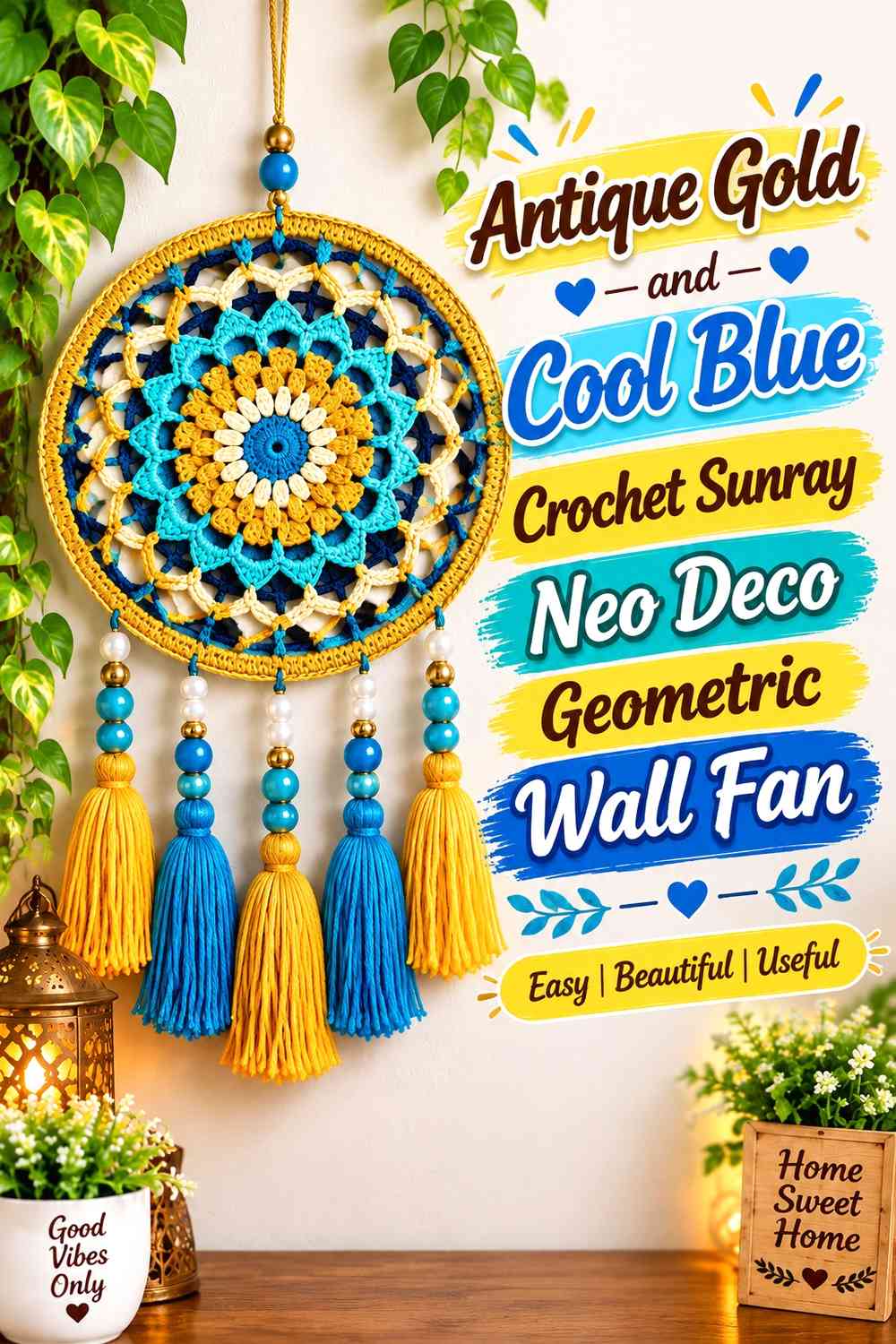
This first scheme uses only the title colors and emphasizes the most recognizable fan structure: antique-gold rays spreading through a cool-blue field. Cool blue provides broad negative space between the ribs, while gold establishes the radial architecture and outer perimeter.
Antique Gold Should Establish the Crochet Fan Rays
Use antique gold consistently on the lines that radiate from the lower pivot. Repetition matters more than making the rays unusually wide.
If every rib changes thickness or color, the wall fan can lose the ordered geometry that gives this palette its Neo Deco direction.
Cool Blue Should Remain Broad Between Antique Gold Rays
Give cool blue enough width to read as full fan wedges rather than narrow stripes. The blue areas naturally grow wider toward the outer arc, which can make the upper section feel lighter and more open.
Antique Gold Can Reappear Around the Cool Blue Outer Arc
A continuous gold border at the fan’s widest edge can connect all of the separate radial lines. Keep that perimeter simpler if the internal rays are already highly decorative.
Creator Credit: Vaishali’s Crochet
2. Cool Blue, Antique Gold, and Warm Ivory Crochet Stepped-Arch Neo Deco Wall Fan
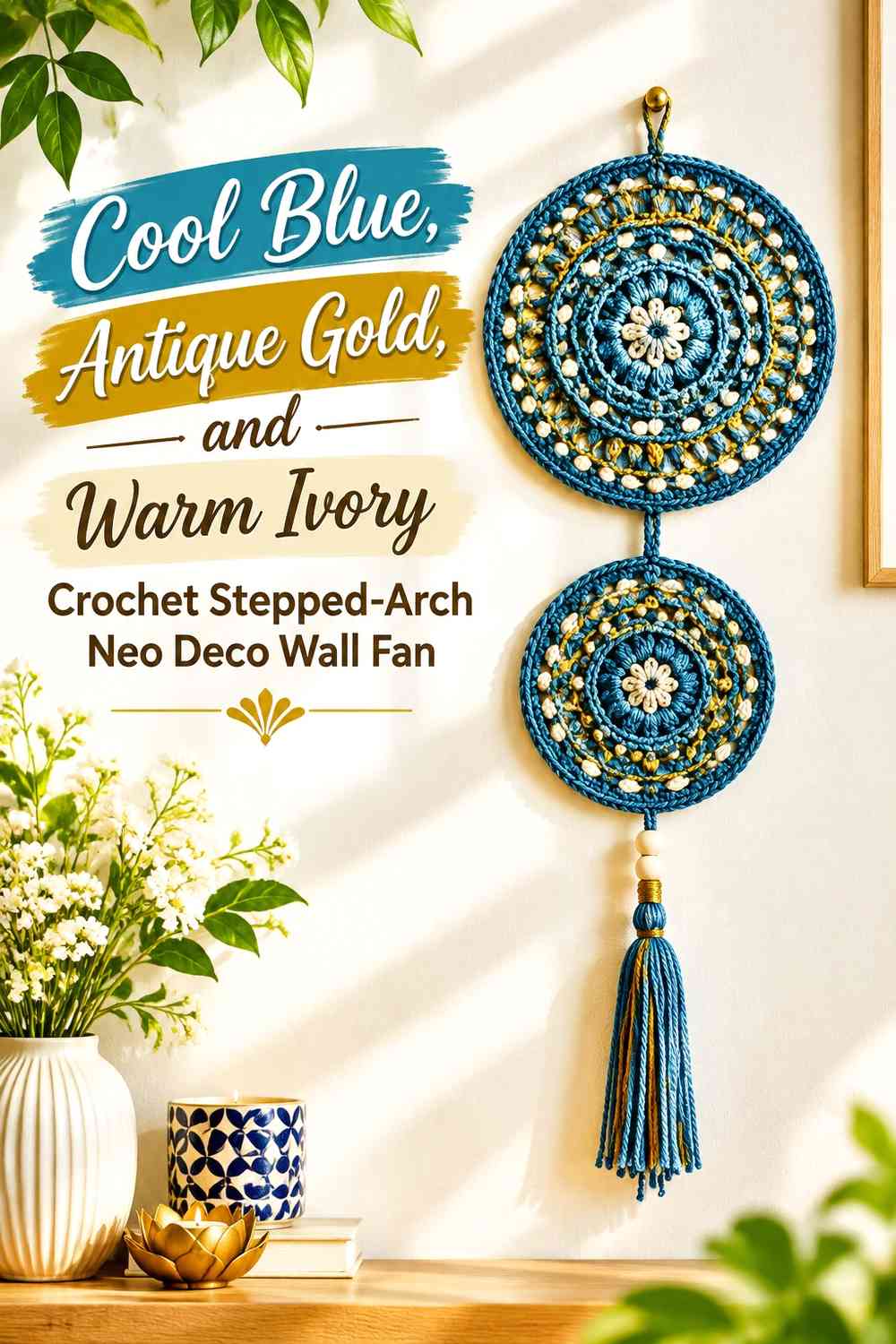
Cool blue dominates this wall fan, antique gold creates repeated stepped arches, and warm ivory provides a restrained lighter interval. The arches can rise outward from the pivot rather than relying entirely on straight rays.
Cool Blue Should Provide Space Around Antique Gold Stepped Arches
Keep broad blue sections between the gold outlines so each stepped arch can be recognized individually. Several gold bands packed closely together may read as one thick stripe instead of nested geometric levels.
Antique Gold Can Build the Neo Deco Arch Rhythm Over Cool Blue
Repeat the same basic stepped movement at larger scales toward the outer edge. The progression gives the fan a structured expanding effect without requiring many different colors.
Warm Ivory Should Separate Antique Gold From Cool Blue Selectively
Use ivory on one inner arch or thin outer interval rather than alternating it with every gold line. Its job is to open the palette, not create an equal three-color fan.
Creator Credit: mum2makes
3. Antique Gold, Cool Blue, and Midnight Navy Crochet Double-Ray Geometric Wall Fan
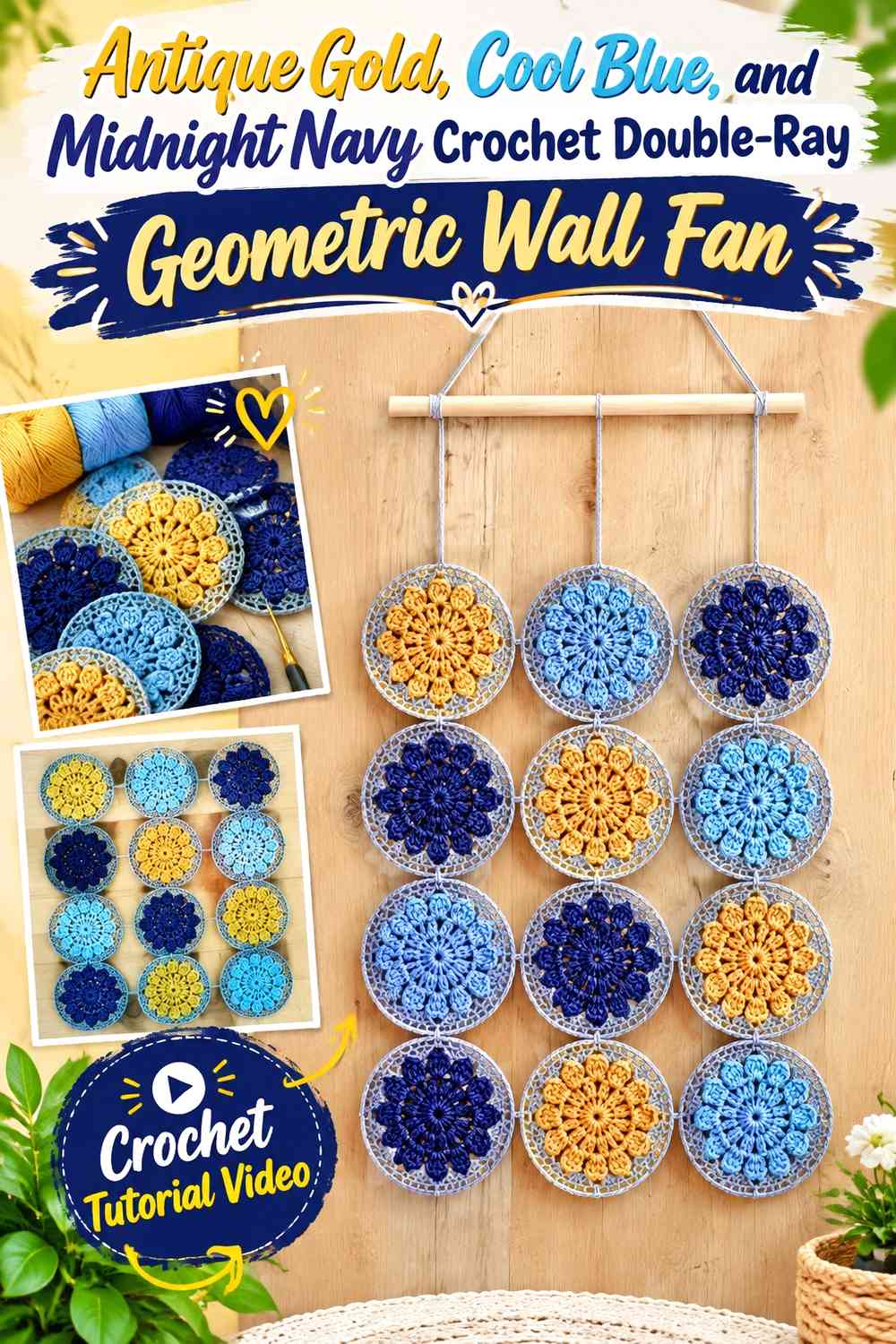
Midnight navy adds depth to the cool side of the palette. Antique gold can form the primary fan ribs, cool blue can occupy the broad wedges, and navy can create a second, narrower ray beside selected gold lines.
Antique Gold Should Stay Brighter Than Midnight Navy Along the Crochet Rays
Use gold for the main radial line and navy for a shadow-like companion. If both receive equal width, the ribs may become visually heavy and reduce the amount of cool blue visible between them.
Cool Blue Should Keep Antique Gold and Midnight Navy From Merging
Leave blue space between double-ray groups. This open interval is especially important near the fan’s outer arc, where several dark and warm lines can otherwise dominate.
Creator Credit: The Crochet Swirl
4. Cool Blue, Antique Gold, and Charcoal Crochet Chevron Neo Deco Wall Fan
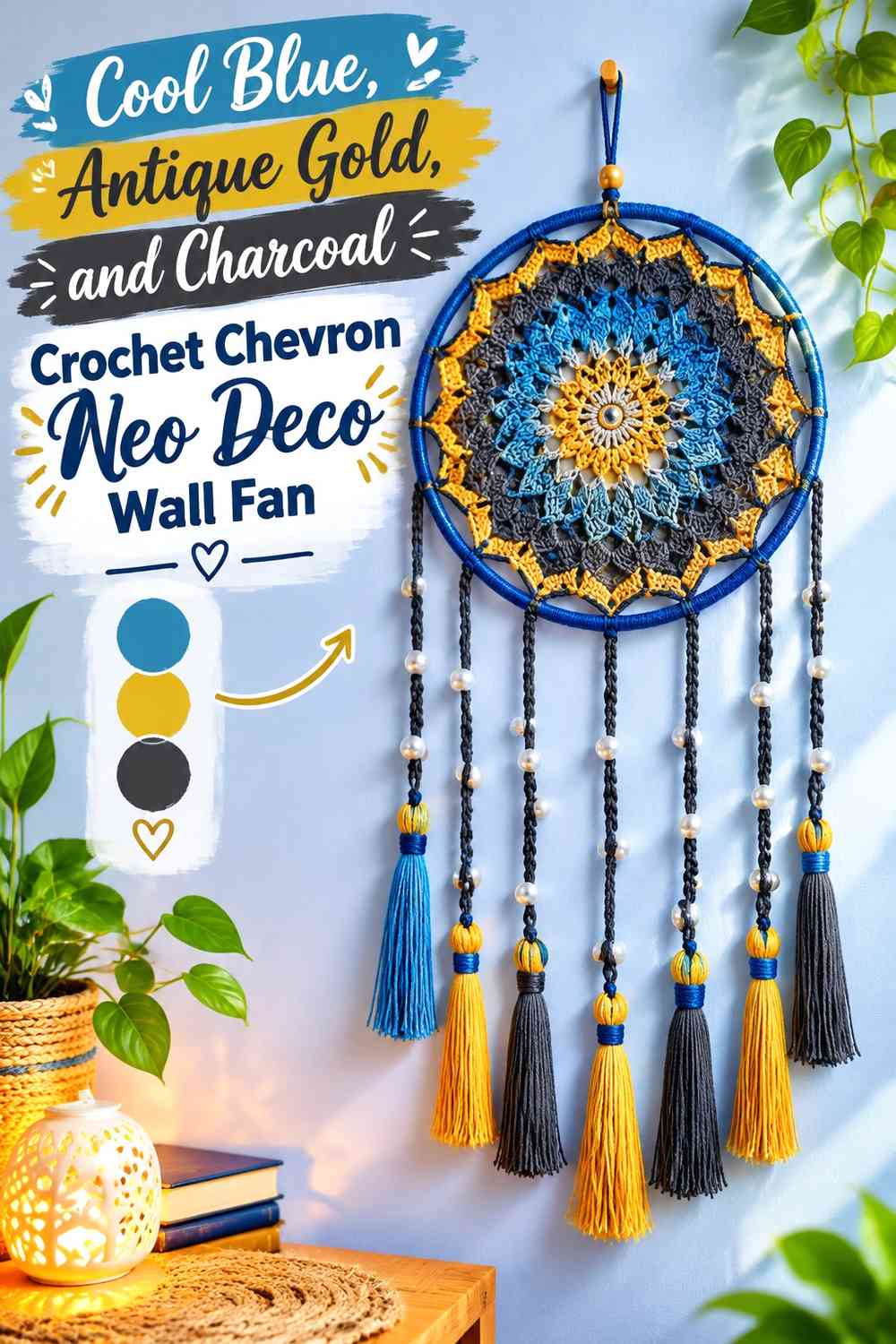
Charcoal gives the fan a sharper architectural direction. Cool blue remains the main field, antique gold carries the important decorative lines, and charcoal appears only in selected chevrons or borders.
Cool Blue Should Remain the Largest Area Behind Antique Gold Chevrons
Use broad blue fan sections as the visual background. The combination of gold and charcoal is already high in visual weight, so the piece needs enough blue to avoid looking overly outlined.
Antique Gold Should Lead the Charcoal Chevron Details
Give antique gold the wider or more repeated chevron role and use charcoal as a narrow shadow, separator, or final point.
This keeps the wall fan centered on the requested antique-gold-and-blue palette rather than becoming charcoal-led.
Creator Credit: Hooked In Loops
5. Antique Gold, Cool Blue, and Pearl Beige Crochet Scalloped Neo Deco Wall Fan
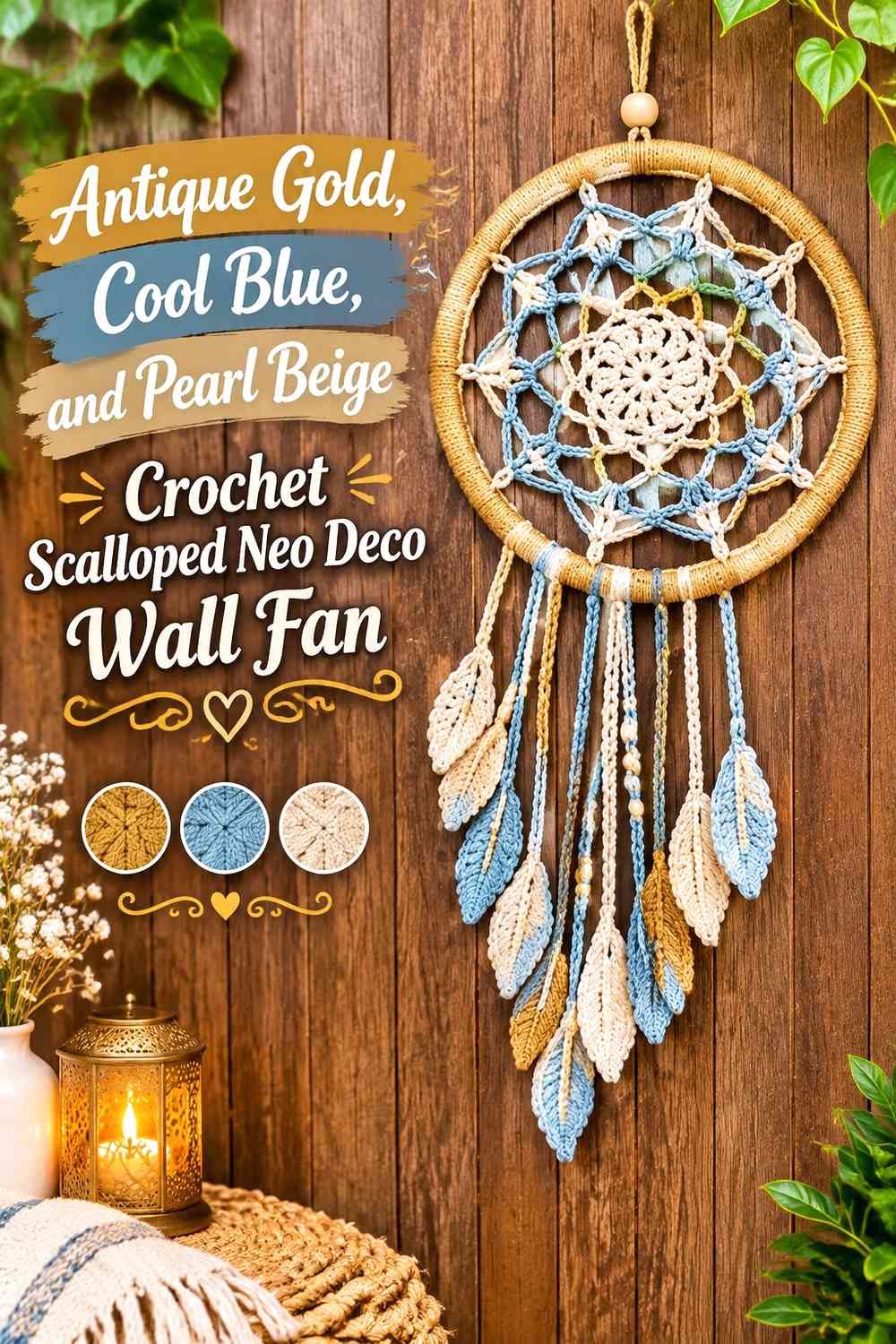
Pearl beige softens the outer edge while antique gold and cool blue control the stronger internal geometry. Antique gold can outline the major wedges, blue can fill them, and beige can form restrained scallops along the perimeter.
Antique Gold Should Keep Pearl Beige Scallops Connected to Cool Blue
Run a gold line immediately inside the pale outer edge so the scallops feel attached to the geometric fan rather than like a separate lace border.
Cool Blue Needs Enough Area Below the Pearl Beige Fan Edge
Keep blue broad near the upper wedges. If pearl beige extends too far toward the pivot, the fan may lose the strong warm-and-cool contrast that makes the gold geometry visible.
Pearl Beige Should Stay Quieter Than Antique Gold Around the Cool Blue Fan
Use beige as a soft finish rather than a second major outlining color. The gold should still establish the most important edges and divisions.
Creator Credit: fadinou
6. Cool Blue, Antique Gold, and Deep Teal Crochet Graduated-Wedge Neo Deco Wall Fan
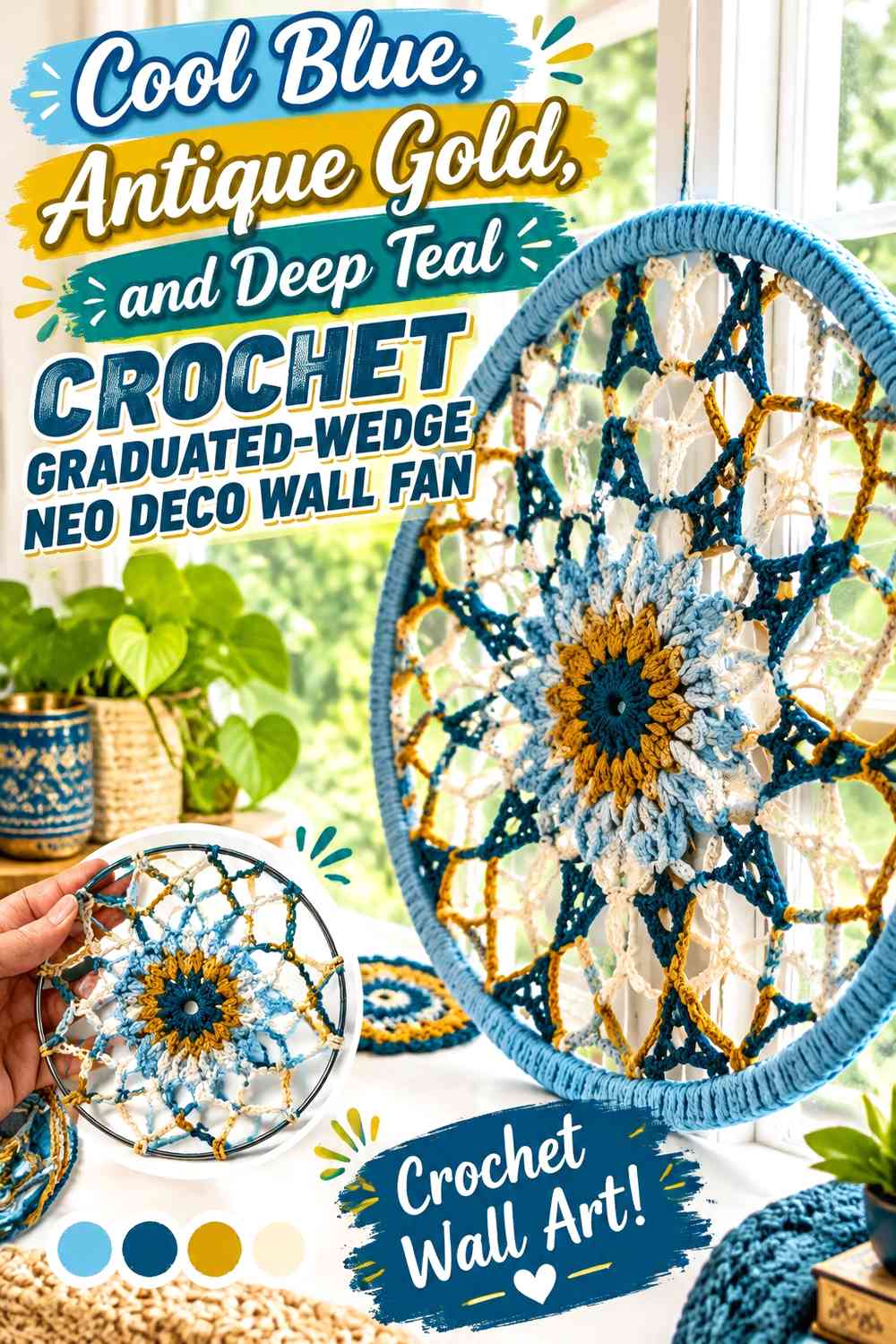
This palette uses two cool hues at different depths. Cool blue forms the larger wedges, deep teal appears in selected narrower sections, and antique gold keeps the radial structure readable.
Cool Blue Should Stay Visibly Lighter Than Deep Teal in the Crochet Wedges
Choose yarns with enough value difference that the two cool colors remain distinct at wall distance. If they merge, the fan loses the graduated effect even though the hues differ.
Antique Gold Can Separate Cool Blue From Deep Teal
Place gold ribs between the two blue-family shades where extra definition is needed. The warm line acts as a visual break and keeps neighboring wedges from becoming one broad cool block.
Deep Teal Should Remain Smaller Than Cool Blue Around the Antique Gold Rays
Restrict teal to selected wedges or the lower part of alternating sections. Cool blue should retain the larger visual share so the project does not become a teal-and-gold fan with blue accents.
Creator Credit: The Stitch Sessions – Crochet & Conversation
7. Antique Gold, Cool Blue, and Terracotta Crochet Sunrise Neo Deco Geometric Wall Fan
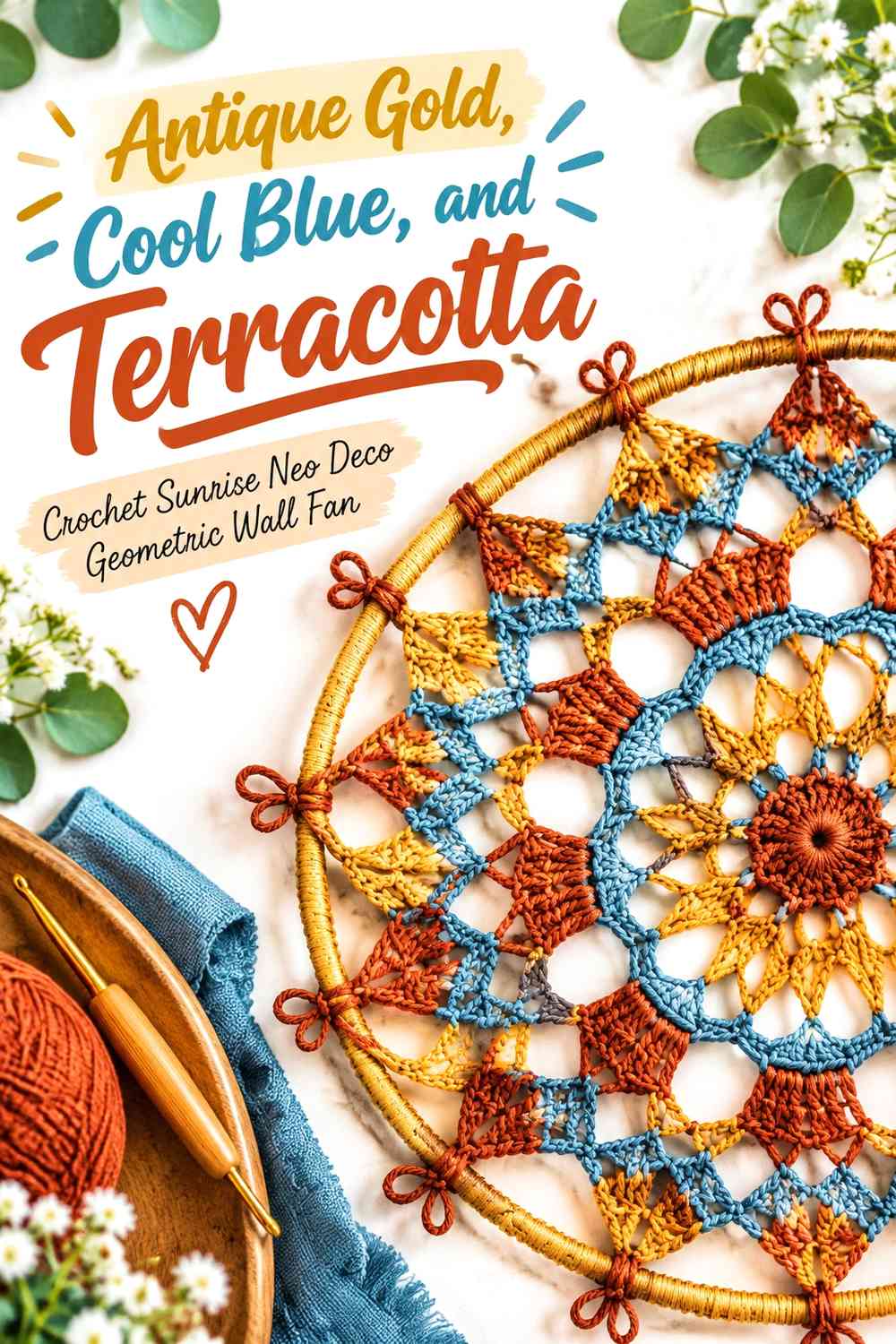
Terracotta introduces a second warm shade but should remain secondary to antique gold. Cool blue can create the open sky-like field, gold defines the strongest rays, and terracotta appears close to the pivot or in alternating interior wedges.
Antique Gold Should Stay More Important Than Terracotta in the Crochet Sunburst
Use gold on the continuous rays and restrict terracotta to shorter sections. That distinction prevents the two warm colors from competing for control of the fan.
Cool Blue Can Separate Antique Gold and Terracotta Rays
Keep a blue wedge between most warm-colored sections. The cool interval gives the design more breathing room and makes the radial repetition clearer.
Terracotta Should Concentrate Near the Cool Blue Fan Pivot
A smaller warm center or lower wedge group can add depth without spreading another strong color around the full perimeter.
Creator Credit: Crochet Maniak
8. Antique Gold, Cool Blue, and Burgundy Crochet Fan-Medallion Neo Deco Wall Fan
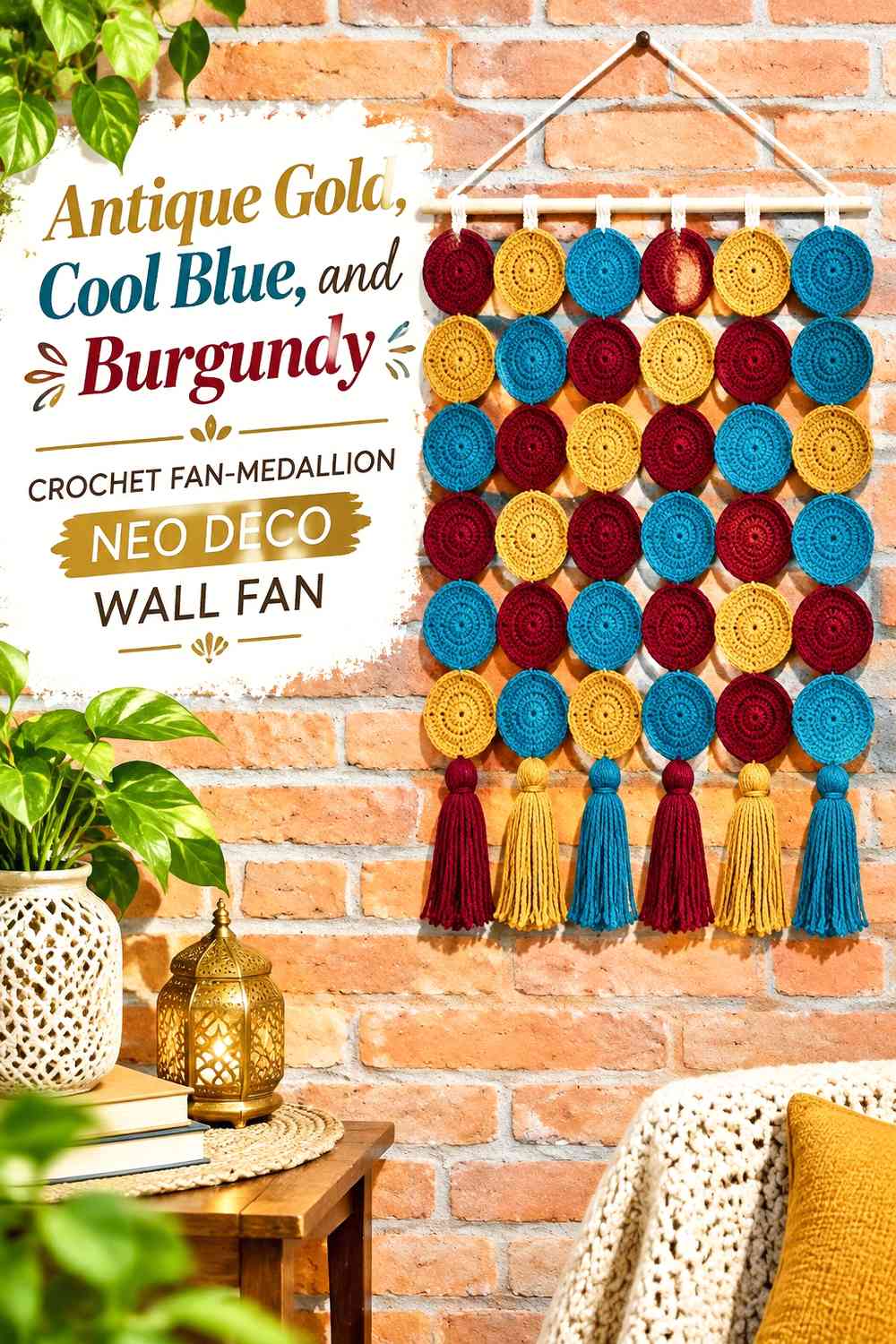
Burgundy creates a jewel-toned focal point at the lower center. Antique gold can outline a compact medallion near the pivot, while cool blue expands outward into larger fan wedges.
Antique Gold Should Frame the Burgundy Crochet Medallion
Keep gold around the medallion perimeter so the deep burgundy center remains visibly separate from any dark wall or shadowed openwork.
Cool Blue Should Expand Beyond the Antique Gold Center
Give blue increasing visual space as the design moves toward the outer arc. This prevents the lower focal medallion from making the entire wall fan feel dark and concentrated.
Burgundy Should Stay Smaller Than Antique Gold and Cool Blue
One central burgundy feature is usually enough. Repeating burgundy around the outer fan can weaken the clean gold-and-blue radial relationship.
Creator Credit: Yarnspirations
9. Cool Blue, Antique Gold, and Slate Gray Crochet Offset-Arc Neo Deco Wall Fan
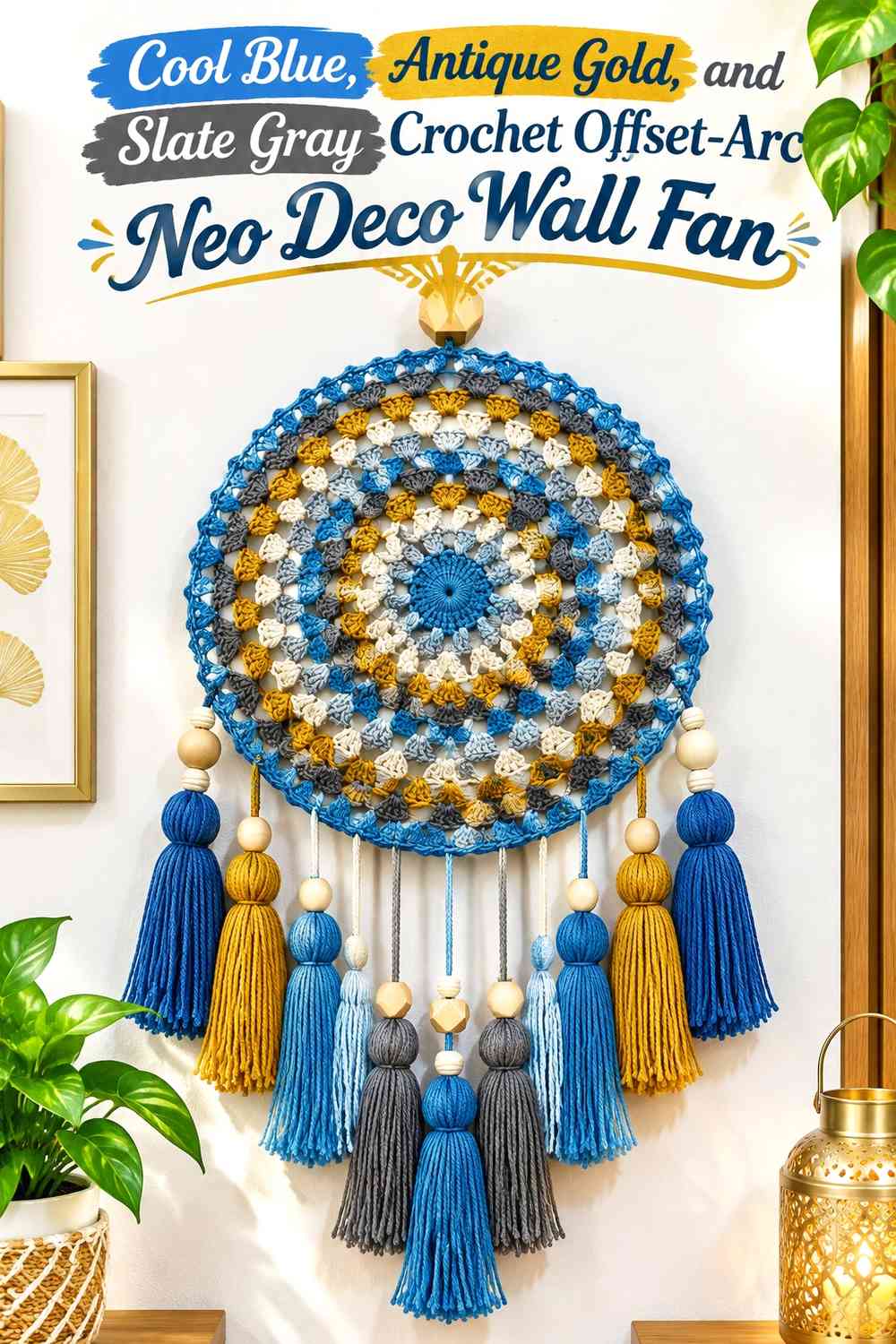
Instead of perfectly centered nested bands, this idea uses slightly offset arcs to create controlled asymmetry. Cool blue remains dominant, antique gold defines the main curve, and slate gray supports the shifted side.
Cool Blue Should Preserve Negative Space Around the Antique Gold Offset Arc
Allow one side of the fan to contain more uninterrupted blue. The imbalance makes the shifted geometry feel deliberate rather than like an incorrectly centered border.
Antique Gold Should Remain the Strongest Arc Against Cool Blue
Keep the gold curve continuous enough that the eye can follow it from side to side. Slate gray should not interrupt the primary line.
Slate Gray Can Anchor One Side of the Antique Gold Fan
Use gray in one wedge group or lower corner rather than outlining the entire piece. Concentrating it supports the asymmetrical Neo Deco direction.
Creator Credit: Ophelia Talks Crochet
10. Antique Gold, Cool Blue, and Forest Green Crochet Jewel-Tone Neo Deco Wall Fan
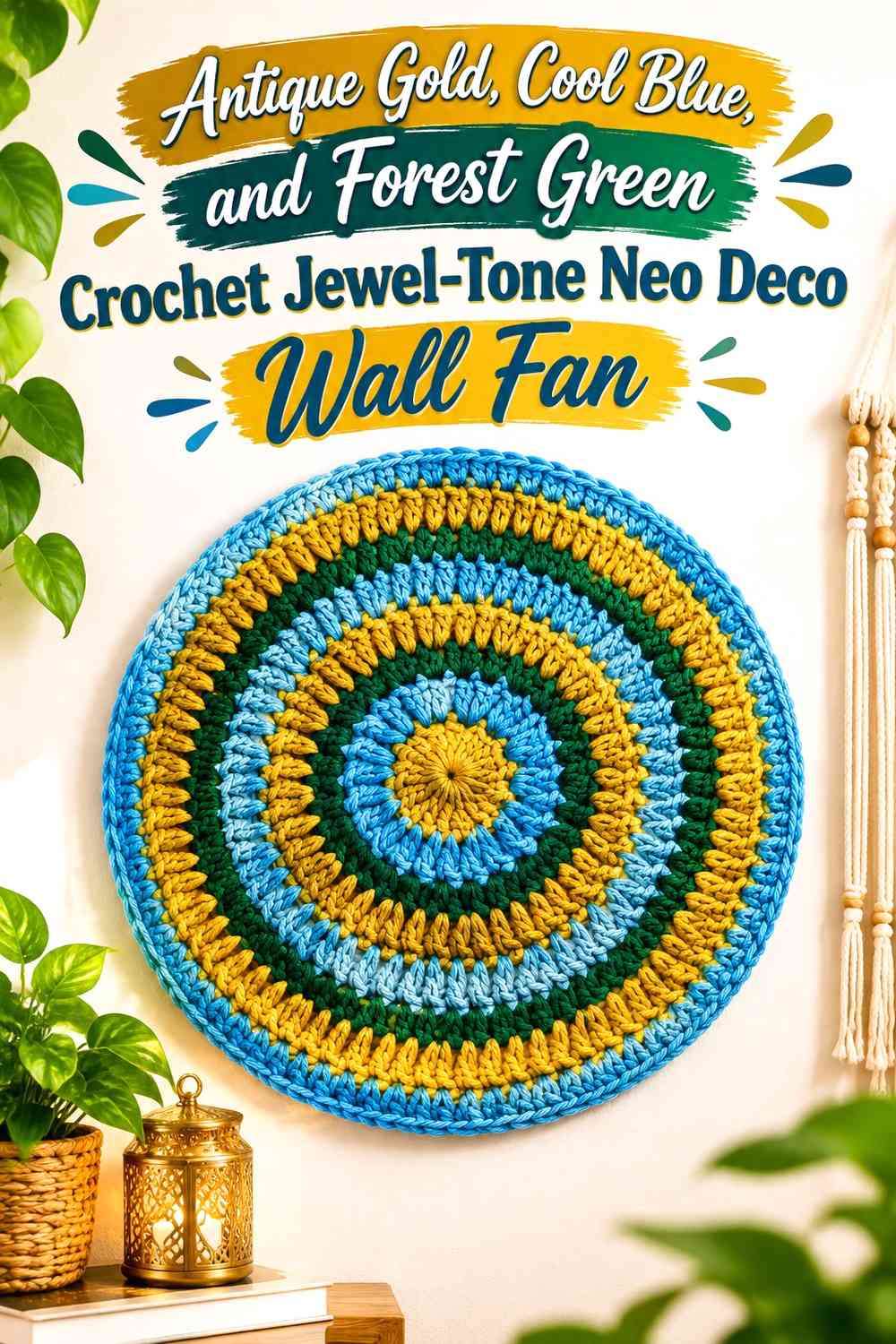
Forest green adds a darker botanical-jewel accent. Antique gold should remain the structural color, cool blue supplies the main field, and green can occupy alternating interior wedges.
Antique Gold Should Separate Forest Green From Cool Blue Wedges
A gold rib between green and blue keeps the two cooler hues from merging, particularly if both are relatively muted.
Cool Blue Should Occupy More Fan Wedges Than Forest Green
Use green strategically—perhaps in every third wedge or only near the outer arc. Too much green shifts the wall fan toward a green-and-gold palette.
Forest Green Can Deepen the Antique Gold Outer Geometry
A small forest-green band immediately inside an antique-gold outer arc creates a darker frame without requiring black or navy.
Creator Credit: The Crochet Crowd
11. Cool Blue, Antique Gold, and Dusty Mauve Crochet Soft Neo Deco Geometric Wall Fan
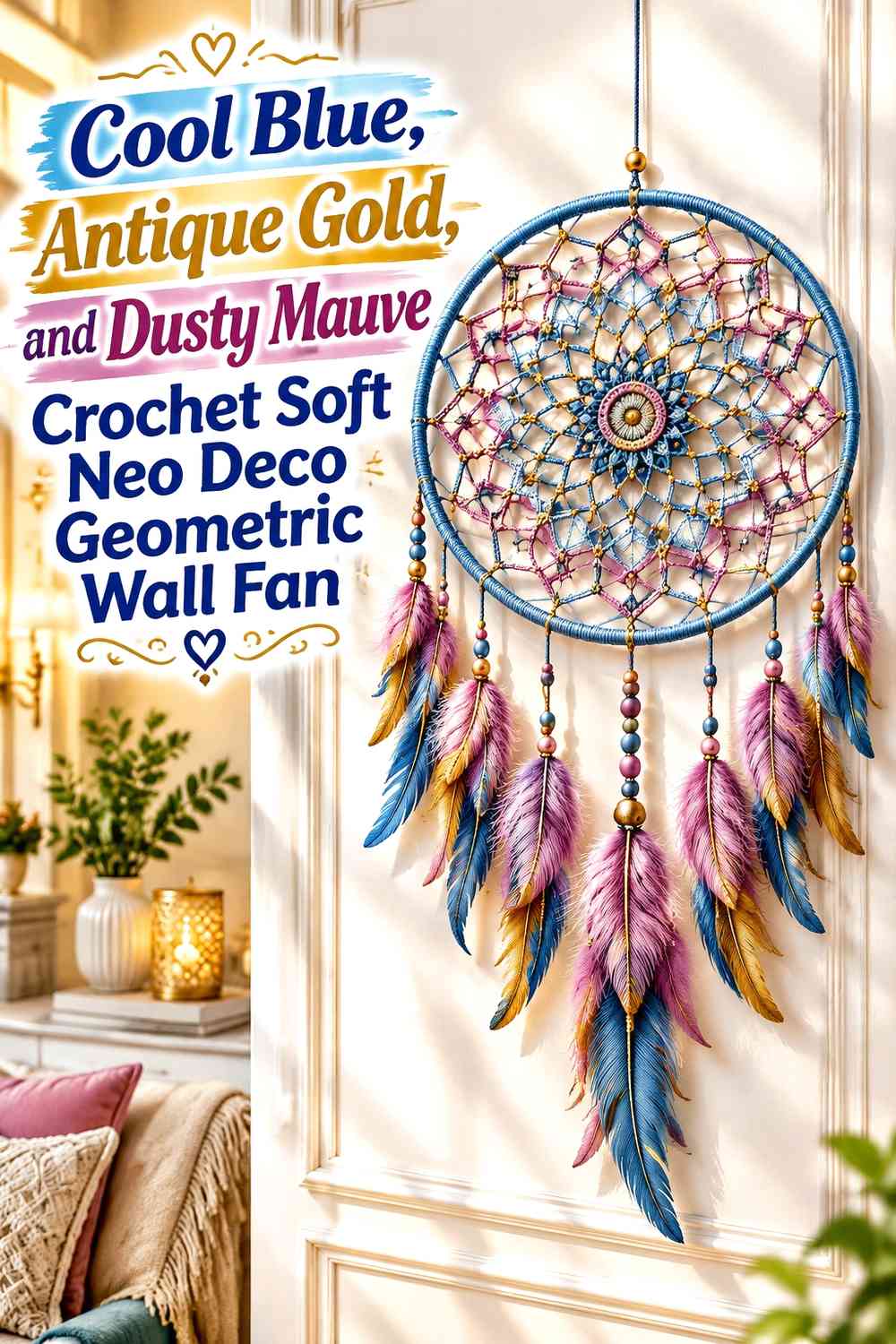
Dusty mauve creates a quieter third-color option. Cool blue can dominate the fan, antique gold carries the main rays and borders, and mauve appears in selected interior wedges.
Cool Blue Should Keep Dusty Mauve From Softening the Fan Too Much
Use blue across the larger geometric areas and let mauve occupy fewer sections. A strong blue foundation keeps the wall piece crisp even with a muted third shade.
Antique Gold Can Give Cool Blue and Dusty Mauve Clear Boundaries
Place gold ribs between the two soft colors. Because blue and mauve can both have muted value, the warm gold line helps each wedge retain a distinct silhouette.
Dusty Mauve Should Remain Smaller Than Antique Gold Details
Keep mauve to selected wedges or one stepped band. The project should still read immediately as antique gold and cool blue.
Creator Credit: cc crochet
12. Antique Gold, Cool Blue, and Black Crochet Graphic-Sunburst Neo Deco Wall Fan
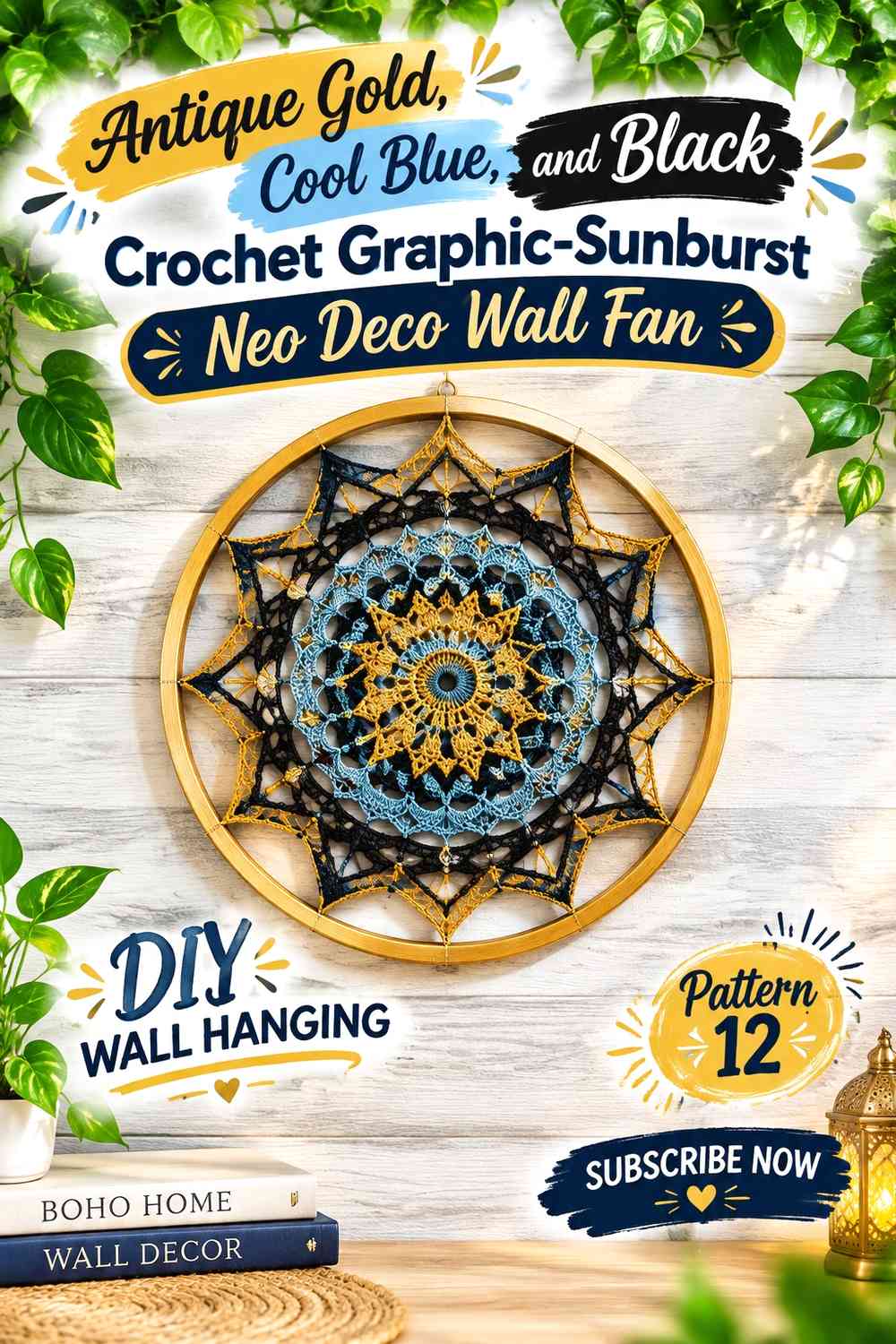
Black produces the strongest graphic treatment. Antique gold forms the primary rays, cool blue fills the fan, and black creates a restrained secondary framework.
Antique Gold Should Remain Wider Than Black Along the Crochet Rays
Use black as a shadow or alternating minor rib rather than matching every gold ray in width. Even narrow black sections can carry considerable visual weight.
Cool Blue Needs Broad Wedges Between Antique Gold and Black Lines
Preserve plenty of blue surface so the fan does not become a dense grid of outlines. Larger blue sections also make the gold appear warmer by comparison.
Black Should Frame Antique Gold and Cool Blue Only at Key Points
A black pivot, narrow lower edge, or selected outer segment is enough. Avoid enclosing every blue wedge in black when gold is already doing the structural work.
Creator Credit: UmmeHoor Crafts
13. Cool Blue, Antique Gold, and Oatmeal Crochet Openwork Neo Deco Wall Fan
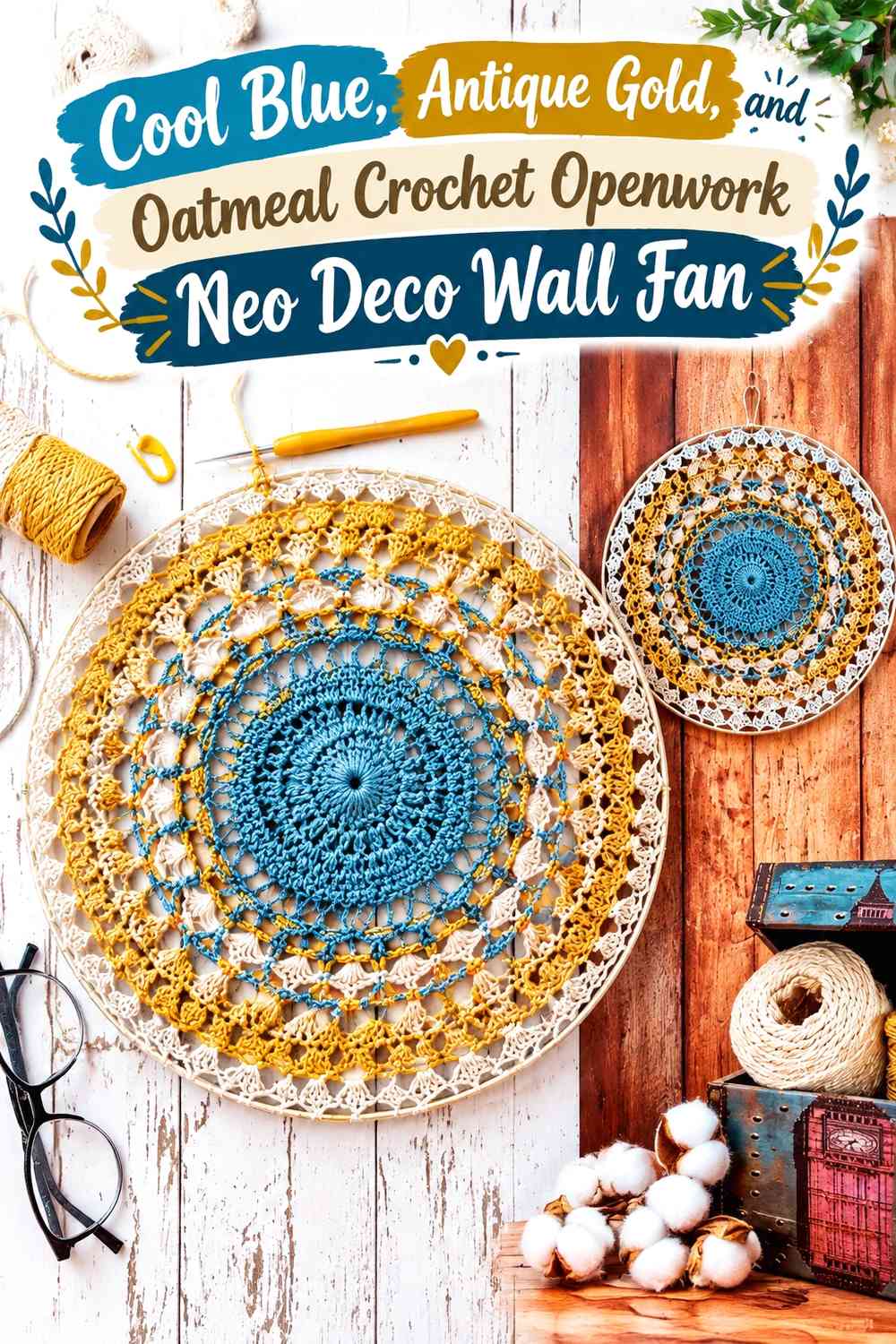
Oatmeal softens the openwork areas and provides a less stark alternative to white. Cool blue can dominate the solid wedges, antique gold defines the fan skeleton, and oatmeal appears in more open decorative bands.
Cool Blue Should Remain Visible Behind the Antique Gold Openwork Geometry
Do not let the open sections occupy most of the fan. Solid blue areas give the eye enough visual material to recognize the wedge structure from across the room.
Antique Gold Can Define the Transition Into Oatmeal Openwork
Use gold immediately before or around the lighter open section. This creates a clear hierarchy between solid blue, structural gold, and softer neutral detail.
Oatmeal Should Lighten Antique Gold Without Replacing Cool Blue
Keep oatmeal to one band or selected upper details. Its purpose is to open the fan visually, not become a third dominant field.
Creator Credit: Crochet By AnDREAM
14. Antique Gold, Cool Blue, and Icy Blue Crochet Layered-Arc Neo Deco Wall Fan
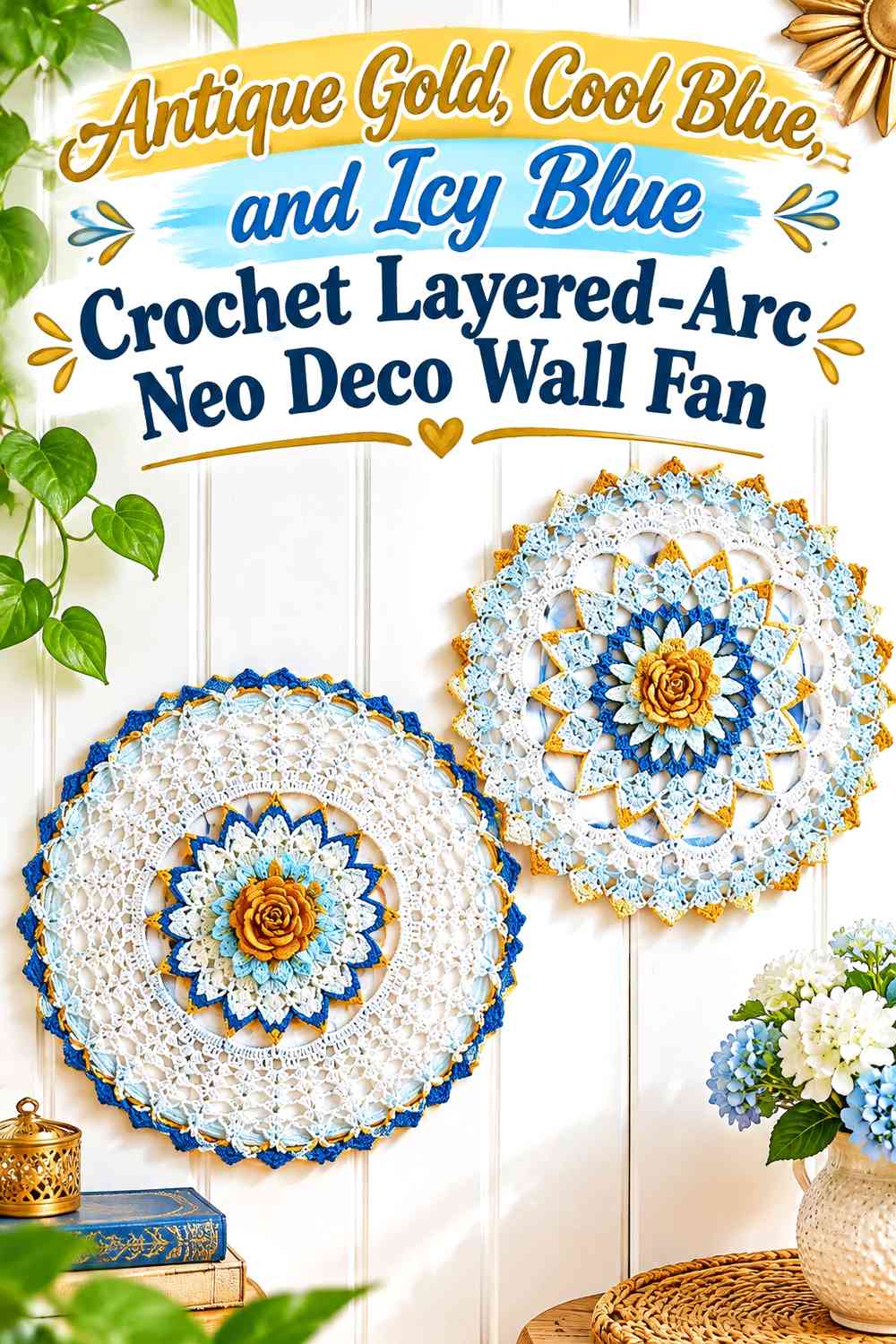
Icy blue creates a tonal transition from cool blue toward a paler outer band. Antique gold can separate the arcs and keep them from blending into one broad blue field.
Antique Gold Should Divide Cool Blue From Icy Blue Arcs
Use gold between major blue bands rather than around every individual stitch section. A few decisive separators create a cleaner layered effect.
Cool Blue Should Remain the Main Interior Fan Color
Give the deeper blue the broad central wedges and allow icy blue to expand closer to the outer arc. This creates a lightening progression as the fan opens.
Icy Blue Should Finish the Antique Gold Outer Geometry Lightly
A pale outer wedge or arc can make the antique-gold perimeter stand out without introducing white. Keep enough color difference between the two blues for the layered structure to remain visible.
Creator Credit: Maggies Crochet Maggie Weldon
15. Antique Gold and Cool Blue Mirrored Two-Color Crochet Neo Deco Geometric Wall Fan
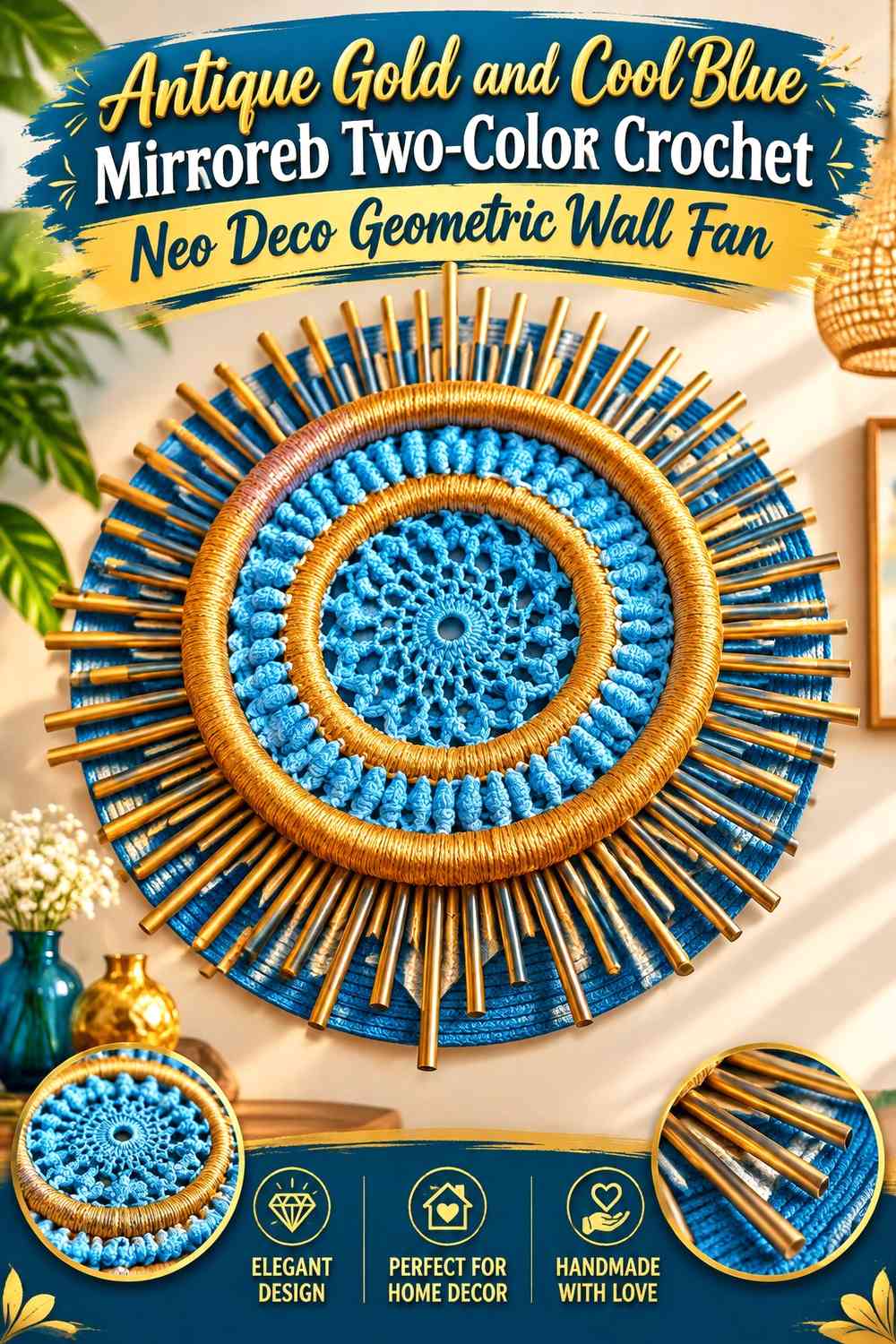
The final wall fan removes every supporting shade and depends entirely on mirrored antique-gold and cool-blue geometry. Instead of using gold only for lines and blue only for fills, selected wedges reverse those roles across the center axis.
Antique Gold Can Lead One Side of the Cool Blue Crochet Fan
Use antique-gold wedge interiors on one side with cool-blue ribs or borders. Toward the center, gradually return to the more familiar blue-field/gold-line relationship.
The reversal creates visual movement without adding another color.
Cool Blue Can Mirror Antique Gold Across the Fan Center
On the opposite half, reverse the proportions systematically. Matching the locations of wide and narrow areas across the central axis keeps the two-color experiment geometric rather than random.
Antique Gold and Cool Blue Need a Strong Shared Outer Arc
Use one continuous color around the top edge to reunite the mirrored halves. Antique gold creates the stronger frame; cool blue creates the quieter finish. Choose according to which color already occupies less of the interior.
Creator Credit: DIYA – Do It Yourself Always
Which Antique Gold and Cool Blue Neo Deco Wall Fan Palette Should You Choose?
For the clearest graphic Neo Deco direction, the sunray, stepped-arch, charcoal-chevron, black-sunburst, diamond-rib, and mirrored two-color versions emphasize repeated lines and symmetry. These work especially well when the fan silhouette itself is simple and the color geometry needs to provide most of the visual interest.
For a lighter wall piece, pearl beige, soft white, oatmeal, or icy blue gives the antique-gold framework more open visual space. These palettes are useful when the hanging will sit against a dark wall or among heavier furniture.
Midnight navy, deep teal, forest green, and burgundy create richer jewel-tone combinations. Use them in smaller quantities so cool blue still contributes enough of the fan surface.
Terracotta and dusty mauve create less conventional directions. Terracotta strengthens the warm side of antique gold, while mauve softens the contrast and lets the gold linework provide more of the definition.
If the fan contains intricate openwork, keep the color system simpler. If the crochet structure is comparatively plain, stronger color blocking and stepped geometric bands can do more of the decorative work.
Conclusion
Antique gold and cool blue give a crochet geometric wall fan two useful visual forces: warm architectural lines and cooler open fields. That makes the pairing especially effective for a Neo Deco direction built from rays, arches, wedges, chevrons, stepped borders, and mirrored sections.
Antique gold works well along the fan ribs because those repeated lines organize the whole semicircle. Cool blue can occupy the widening wedges and provide enough negative space for the gold to remain clear. Third colors should solve a specific problem—lightening an openwork band, deepening a border, separating similar values, or creating one controlled focal section.
Plan the color layout in the actual fan shape rather than designing a complete circle and simply removing half. The narrow pivot and broad upper arc distribute color very differently. Simplify details near the lower center and allow the strongest stepped or angular decoration more space near the outer edge.
Use the credited tutorials for their original mandala, dreamcatcher, hoop, radial-motif, or wall-hanging techniques. Treat the semicircular wall-fan silhouette and Neo Deco color geometry as independent adaptations, and choose a mounting method appropriate to the finished piece.
Frequently Asked Questions
Should Antique Gold or Cool Blue Dominate a Crochet Geometric Wall Fan?
Either can dominate, but they produce different results. Cool blue works well as the broad field because antique-gold ribs remain easy to see against it. An antique-gold-dominant fan feels warmer and makes cool blue function more like an inset accent.
For a strong Neo Deco effect, decide which color controls the geometry rather than simply dividing the yarn quantities equally.
Where Should Antique Gold Go on a Cool Blue Neo Deco Wall Fan?
Useful placements include radial ribs, the lower pivot, stepped arches, chevron outlines, diamond intersections, and the outer fan arc.
These structural locations allow relatively small amounts of antique gold to organize large cool-blue areas.
Does Antique Gold Yarn Need to Be Metallic?
No. Antique gold can simply describe a muted warm gold color. The geometric effect depends on its visual contrast with cool blue rather than on metallic fibers or shine.
How Can I Make Cool Blue Fan Wedges Look More Geometric?
Keep their boundaries deliberate. Use repeated antique-gold ribs, stepped edges, nested arcs, or controlled changes in wedge width rather than allowing every section to change shape independently.
Repeating one geometric rule usually creates a clearer wall fan than combining several unrelated motifs.
Can a Crochet Mandala Tutorial Be Adapted Into a Wall Fan?
A mandala tutorial can provide useful radial shaping, openwork, and color-placement concepts, but a full circular mandala is not automatically a semicircular fan pattern.
Treat the half-fan shape, lower edge, support, and mounting as separate design considerations instead of simply assuming half of the original instructions will produce a stable wall hanging.
What Third Colors Work With Antique Gold and Cool Blue?
Midnight navy, deep teal, icy blue, pearl beige, warm ivory, oatmeal, charcoal, black, burgundy, forest green, dusty mauve, and terracotta can all serve different purposes.
Use the third color for a defined job such as shadowing rays, lightening an outer arc, or creating one focal medallion.
How Can I Keep an Antique Gold and Cool Blue Wall Fan From Looking Too Busy?
Limit the number of geometric systems. If the fan already has strong radial ribs, choose either stepped arches, chevrons, diamonds, or a contrasting outer edge rather than layering all of them together.
Also simplify the lower pivot where the wedge sections become narrowest. Larger, cleaner color areas near the center make the more detailed outer geometry easier to appreciate.