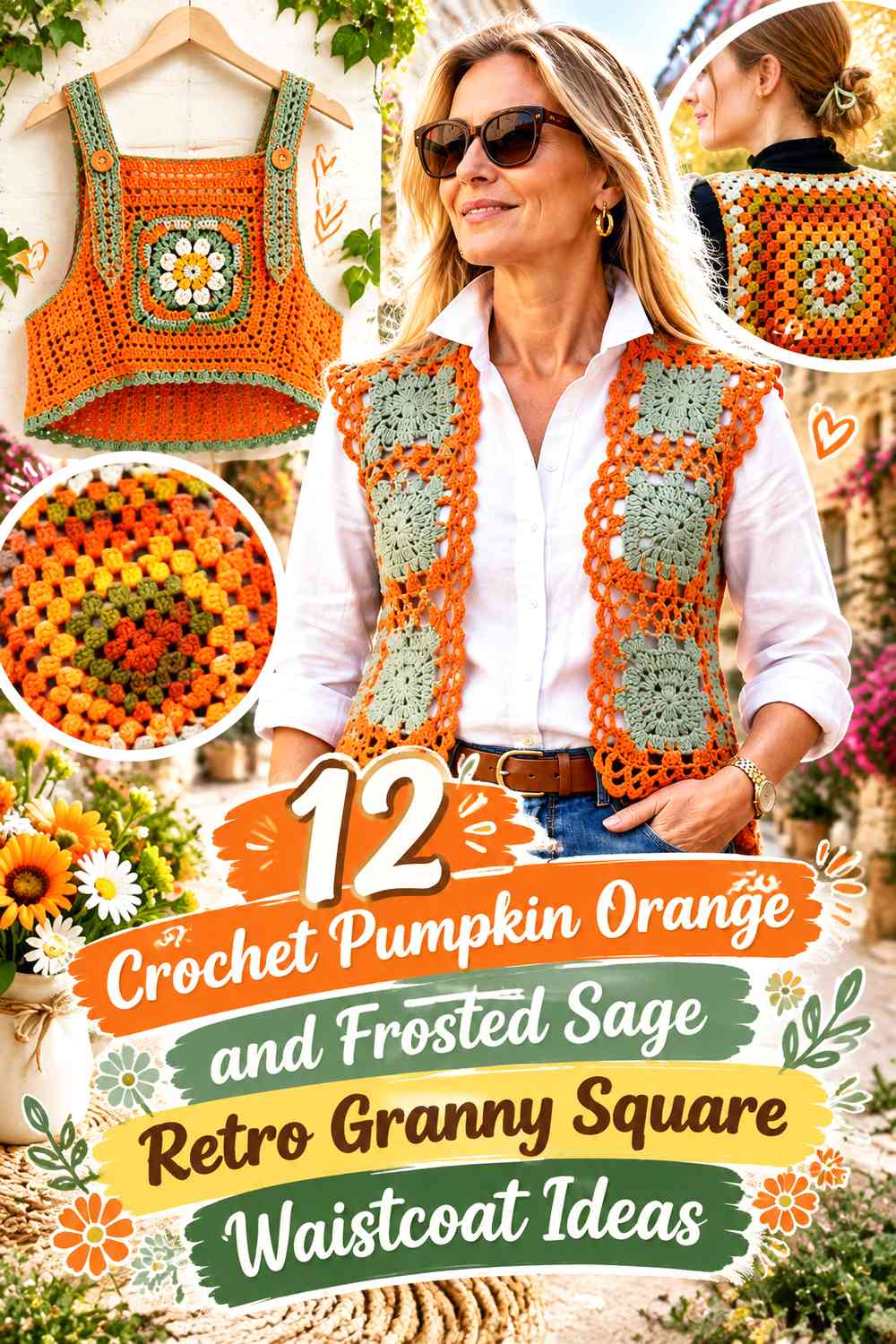

Pumpkin orange and frosted sage create a distinctive retro pairing for a granny square waistcoat. Pumpkin orange supplies the warmer, more assertive color, while frosted sage gives the motifs a muted green counterpoint that can soften repeated orange sections without turning the garment neutral.
The important decision is not simply whether both colors appear. Their placement determines whether the waistcoat looks orange-led, sage-led, evenly blocked, center-focused, or strongly framed. Because granny squares repeat across the front, back, shoulders, and sides, even a small change in where a color appears can become much more noticeable after assembly.
The ideas below explore different ways to distribute the same two colors across a retro crochet waistcoat. The credited tutorials support the garment or granny-square construction concept; the pumpkin orange and frosted sage palettes are independent color adaptations.
Quick List
- Pumpkin Orange-Led Concentric Crochet Retro Granny Square Waistcoat
- Frosted Sage-Led Concentric Crochet Retro Granny Square Waistcoat
- Pumpkin Orange and Frosted Sage Alternating-Block Crochet Retro Granny Square Waistcoat
- Pumpkin Orange Center and Frosted Sage Frame Crochet Granny Square Waistcoat
- Frosted Sage Center and Pumpkin Orange Frame Crochet Granny Square Waistcoat
- Pumpkin Orange Shoulder-Accent Crochet Retro Granny Square Waistcoat With Frosted Sage
- Frosted Sage Joining-Grid Crochet Granny Square Waistcoat With Pumpkin Orange Motifs
- Pumpkin Orange Joining-Grid Crochet Granny Square Waistcoat With Frosted Sage Motifs
- Pumpkin Orange and Frosted Sage Mirrored-Front Crochet Granny Square Waistcoat
- Frosted Sage Body With Pumpkin Orange Retro-Trim Crochet Granny Square Waistcoat
- Pumpkin Orange Floral-Center and Frosted Sage Crochet Granny Square Waistcoat
- Frosted Sage Wrap-Style Crochet Granny Square Waistcoat With Pumpkin Orange Anchors
Balance Pumpkin Orange and Frosted Sage Across the Whole Waistcoat
A granny square that looks balanced on its own can produce a very different result once it is repeated across an entire garment. If pumpkin orange fills the same large area in every motif, several neighboring squares may combine visually into a much warmer waistcoat than expected.
Decide which color should control the overall garment before making the complete set of motifs. For an orange-led version, repeat pumpkin orange in larger middle or outer areas and let frosted sage interrupt it. For a sage-led version, give frosted sage the repeated framework and reserve pumpkin orange for smaller focal areas.
Check Pumpkin Orange and Frosted Sage Value Contrast Before Joining
Different hues do not automatically create strong light-dark contrast. A muted pumpkin orange and a medium frosted sage can sometimes sit surprisingly close in value, particularly when the crochet fabric is viewed from several feet away.
Place the yarns together and check a sample motif before committing to the full waistcoat. A grayscale photo can also help reveal whether individual granny-square rounds remain distinct. If the two colors merge more than you want, change their surface proportions rather than automatically introducing another color.
Let Pumpkin Orange and Frosted Sage Repeat at Garment Edges
The neckline, armholes, hem, and front opening can either unify the granny squares or introduce another competing visual element. Repeating pumpkin orange or frosted sage at these edges gives the whole waistcoat a clearer color hierarchy.
A sage edge tends to calm a heavily orange motif layout, while pumpkin orange edging can pull warmth outward and emphasize the garment silhouette. Choose the edge color after laying several completed motifs together rather than making that decision from one square.
1. Pumpkin Orange-Led Concentric Crochet Retro Granny Square Waistcoat
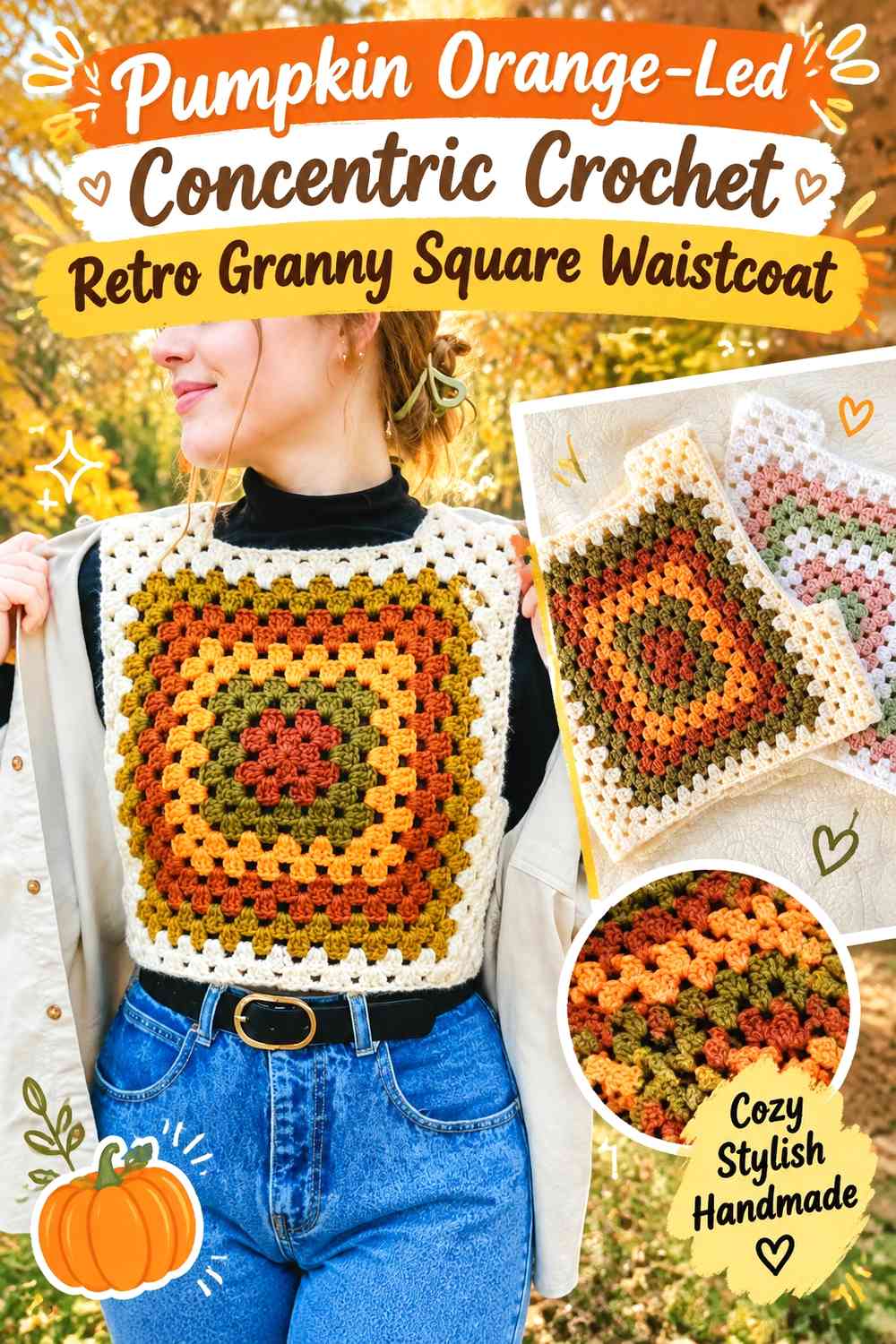
This version gives pumpkin orange the largest visual share and uses frosted sage as a repeating interruption inside broad concentric granny-square areas. It works especially well when the waistcoat uses large center-out motifs because each color change becomes a visible band rather than a tiny patch. Keep the sage sections deliberate so the muted green reads as part of the design rather than an occasional leftover shade.
Pumpkin Orange Should Control the Broad Granny Square Bands
Use pumpkin orange across some of the wider visible areas of the main squares when you want the waistcoat to read orange first. Repeating the warm shade through both front and back prevents one side of the garment from feeling unrelated to the other.
Avoid dividing every band equally between pumpkin orange and frosted sage. Unequal coverage gives the palette a clearer hierarchy and strengthens the large-scale retro geometry.
Frosted Sage Can Separate Pumpkin Orange Without Breaking the Retro Rings
Place frosted sage between selected pumpkin orange areas to create visual pauses in the center-out pattern. The sage does not need to occupy as much space as orange; its change in hue already makes it noticeable.
Check where the sage bands land once the square reaches wearable scale. A narrow-looking section on a small motif can become a prominent stripe across a full waistcoat panel.
Creator Credit: HayHay Crochet
2. Frosted Sage-Led Concentric Crochet Retro Granny Square Waistcoat
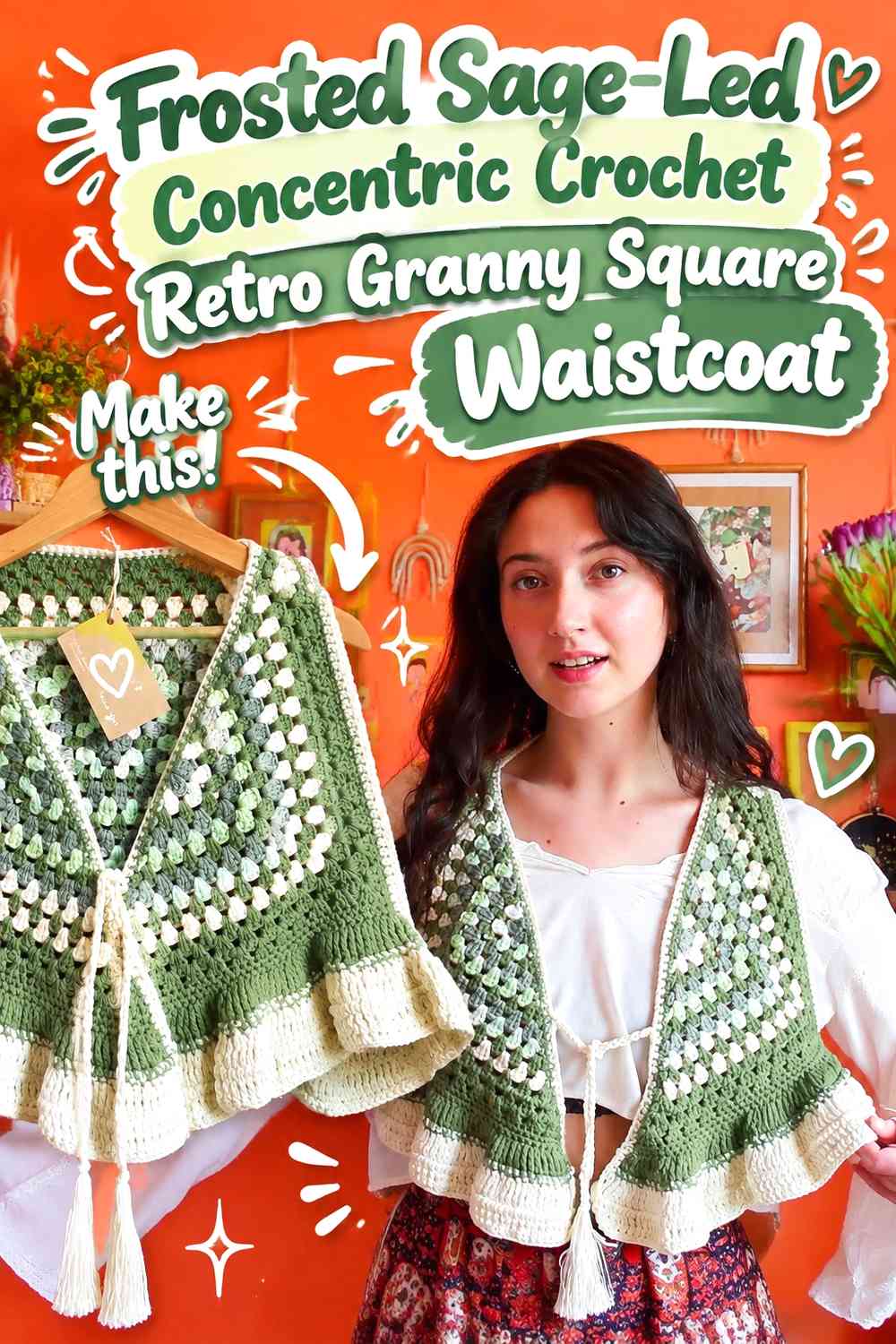
Reverse the hierarchy by letting frosted sage dominate the large granny-square fields and concentrating pumpkin orange into selected inner and middle bands. This makes the garment visually quieter from a distance while preserving the unmistakable warm orange flashes associated with the retro palette.
Frosted Sage Can Carry the Largest Waistcoat Areas
Use frosted sage for the broadest rounds or the outer portions of oversized motifs. That puts the softer green near adjoining squares, shoulders, and side areas, where it can connect separate sections of the waistcoat.
A consistent sage outer area is particularly useful when pumpkin orange appears in several different positions inside the motifs. The repeated green gives those variations one common frame.
Pumpkin Orange Works Better as a Defined Accent Against Frosted Sage
Concentrate pumpkin orange into one or two meaningful areas rather than inserting a thin orange line into every possible round. A stronger but less frequent orange section is easier to read against a sage-led garment.
Look at the front and back together before assembly. If nearly all the strongest orange falls on one panel, redistribute a few motifs so the warm color does not become unintentionally front-heavy.
Creator Credit: Megan (doodies crochet)
3. Pumpkin Orange and Frosted Sage Alternating-Block Crochet Retro Granny Square Waistcoat
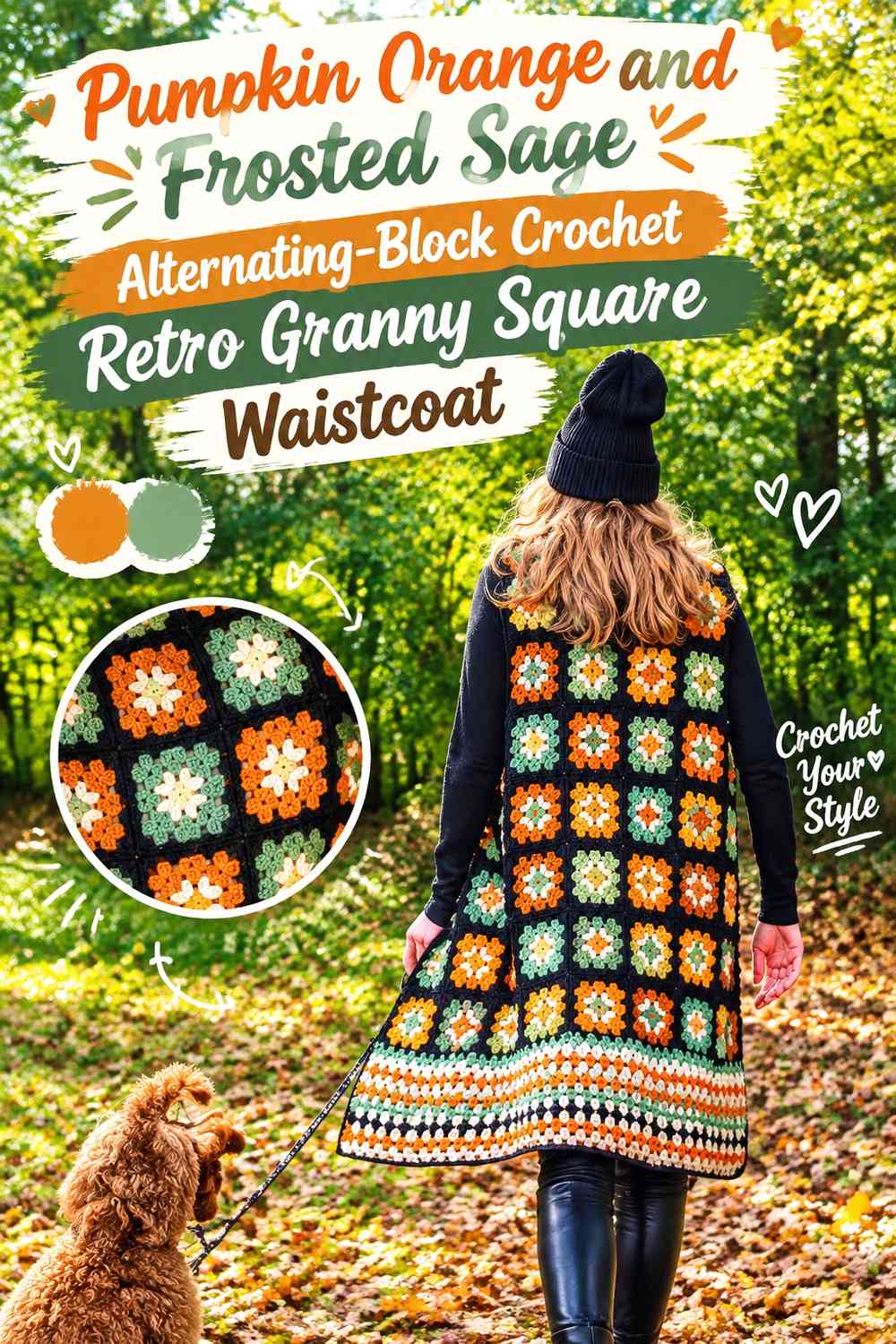
Instead of changing colors repeatedly inside every square, assign some motifs a stronger pumpkin-orange identity and others a stronger frosted-sage identity. Alternating those blocks creates a patchwork effect with clearer large-scale rhythm. It is a useful choice for a longer waistcoat because color placement can travel vertically down the garment.
Pumpkin Orange Blocks Need Even Distribution Across the Waistcoat
Lay every pumpkin-orange-heavy square into the garment map before joining. Several warm motifs grouped around one side seam or shoulder can make the waistcoat appear unbalanced even if the total number of orange and sage squares is equal.
Use the front opening and center back as reference areas. Spread the strongest orange blocks so the warm color appears intentionally across the complete silhouette.
Frosted Sage Blocks Can Give Pumpkin Orange More Breathing Room
Frosted-sage-heavy motifs create quieter sections between orange blocks. This is useful in a longer waistcoat, where repeating orange continuously from shoulder to hem could make the palette feel much denser.
Keep at least a small amount of pumpkin orange inside some sage-led motifs, or vice versa, if you want neighboring blocks to feel related rather than completely separate.
Creator Credit: Granny Wilson’s Crafts
4. Pumpkin Orange Center and Frosted Sage Frame Crochet Granny Square Waistcoat
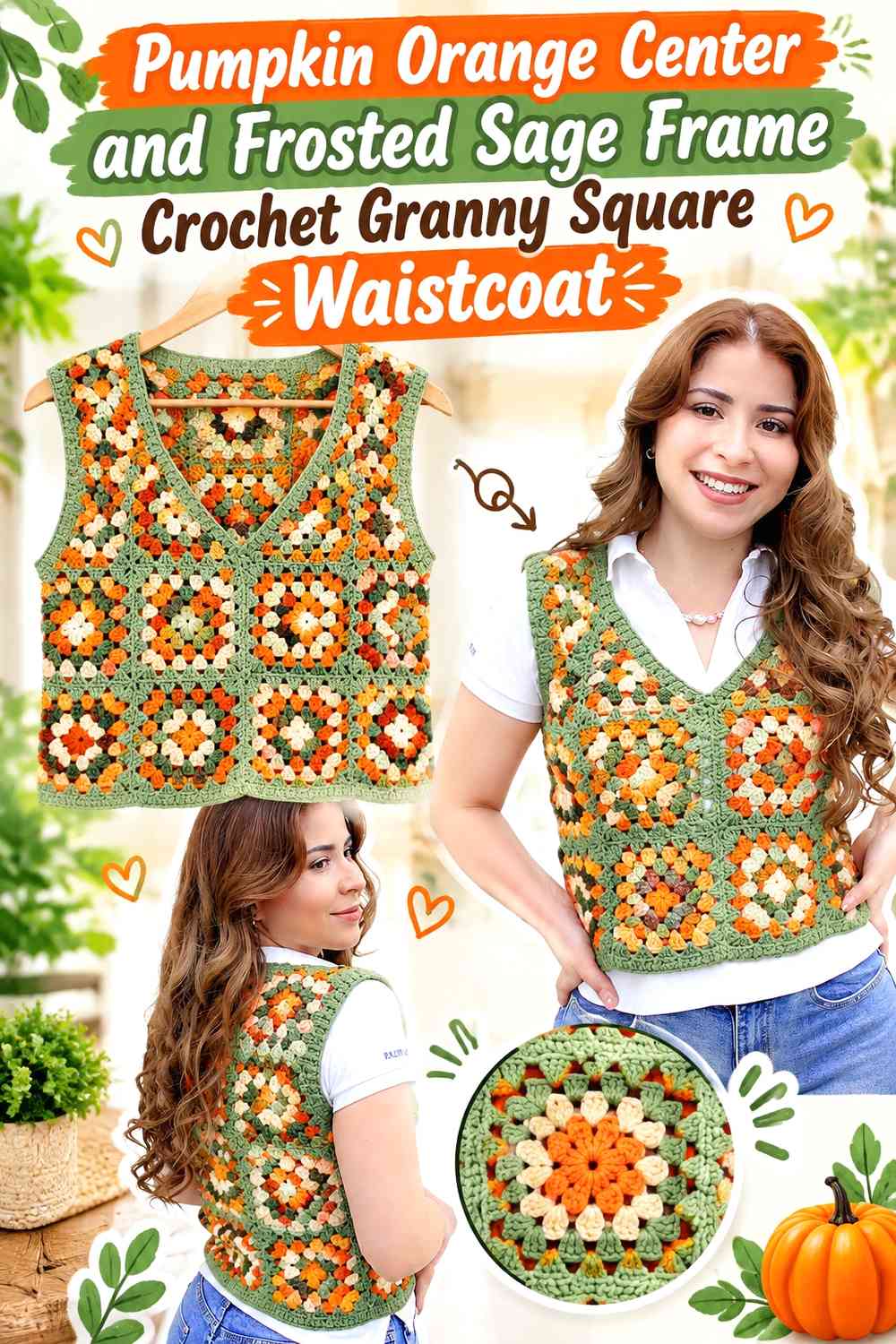
Give every motif a recognizable pumpkin orange center and let frosted sage expand toward the square edges. Repetition makes the orange centers behave almost like a dotted pattern across the waistcoat, while the sage outer rounds become increasingly continuous where motifs meet.
Pumpkin Orange Centers Create Repeated Retro Focal Points
Keep pumpkin orange in a consistent central position if you want each granny square to remain easy to recognize from a distance. The repetition is especially effective across the front panels, where several centers can form a deliberate visual rhythm.
Watch the size of the orange center. If it expands too far into every square, the frosted sage frame may become too narrow to separate neighboring focal points.
Frosted Sage Frames Can Connect Pumpkin Orange Motifs
Using frosted sage toward the outside of every square gives the joining areas a calmer appearance. Once motifs sit next to one another, the sage sections can visually merge into a larger green framework around the orange centers.
This approach is useful when you want obvious individual granny squares without creating a strongly contrasting joining grid.
Creator Credit: Brunaticality
5. Frosted Sage Center and Pumpkin Orange Frame Crochet Granny Square Waistcoat
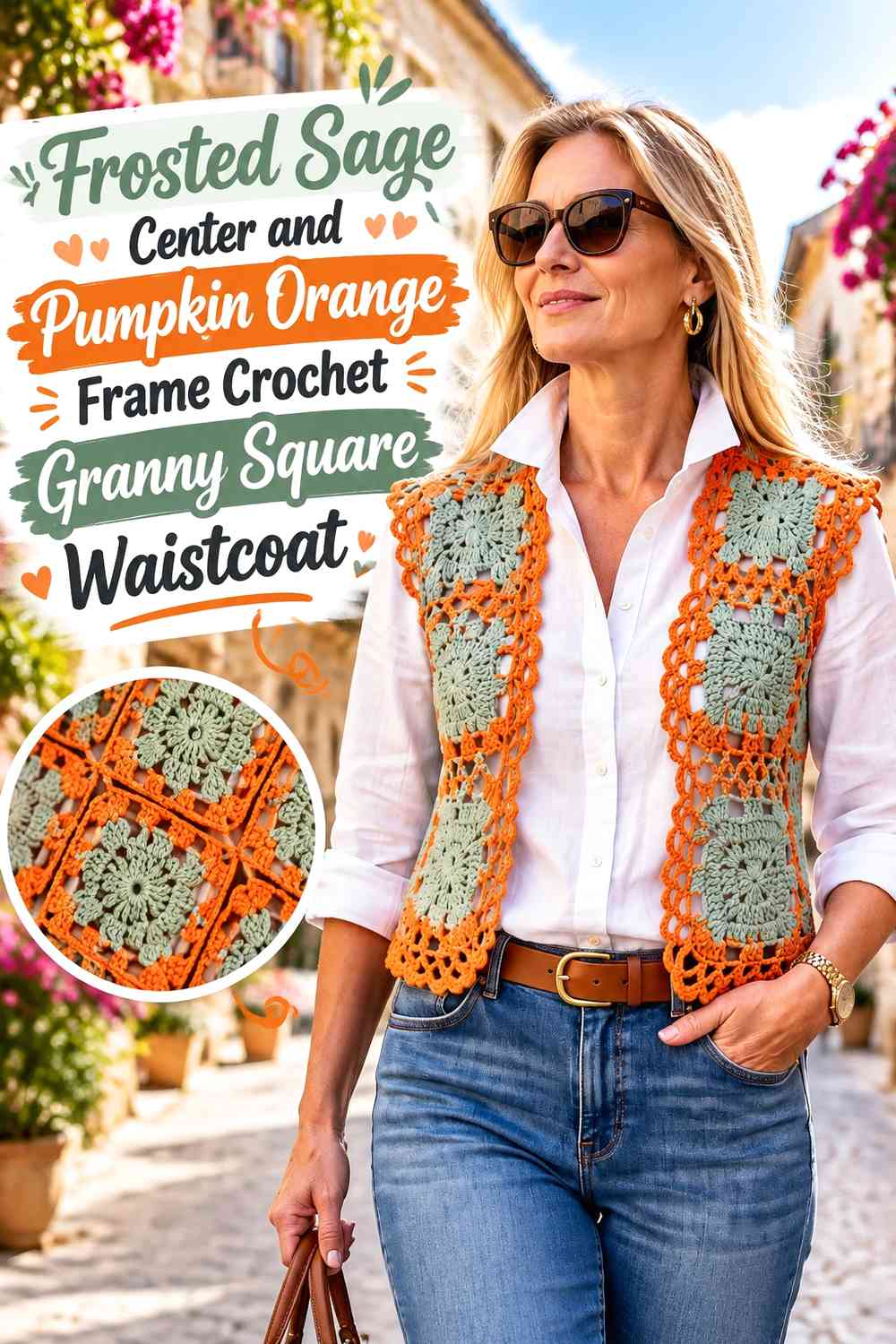
This arrangement produces almost the opposite visual effect: frosted sage settles into the center of each motif while pumpkin orange moves outward and begins defining the garment as the squares connect. Because the warmer color occupies motif boundaries, the finished waistcoat can look substantially more orange even when the two shades appear in similar amounts.
Frosted Sage Centers Need Enough Area to Stay Visible
Do not reduce frosted sage to such a small center that it disappears once the waistcoat is viewed as a complete garment. Give the green enough space to register clearly before the stronger pumpkin orange rounds begin.
Repeating the same sage center also helps connect motifs whose surrounding orange sections vary slightly.
Pumpkin Orange Outer Rounds Can Build a Strong Waistcoat Grid
Pumpkin orange around each square creates repeated warm lines across the joined garment. Decide whether you want those orange boundaries to blend into the seams or remain visibly separate.
If the orange grid already has strong visual weight, keep the neckline and armhole finish restrained. Adding wide pumpkin-orange edging everywhere may make the framing heavier than the motif centers.
Creator Credit: Handwork diy
6. Pumpkin Orange Shoulder-Accent Crochet Retro Granny Square Waistcoat With Frosted Sage
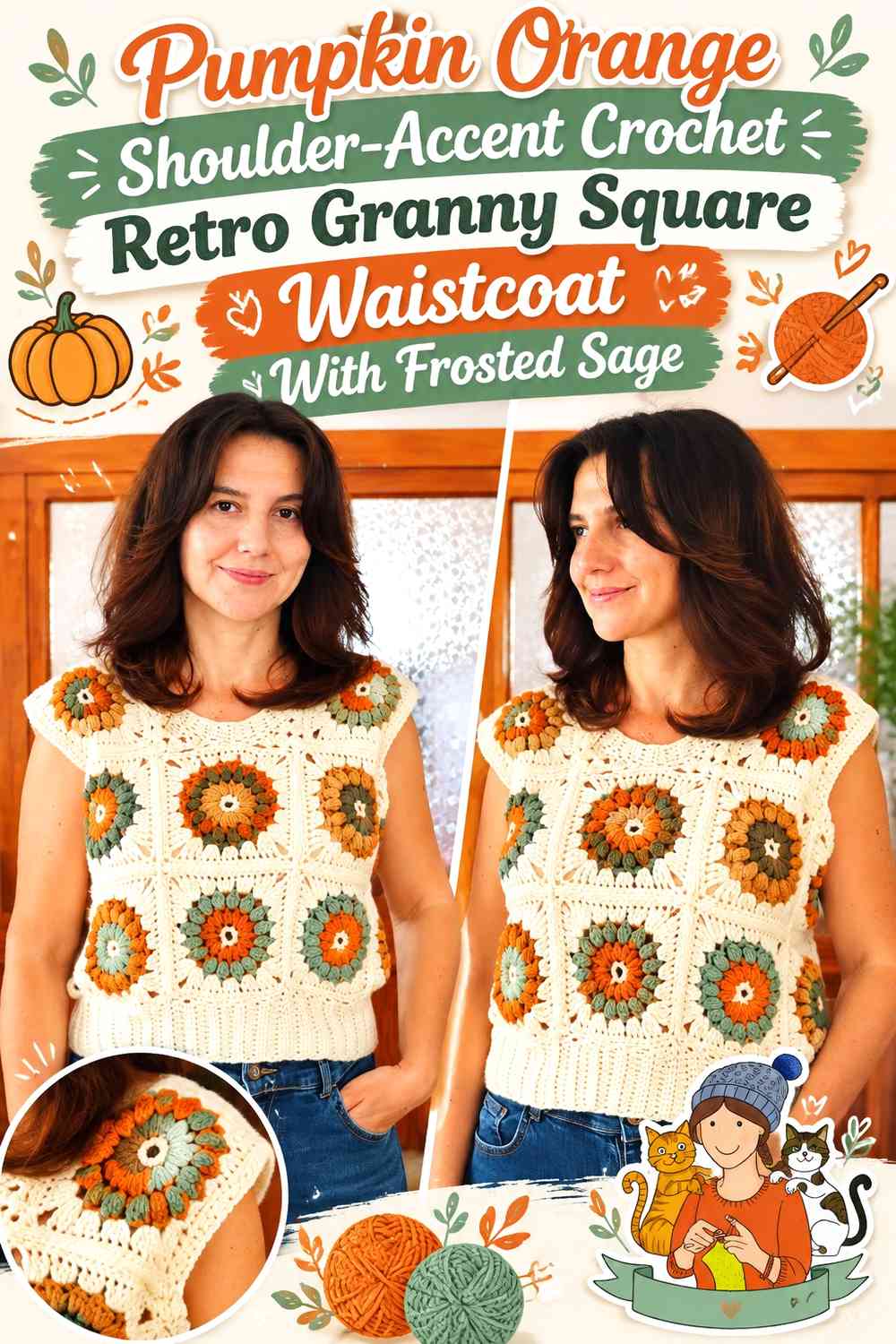
Let frosted sage control most of the torso and concentrate pumpkin orange around selected upper motifs. This changes the usual all-over retro distribution by giving the shoulder area a warmer focal zone. It can work well when you want the waistcoat to remain relatively sage-led while still showing pumpkin orange prominently from the front.
Pumpkin Orange Shoulder Squares Should Connect to the Main Palette
Repeat pumpkin orange somewhere below the shoulders, even if only in smaller motif centers or edging. Without that repetition, strongly orange upper motifs can look detached from a predominantly frosted-sage body.
The goal is not perfect symmetry. It is enough visual repetition for the orange shoulder accents to look intentional.
Frosted Sage Can Keep the Torso Visually Quieter
Use frosted sage across larger lower motifs or outer rounds so the body of the waistcoat does not compete with the pumpkin-orange shoulder emphasis.
Before final joining, view the waistcoat vertically. If all the sage sits low and all the orange sits high, introduce a few crossovers between the two areas to avoid an abrupt horizontal color divide.
Creator Credit: Sirin’s Crochet
7. Frosted Sage Joining-Grid Crochet Granny Square Waistcoat With Pumpkin Orange Motifs
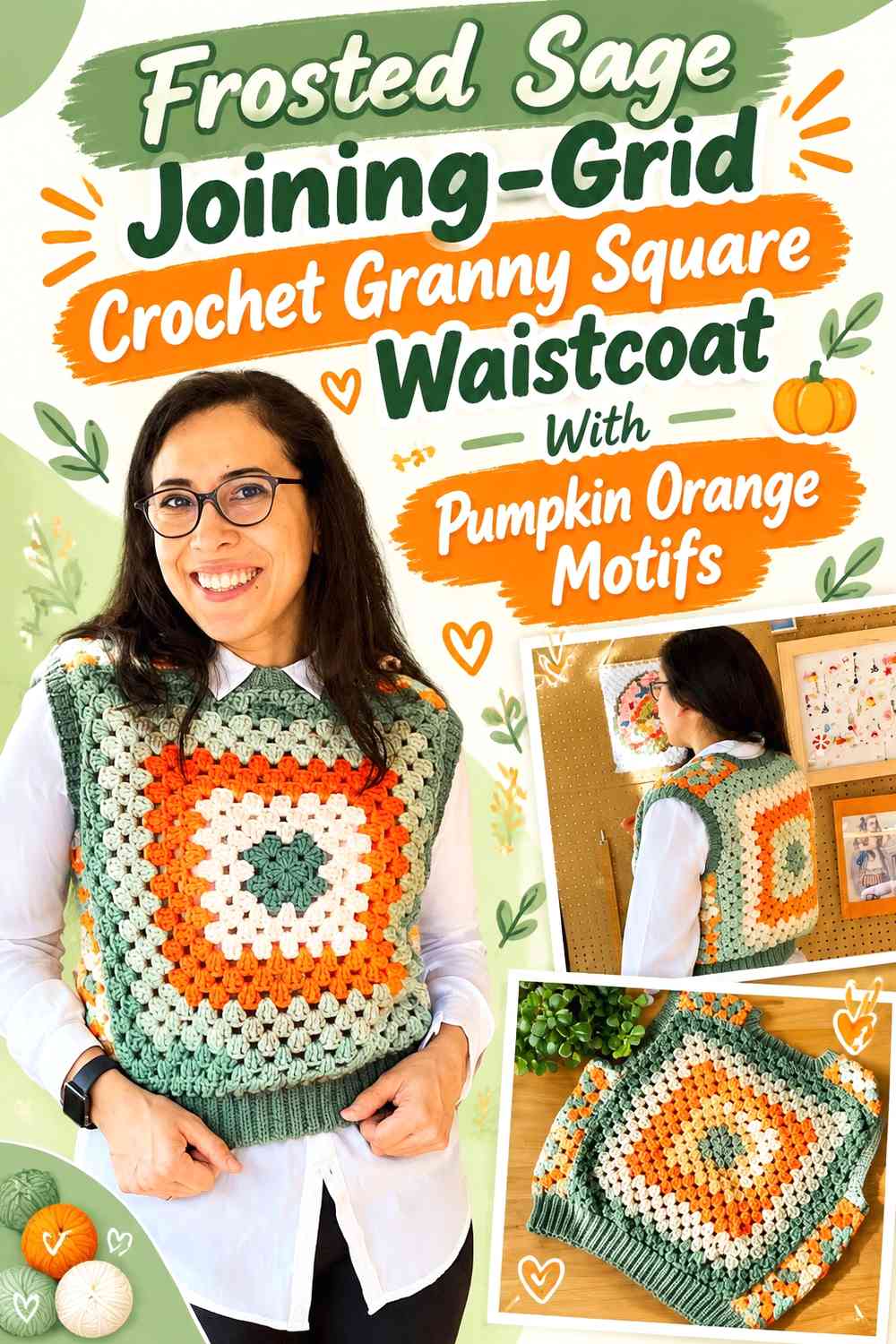
Here, the individual squares can carry generous pumpkin orange, while frosted sage takes responsibility for the boundaries between them. A visible sage joining framework can organize a busy collection of warm motifs and emphasize the modular granny-square construction.
Frosted Sage Joins Can Organize Pumpkin Orange Granny Squares
A consistent frosted sage connection between motifs creates repeated lines across the front and back. This helps visually separate pumpkin-orange areas that might otherwise merge when neighboring squares contain similar warm sections.
Test a small joined group first. The wider the sage connection appears, the more it becomes an important third design element alongside the motif centers and outer rounds.
Pumpkin Orange Should Repeat Beyond the Centers
If pumpkin orange appears only as tiny centers, a strong frosted-sage grid may overpower it. Carry orange into selected middle rounds or larger motifs so the waistcoat still reads as a genuine orange-and-sage pairing.
This is especially important at the front, where the joining lines may be more noticeable around the neckline and opening.
Creator Credit: Pops de Milk Crochet
8. Pumpkin Orange Joining-Grid Crochet Granny Square Waistcoat With Frosted Sage Motifs
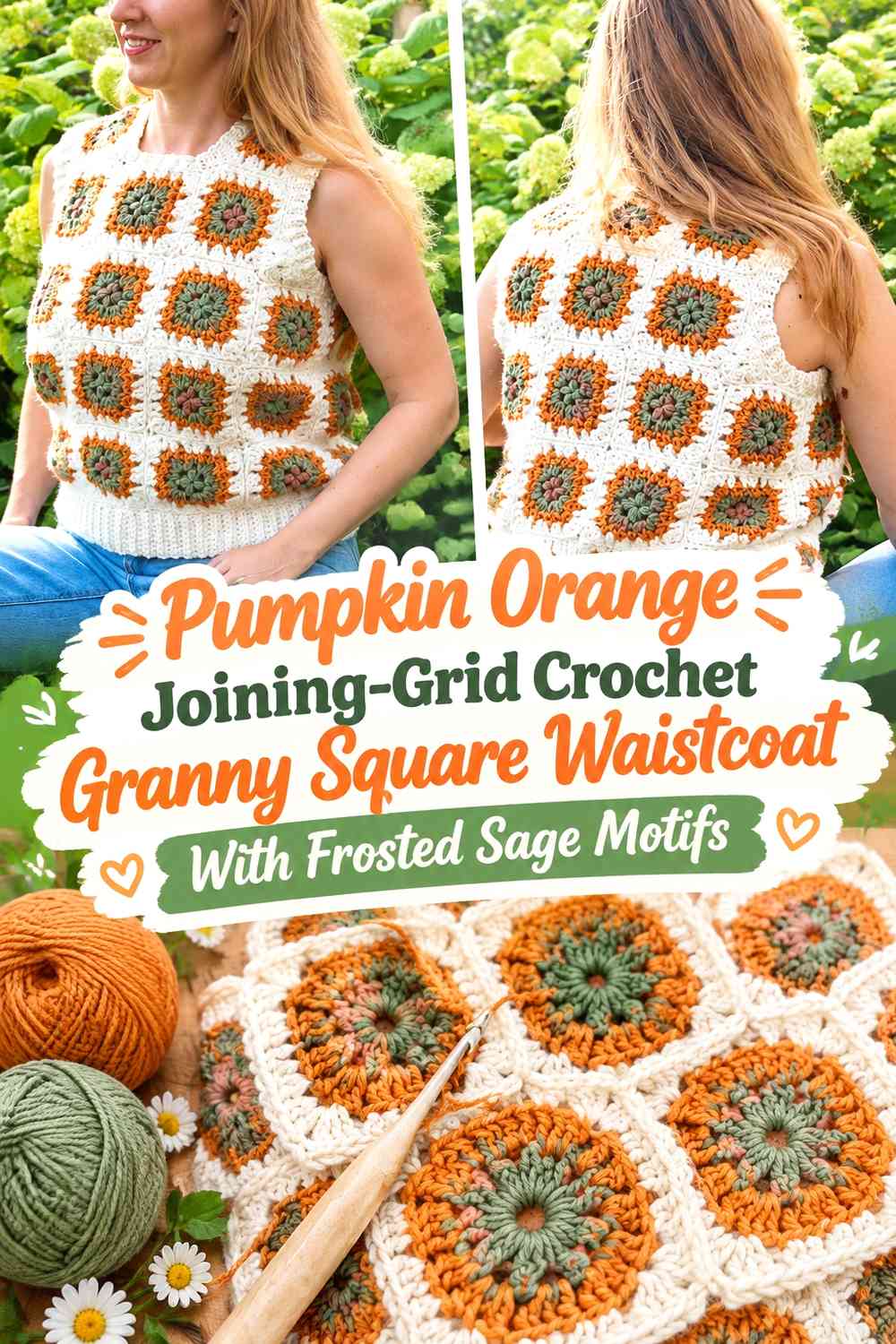
Use pumpkin orange for the joins and let frosted sage occupy more of the motifs themselves. The resulting grid is warmer and more graphic than a sage join, making the construction lines part of the retro color statement.
Pumpkin Orange Joins Become a Major Waistcoat Feature
Because every joined edge repeats across the garment, pumpkin orange can gain more visual territory than expected. Make a test connection between several squares before committing to the complete waistcoat.
If the orange grid already creates enough warmth, keep additional orange inside the motifs more selective. That prevents every structural line and every focal point from competing at the same intensity.
Frosted Sage Motifs Need Clear Shapes Against Pumpkin Orange
Give frosted sage sufficient uninterrupted area inside each square. Tiny green sections surrounded by orange seams can lose their identity once many motifs are assembled.
A sage-heavy center or middle section creates enough visual mass to balance the continuous pumpkin-orange framework.
Creator Credit: Made on Mill
9. Pumpkin Orange and Frosted Sage Mirrored-Front Crochet Granny Square Waistcoat
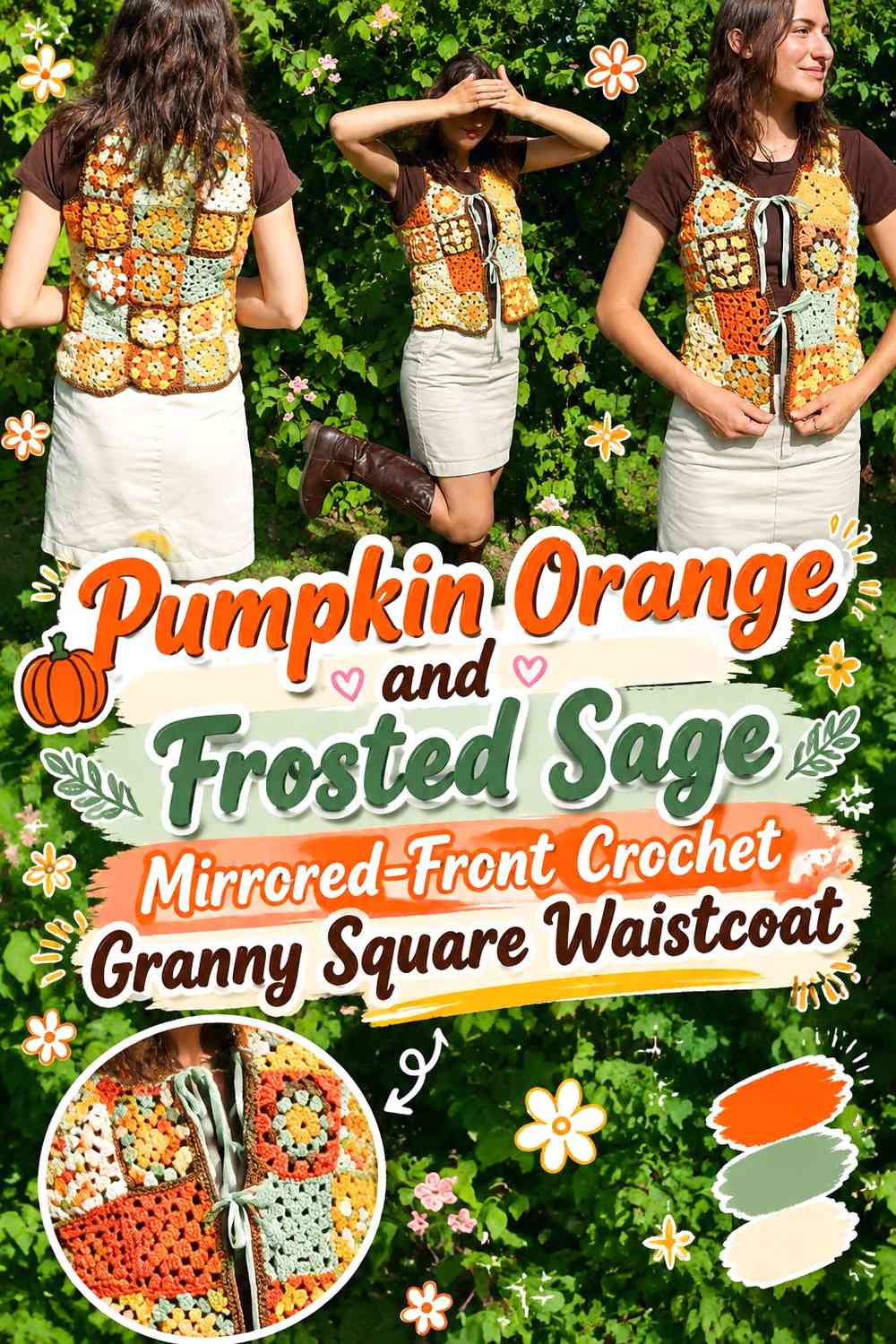
Treat the two front sections as a pair. Pumpkin orange can dominate one side of selected motifs while frosted sage takes the corresponding position on the opposite front, creating a controlled mirrored effect without requiring every square to be identical.
Pumpkin Orange and Frosted Sage Should Mirror at the Front Opening
Lay the two front sections next to each other before joining them to the back. The center opening makes color relationships especially noticeable, so an accidental cluster can look more obvious here than at a side seam.
Mirror major color blocks while allowing smaller details to vary. This keeps the waistcoat coordinated without making the entire patchwork rigidly symmetrical.
Frosted Sage Can Carry the Back While Pumpkin Orange Defines the Front
If the front already has strong orange-and-sage contrast, using more frosted sage across the back can keep the full garment from becoming overly warm.
Repeat pumpkin orange in a few rear motifs or along part of the edge so the transition does not feel like two unrelated waistcoats joined at the shoulders.
Creator Credit: Calluna Crochet
10. Frosted Sage Body With Pumpkin Orange Retro-Trim Crochet Granny Square Waistcoat
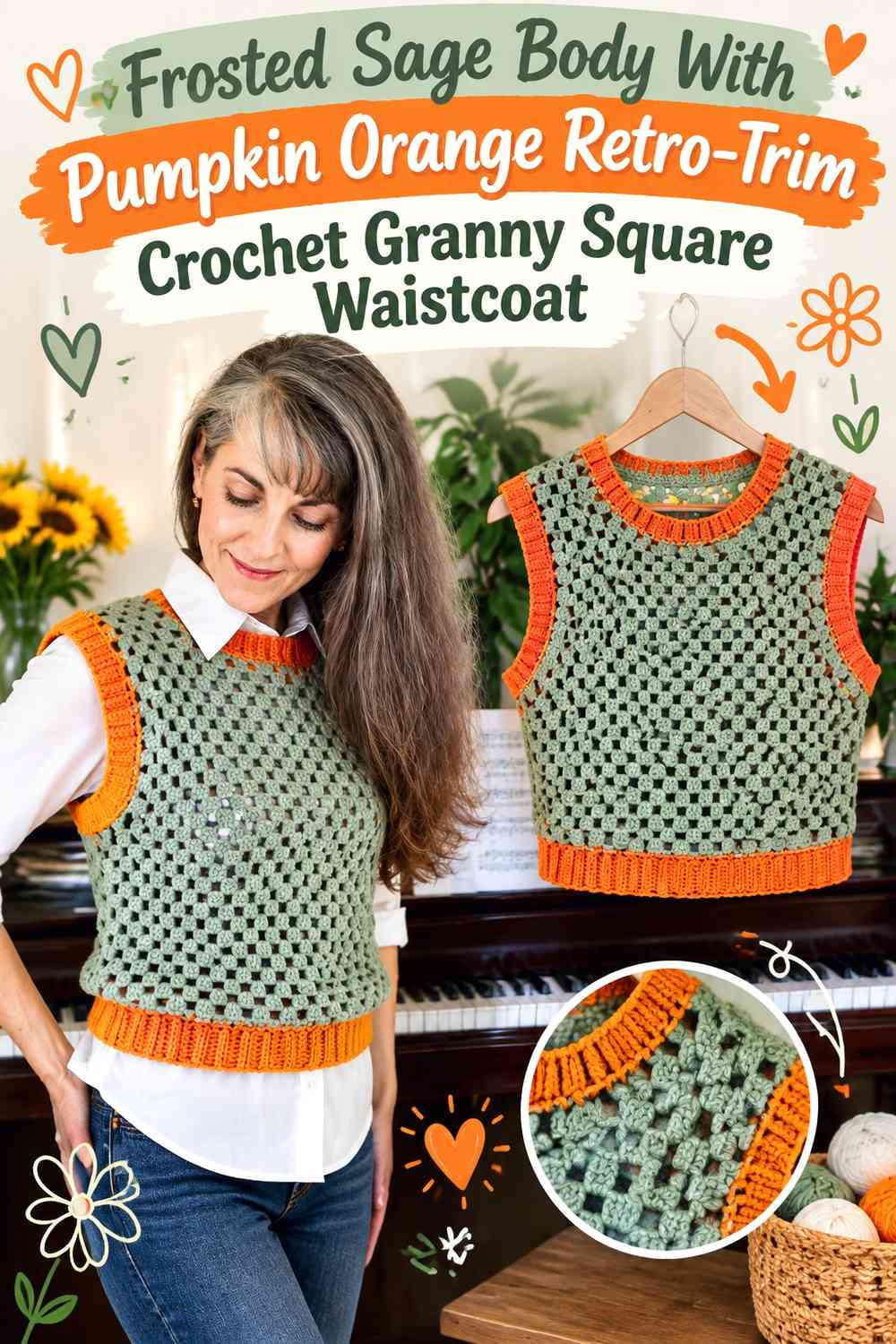
Let the granny-square body remain predominantly frosted sage and shift much of the pumpkin orange to the neckline, armholes, hem, or other continuous finishing areas. This creates a cleaner two-tone direction because the warm shade defines the outline instead of appearing equally inside every motif.
Pumpkin Orange Trim Can Define a Frosted Sage Waistcoat
A repeated orange edge around major openings creates a strong outline against a sage body. Because edging is continuous, even a relatively narrow orange area can become visually important.
Assess the waistcoat before widening the trim. A border that looks modest on one section may feel much stronger once it surrounds several garment openings.
Frosted Sage Motifs Should Remain the Largest Color Field
Keep most square interiors sage-led if the purpose of the design is to make pumpkin orange a framing color. Adding large orange sections back into every motif can weaken that distinction.
Small orange centers can still connect the trim to the granny squares without competing with the frosted-sage field.
Creator Credit: Crochet & Yara
11. Pumpkin Orange Floral-Center and Frosted Sage Crochet Granny Square Waistcoat
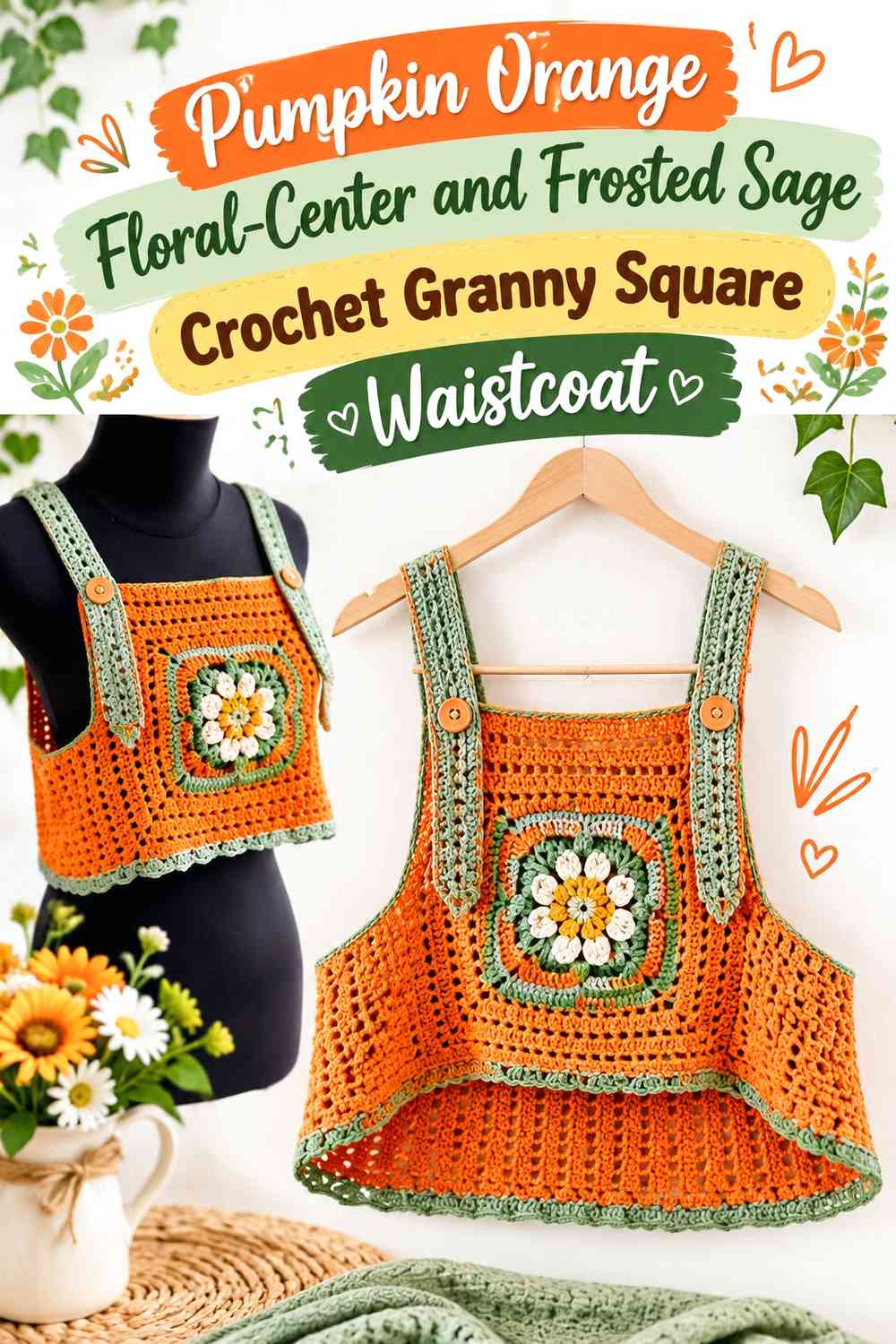
A flower-centered granny motif gives pumpkin orange a natural focal role. Use the warm shade where the eye should first notice the flower and let frosted sage surround or frame it. Because the floral center is repeated across many squares, the amount of orange needed per motif can remain relatively small.
Pumpkin Orange Floral Centers Need Consistent Repetition
Keeping pumpkin orange in the same central role across several motifs turns the flowers into a deliberate pattern rather than a collection of unrelated accents.
Avoid expanding orange into every surrounding round unless you want the flowers to merge visually. Leaving frosted sage around the centers gives each focal point more separation.
Frosted Sage Can Keep Pumpkin Orange Flowers Distinct
Use frosted sage around the flower area or toward the square boundary to create space between neighboring orange centers.
Check several motifs together rather than judging a single square. Floral details that look clear individually can become much busier when repeated across an entire front panel.
Creator Credit: Crochet Anne
12. Frosted Sage Wrap-Style Crochet Granny Square Waistcoat With Pumpkin Orange Anchors
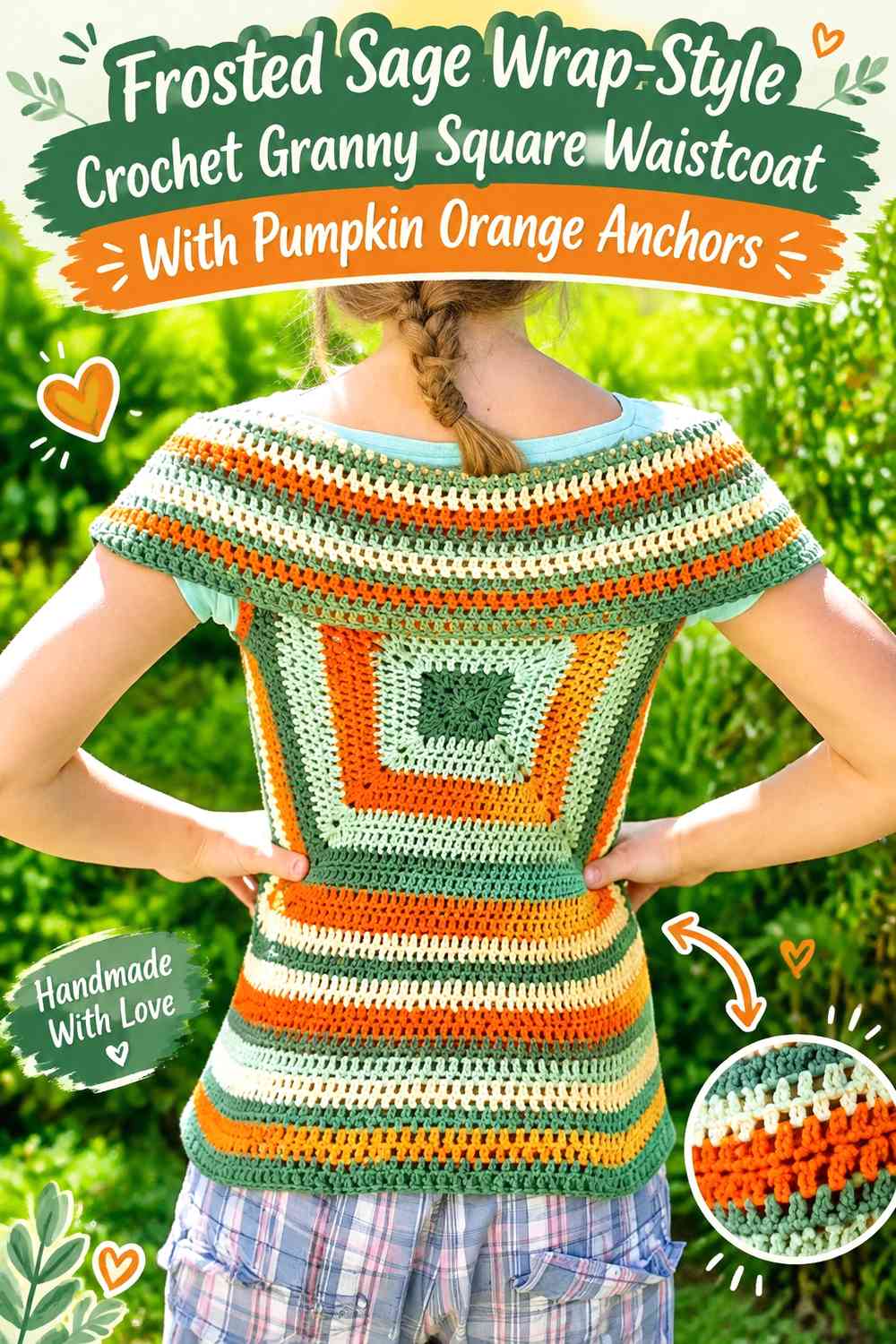
For a larger square or wrap-style waistcoat, let frosted sage occupy much of the uninterrupted fabric and use pumpkin orange at strategic points in the center-out pattern. Because a large motif travels around more of the body, every orange band has greater visual reach than it would in a small-square grid.
Frosted Sage Can Calm a Large Granny Square Waistcoat
Broad frosted-sage sections keep the scale of a giant granny motif readable without making every expanding ring equally prominent.
Consider where those sage sections will fall after the fabric wraps around the body. Color placement that looks centered when the square is flat may move toward the sides once it becomes a garment.
Pumpkin Orange Anchors Should Be Planned Around the Full Square
Place pumpkin orange where it will remain visible from more than one viewing angle. A warm center, selected outer band, or repeated edge can help connect the front and back portions of a wrap-style construction.
Avoid adding orange bands simply to maintain a strict alternating sequence. On a large motif, fewer well-placed orange areas can produce a stronger retro effect than constant color switching.
Creator Credit: Andrea’s Loops
How the Pumpkin Orange and Frosted Sage Waistcoat Ideas Compare
For the strongest pumpkin-orange presence, the orange-led concentric design, orange-frame motifs, orange joining grid, and orange-trim waistcoat put the warm shade where it occupies broad or repeated structural areas.
For a softer overall garment, start with the frosted-sage-led concentric version, sage joining grid, sage body with orange trim, or wrap-style design. These approaches keep more uninterrupted green around the torso while allowing pumpkin orange to remain a deliberate retro accent.
The center-focused versions are useful when you want each granny square to stay individually visible. Joining-grid schemes emphasize the modular construction instead, while mirrored fronts make color placement most noticeable around the opening. The floral idea creates the strongest repeated focal points, so it benefits from more restrained color around each center.
Conclusion
Pumpkin orange and frosted sage can produce very different retro granny square waistcoats without changing the two-color palette. The main decision is where each shade receives visual space.
Choose pumpkin-orange outer rounds, joins, or trim when you want the garment to read warmer from a distance. Give frosted sage those structural roles when you want a quieter green framework around stronger orange accents. For clearly defined motifs, put one shade in the center and the other toward the outside. For a more graphic patchwork effect, change the dominant color from square to square or use one shade for the joining grid.
Before completing a full batch of motifs, place several squares together and look at them as a garment rather than as individual pieces. That small check makes it much easier to see whether pumpkin orange is dominating too strongly, frosted sage is disappearing, or the two colors need a clearer hierarchy. Use the credited tutorials for their original construction guidance while adapting the color placement independently.
Frequently Asked Questions
Should pumpkin orange or frosted sage dominate a retro granny square waistcoat?
Either can lead. Pumpkin orange creates the warmer and more immediately retro direction, while a frosted-sage-led layout produces a more muted garment with orange acting as the focal accent. Decide which color should define the waistcoat from a distance before planning individual square rounds.
How can I stop pumpkin orange from overwhelming frosted sage?
Reduce the number of large orange areas rather than eliminating orange completely. Frosted sage can take over outer rounds, joins, lower motifs, or garment edging while pumpkin orange remains concentrated in centers and selected bands.
How can I make frosted sage more visible beside pumpkin orange?
Give sage a larger continuous area. A broad frosted-sage round, joining grid, or group of sage-led motifs will usually read more clearly than scattering very narrow sage stripes between several orange sections.
Should pumpkin orange or frosted sage be used for the joins?
Use frosted sage when you want calmer separation between warm motifs. Use pumpkin orange when you want the seams themselves to become part of the retro graphic pattern. Test several connected squares first because joining color repeats across a much larger area than it appears to while working one motif.
Can pumpkin orange and frosted sage work without adding cream or brown?
Yes. A two-color scheme can be effective when the shades have clearly defined roles. If the colors are close in light-dark value, use larger blocks and clear placement rather than adding another shade automatically.
How do I check whether pumpkin orange and frosted sage have enough contrast?
Place the yarns side by side and view them from a distance, then check a sample granny square rather than relying only on the loose skeins. A grayscale photo can help reveal light-dark differences that are harder to judge from hue alone.
Should the pumpkin orange and frosted sage layout be identical on the front and back?
Not necessarily. The front can carry stronger contrast while the back remains calmer, or the two panels can reverse the dominant color. Repeat both shades across the shoulder area or selected motifs so the change feels intentional rather than disconnected.