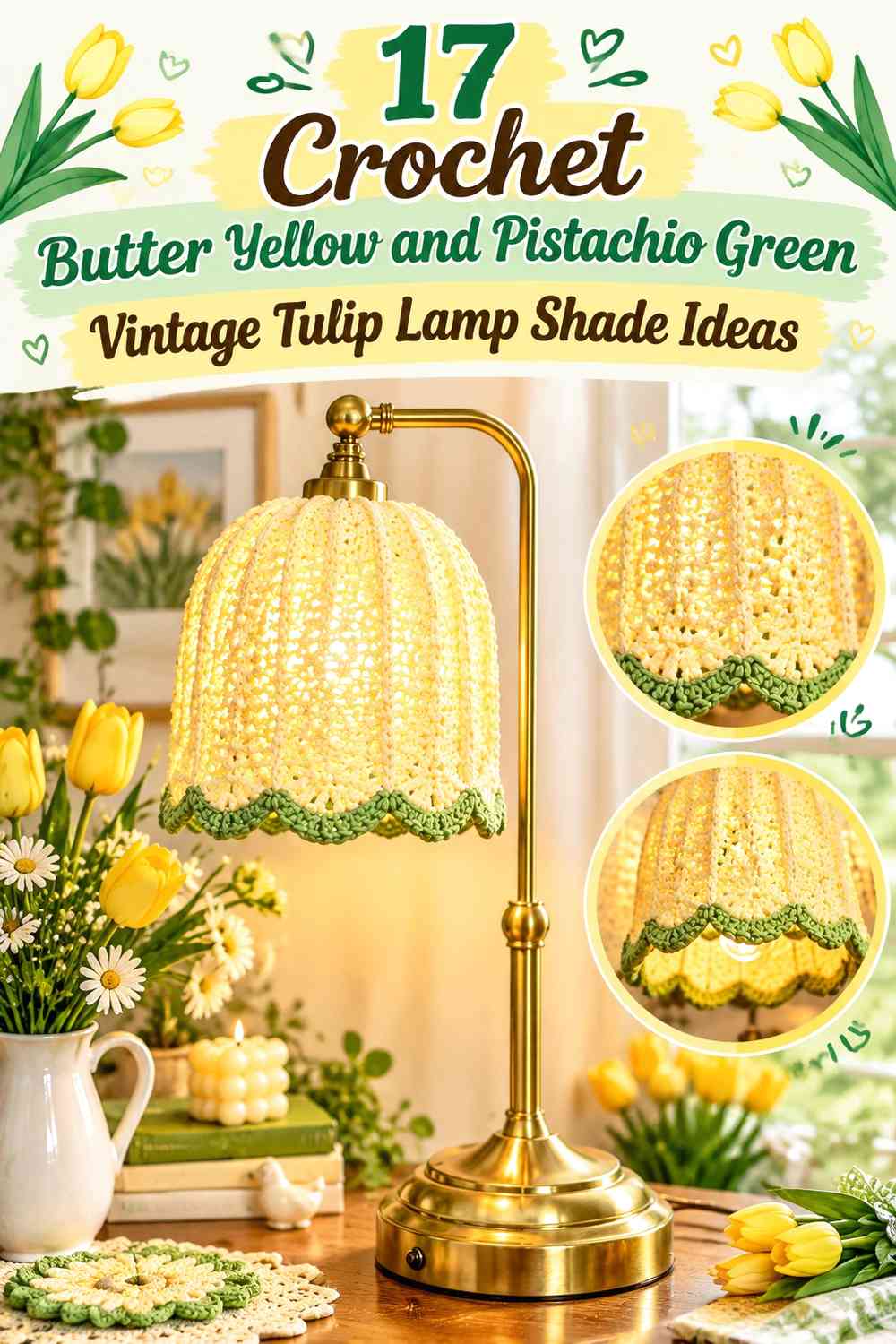

Butter yellow and pistachio green give a crochet tulip lamp shade a soft vintage floral direction without requiring a large spring palette. Butter yellow can form the tulip petals or the main shade field, while pistachio green can define stems, leaves, panel borders, top rings, and lower scallops.
The shape of the lamp shade matters as much as the colors. On a tapered shade, motifs near the bottom have more visual space than those close to the top. A butter-yellow tulip that looks modest on a flat swatch can become a strong focal point once repeated around the widest circumference, while a thin pistachio-green rim can influence the whole design because it circles the shade continuously.
The tutorial sources below include direct crochet lampshade covers plus tulip flowers, tulip granny squares, and floral constructions that can support the decorative concept. The butter-yellow, pistachio-green, vintage, and exact lamp-shade arrangements are independent adaptations.
For an illuminated lamp, treat crochet as decorative covering rather than a heat shield. Follow the lamp and shade manufacturer’s requirements, keep yarn and embellishments safely separated from the bulb and other hot components, and do not assume a particular fiber or stitch is heat-safe.
Quick List
- Butter Yellow Crochet Vintage Tulip Lamp Shade With Pistachio Green Scallops
- Pistachio Green Crochet Floral Lamp Shade With Butter Yellow Tulips
- Butter Yellow Crochet Panelled Tulip Lamp Shade With Pistachio Green Leaves
- Pistachio Green Crochet Lamp Shade With Butter Yellow Dimensional Tulips
- Butter Yellow Tulip Granny-Panel Crochet Lamp Shade With Pistachio Green Frames
- Pistachio Green Tulip Granny-Panel Crochet Lamp Shade With Butter Yellow Centers
- Butter Yellow and Pistachio Green Alternating Crochet Tulip Lamp Shade
- Butter Yellow Upper Crochet Lamp Shade With a Pistachio Green Tulip Garden
- Pistachio Green Upper Crochet Lamp Shade With Butter Yellow Lower Tulips
- Butter Yellow Scalloped Crochet Lamp Shade With Pistachio Green Tulip Stems
- Pistachio Green Openwork Crochet Lamp Shade With Butter Yellow Tulip Appliqués
- Butter Yellow Crochet Lamp Shade With a Pistachio Green Tulip Crown
- Pistachio Green Crochet Lamp Shade With a Butter Yellow Tulip Bouquet Cluster
- Butter Yellow Geometric Tulip Crochet Lamp Shade With Pistachio Green Borders
- Butter Yellow Crochet Lamp Shade Framed in Pistachio Green
- Pistachio Green Tulip-Stitch Crochet Lamp Shade With Butter Yellow Buds
- Butter Yellow and Pistachio Green Split-Panel Crochet Tulip Lamp Shade
Let Butter Yellow and Pistachio Green Follow the Lamp Shade Shape
A lamp shade is rarely a completely flat colorwork surface. Drum shades keep a similar circumference from top to bottom, while tapered shades give lower motifs considerably more room.
Plan the largest butter-yellow tulips or pistachio-green leaves where the shade has enough width for them to remain recognizable. Smaller floral details can move toward the top without making the upper area feel overcrowded.
Use Pistachio Green to Separate Butter Yellow Tulips
Several butter-yellow petals placed side by side can visually merge, especially when the underlying shade is also pale. Pistachio-green leaves, stems, borders, or visible background areas can give each bloom a clearer boundary.
If the actual yellow and green yarns are close in light-dark value, increase the amount of uninterrupted green around the petals rather than adding another color automatically.
Check Butter Yellow and Pistachio Green With the Lamp Off and On
Crochet color can look different when light passes through or around an existing shade. Openwork also exposes more of the underlying shade than dense crochet does.
Evaluate the finished sample with the lamp switched off first, then only use it on an illuminated lamp if the original shade, bulb clearance, and manufacturer’s guidance make the decorative cover appropriate. Color decisions should never override safe lamp construction.
1. Butter Yellow Crochet Vintage Tulip Lamp Shade With Pistachio Green Scallops
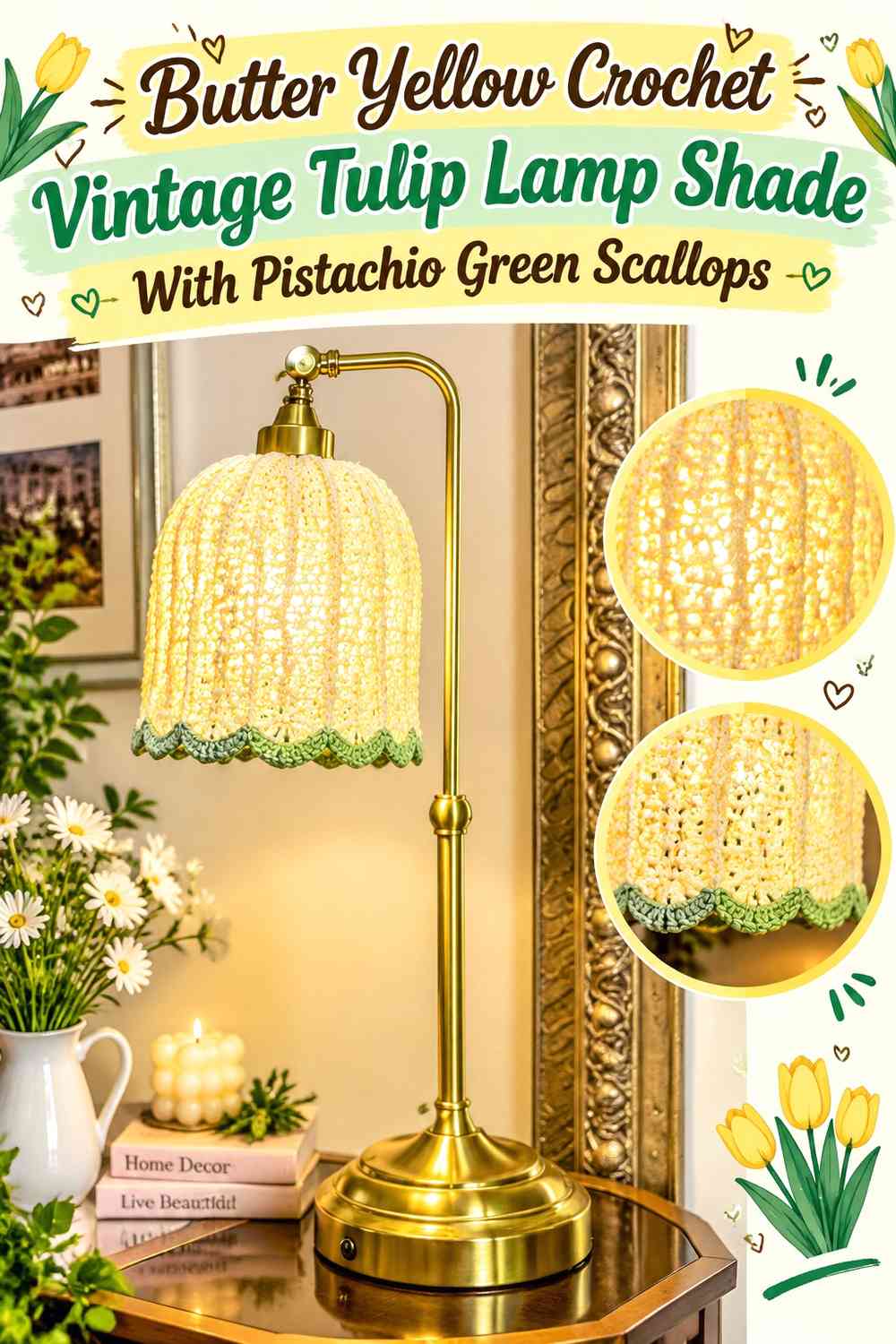
Let butter yellow cover most of the lampshade body and place pistachio green around the lower scalloped edge. This creates a warm vintage field with a botanical finish at the widest part of the shade, where the contrasting green is easiest to see.
Butter Yellow Should Carry the Main Vintage Lamp Shade Surface
Use butter yellow across a broad uninterrupted area when you want the shade to feel light and floral before the tulip details are added.
Keeping the main body consistent also allows openwork, crossed stitches, or another vintage-looking surface texture to provide variation without too many color changes.
Pistachio Green Can Ground the Butter Yellow Lower Scallops
Use pistachio green around the bottom where it can define each scallop and give the pale shade a clearer stopping point.
Because the lower circumference may be the widest section, even a relatively narrow green edge can have substantial visual impact.
Creator Credit: The Stitch Sessions – Crochet & Conversation
2. Pistachio Green Crochet Floral Lamp Shade With Butter Yellow Tulips
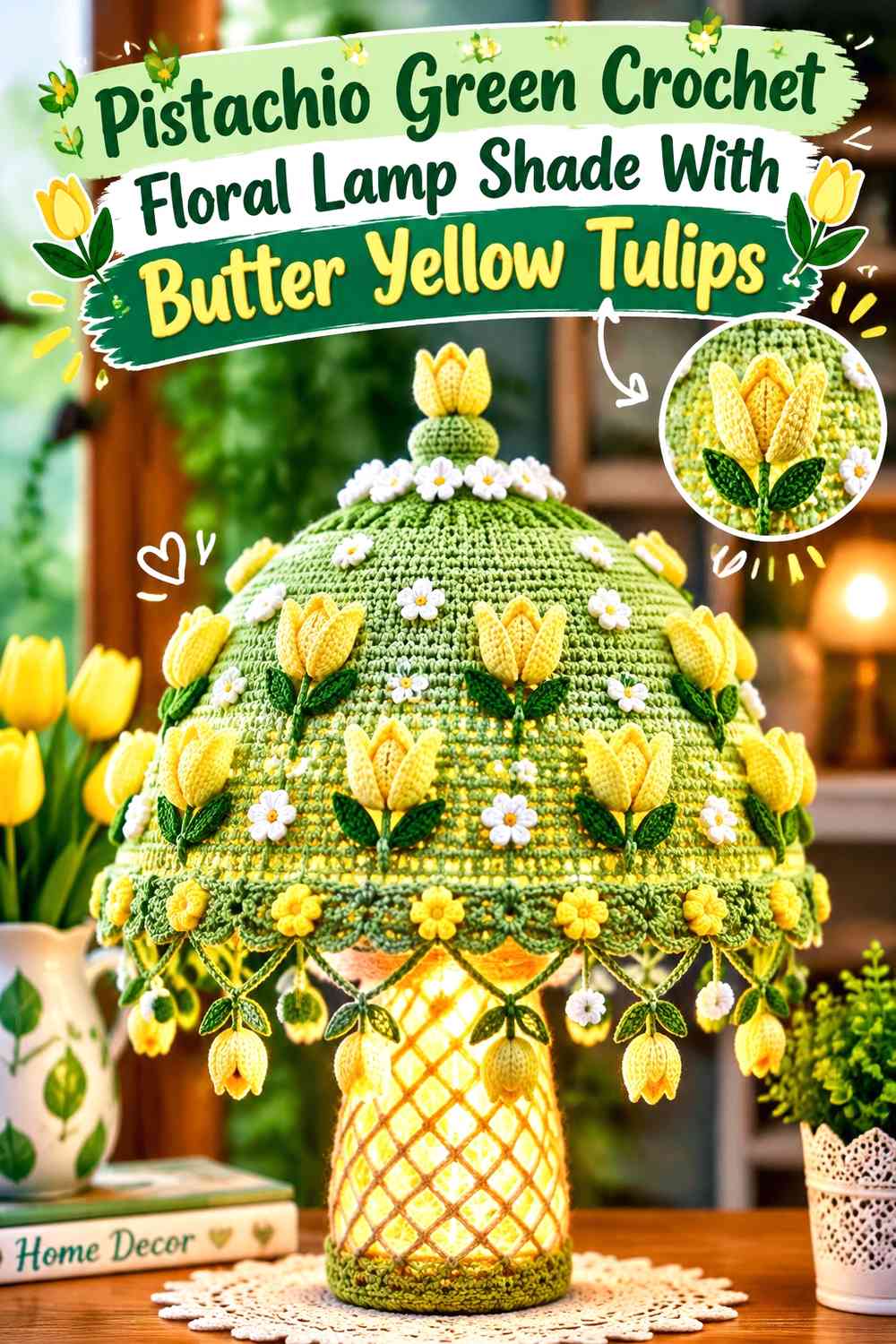
Use pistachio green across most of the floral shade and make butter-yellow tulip flowers the obvious decorative focal points. The green background connects the entire lampshade while the repeated yellow blooms create a vintage garden effect.
Butter Yellow Tulips Need Pistachio Green Space Around Them
Avoid overlapping every yellow flower if you want individual tulip forms to remain recognizable.
Leave enough green between neighboring blooms for the petals to read as separate motifs instead of becoming one continuous yellow floral mass.
Pistachio Green Should Connect the Butter Yellow Flowers Around the Shade
Use green consistently between and behind the tulips so the floral cover still looks cohesive from every angle.
Check the complete circumference rather than decorating only the front. A lamp shade may be seen from several sides depending on its placement.
Creator Credit: Throne Talk
3. Butter Yellow Crochet Panelled Tulip Lamp Shade With Pistachio Green Leaves

Use butter yellow for broad shade panels and incorporate pistachio-green leaves beside or beneath individual tulip motifs. This gives the shade a vintage botanical look without covering every panel in equal amounts of both colors.
Butter Yellow Panels Should Stay Broad Around Pistachio Green Leaves
Protect enough uninterrupted yellow for the panel structure to remain visible.
If green leaves spread too far across every section, the shade can begin to look green-led rather than like a yellow floral lamp with botanical accents.
Pistachio Green Leaves Can Clarify Butter Yellow Tulip Shapes
Use green immediately below or beside the flower heads where the leaves naturally give the petals separation.
Repeat the leaf placement consistently enough for the tulips to look related, while allowing small variations in angle so the shade does not feel mechanically identical from panel to panel.
Creator Credit: The Thread Nook
4. Pistachio Green Crochet Lamp Shade With Butter Yellow Dimensional Tulips
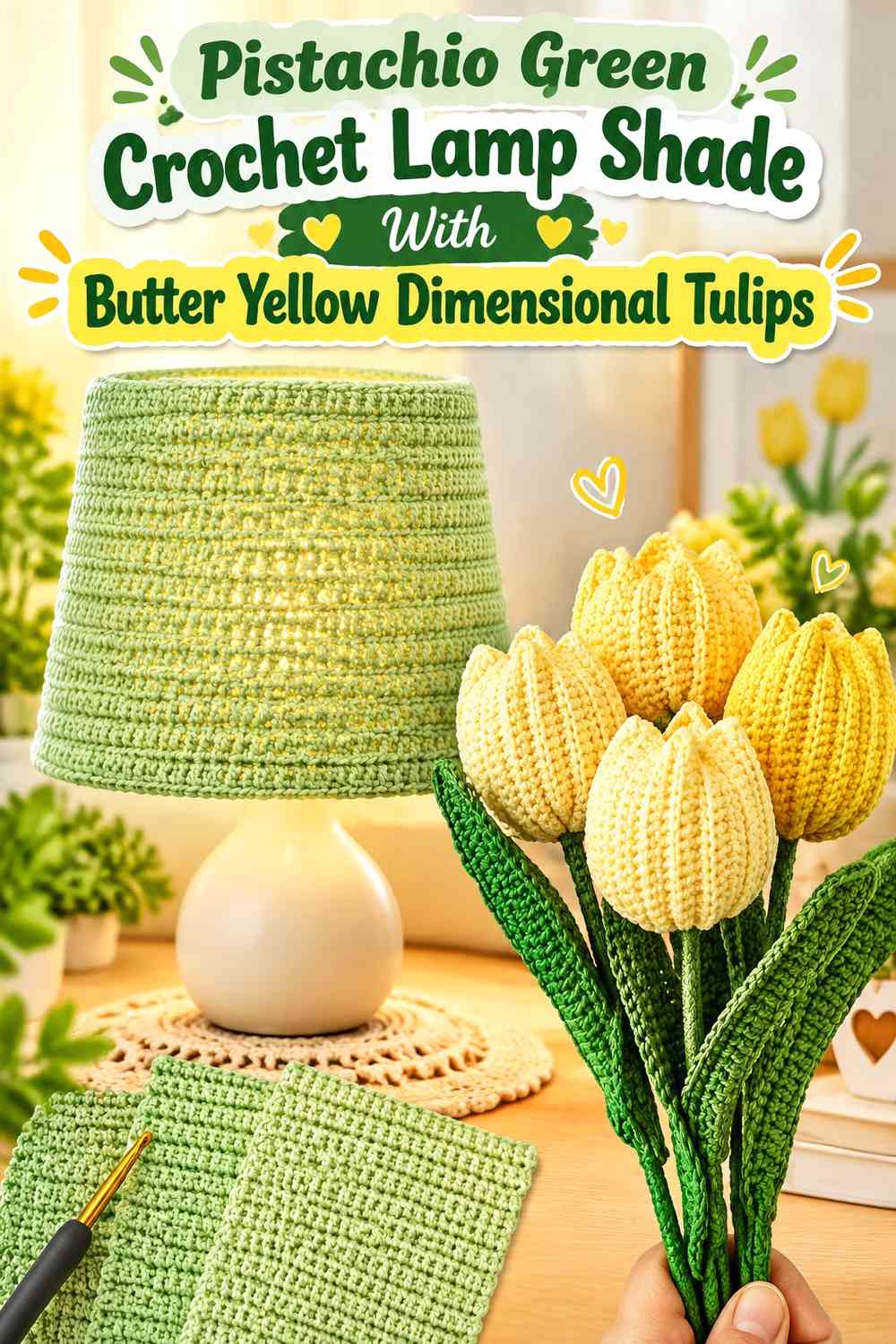
Make the lamp shade predominantly pistachio green and attach or incorporate dimensional butter-yellow tulips at selected points. Because raised motifs create extra visual depth, fewer flowers may be needed than on a flat appliqué design.
Butter Yellow Dimensional Tulips Need Clear Pistachio Green Background
Give each flower enough visible green around its outer petals so the three-dimensional shape remains easy to distinguish.
Crowding several raised flowers together can make both color and texture feel heavier than expected.
Pistachio Green Should Remain Calm Behind Butter Yellow Tulips
Keep the shade body relatively simple if the flowers themselves are highly dimensional.
A quiet green surface prevents openwork, raised tulips, contrasting borders, and multiple textures from all competing at once.
Creator Credit: Crochet Craftsman
5. Butter Yellow Tulip Granny-Panel Crochet Lamp Shade With Pistachio Green Frames
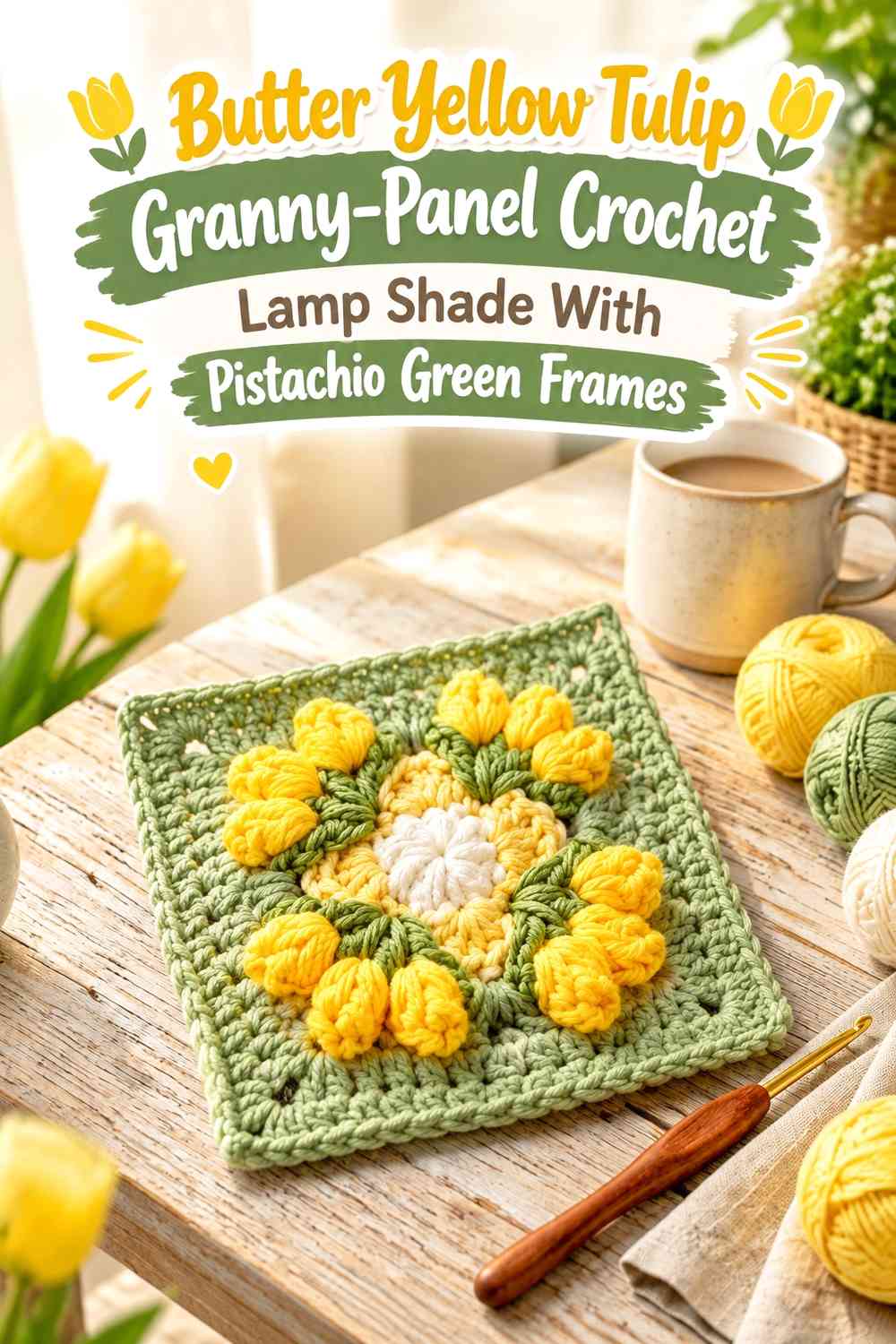
Build the decorative surface from tulip granny squares or square-inspired panels. Use butter yellow in the flower areas and pistachio green around the outer rounds so every motif has a botanical frame.
Butter Yellow Tulips Need Consistent Positions Inside Pistachio Green Panels
Keep the main flower placement related from panel to panel so the lamp shade develops a clear repeated rhythm around its circumference.
On a tapered shade, check whether square motifs need spacing between them rather than forcing identical panels onto areas with different widths.
Pistachio Green Frames Can Connect Butter Yellow Granny Panels
Use the same green near the edges and joins so separate floral squares look like one shade cover rather than unrelated patches.
A green outer framework is particularly helpful when several butter-yellow flowers sit close together around the widest part of the shade.
Creator Credit: Crochet By Gillian
6. Pistachio Green Tulip Granny-Panel Crochet Lamp Shade With Butter Yellow Centers
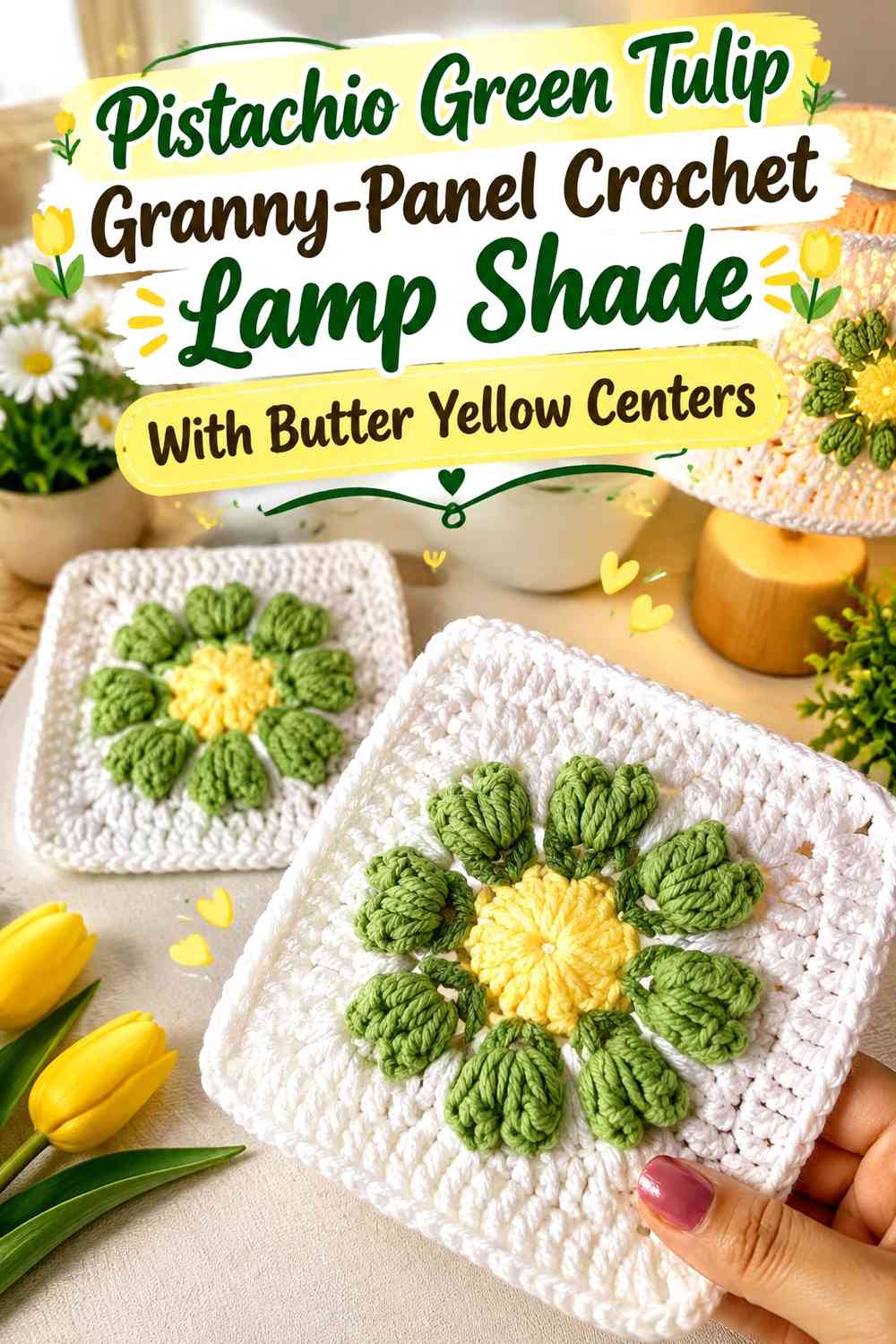
Reverse the motif hierarchy with pistachio green occupying more of each panel and butter yellow concentrated toward the tulip centers. This gives the shade a calmer green appearance with small repeated warm focal points.
Butter Yellow Centers Should Remain Visible Inside Pistachio Green Motifs
Give the yellow sections enough area to survive the transition from flat square to curved lamp-shade surface.
Extremely small centers may disappear from normal room-viewing distance even when they look clear in the hand.
Pistachio Green Can Unite the Butter Yellow Tulip Panels
Allow green to continue through outer rounds and joins so neighboring motifs share a consistent field.
This gives the shade more visual continuity than changing both the flower and frame arrangement in every panel.
Creator Credit: Crochet Mili
7. Butter Yellow and Pistachio Green Alternating Crochet Tulip Lamp Shade
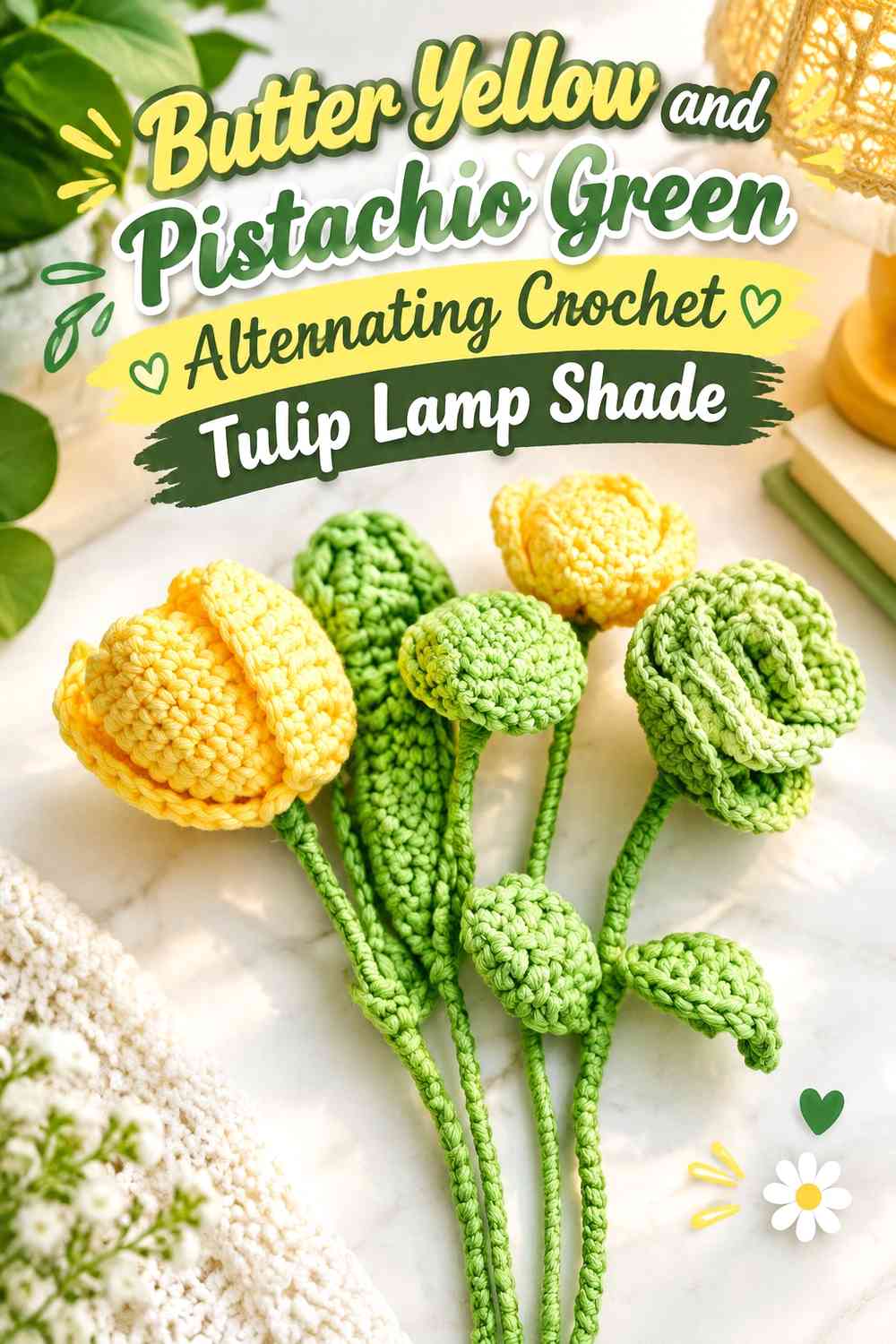
Alternate larger sections of butter yellow and pistachio green rather than changing color inside every tiny stitch. The broad rhythm gives both shades enough space to remain readable around the shade and can create a distinctly vintage striped-floral effect.
Butter Yellow Sections Need Enough Width Beside Pistachio Green
Use broad yellow areas so tulip petals or floral texture do not become compressed into narrow bands.
This is especially important on smaller lamp shades where too many stripes can make the whole surface look busy.
Pistachio Green Should Repeat With a Clear Butter Yellow Rhythm
Keep the green sections related in width or placement so the alternating design appears planned.
If one section must become narrower because of shaping, balance it visually elsewhere rather than forcing perfectly equal stripes around a tapered surface.
Creator Credit: Trendy Mami
8. Butter Yellow Upper Crochet Lamp Shade With a Pistachio Green Tulip Garden
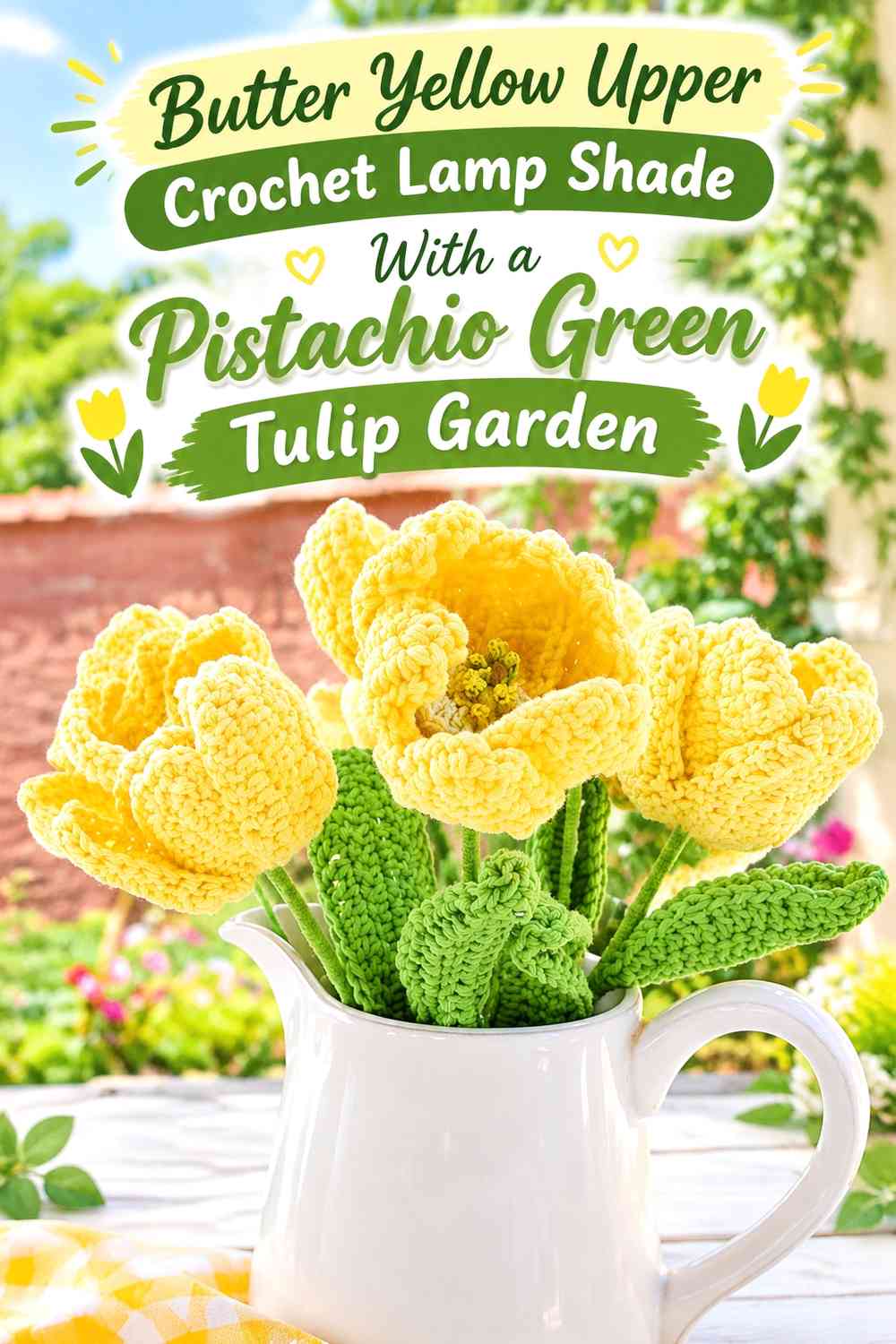
Use butter yellow across the upper half and develop a pistachio-green botanical field closer to the bottom, where small butter-yellow tulips can rise from the greenery. This creates a garden-at-the-base composition rather than repeating flowers evenly everywhere.
Pistachio Green Can Build a Garden Beneath Butter Yellow
Give the lower green area enough height for stems and leaves to form a recognizable botanical zone.
A very narrow green stripe will look more like edging than a tulip garden.
Butter Yellow Tulips Can Rise Out of the Pistachio Green Lower Field
Repeat butter yellow from the upper body into the flower heads so the two color zones remain connected.
Keep some green visible between the tulip blooms so the flowers do not merge with the large yellow section above.
Creator Credit: Moara Crochet
9. Pistachio Green Upper Crochet Lamp Shade With Butter Yellow Lower Tulips
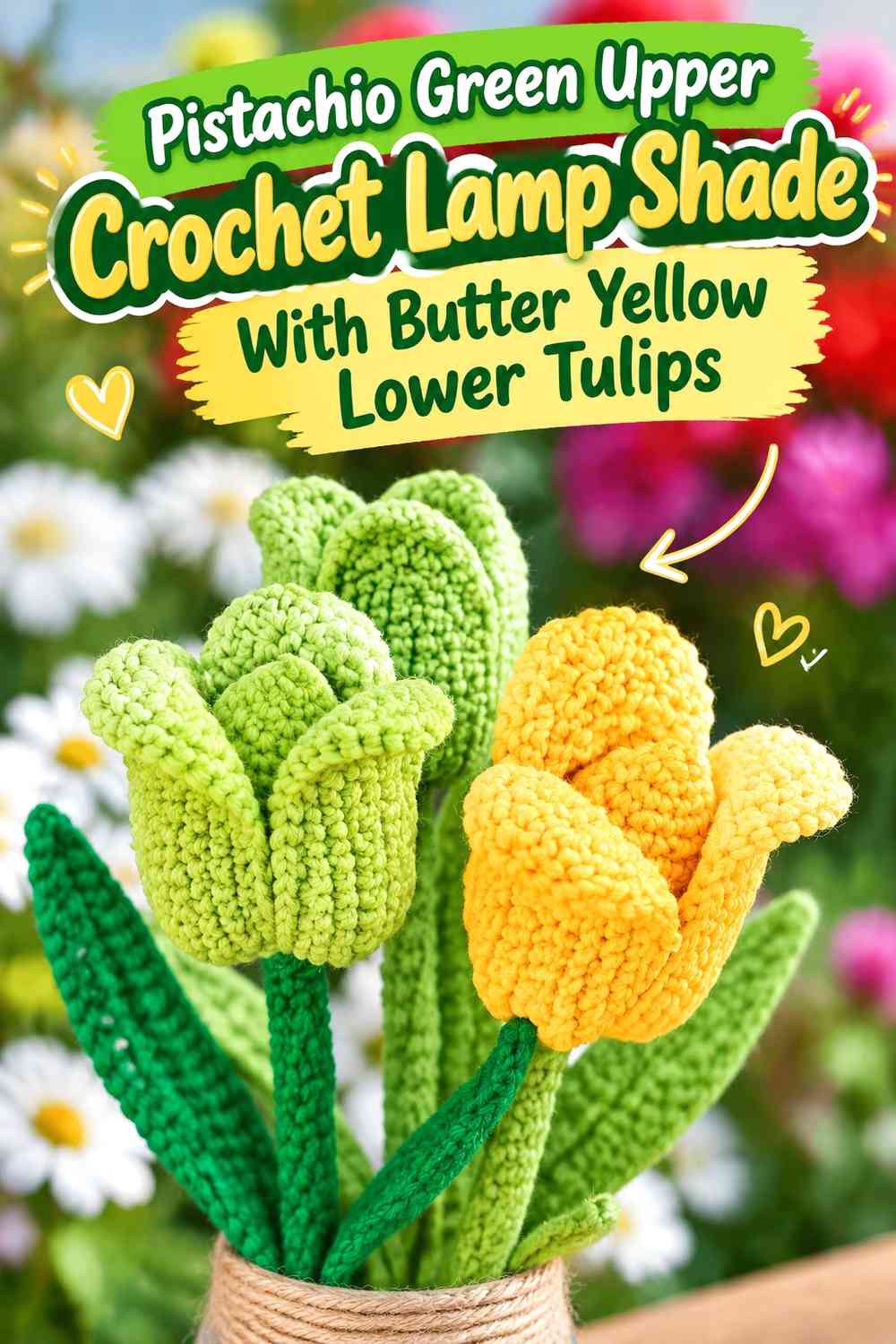
Reverse the previous arrangement by using pistachio green across the upper shade and concentrating butter-yellow tulips near the wider bottom. The lower flowers become more prominent because they occupy the area with the most circumference.
Butter Yellow Tulips Can Use the Wider Pistachio Green Lower Area
Place the largest floral details where the shade gives them enough horizontal room.
If the bottom circumference is substantially wider than the top, distribute the flowers based on visible spacing rather than assuming the same motif count would fit every horizontal band.
Pistachio Green Should Stay Continuous Above Butter Yellow Flowers
Keep the upper area relatively quiet so the lower tulip row remains the intentional focal feature.
A small green border below the flowers can also keep the yellow motifs from visually falling off the bottom edge.
Creator Credit: Crocket Crochet
10. Butter Yellow Scalloped Crochet Lamp Shade With Pistachio Green Tulip Stems
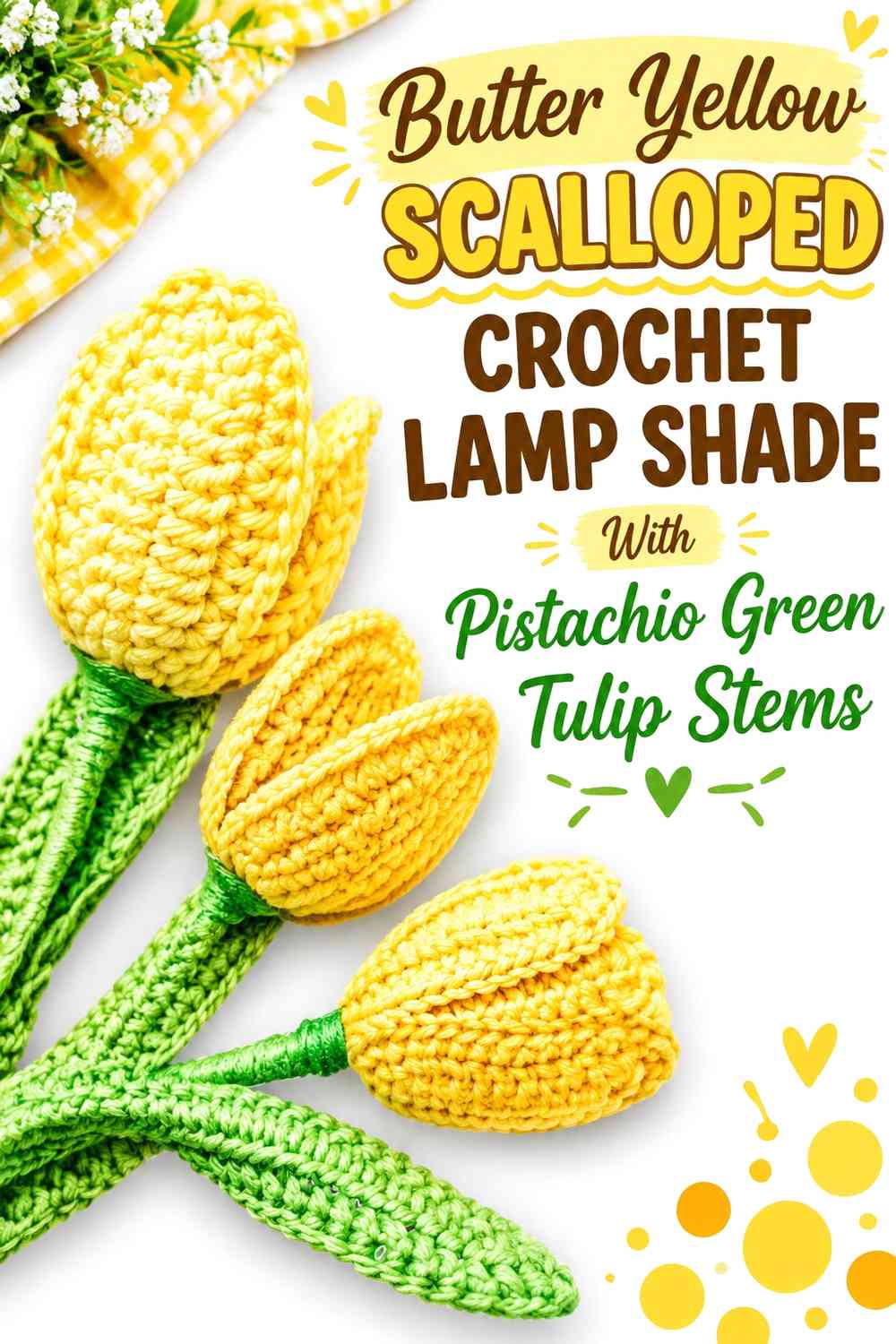
Let butter yellow form the body and lower scallops while pistachio green appears as upward-growing stems and leaves. This makes the botanical lines part of the vertical structure instead of using green only around the border.
Pistachio Green Stems Can Lead the Eye Through Butter Yellow
Use selected vertical green lines to connect the lower edge to tulip heads placed higher on the shade.
Keep the stems sufficiently separated so they look botanical rather than like regular green pinstripes.
Butter Yellow Scallops Should Remain Visible Between Pistachio Green Stems
Leave enough yellow at the lower edge for the scalloped shape to remain clear.
If every scallop is heavily outlined in green, the pistachio detail can overwhelm the softer vintage finish.
Creator Credit: The Crochet Circle
11. Pistachio Green Openwork Crochet Lamp Shade With Butter Yellow Tulip Appliqués
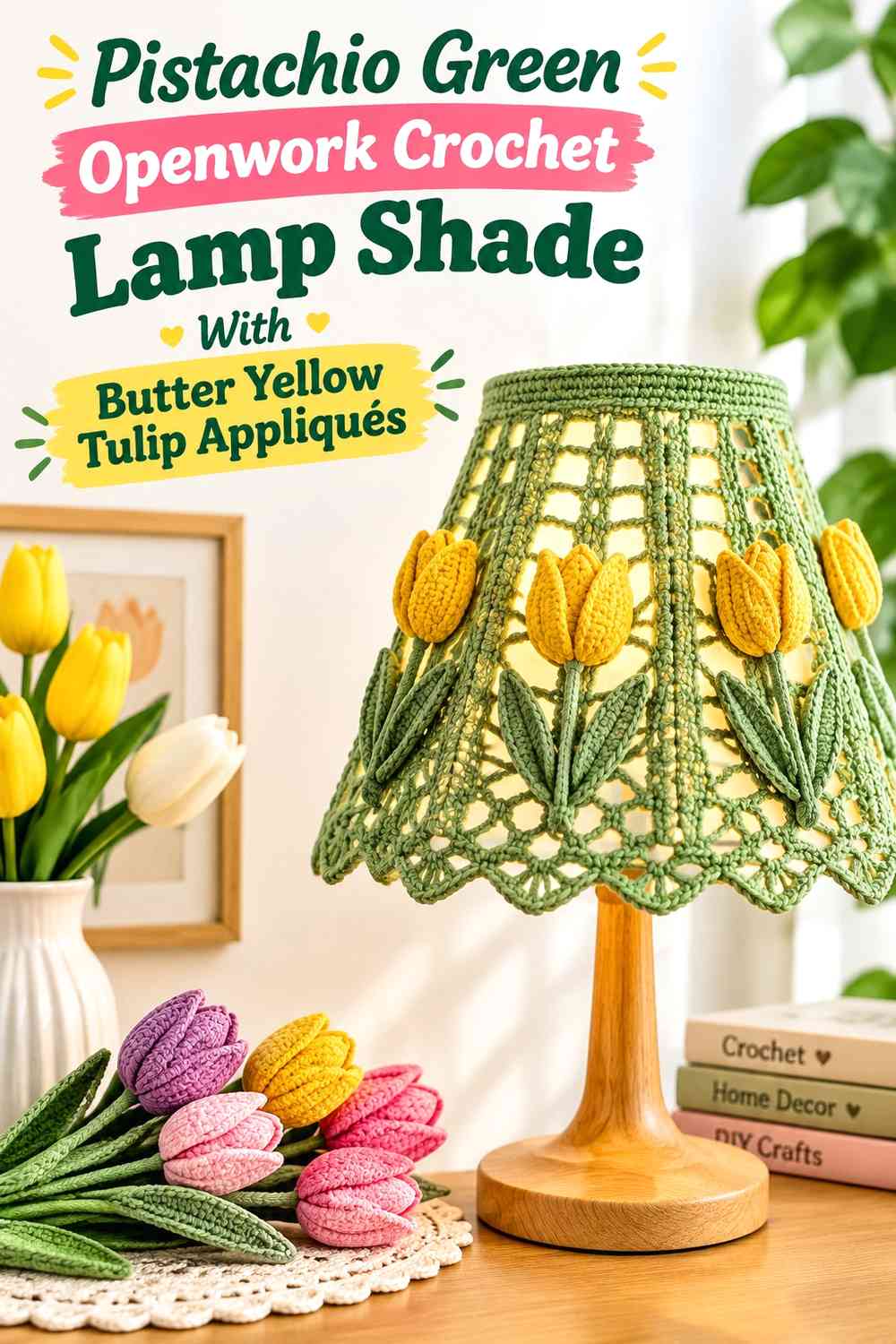
Use pistachio green for an airy openwork cover and place butter-yellow tulip motifs on selected solid areas or frame sections. This is a lighter-looking option because more of the underlying shade remains visible through the crochet.
Butter Yellow Appliqués Need Solid Pistachio Green Placement Areas
Avoid positioning a detailed flower where most of it sits over large open spaces unless the construction clearly supports that attachment.
A more stable green area gives the tulip a cleaner background and helps preserve its shape.
Pistachio Green Openwork Should Stay Visible Around Butter Yellow Tulips
Do not cover every gap with another floral motif. The negative space is part of what distinguishes this idea from a dense flower-covered shade.
A few yellow tulips can create enough vintage botanical character when the green lace already supplies substantial texture.
Creator Credit: Hookok
12. Butter Yellow Crochet Lamp Shade With a Pistachio Green Tulip Crown
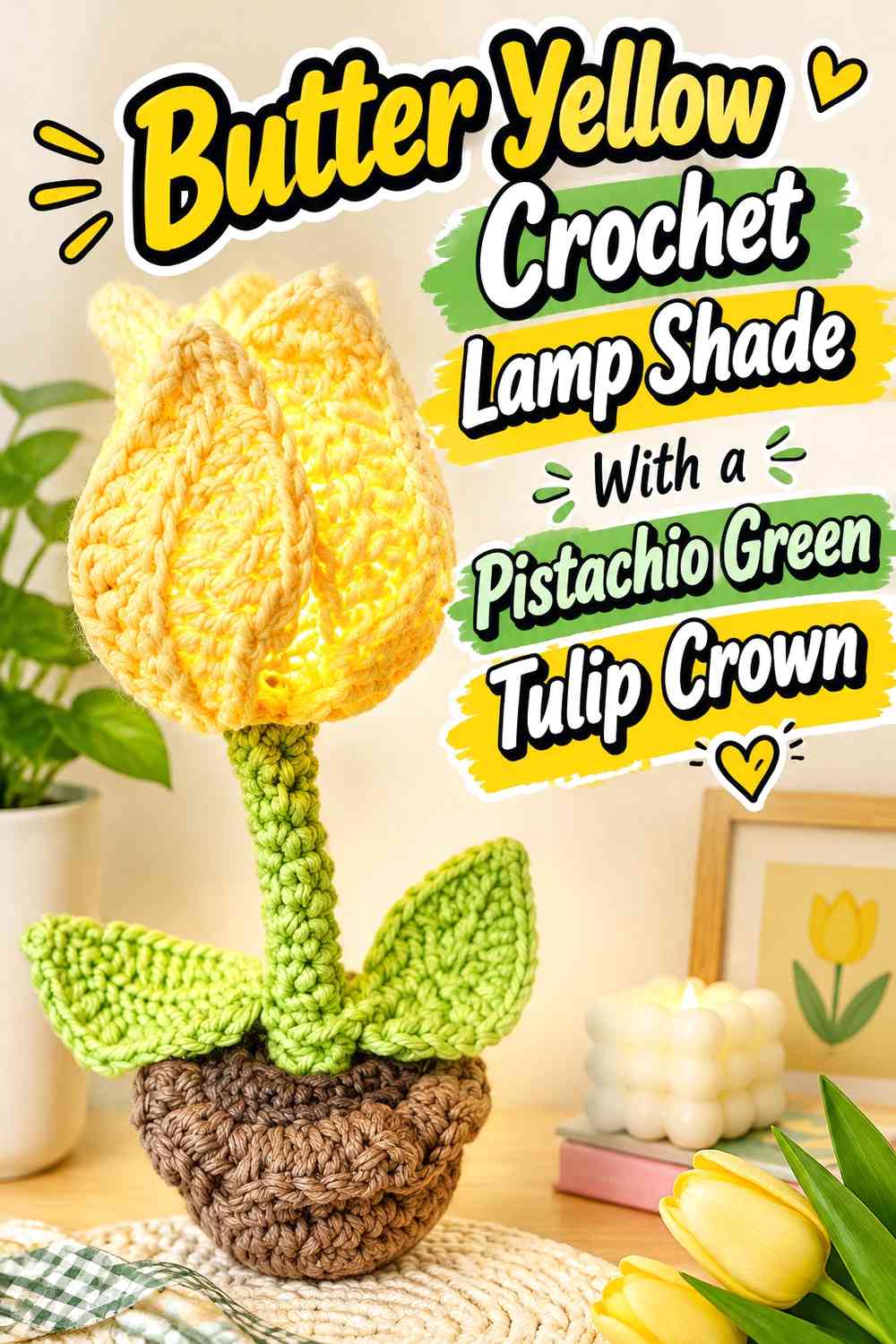
Place most of the lamp shade in butter yellow and arrange a row of pistachio-green leaves with yellow tulip forms near the upper rim. The decorative crown draws attention upward instead of concentrating every floral detail around the bottom.
Pistachio Green Can Define the Butter Yellow Upper Tulip Crown
Use green leaves or small framing sections between adjacent flowers so the yellow blooms do not disappear into the yellow body.
The green division is especially useful when the flower heads share the same butter-yellow shade as the main lamp cover.
Butter Yellow Needs a Clear Break Below the Pistachio Green Crown
Leave an uninterrupted yellow area beneath the floral row so the crown remains distinct.
If additional pistachio green is needed, repeat it in a narrow lower border rather than extending leaves down the entire shade.
Creator Credit: Pocket Yarnlings
13. Pistachio Green Crochet Lamp Shade With a Butter Yellow Tulip Bouquet Cluster
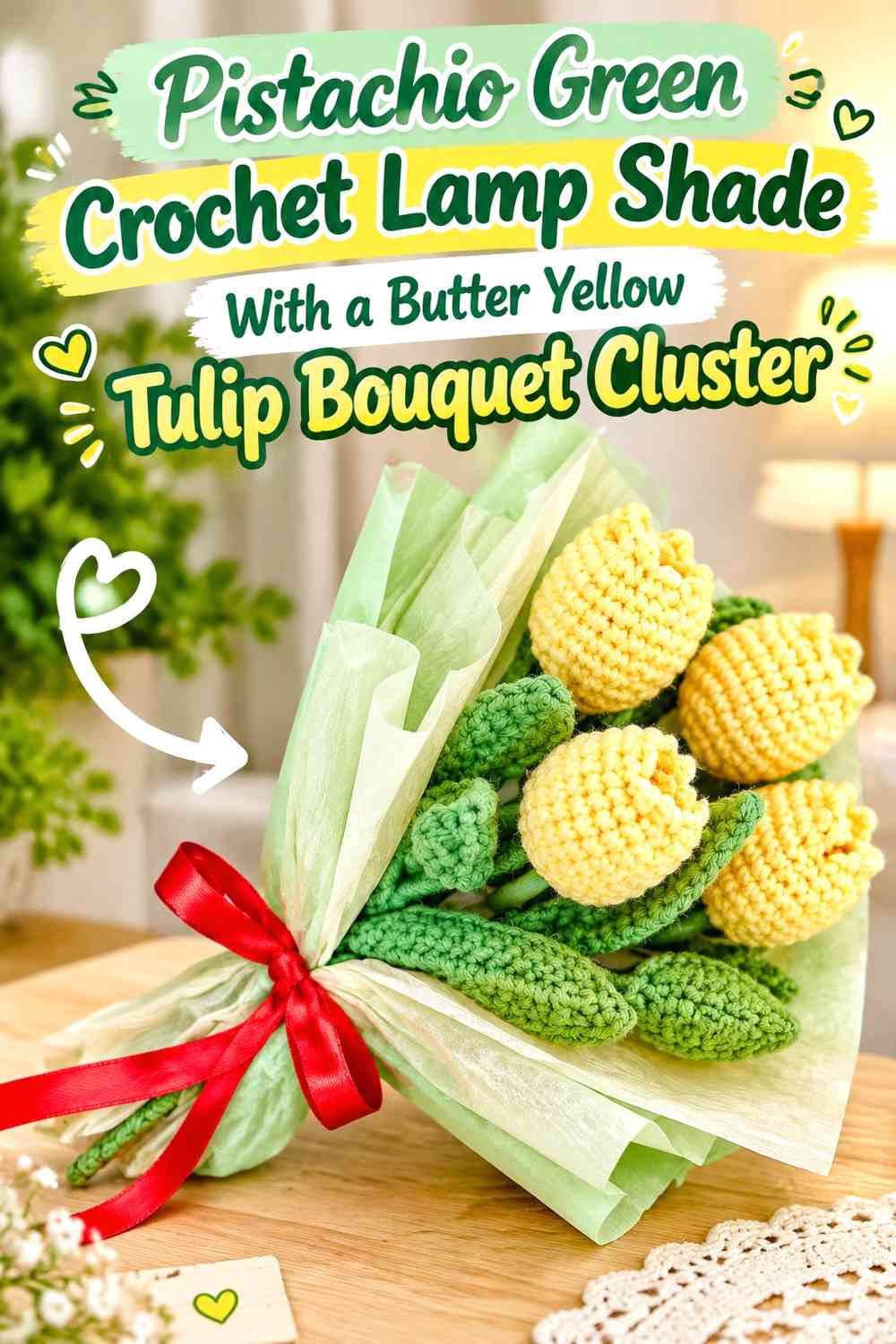
Instead of distributing flowers evenly, group several butter-yellow tulips into one bouquet-like cluster on a pistachio-green shade. The asymmetrical treatment creates a vintage decorative focal area while leaving much of the lamp cover quiet.
Butter Yellow Tulips Should Form a Clear Cluster Against Pistachio Green
Vary the flower heights or positions slightly so the bouquet does not resemble a rigid horizontal row.
Keep enough green visible between larger flower heads for individual tulip silhouettes to remain recognizable.
Pistachio Green Can Balance the Butter Yellow Bouquet With Open Space
Allow the opposite side of the shade to remain substantially calmer.
If the cluster feels too heavy from the front, repeat a much smaller yellow detail elsewhere instead of duplicating the full bouquet on every side.
Creator Credit: DidyToys
14. Butter Yellow Geometric Tulip Crochet Lamp Shade With Pistachio Green Borders
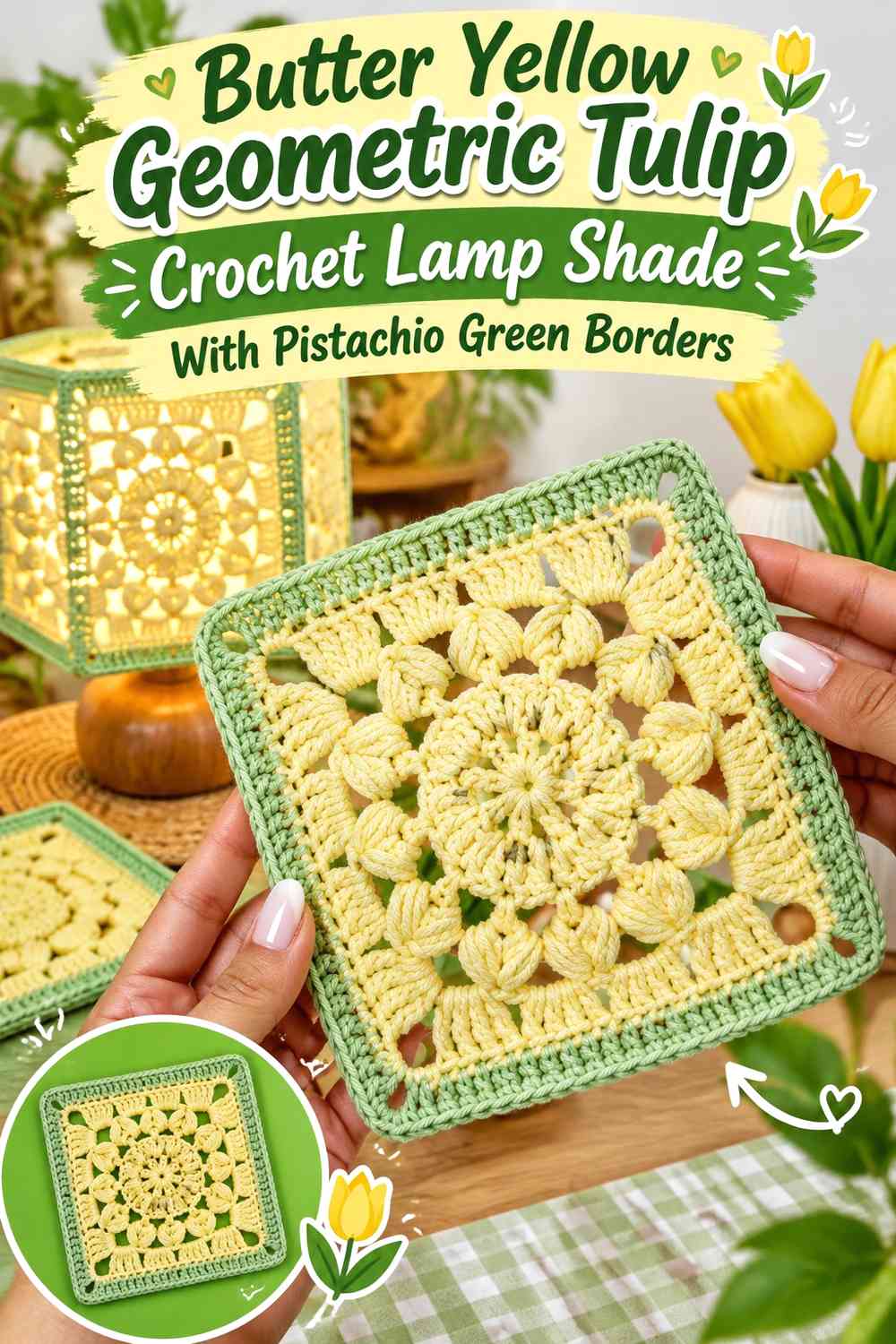
Use tulip granny-square or block-style motifs to create a more geometric vintage shade. Butter yellow can form the flower centers while pistachio green separates the blocks and outlines the upper and lower boundaries.
Butter Yellow Tulip Blocks Need Clear Pistachio Green Separation
Leave a green border between motifs so adjacent yellow flowers do not combine into one continuous band.
This is particularly useful when the lamp shade is small and only a few motif repeats fit around the circumference.
Pistachio Green Borders Can Organize Butter Yellow Geometric Panels
Use green consistently at the joins or outer rounds to create one visual framework.
If the joins already provide substantial green, keep the top and bottom edging narrower so the frame does not become heavier than the flower panels.
Creator Credit: Sirin’s Crochet
15. Butter Yellow Crochet Lamp Shade Framed in Pistachio Green
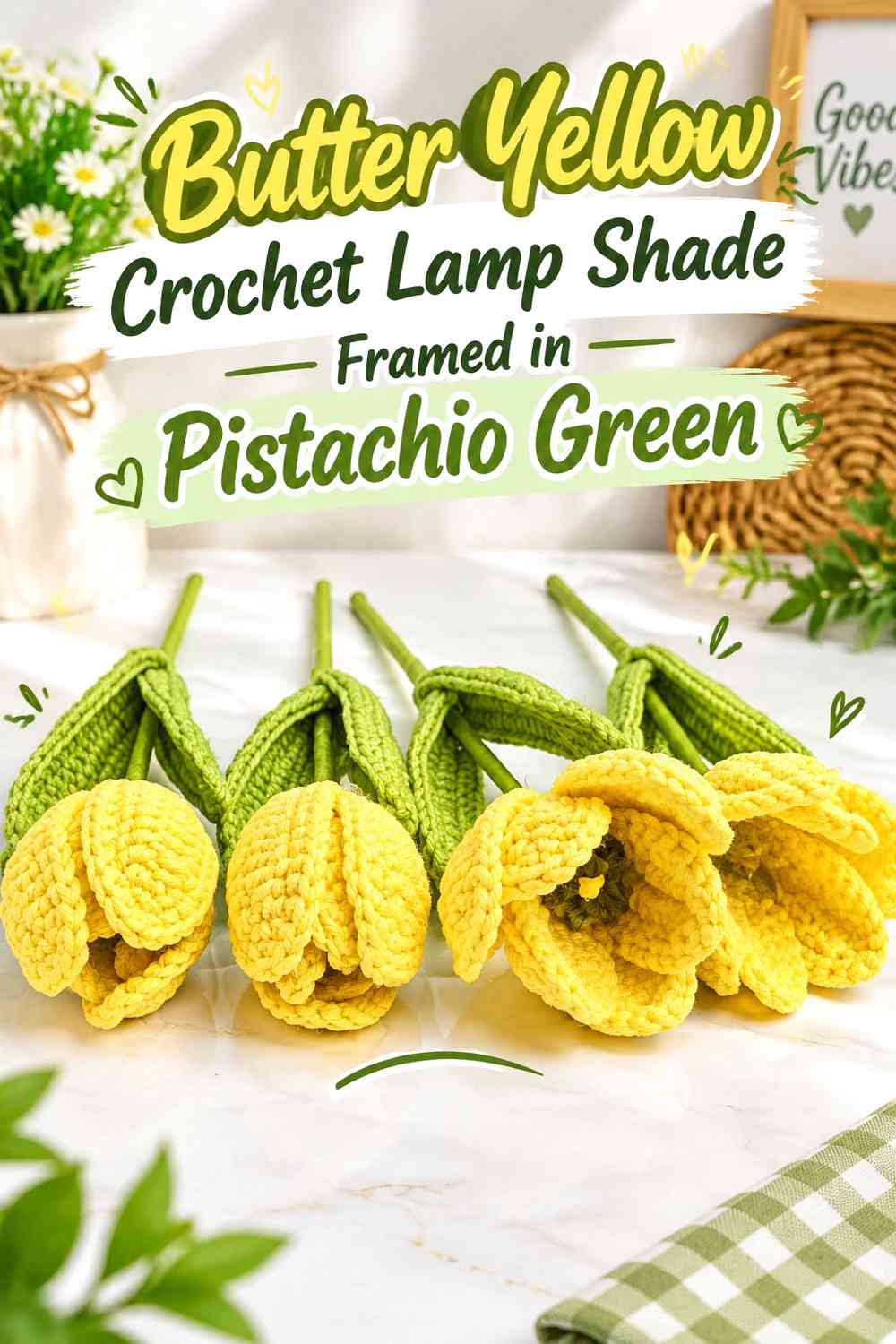
Keep the central shade almost entirely butter yellow and place pistachio green around both the upper and lower rings. Tulip details can remain subtle within the yellow field because the dark-enough green frame already establishes the botanical palette.
Pistachio Green Can Frame Butter Yellow at Both Lamp-Shade Edges
Repeat green at the top and bottom to give the pale body a deliberate boundary.
The two borders do not need equal depth. A slightly stronger lower border can visually anchor a tapered shade while a narrow upper rim keeps the top light.
Butter Yellow Should Stay Broad Between Pistachio Green Frames
Protect enough uninterrupted yellow so the shade does not become compressed between two green sections.
Use tulip texture or small petal details inside that broad field instead of another large color block.
Creator Credit: Mayelin Ros
16. Pistachio Green Tulip-Stitch Crochet Lamp Shade With Butter Yellow Buds
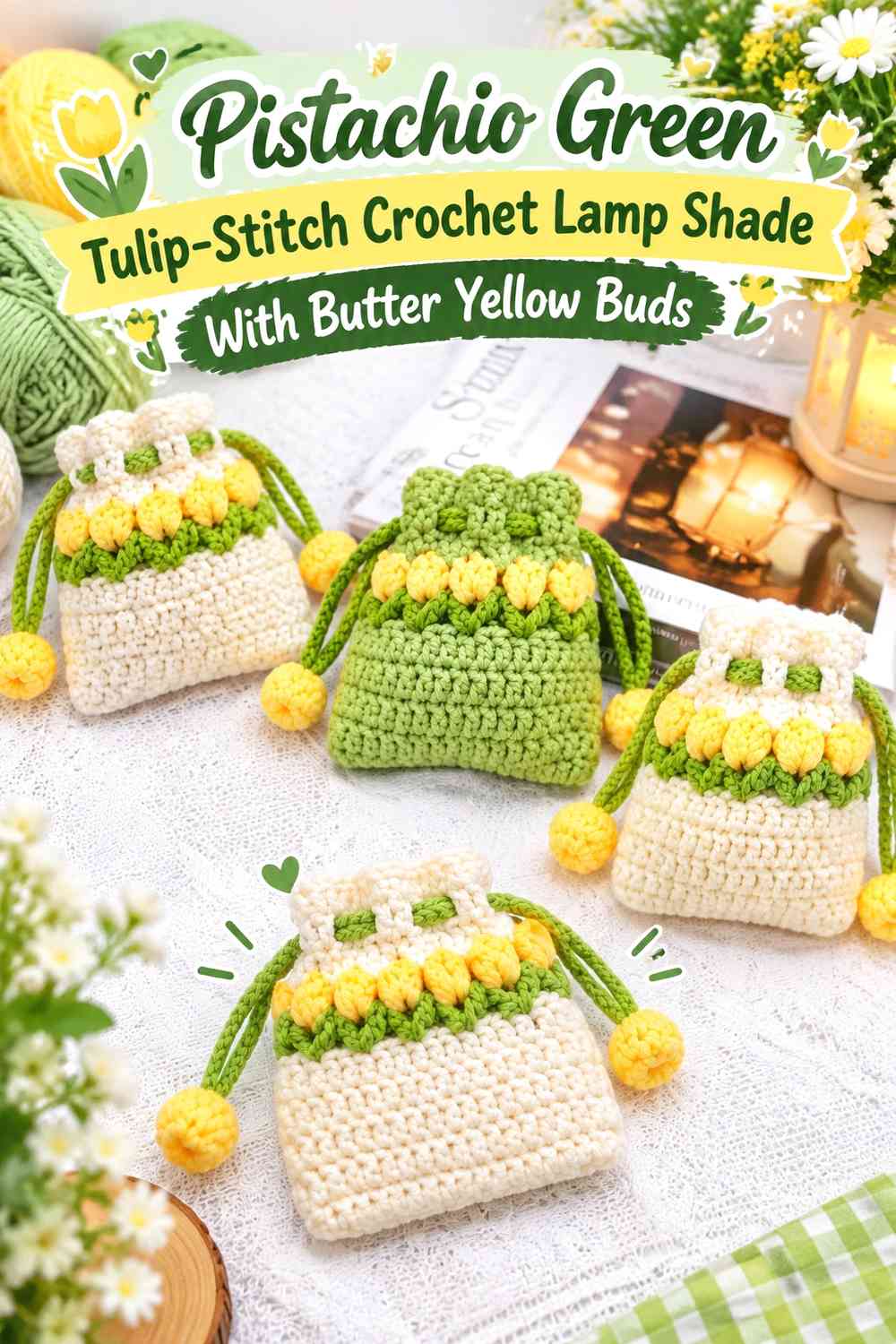
Use pistachio green as the field and create repeated butter-yellow tulip-inspired buds or floral stitch details across the surface. Unlike attached dimensional flowers, this approach makes the tulips part of the fabric itself.
Butter Yellow Buds Need Enough Pistachio Green Between Them
Space the yellow floral repeats so each bud remains recognizable instead of forming an almost continuous yellow band.
The vertical or staggered repetition can create a vintage wallpaper effect when the green field remains clearly visible.
Pistachio Green Should Connect Every Butter Yellow Tulip Repeat
Keep the stems, background, or surrounding fabric consistently green.
A strong green field is what turns the repeated yellow details into a garden pattern rather than a conventional striped shade.
Creator Credit: Thao’s Homemade Crochet
17. Butter Yellow and Pistachio Green Split-Panel Crochet Tulip Lamp Shade
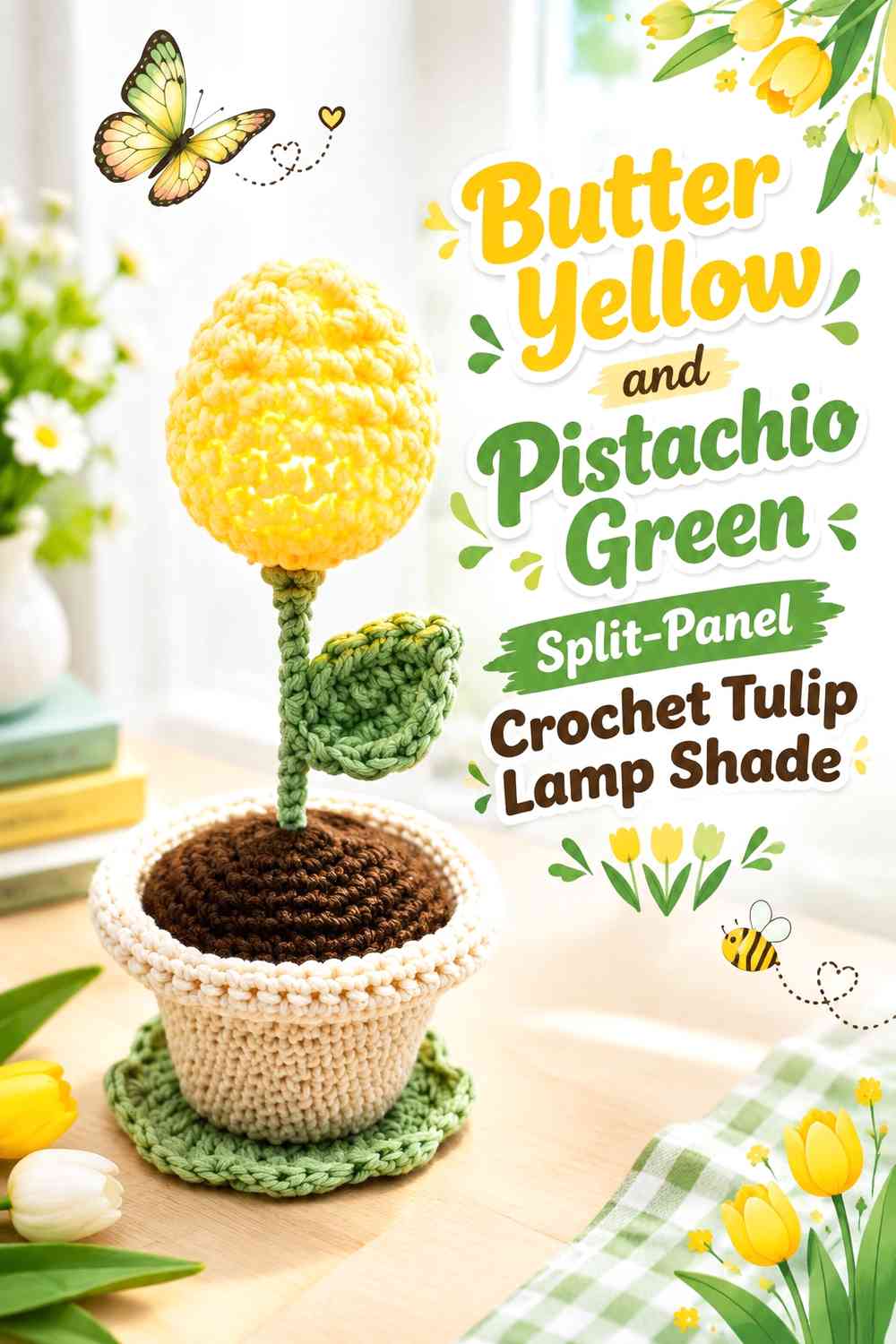
Finish with larger vertical panels rather than horizontal bands. Alternate or divide the shade into substantial butter-yellow and pistachio-green sections, then let tulip motifs cross or repeat near selected panel boundaries.
Butter Yellow and Pistachio Green Panels Need Deliberate Widths
Plan the vertical divisions around the actual circumference of the lamp shade. A narrow leftover panel at the back can make an otherwise clean design look accidental.
On a tapered shade, check panel width at both the upper and lower rings because equal-looking divisions may need to respond to the changing circumference.
Butter Yellow Tulips Can Bridge Pistachio Green Panel Boundaries
Place selected flowers so their yellow heads relate to one panel while green leaves visually connect to the neighboring section.
This keeps the color blocking from looking completely separate from the floral theme.
Pistachio Green Should Repeat Around the Butter Yellow Tulip Shade
Make sure the green appears in more than one visible panel or border. One isolated pistachio section can look disconnected once the shade is viewed from different sides.
Repeat the same green in the top or bottom frame if the vertical panel placement needs another connecting detail.
Creator Credit: Jess Crafting
Comparing the Butter Yellow and Pistachio Green Vintage Tulip Lamp Shade Ideas
For a butter-yellow-led lamp shade, ideas 1, 3, 5, 8, 10, 12, 14, and 15 keep the warm pale shade across most of the body or flower field. Pistachio green then defines scallops, leaves, frames, joins, or botanical details.
Ideas 2, 4, 6, 9, 11, 13, and 16 give pistachio green more uninterrupted space. These work well when you want butter-yellow tulips to function as clear focal motifs rather than blending into the background.
Idea 7 gives the colors a more regular alternating rhythm, while idea 17 uses larger vertical blocks. Granny-panel versions create the strongest modular vintage effect; dimensional-tulip versions create more depth and therefore benefit from simpler background color placement.
Conclusion
Butter yellow and pistachio green work especially well for a vintage tulip lamp shade when one shade creates the field and the other clarifies the flowers or frame.
Use butter yellow as the main surface when you want a light, warm vintage shade, then bring pistachio green into leaves, stems, joins, scallops, and upper or lower borders. Reverse the hierarchy when you want a botanical green shade with yellow tulips acting as obvious points of light.
For a traditional floral look, use repeated tulips around the circumference. For a quieter vintage result, concentrate the flowers in one bouquet, crown, or lower garden section. Granny panels and broad color blocks create a more graphic direction, while openwork and dimensional flowers put greater emphasis on texture.
Always plan the design against the actual lamp shade rather than a flat swatch alone. Circumference, taper, underlying shade color, and illumination can all change how much butter yellow and pistachio green remains visible. Use the credited tutorials for the constructions or tulip motifs they demonstrate and apply the final lamp-shade arrangement independently.
Frequently Asked Questions
Should Butter Yellow or Pistachio Green Dominate a Vintage Tulip Lamp Shade?
Use butter yellow when you want the lamp shade to feel lighter and warmer, with pistachio green defining botanical details. Use pistachio green as the main field when you want yellow tulips to stand out more clearly.
Where Should Pistachio Green Go on a Butter Yellow Tulip Lamp Shade?
Useful placements include stems, leaves, panel joins, top and bottom rims, scalloped edges, granny-square borders, and open spaces between yellow flowers. Give the green a consistent role rather than scattering small accents randomly.
How Can I Keep Butter Yellow Tulips Visible on a Pale Lamp Shade?
Surround the petals with enough pistachio green to create separation. A green leaf cluster, frame, or background section can be more effective than adding another flower color.
Can I Use Crochet Tulip Appliqués on a Lamp Shade Cover?
They can be used as decorative motifs when the construction is suitable, but dimensional appliqués add weight and thickness. Keep decorations safely separated from the bulb and hot components and follow the lamp manufacturer’s requirements.
Are Tulip Granny Squares Suitable for a Crochet Lamp Shade?
They can provide a useful modular decorative surface, particularly on a shade shape that accommodates panels. Check how the motifs fit around the actual circumference and taper before making the full set.
Should Butter Yellow Tulips Be Placed at the Top or Bottom of the Shade?
Larger motifs often have more room near the wider part of a tapered shade, while smaller details can work near the top. The exact placement should follow the actual shade proportions rather than a universal rule.
How Can I Check Butter Yellow and Pistachio Green Contrast?
Place the actual yarns side by side and work a small floral sample. A grayscale photograph can help compare their light-dark values independently of the yellow-and-green hue difference.
Can I Make the Entire Lamp Shade Pistachio Green With Only a Few Butter Yellow Tulips?
Yes. A small number of yellow flowers can remain highly visible against a broad green field. Give each bloom enough surrounding green space so it functions as a deliberate focal point.
Does a Crochet Lampshade Cover Make a Lamp Safer or Cooler?
No. Crochet should be treated as decorative material, not as a heat barrier or safety device. Use it only where the lamp, bulb clearance, original shade, and manufacturer’s instructions make the decorative cover appropriate.
Can a Tulip Flower Tutorial Be Combined With a Separate Lampshade Tutorial?
Yes. A tulip tutorial can provide the floral motif while a dedicated lampshade tutorial supplies the cover construction. Check motif scale, weight, and placement on the finished shade before permanently attaching the decorations.