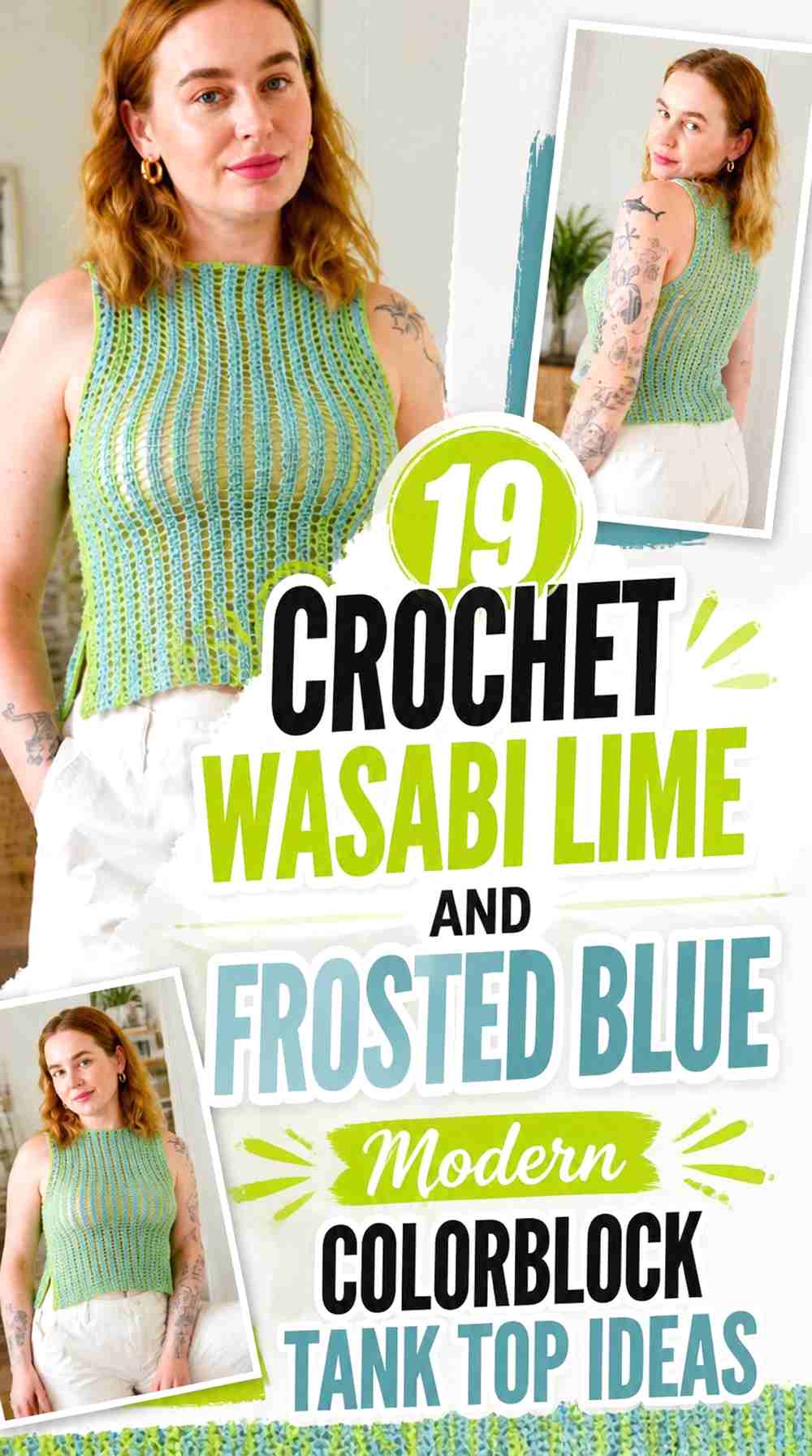

Wasabi Lime and Frosted Blue create an unusual modern pairing for a crochet tank top. The yellow-green side of Wasabi Lime adds energy, while Frosted Blue gives the palette a cooler, quieter counterweight. The key is deciding whether the colors should compete as equal blocks or whether one should cover most of the garment while the other defines the neckline, straps, sides, or hem.
Because both shades can be relatively light depending on the yarn you choose, hue difference alone may not create strong visual separation. Before committing to large tank-top panels, place the yarns next to each other and check them from a distance. A quick grayscale photo can also reveal whether the two colors are close in lightness. If they merge, use a slightly deeper version of either Wasabi Lime or Frosted Blue while preserving the same overall palette.
Quick List
- Wasabi Lime and Frosted Blue Front-and-Back Crochet Tank Top
- Wasabi Lime and Frosted Blue Broad-Band Crochet Tank Top
- Frosted Blue and Wasabi Lime Square-Neck Crochet Tank Top
- Wasabi Lime and Frosted Blue Vertical-Split Crochet Tank Top
- Wasabi Lime Center-Block and Frosted Blue Side-Panel Crochet Tank Top
- Frosted Blue Center-Block and Wasabi Lime Side-Panel Crochet Tank Top
- Frosted Blue and Wasabi Lime Scallop-Edge Crochet Tank Top
- Wasabi Lime and Frosted Blue Ribbed Crochet Tank Top
- Frosted Blue Mesh and Wasabi Lime Crochet Tank Top
- Frosted Blue and Wasabi Lime Modern Trim Crochet Tank Top
- Wasabi Lime and Frosted Blue Cropped Panel Crochet Tank Top
- Frosted Blue and Wasabi Lime Corset-Detail Crochet Tank Top
- Wasabi Lime and Frosted Blue Offset-Side Crochet Tank Top
- Frosted Blue and Wasabi Lime Lace-Shell Crochet Tank Top
- Frosted Blue Mesh and Wasabi Lime Shell-Edge Crochet Tank Top
- Frosted Blue and Wasabi Lime Racerback Crochet Tank Top
- Frosted Blue and Wasabi Lime V-Neck Crochet Tank Top
- Frosted Blue and Wasabi Lime Ribbed-Hem Crochet Tank Top
How to Balance Wasabi Lime and Frosted Blue on a Crochet Tank Top
Equal amounts of Wasabi Lime and Frosted Blue create a more graphic colorblock effect, especially when the colors meet across broad panels. A 60/40 or 70/30 balance usually creates a clearer hierarchy. The dominant color establishes the tank’s overall appearance, while the smaller block can emphasize the neckline, straps, hem, sides, or upper body.
Placement matters more on a tank than on a flat crochet project because the garment is viewed from the front, side, and back. A narrow contrasting strip at an armhole may look substantial from the front but nearly disappear from the back. Check the full silhouette when deciding how much Wasabi Lime and Frosted Blue each section should receive.
Keep Wasabi Lime and Frosted Blue Color Blocks Visible in Crochet Texture
Textured crochet can soften color boundaries. Ribbing, puffed texture, shells, or open mesh can break a solid block into highlights and shadows, making two similar-value yarns seem less distinct than they looked in the skein.
If you want crisp modern blocks, place the major color change at a structural boundary such as a panel edge, neckline, hem, or broad horizontal section. When the stitch texture itself is the main feature, using Frosted Blue over the larger textured area and reserving Wasabi Lime for a cleaner edge can keep both the stitch pattern and palette readable.
Plan Wasabi Lime and Frosted Blue Around the Tank Top Shape
Decide on the color map before completing both tank panels. Straps, square necklines, V-necks, racerbacks, ribbed hems, and scalloped borders all give you natural places to repeat the smaller color.
Repetition is especially useful when one shade occupies only a small area. If Wasabi Lime appears only at one shoulder, for example, repeating it at the opposite hem or back edge can make the asymmetry look deliberate rather than accidental.
1. Wasabi Lime and Frosted Blue Front-and-Back Crochet Tank Top
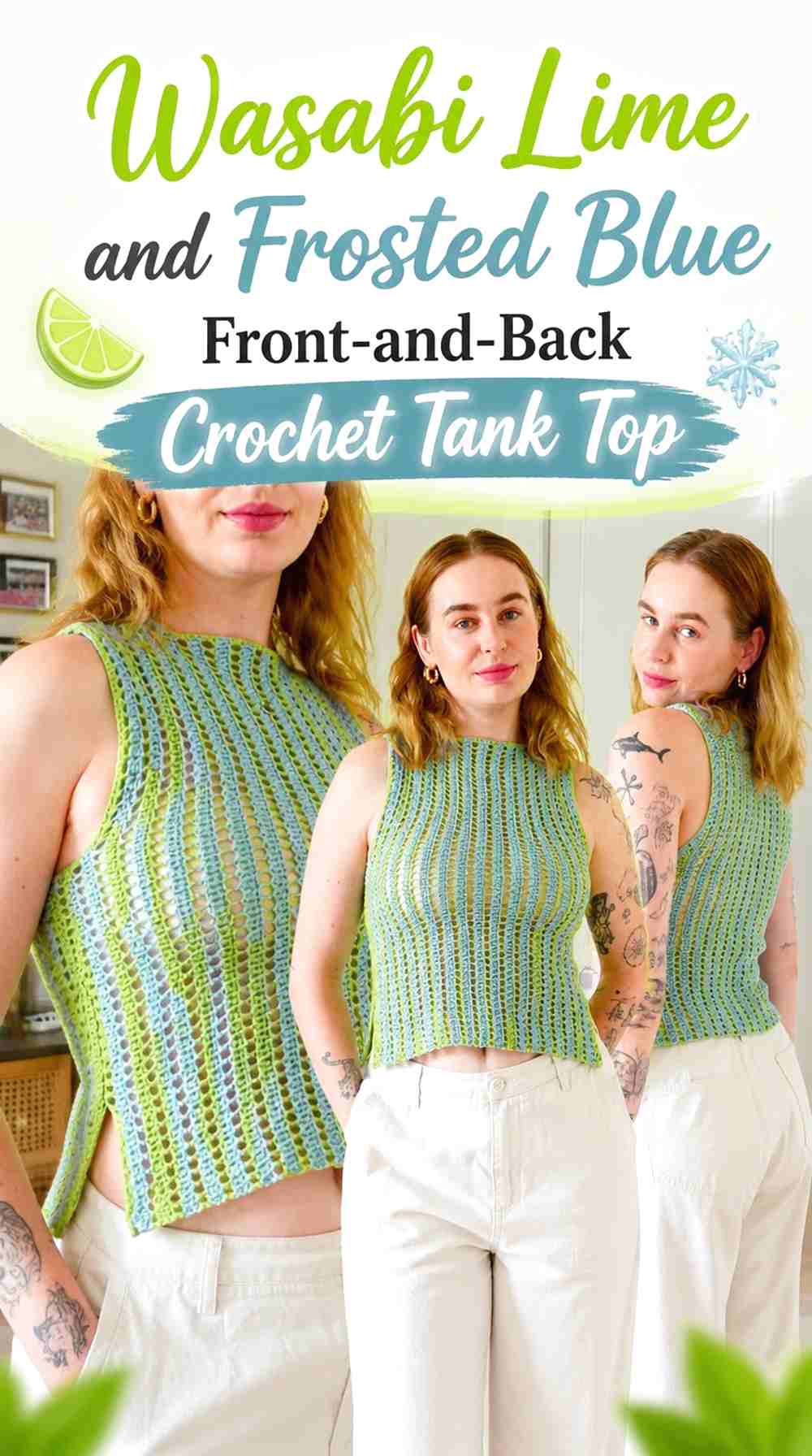
Use Wasabi Lime for one main garment face and Frosted Blue for the other to create the clearest possible two-color statement without dividing either panel into many smaller sections. The color change becomes part of the garment’s structure, so the tank looks different as the wearer turns rather than presenting every color decision on the front.
Wasabi Lime Can Give the Front of the Tank More Visual Energy
A Wasabi Lime front makes the warmer yellow-green color the first thing seen, while Frosted Blue remains visible at the sides and back. This works particularly well when you want the lime to lead without covering every visible surface.
Check the side seams before finalizing the plan. If the front wraps far around the body, Wasabi Lime may visually dominate more than expected, so the apparent balance may be closer to 70/30 than 50/50.
Frosted Blue Can Calm the Back of the Wasabi Lime Tank
Keeping Frosted Blue across the back gives the palette a larger quiet area and prevents every viewing angle from being equally bright. It can also make Wasabi Lime straps or edging easier to repeat on the back without losing them against another lime field.
Creator Credit: Katie Joslin YouTube tutorial
2. Wasabi Lime and Frosted Blue Broad-Band Crochet Tank Top

Broad horizontal blocks suit this palette when you want both colors visible from every angle. Instead of narrow stripes, use fewer, larger areas so the tank still reads as modern colorblocking. Frosted Blue can occupy the upper body while Wasabi Lime takes the lower section, or the arrangement can be reversed.
Frosted Blue Works Well Across the Upper Wasabi Lime Colorblock Tank
Placing Frosted Blue near the neckline and straps keeps the cooler shade close to the face and establishes a calm upper section. Let Wasabi Lime begin lower on the body so the transition creates one obvious graphic boundary rather than several busy stripes.
Before choosing the transition point, compare it with the tank’s armholes. A color change that cuts directly through a major shaping area can look less deliberate than one positioned above or below it.
Wasabi Lime Needs Enough Depth to Read as a True Color Block
A very narrow lime band can look like ordinary striping rather than colorblocking. Give Wasabi Lime enough uninterrupted surface to establish its own visual zone, particularly if Frosted Blue is the lighter or softer yarn in your actual selection.
Creator Credit: it’s erin b. YouTube tutorial
3. Frosted Blue and Wasabi Lime Square-Neck Crochet Tank Top
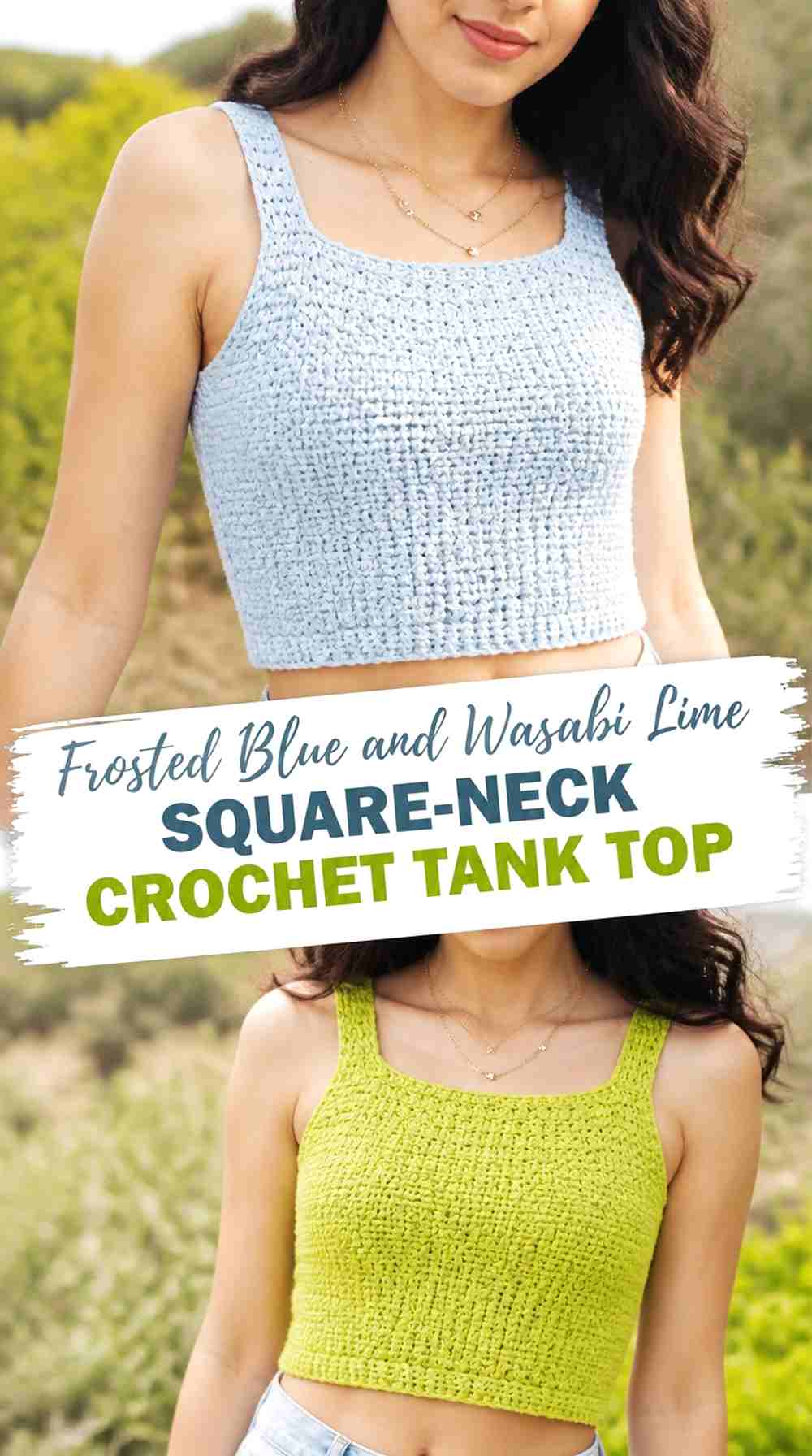
Let Frosted Blue cover most of a square-neck tank and use Wasabi Lime to emphasize the upper geometry. The straight neckline already creates a strong shape, so a lime frame around that area can give the tank a defined colorblock feature without dividing the entire body.
Wasabi Lime Can Outline the Frosted Blue Square Neck
Use Wasabi Lime around the neckline or upper strap area when you want the square shape to remain visually obvious. The contrast is most effective when the lime section has consistent width rather than becoming an irregular accent.
Check the neckline from several angles before adding more lime elsewhere. If the frame already has enough visual weight, repeating Wasabi Lime only at the hem may be sufficient.
Frosted Blue Keeps the Wasabi Lime Neckline From Taking Over
A broad Frosted Blue body gives the brighter Wasabi Lime feature room to stand out. This is a useful approach if you like the lime but do not want it to cover most of the wearable surface.
If the two yarns look almost identical in grayscale, strengthen the contrast slightly rather than widening the lime frame indefinitely. Better light/dark separation can define the square neck with less color area.
Creator Credit: Leelee Knits YouTube tutorial
4. Wasabi Lime and Frosted Blue Vertical-Split Crochet Tank Top
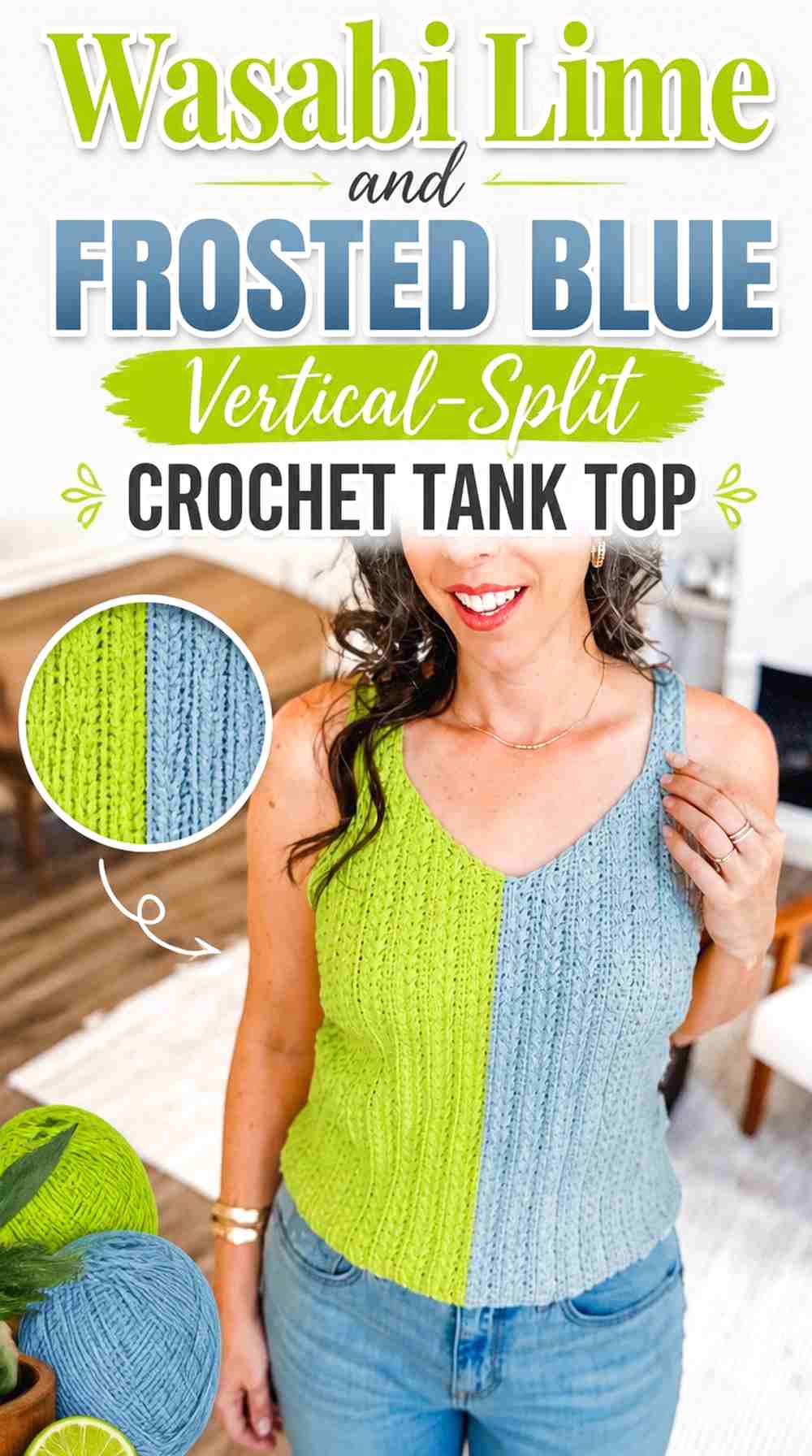
A broad vertical split produces one of the most graphic versions of this palette. Use approximately one side in Wasabi Lime and the other in Frosted Blue, or deliberately favor one shade with an uneven 60/40 division.
Wasabi Lime Makes the Vertical Frosted Blue Split More Directional
Instead of automatically dividing the front exactly in half, allow Wasabi Lime to occupy the narrower section if it is visually stronger than the blue yarn. The uneven ratio can keep the tank from looking overly rigid while preserving the modern block effect.
A side-to-side crochet texture is particularly useful for evaluating this layout because the color change and fabric direction can reinforce each other visually.
Frosted Blue Can Continue the Wasabi Lime Split Around the Back
Decide whether the front division should continue through the back or whether the back should become one solid shade. Continuing both colors produces a fully colorblocked garment, while a solid Frosted Blue back gives the front more emphasis.
Creator Credit: Briana K YouTube tutorial
5. Wasabi Lime Center-Block and Frosted Blue Side-Panel Crochet Tank Top
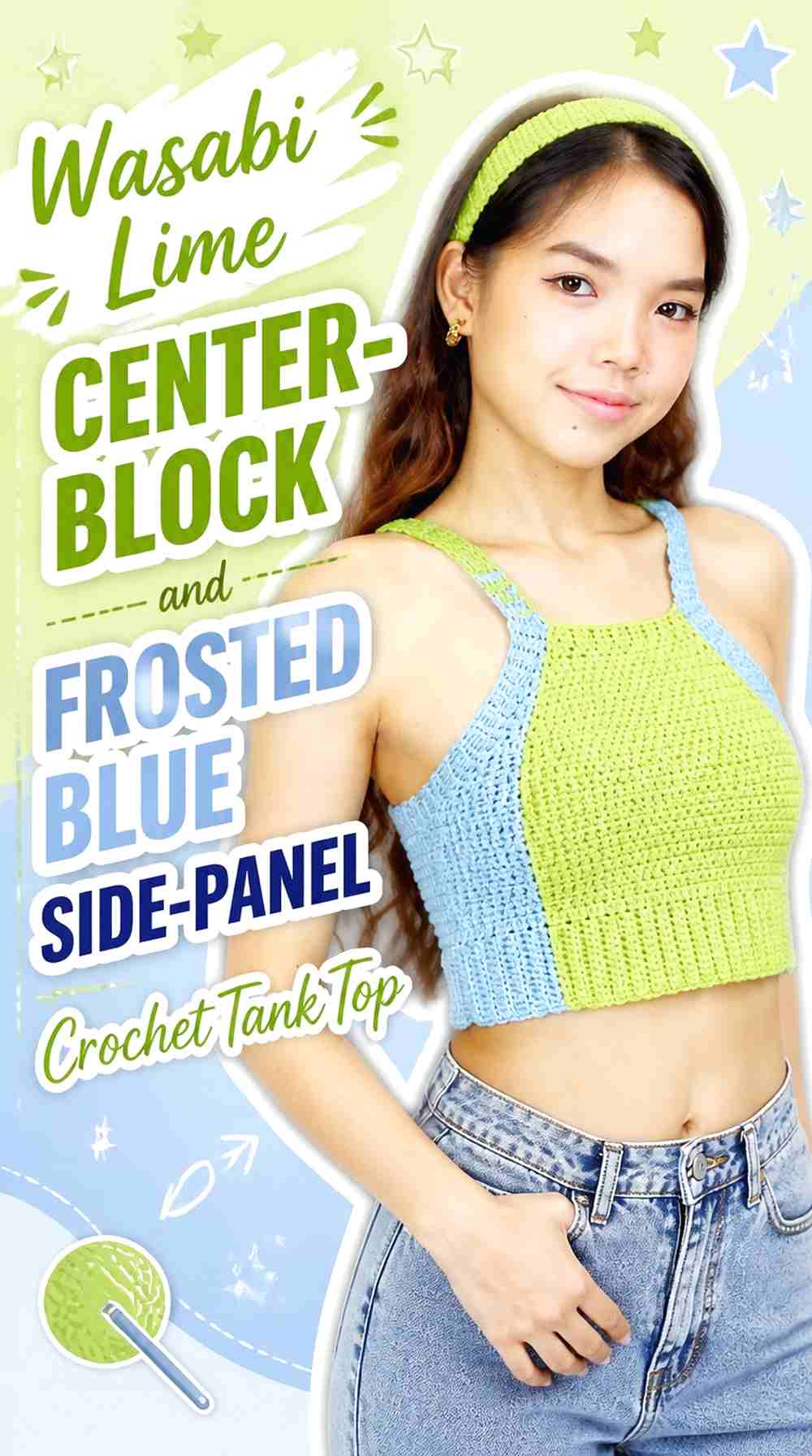
Place Wasabi Lime through the central front area and let Frosted Blue occupy the outer portions of the tank. This concentrates the stronger yellow-green color where it remains clearly visible while the blue controls the edges around the armholes and sides.
Wasabi Lime Needs a Wide Enough Center Block to Stay Intentional
A center section that becomes too narrow can resemble a stripe. Keep enough Wasabi Lime visible across the torso for the area to read as a major garment component rather than decorative trim.
The exact width should be judged against the finished front panel, not against the number of stitches alone. Different stitch textures can make the same stitch count appear wider or narrower.
Frosted Blue Can Frame Wasabi Lime at the Tank Sides
Using Frosted Blue near both side edges gives the lime center a defined boundary. It also creates an easy place to continue blue into the back if you want a predominantly Frosted Blue rear panel.
Creator Credit: Chenda DIY YouTube tutorial
6. Frosted Blue Center-Block and Wasabi Lime Side-Panel Crochet Tank Top
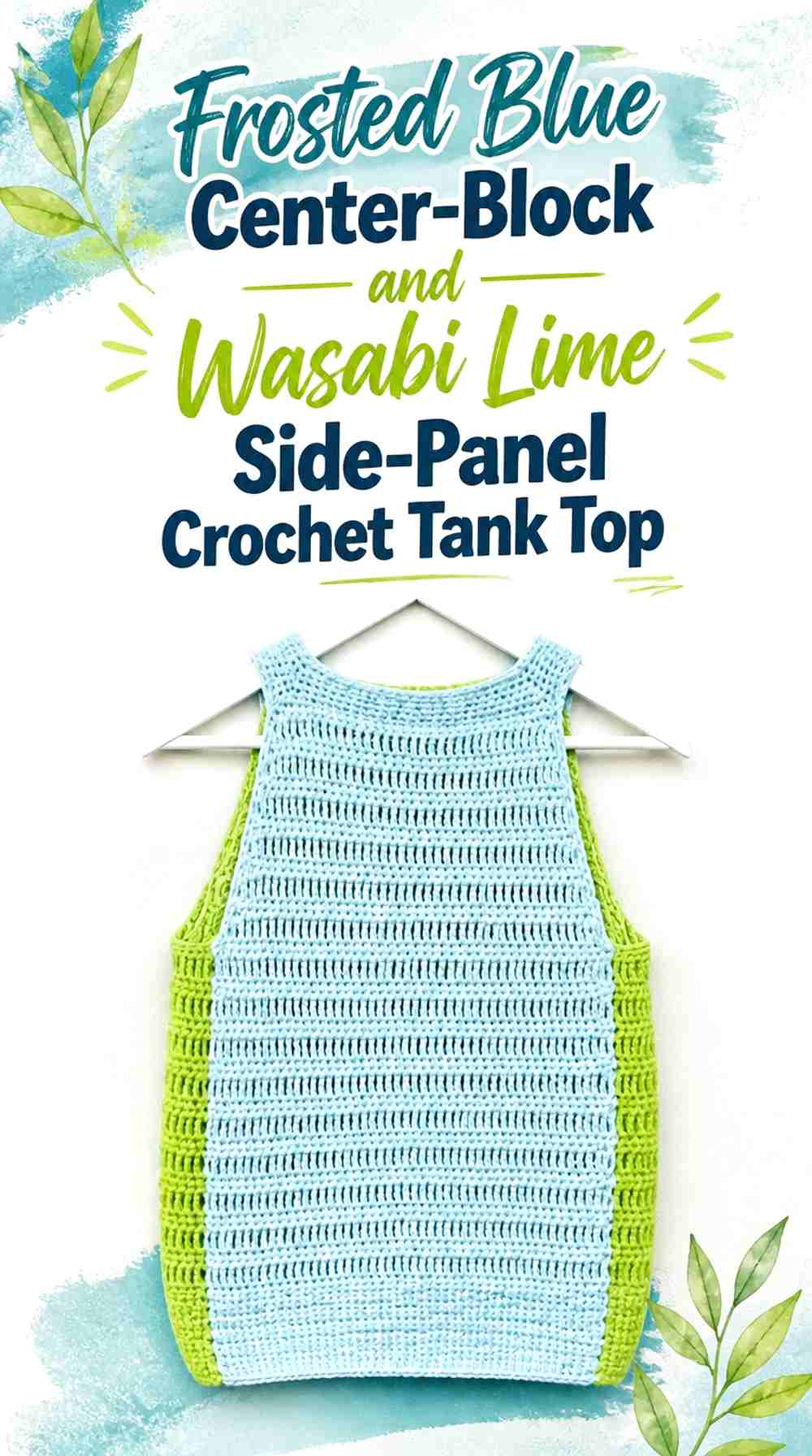
Reverse the previous hierarchy by putting Frosted Blue through the center and Wasabi Lime at the sides. This makes the lime more visible during movement and from angled views while keeping the front center relatively cool and restrained.
Frosted Blue Creates a Quiet Center Between Wasabi Lime Panels
A broad Frosted Blue center can stop two Wasabi Lime side areas from visually merging into one dominant bright field. Maintain a generous blue width if you want the center block to remain the tank’s main feature.
Wasabi Lime Side Blocks Need Consistent Placement Against Frosted Blue
Check both sides together rather than completing one lime section in isolation. Unequal visual widths may become especially noticeable around armholes or side seams, where garment shaping can change how much of each block is visible.
Creator Credit: Crochet with Clare YouTube tutorial
7. Frosted Blue and Wasabi Lime Scallop-Edge Crochet Tank Top

Use Frosted Blue over most of the tank and make Wasabi Lime the color that defines the decorative outer edge. The scalloped detail already has movement, so concentrating lime there creates a recognizable finish without adding more blocks to the body.
Wasabi Lime Makes a Frosted Blue Scallop Edge Easier to Notice
A contrasting scallop can disappear when its color is too similar to the body. Wasabi Lime separates the edge from Frosted Blue and helps each curved section remain visible.
Keep the lime concentrated around the planned scalloped areas if you want the edging to remain the primary accent. Adding many unrelated lime blocks can compete with the border.
Frosted Blue Gives Wasabi Lime Scallops Enough Negative Space
A larger blue surface lets the lime edge act as a frame. If you repeat Wasabi Lime elsewhere, use it sparingly at straps or a small neckline detail so the scallop still feels purposeful.
Creator Credit: Hayhay Crochet YouTube tutorial
8. Wasabi Lime and Frosted Blue Ribbed Crochet Tank Top
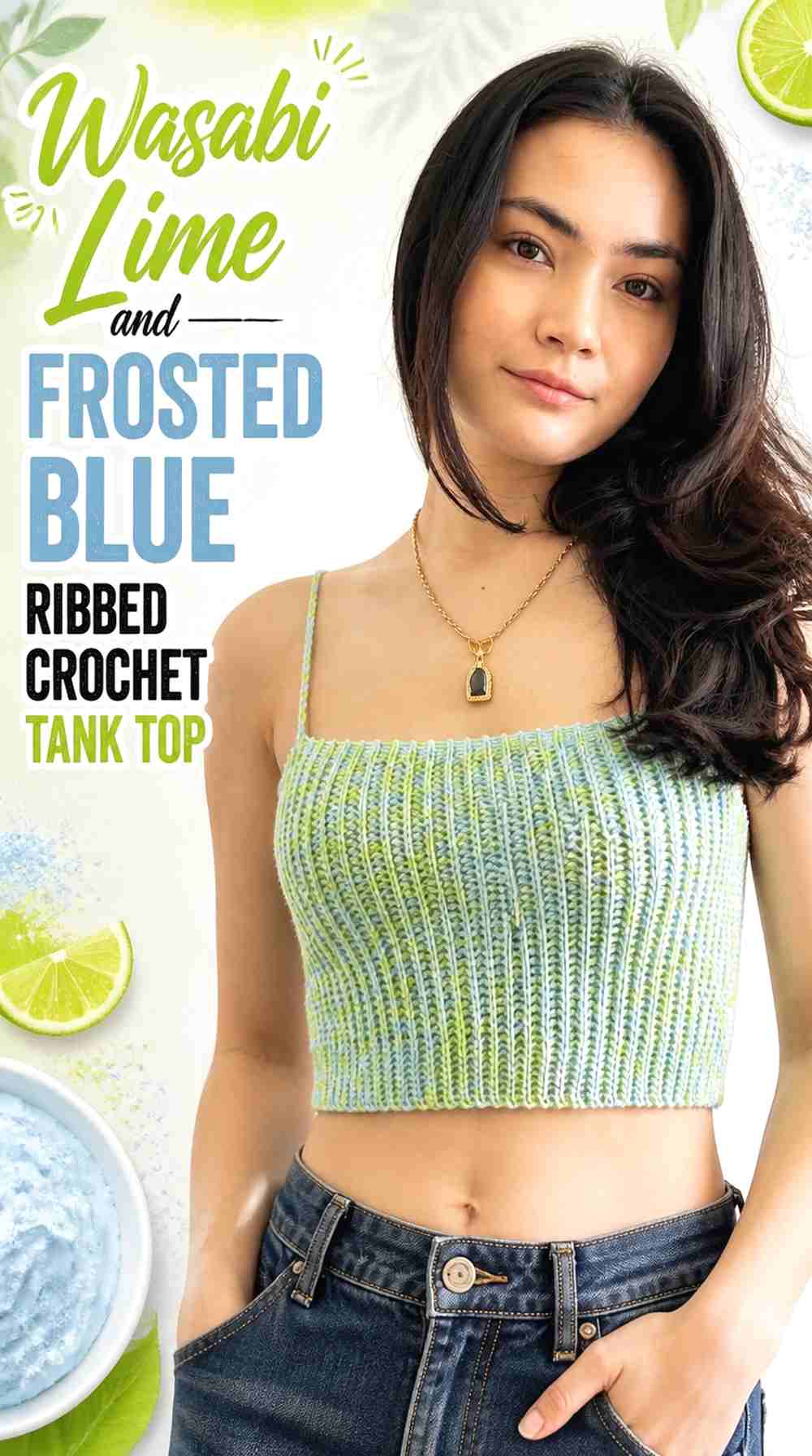
Ribbing can make both shades appear more dimensional because the raised and recessed areas create natural light and shadow. Instead of scattering the colors, divide the ribbed tank into one or two large color zones so the texture does not compete with a complicated palette.
Wasabi Lime Shows Strongly Across a Broad Ribbed Tank Section
Use Wasabi Lime over a substantial portion of the ribbed surface when you want the texture and yellow-green color to share attention. Tiny lime details can become fragmented by ribbing, especially when viewed from a distance.
Frosted Blue Can Separate Wasabi Lime Ribbing at the Straps or Upper Edge
Frosted Blue at the upper tank can interrupt a large lime field and visually separate the body from the straps. Compare the colors after crocheting a small textured sample, because ribbing can change their perceived depth compared with smooth yarn in the skein.
Creator Credit: Granny Gaia YouTube tutorial
9. Frosted Blue Mesh and Wasabi Lime Crochet Tank Top
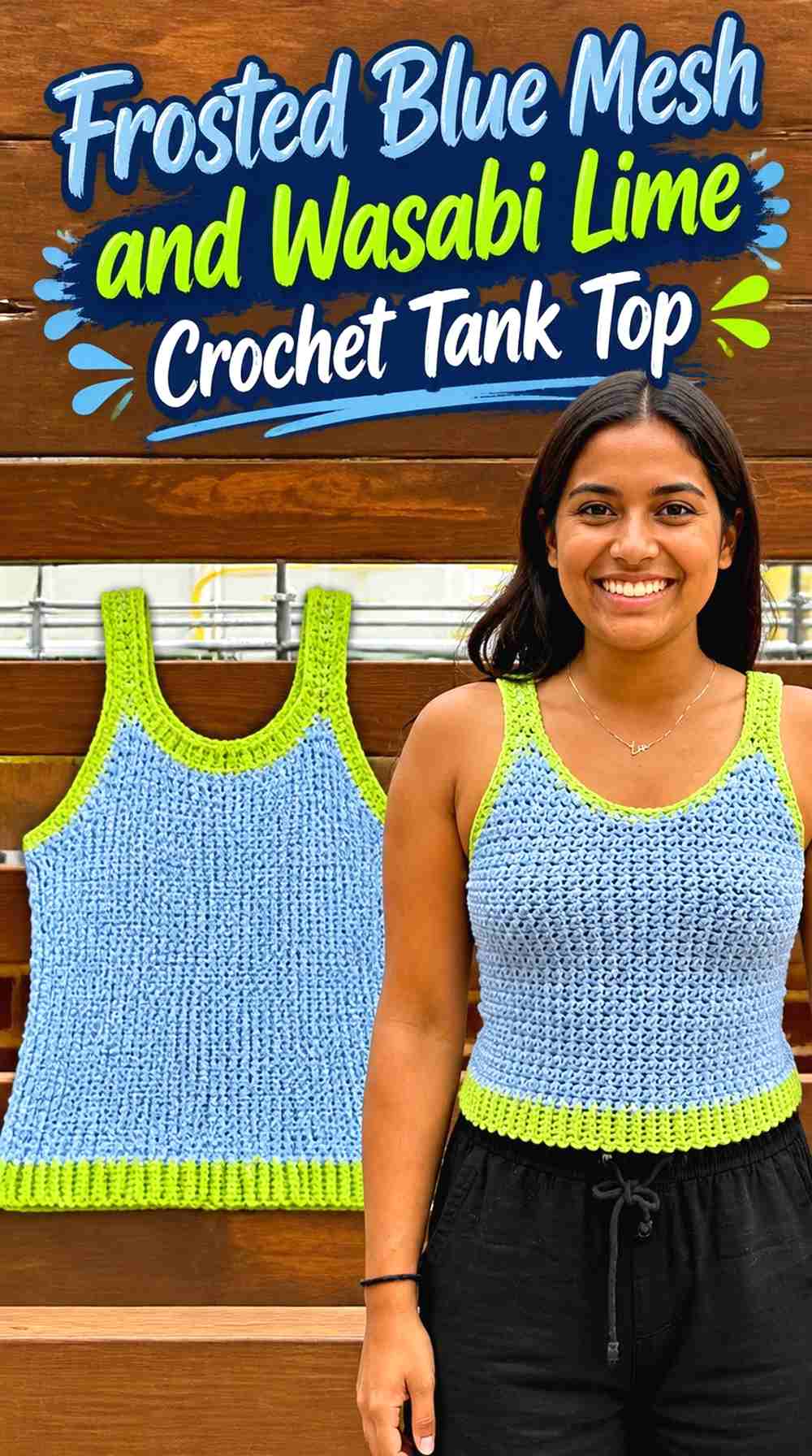
Mesh gives Frosted Blue a lighter visual presence because the background shows through the fabric. Wasabi Lime can therefore be used in more solid-looking areas such as ribbing, trim, or an upper section without necessarily overpowering the blue.
Frosted Blue Mesh Makes the Wasabi Lime Sections Feel More Solid
When Frosted Blue is worked into an open texture, it occupies less visual mass than a dense Wasabi Lime block. Take that difference into account before assuming equal yarn area will produce equal visual weight.
Wasabi Lime Can Define the Frosted Blue Mesh Tank Edges
A lime neckline or lower border can stop an airy Frosted Blue body from looking visually unfinished. Keep the edge consistent around connected areas so the lime acts as a deliberate frame instead of isolated patches.
Creator Credit: LoopsByLisa YouTube tutorial
10. Frosted Blue and Wasabi Lime Modern Trim Crochet Tank Top
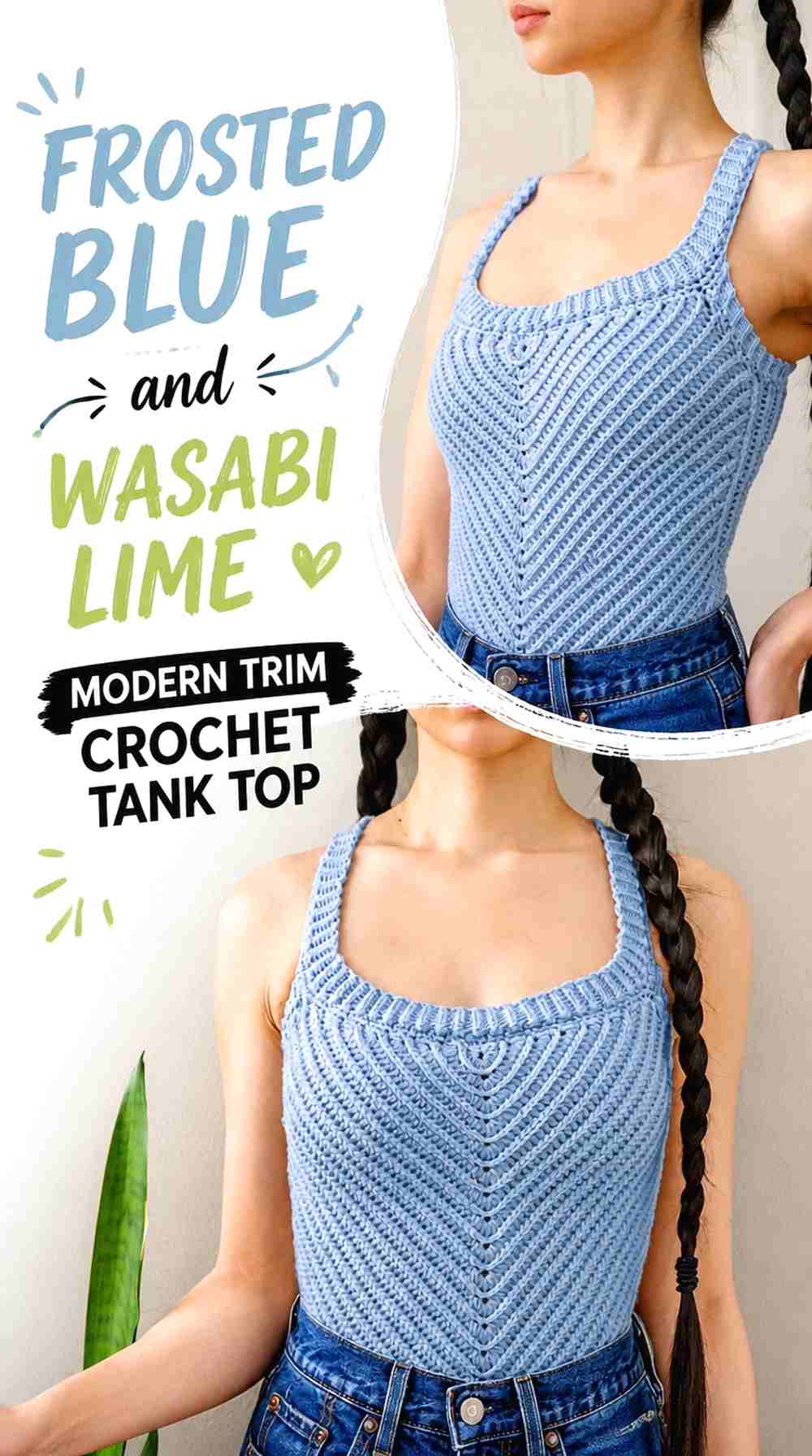
For a quieter interpretation, let Frosted Blue cover most of the tank and reserve Wasabi Lime for structural details. Neckline trim, armhole edges, or a narrow lower section can provide enough lime repetition to establish the palette without creating a 50/50 split.
Wasabi Lime Trim Can Sharpen a Frosted Blue Tank Shape
Use lime where you want the garment outline to become clearer. Armhole and neckline trim can show the tank’s architecture without interrupting the main Frosted Blue field.
Avoid making every edge lime automatically. Choosing two connected trim areas often looks more intentional than outlining every possible boundary.
Frosted Blue Should Remain Broad Around Wasabi Lime Details
The blue needs uninterrupted space for this low-lime strategy to work. If additional Wasabi Lime blocks are added across the body, the tank shifts from accent-led colorblocking toward an equal two-color design.
Creator Credit: TCDDIY YouTube tutorial
11. Wasabi Lime and Frosted Blue Cropped Panel Crochet Tank Top
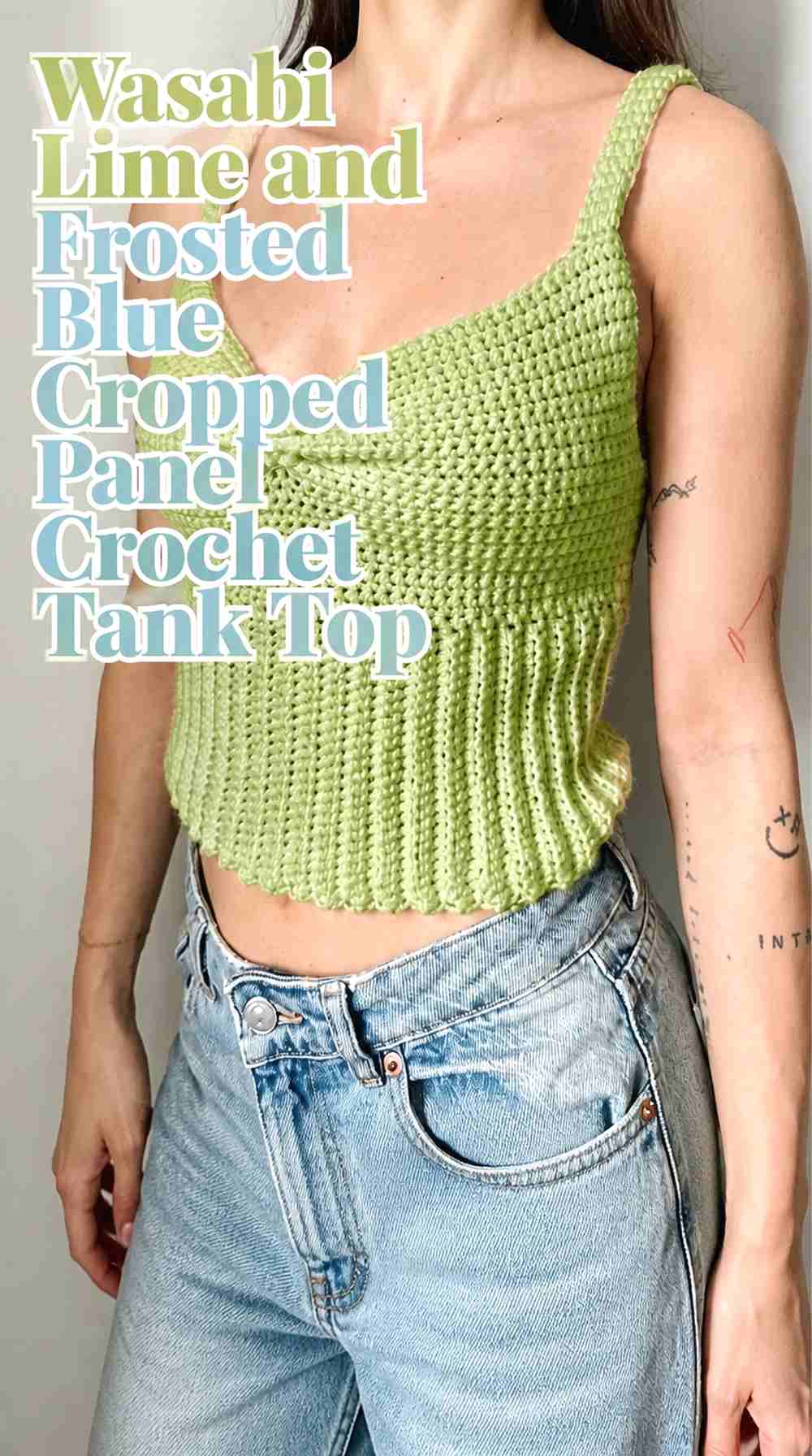
A shorter tank gives each color less total surface, so broad simple blocks usually read more clearly than several narrow changes. Use Wasabi Lime for the front panel and Frosted Blue for the back, or divide the upper and lower portions into two substantial fields.
Wasabi Lime Needs Controlled Coverage on a Short Frosted Blue Tank
On a cropped silhouette, even a relatively small lime area can occupy a large percentage of the garment. Decide the ratio from a sketch of the complete tank rather than estimating it from a few early rows.
Frosted Blue Can Keep the Wasabi Lime Crop From Looking Overly Busy
If Wasabi Lime already covers the most prominent front area, leave Frosted Blue relatively uninterrupted elsewhere. That larger cool section creates a visual resting point and keeps the two-color design from turning into frequent striping.
Creator Credit: Kenikse Crochet YouTube tutorial
12. Frosted Blue and Wasabi Lime Corset-Detail Crochet Tank Top
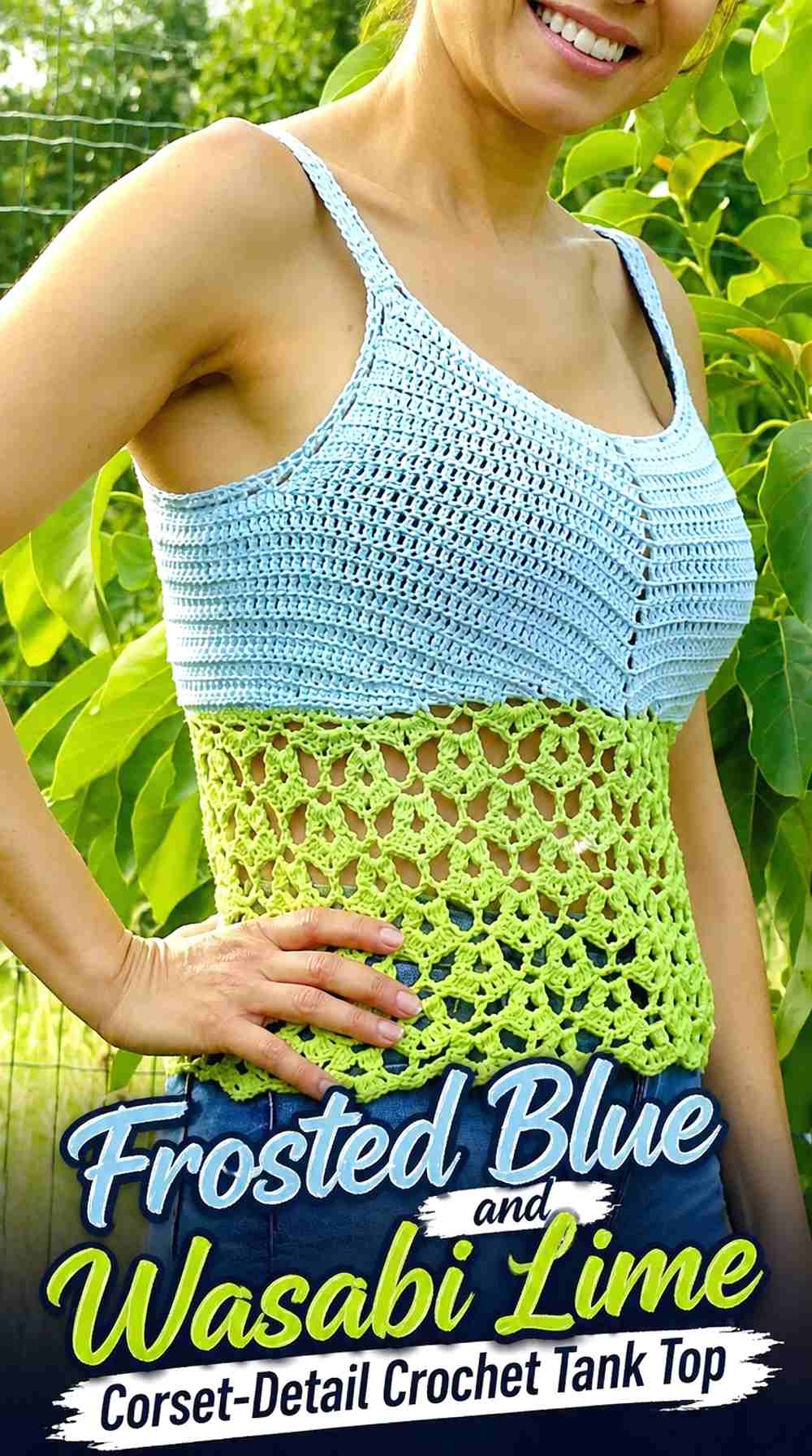
Use Frosted Blue as the primary tank color and apply Wasabi Lime to a closure, upper section, or other visually contained detail. Concentrating the lime around one functional-looking feature creates a more architectural color scheme than distributing small accents everywhere.
Wasabi Lime Can Emphasize a Frosted Blue Closure Area
A lime detail near the closure gives the eye a clear focal point. Keep the surrounding Frosted Blue relatively simple so the contrast emphasizes the feature rather than competing with several other lime zones.
Frosted Blue Keeps Wasabi Lime Detail From Dominating the Whole Tank
Because Wasabi Lime can attract attention even in a small area, a broad blue body helps control it. If the lime feature already feels prominent, repeat the shade only once elsewhere—such as at the lower edge—to connect the palette.
Creator Credit: Francesca Uncinettando Crochet&Love YouTube tutorial
13. Wasabi Lime and Frosted Blue Offset-Side Crochet Tank Top
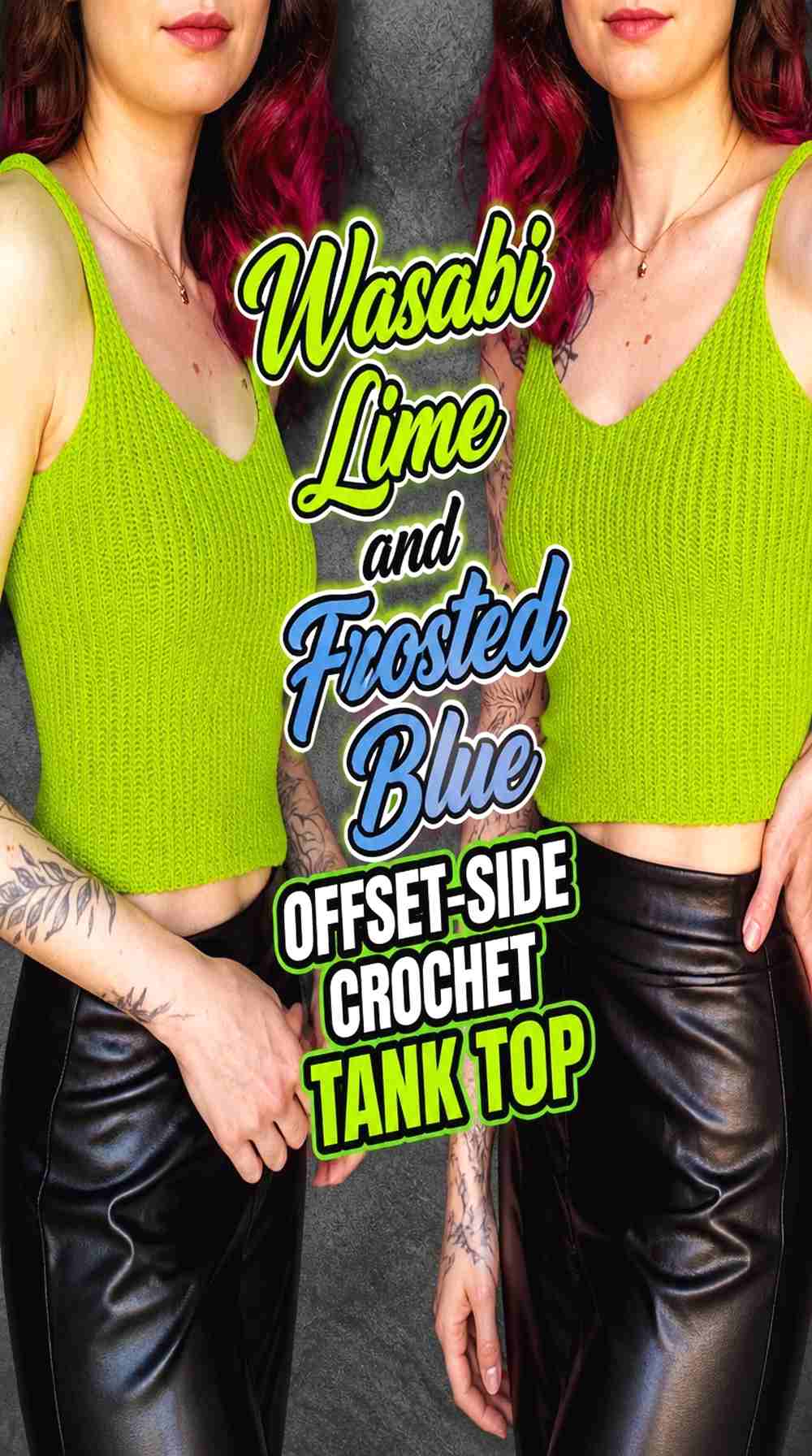
Instead of centering the color division, move a Wasabi Lime block toward one side of an otherwise Frosted Blue tank. The asymmetry gives the familiar two-color palette a more contemporary layout without requiring extra colors.
Wasabi Lime Looks More Deliberate When the Offset Block Is Substantial
A tiny off-center section may resemble an accidental color change. Give Wasabi Lime enough width to establish a clear vertical shape, then let Frosted Blue remain dominant over the rest of the body.
Frosted Blue Can Balance Wasabi Lime With a Small Opposite-Side Repeat
If the main lime block sits on one side, repeat Wasabi Lime in a small detail on the opposite side or back. That does not make the design symmetrical, but it can keep the lime from feeling disconnected.
Creator Credit: Masha Handmade YouTube tutorial
14. Frosted Blue and Wasabi Lime Lace-Shell Crochet Tank Top
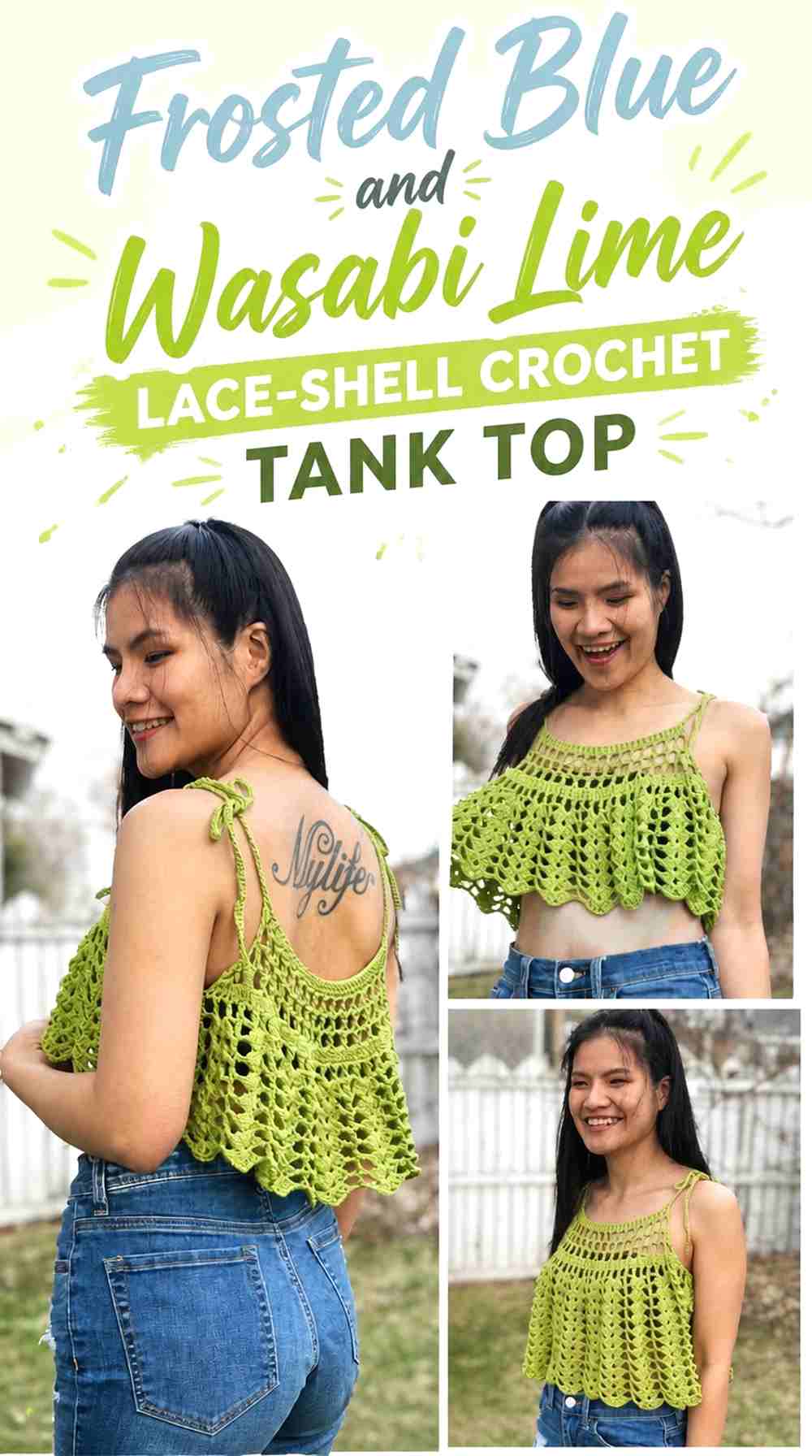
A lace-shell surface changes how color is perceived because open spaces break each yarn area into smaller visual units. Frosted Blue can carry the more open body while Wasabi Lime defines a more solid upper or lower zone.
Frosted Blue Keeps the Wasabi Lime Lace-Shell Palette Light
Using Frosted Blue through much of the openwork maintains a cooler, visually lighter base. Wasabi Lime can then establish a strong boundary at the upper body or hem rather than competing inside every lace repeat.
Wasabi Lime Should Follow a Clear Boundary Against Frosted Blue Lace
Avoid changing colors at irregular points throughout a detailed shell surface unless that fragmented effect is intentional. A broad Wasabi Lime block positioned at a natural garment division makes the color scheme easier to read and protects the lace texture from unnecessary visual noise.
Creator Credit: KnitcroAddict YouTube tutorial
15. Frosted Blue Mesh and Wasabi Lime Shell-Edge Crochet Tank Top

This variation makes Frosted Blue the airy main field and concentrates Wasabi Lime around shell-style edging or another decorative finish. It gives the palette two distinct jobs: blue creates the surface, while lime identifies the outline.
Wasabi Lime Can Make Frosted Blue Shell Edging a Focal Point
A decorative edge deserves enough contrast to remain visible. If your Wasabi Lime and Frosted Blue yarns have very similar lightness, choose a slightly stronger lime within the same yellow-green family rather than increasing the border’s width solely to make it noticeable.
Frosted Blue Mesh Needs Restraint Around the Wasabi Lime Border
Let the mesh remain predominantly blue once the lime edge is established. Repeating large lime sections inside the mesh may weaken the distinction between the airy body and the defined outer finish.
Creator Credit: AC Crochets YouTube tutorial
16. Frosted Blue and Wasabi Lime Racerback Crochet Tank Top
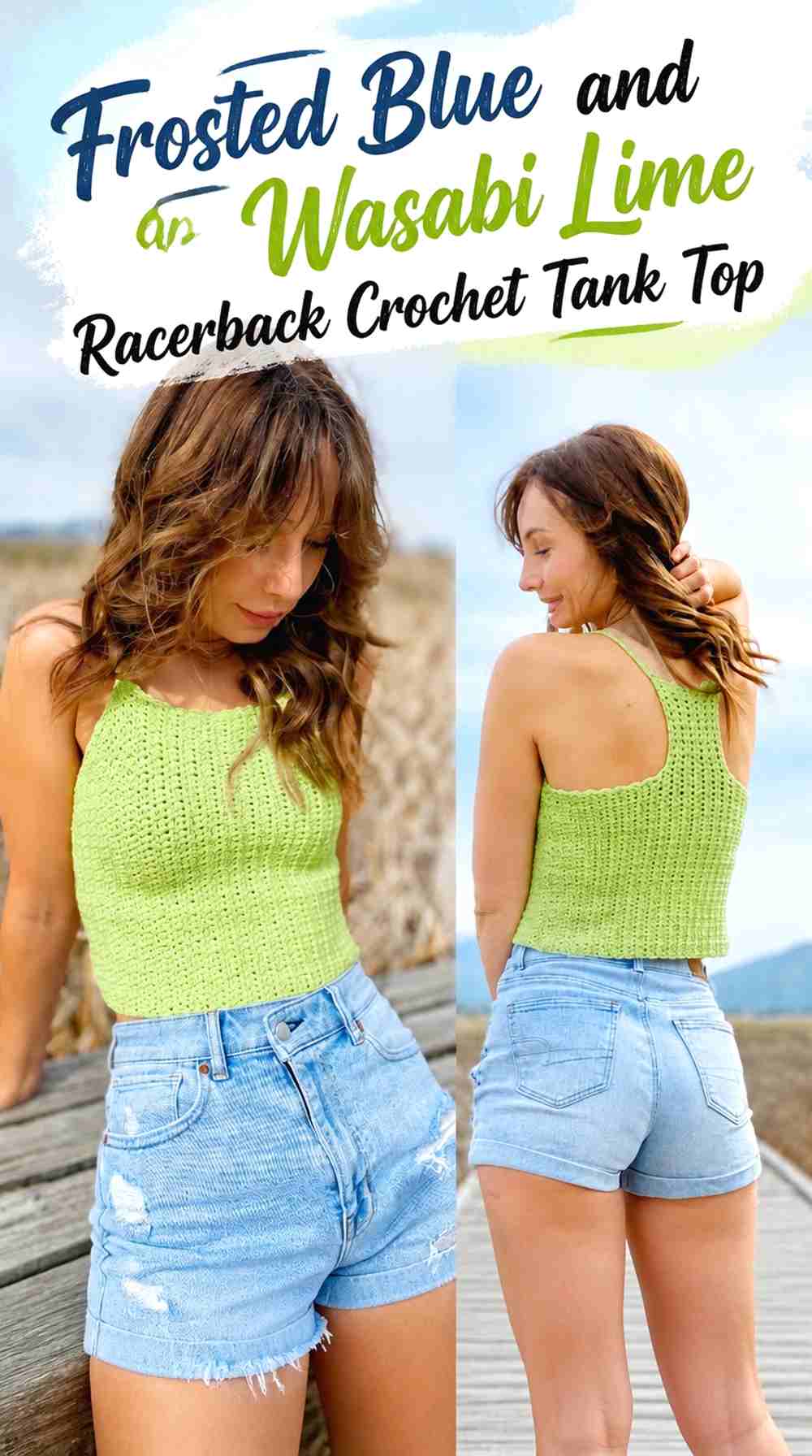
A racerback gives the rear of the tank enough visual importance to carry its own color strategy. Keep the front predominantly Frosted Blue and move Wasabi Lime toward the racerback, straps, or upper-back area for a design that changes noticeably between front and rear views.
Wasabi Lime Can Turn the Frosted Blue Racerback Into the Main Rear Detail
Using lime through the narrower back section makes the construction more visible and gives the accent a clear purpose. It also avoids cutting the larger front body into unnecessary small blocks.
Frosted Blue Keeps the Wasabi Lime Racerback From Overloading the Front
A mostly Frosted Blue front creates contrast between the two viewing angles. If you want a stronger connection between front and back, repeat Wasabi Lime at a small front trim area rather than making another large lime block.
Creator Credit: Evelyn And Peter Crochet YouTube tutorial
17. Frosted Blue and Wasabi Lime V-Neck Crochet Tank Top
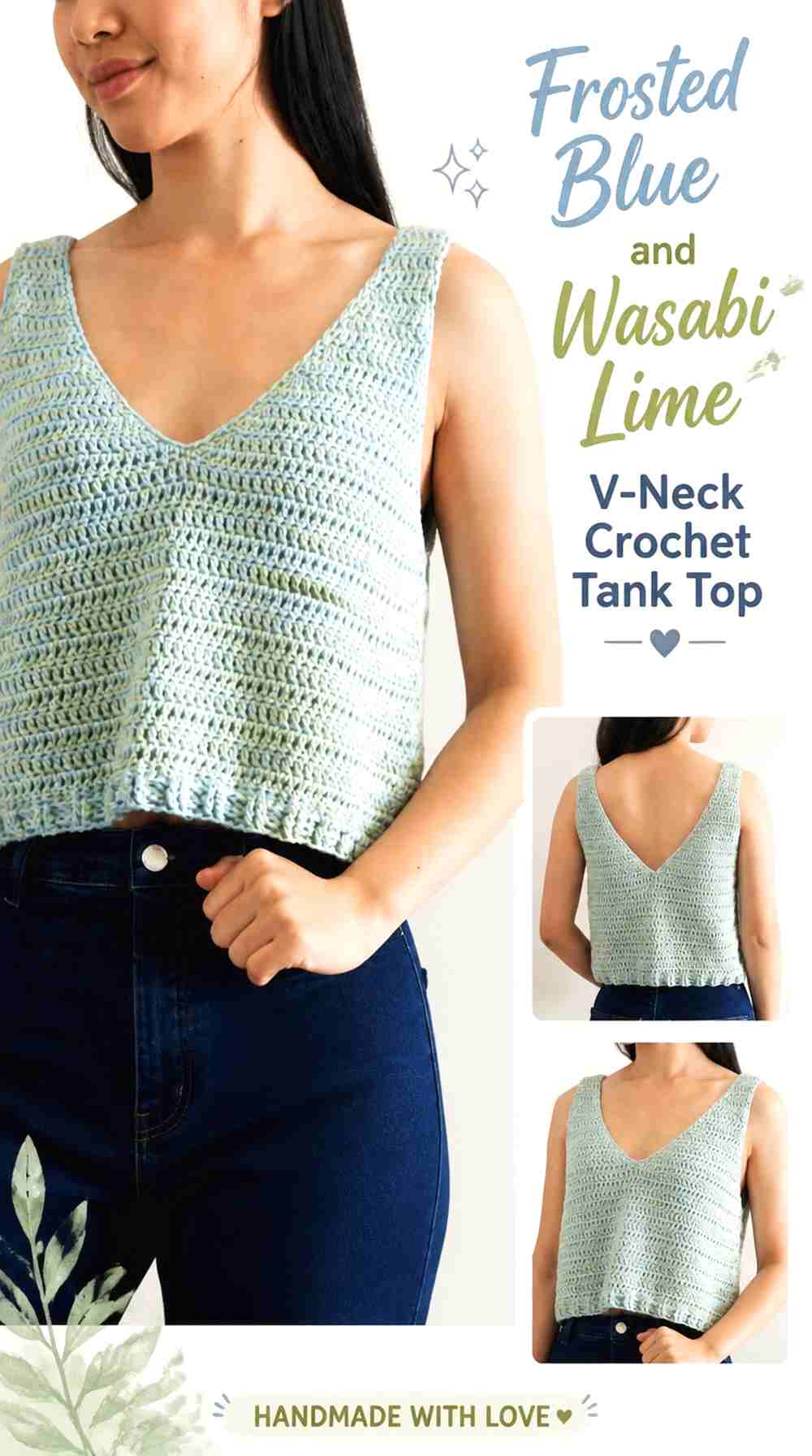
A V-neck naturally directs attention toward the center of the upper tank, making it a useful location for controlled Wasabi Lime placement. Frosted Blue can remain dominant through the body while lime follows the V, straps, or upper triangles.
Wasabi Lime Can Trace the Frosted Blue V-Neck Without Becoming a Stripe
Give the lime enough width around the V to read as a deliberate upper color block rather than a thin decorative line. The exact width should remain proportional to the straps and neckline so the upper tank still looks cohesive.
Frosted Blue Should Continue Below the Wasabi Lime V-Neck
A broad blue body keeps the V-shaped lime area from competing with additional color changes. If you want a second lime repeat, the lower hem is a useful distant location because it visually brackets the blue rather than interrupting it.
Creator Credit: forthefrills YouTube tutorial
18. Frosted Blue and Wasabi Lime Ribbed-Hem Crochet Tank Top
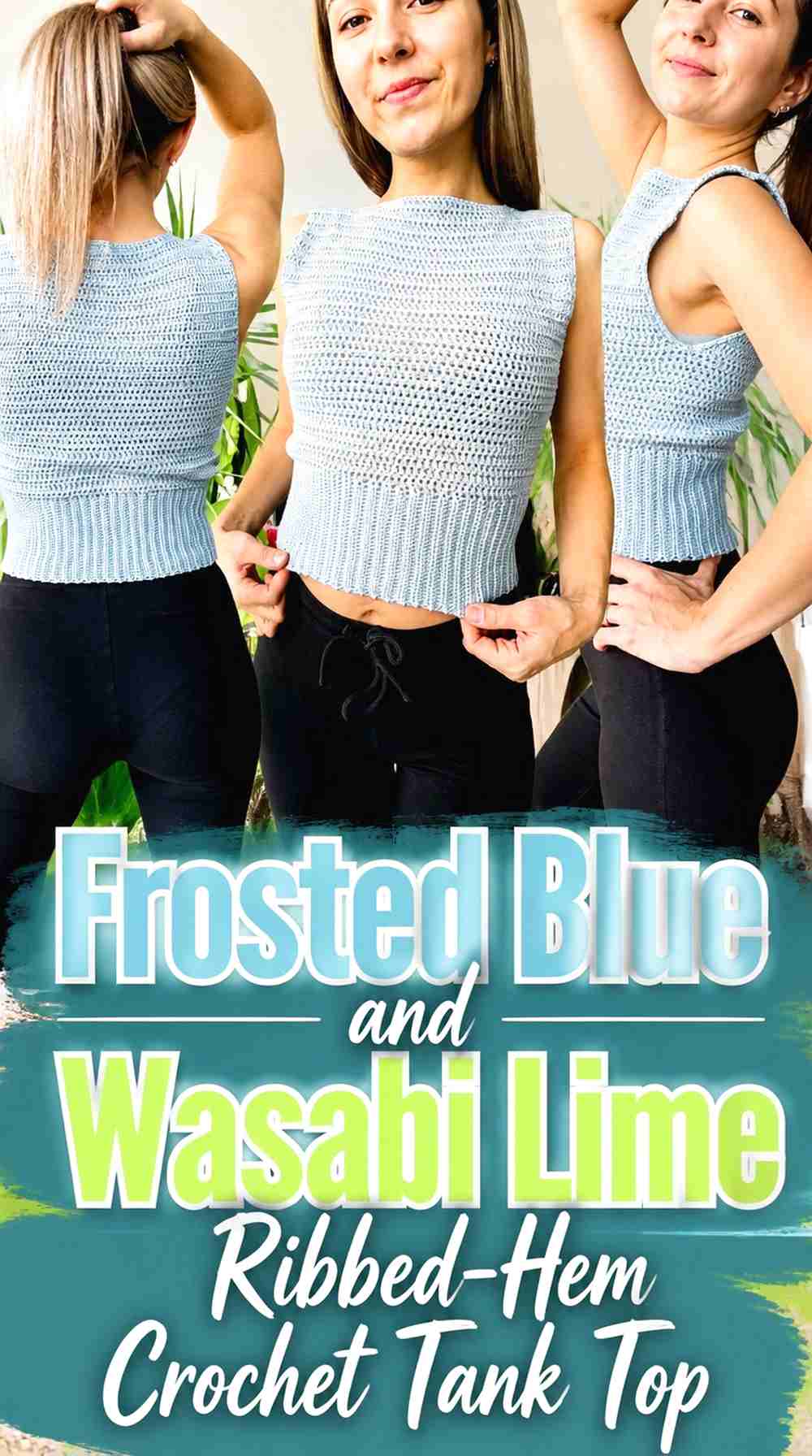
Finish the collection with a restrained 80/20-style palette: Frosted Blue over most of the tank and Wasabi Lime concentrated in the ribbed hem. The ribbed texture gives the smaller color area extra visual presence, so the lime does not need to cover much of the garment.
Wasabi Lime Gives the Frosted Blue Ribbed Hem a Strong Finish
A lime ribbed hem creates a clean endpoint for a Frosted Blue body. Because ribbing already adds texture, keep the color change broad and simple instead of introducing several additional shades or narrow stripes.
Frosted Blue Lets the Wasabi Lime Hem Stay Modern Rather Than Decorative
Keep Frosted Blue continuous from the upper body through most of the tank if you want the hem to function as a true color block. Repeating a small amount of lime near the neckline is optional, but matching the hem with large lime shoulder sections would create a much more balanced two-color scheme.
Creator Credit: by Kristine YouTube tutorial
Which Wasabi Lime and Frosted Blue Colorblock Tank Top Direction Should You Choose?
For the strongest graphic separation, start with the front-and-back, vertical-split, center-panel, or broad-band ideas. These give both Wasabi Lime and Frosted Blue enough uninterrupted surface to read immediately as color blocks.
For a quieter wearable, keep Frosted Blue dominant and move Wasabi Lime to the square neckline, scallops, mesh edging, V-neck, or ribbed hem. The palette remains recognizable, but lime functions as an architectural accent rather than covering half the tank.
If stitch texture is an important part of the tank, compare the ribbed, Wheat Stitch-style, mesh, and lace-shell directions. Make a small sample in both yarns before committing to placement; texture can change how light or strong each shade appears and can reduce the contrast you saw between untouched skeins.
Conclusion
Wasabi Lime and Frosted Blue can move in several directions without abandoning the same two-color identity. Equal panels produce the boldest modern colorblock effect, while a Frosted Blue-dominant tank with Wasabi Lime edging feels more restrained. Moving lime to a racerback, square neck, V-neck, scallop edge, or ribbed hem creates a focal feature without dividing the entire body.
Choose the color map before beginning the major garment sections, then compare the actual yarns for light/dark separation. Once you know which shade should lead, use the original creator tutorial for the exact tank construction and keep your color changes focused on broad, intentional areas.
Frequently Asked Questions
Should Wasabi Lime or Frosted Blue dominate a crochet tank top?
Either can lead, but the decision changes the overall effect. A Wasabi Lime-dominant tank looks more energetic, while using Frosted Blue across most of the body makes lime accents around the neckline, straps, hem, or sides more noticeable. If you are uncertain, start around a 70/30 balance rather than splitting every area equally.
How can I tell whether Wasabi Lime and Frosted Blue have enough contrast?
Compare the yarns side by side in the lighting where you normally work, then look at them from several feet away. You can also photograph them and view the image in grayscale. If the shades nearly merge in grayscale, consider a slightly darker Frosted Blue or a deeper Wasabi Lime while preserving the same color families.
Where should Wasabi Lime go on a mostly Frosted Blue crochet tank top?
Good locations include the neckline, straps, ribbed hem, scalloped edge, side panels, racerback, or one substantial upper or lower block. Choose one main lime feature and, if needed, repeat a smaller amount elsewhere to make the placement feel connected.
Can Wasabi Lime and Frosted Blue work in a mesh crochet tank?
Yes, but mesh changes the visual weight of color because the background remains visible through the stitches. A Frosted Blue mesh section may look lighter than a similarly sized solid Wasabi Lime area, so judge the balance from a worked sample rather than yarn quantity alone.
Should Wasabi Lime and Frosted Blue color blocks be the same size?
Not necessarily. Equal blocks create a strong graphic look, while unequal sections create a clearer dominant-and-accent relationship. A 60/40, 70/30, or more accent-focused arrangement can work better when one of your actual yarns is noticeably brighter or more saturated.
How can I substitute a different Wasabi Lime or Frosted Blue yarn?
Preserve the role of each shade rather than chasing an exact commercial color name. For Wasabi Lime, look for a comparable yellow-green with similar intensity. For Frosted Blue, choose a cool softened blue, then make sure the replacement still has enough light/dark separation from the lime for your planned color blocks.
What is the easiest way to keep a Wasabi Lime and Frosted Blue tank from looking too busy?
Use fewer, larger color areas. Broad front and back panels, a single horizontal division, one center block, or a contrasting neckline and hem usually read more clearly than frequent narrow stripes. Let crochet texture provide smaller-scale detail while the colors stay organized into obvious zones.