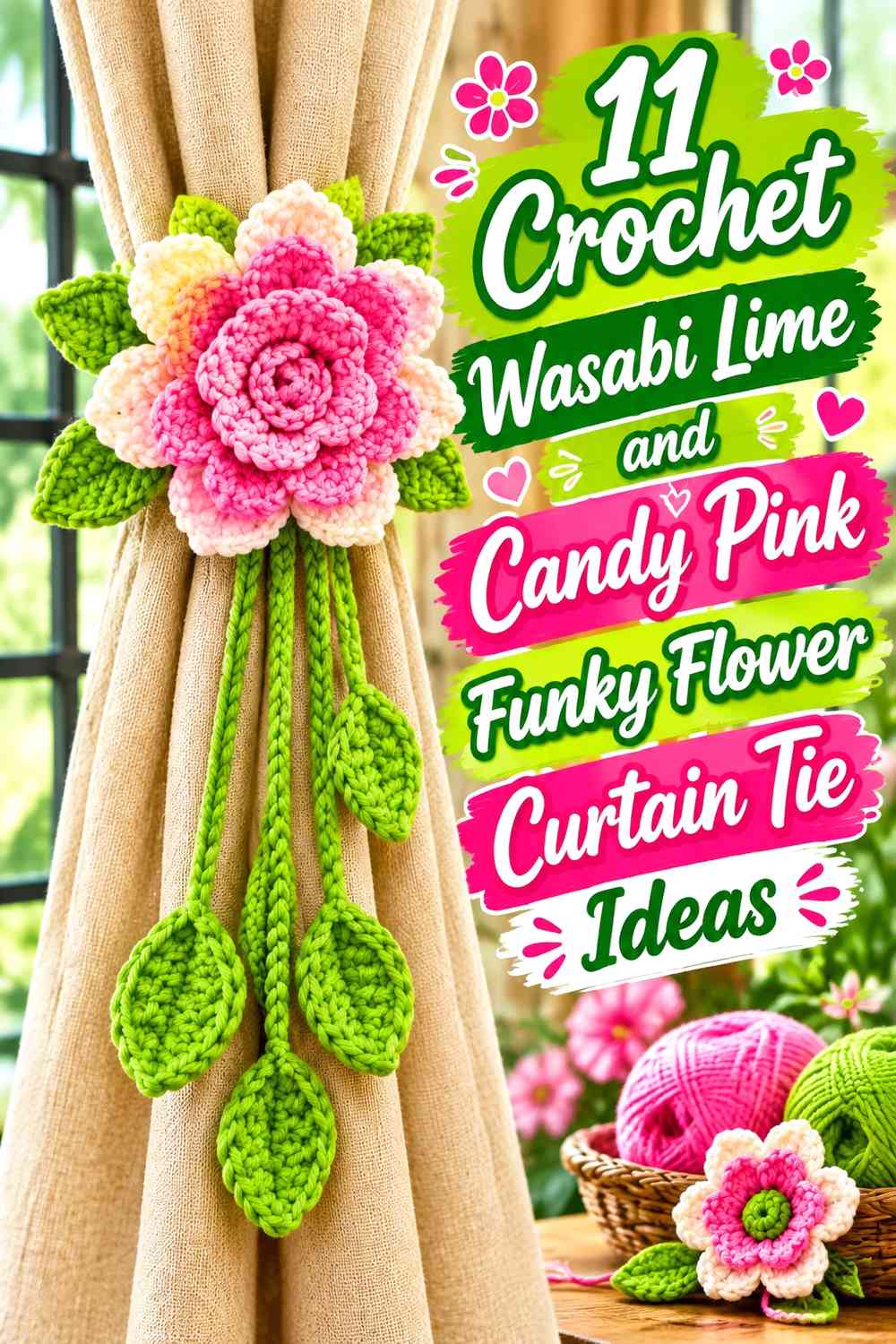

Wasabi Lime and Candy Pink make an intentionally lively pairing for crochet flower curtain ties. The green can function like an exaggerated botanical color across stems, leaves, cords, and tie bands, while Candy Pink gives petals and flower centers a strong decorative presence against gathered curtain fabric.
The main decision is not simply which color to use. It is how much space each color receives and where the contrast appears once the tie wraps around a curtain. A large Candy Pink flower can disappear into pink curtains, while an all-over Wasabi Lime band can become more visually dominant than the flower itself. These ideas change the balance, motif placement, accents, and distribution so the same two-color theme can move from graphic and retro to softer, scattered, or deliberately mismatched.
Quick List
- Wasabi Lime Band and Candy Pink Layered Rose Crochet Curtain Tie
- Wasabi Lime Daisy and Candy Pink Center Crochet Curtain Tie
- Candy Pink Tulip and Wasabi Lime Stem Crochet Curtain Tie
- Candy Pink Bell Flowers and Wasabi Lime Vine Crochet Curtain Tie
- Wasabi Lime Flower and Candy Pink Petal Edge Crochet Curtain Tie
- Candy Pink Six-Petal Flower and Wasabi Lime Outline Crochet Curtain Tie
- Wasabi Lime Band and Candy Pink Ruffled Flower Crochet Curtain Tie
- Candy Pink Mini Flowers and Wasabi Lime Links Crochet Curtain Tie
- Candy Pink Flower, Wasabi Lime Frame, and Charcoal Crochet Curtain Tie
- Wasabi Lime Tie and Candy Pink Rose Crochet Curtain Tie
- Candy Pink and Wasabi Lime Layered Flower Crochet Curtain Tie
Balance Wasabi Lime and Candy Pink Around the Curtain Folds
Curtain ties are viewed differently from flat crochet pieces because much of the band disappears around gathered fabric. Decide which color deserves to remain visible from the front before assigning it to the tie, leaves, or flower. If Candy Pink is meant to be the focal color, concentrating it on front-facing petals usually protects that role even when most of the Wasabi Lime band sits behind the curtain.
A more experimental option is to reverse those expectations and crochet a Wasabi Lime flower with Candy Pink structural details. That puts the less traditionally floral shade in the most prominent position and immediately gives the tie a funkier direction.
Check Wasabi Lime and Candy Pink Contrast Before Repeating the Pair
Hue difference does not guarantee strong light-and-dark separation. Depending on the yarns chosen, Wasabi Lime and Candy Pink may be quite similar in value even though they look very different in color.
Place the yarns side by side and, if necessary, check a grayscale photo before committing to small flower centers or narrow edging. If the two shades merge at a distance, a small cream, deep plum, orange, or charcoal detail can create separation without taking over the main Wasabi Lime and Candy Pink identity.
1. Wasabi Lime Band and Candy Pink Layered Rose Crochet Curtain Tie
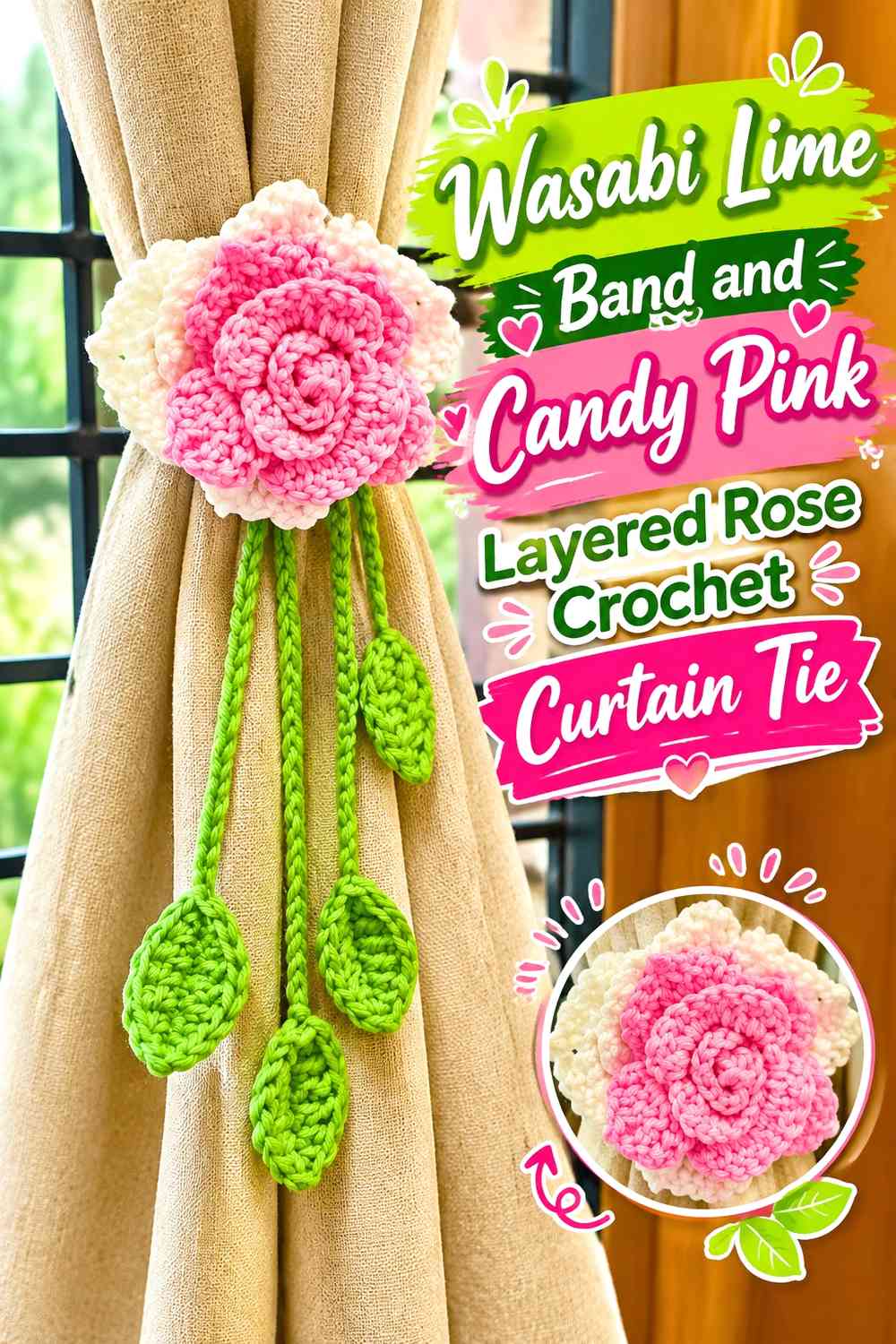
This version gives Candy Pink the largest decorative role through a layered flower while Wasabi Lime carries the functional tie and botanical details. That distribution keeps the bright green moving around the curtain without asking it to compete with every petal. It works particularly well when the flower is positioned where the curtain folds meet the front of the tie.
Candy Pink Should Stay Concentrated on the Layered Rose
Keep most of the Candy Pink on the flower rather than scattering equal amounts across the band. A concentrated pink area gives the rose a clear focal point and makes it easier to judge whether the flower remains visible after the curtain is gathered.
If the rose has several visible layers, slight changes in texture can already create enough separation. There is no need to introduce many extra colors unless the Candy Pink layers visually collapse together from normal viewing distance.
Wasabi Lime Can Connect the Rose to the Curtain Tie
Use Wasabi Lime on the surrounding band, leaves, or connecting sections so the flower does not look like a separate appliqué placed randomly on the tie. Repeating green immediately beside the Candy Pink rose creates a deliberate transition from decorative flower to functional holder.
If the curtain itself is green, however, check whether the Wasabi Lime band disappears into it. In that case, let more Candy Pink extend toward the attachment area so the finished tie remains readable.
Creator Credit: Hopeful Turns
2. Wasabi Lime Daisy and Candy Pink Center Crochet Curtain Tie
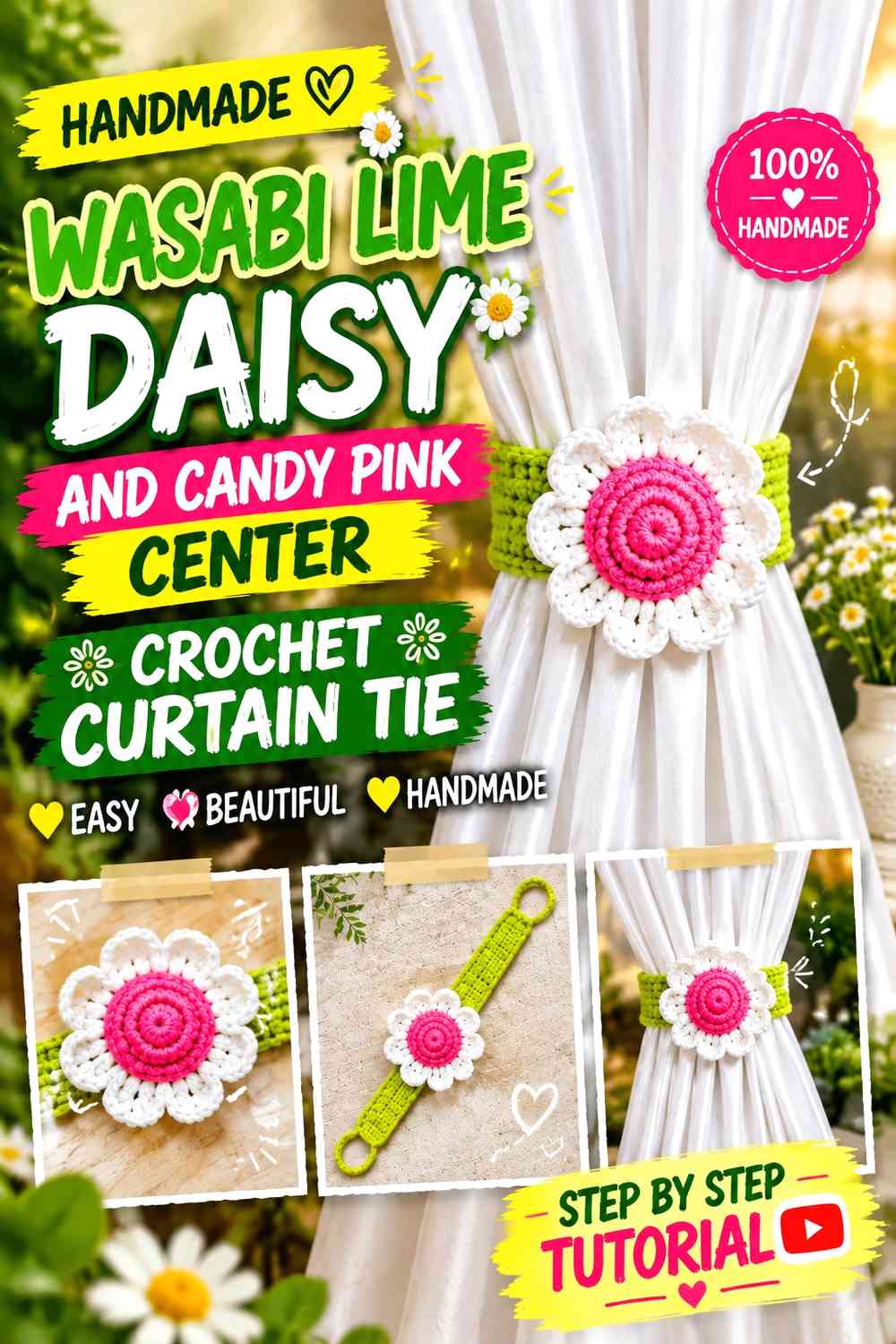
Turning Wasabi Lime into the flower color makes this version noticeably less conventional. Instead of treating green only as a leaf shade, let it cover the daisy-style petals and reserve Candy Pink for the center, small joining details, or the visible end of the tie.
Wasabi Lime Petals Make the Flower the Main Graphic Element
Use Wasabi Lime across the full petal shape when you want the curtain tie to look intentionally playful rather than botanically realistic. Because the green occupies the widest part of the motif, the flower remains the first thing seen even if the tie band is quieter.
Check the motif against the actual curtain before making a matching pair. Wasabi Lime petals can have very different visibility against white, beige, patterned, or green fabric.
Candy Pink Gives the Wasabi Lime Daisy a Defined Center
Candy Pink works well in the center because a compact contrasting circle can help organize several bright Wasabi Lime petals. If the two yarn colors are close in value, enlarge the visual separation with a tiny neutral ring rather than adding more pink across every petal.
Keeping Candy Pink controlled also makes it easier to repeat a small pink detail elsewhere on the tie without making both colors compete for equal attention.
Creator Credit: Drashti Crochet
3. Candy Pink Tulip and Wasabi Lime Stem Crochet Curtain Tie
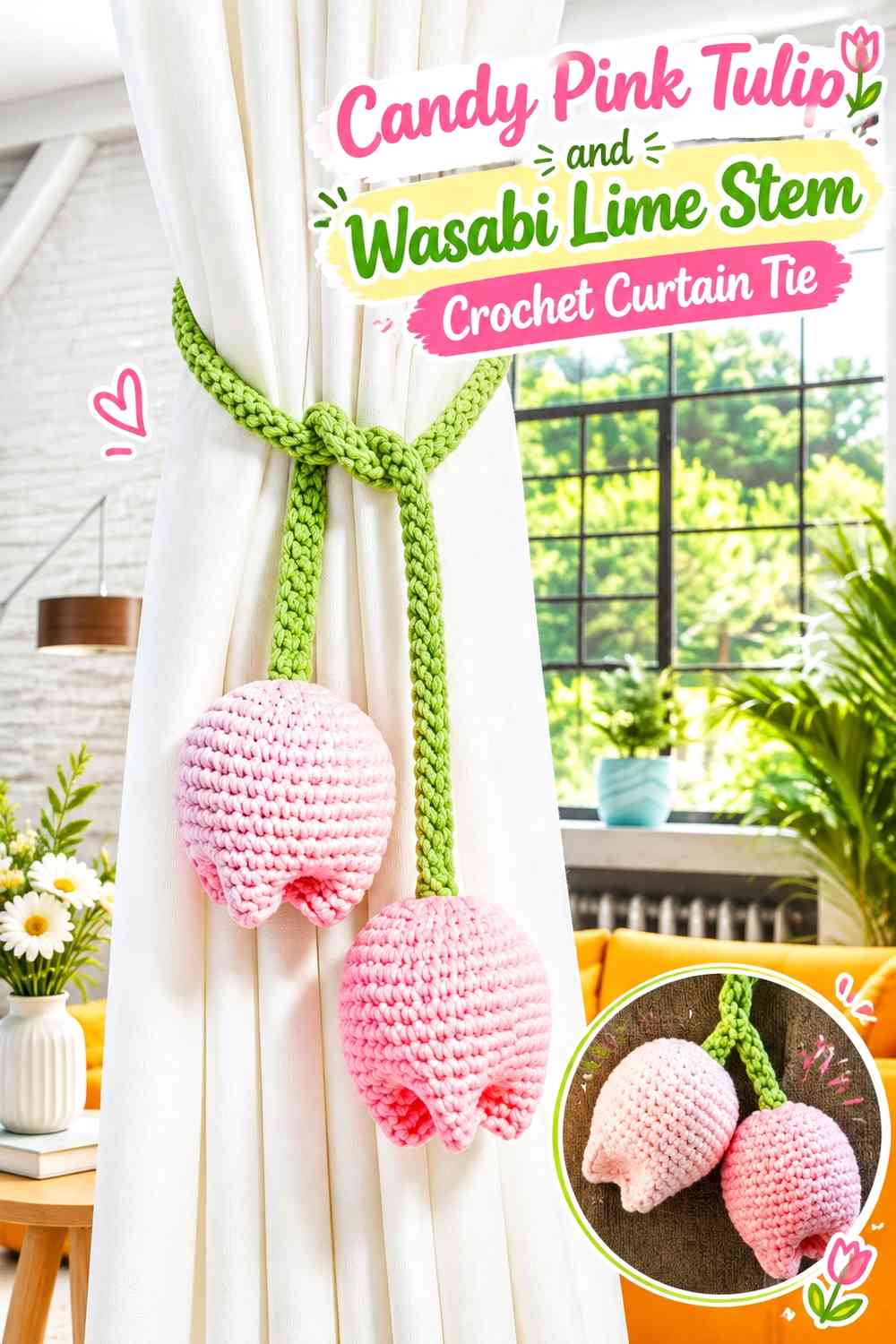
A tulip-style shape creates a cleaner color division than a many-petaled flower. Candy Pink can stay concentrated in the closed or cupped bloom while Wasabi Lime forms the stem, leaves, and tying section. The result gives each color a distinct job instead of mixing them throughout the motif.
Candy Pink Keeps the Tulip Shape Easy to Read
Let Candy Pink cover the main bloom without interrupting it with several small color changes. A continuous pink flower shape is easier to recognize when the curtain tie is viewed from across a room or partially surrounded by fabric folds.
Position the Candy Pink bloom toward the front of the gathered curtain. If it rotates toward the wall, the strongest part of the palette will disappear.
Wasabi Lime Can Extend From the Tulip Into the Tie
Carrying Wasabi Lime from the stem into the functional tie creates continuity and reduces the need for a third connecting color. This is especially useful for a tulip design because the green line can visually lead from flower to wrap.
If the green feels too dominant once the tie circles the curtain, keep the back section simple and add only a small Candy Pink repeat near the visible closure.
Creator Credit: Let’s crochet
4. Candy Pink Bell Flowers and Wasabi Lime Vine Crochet Curtain Tie
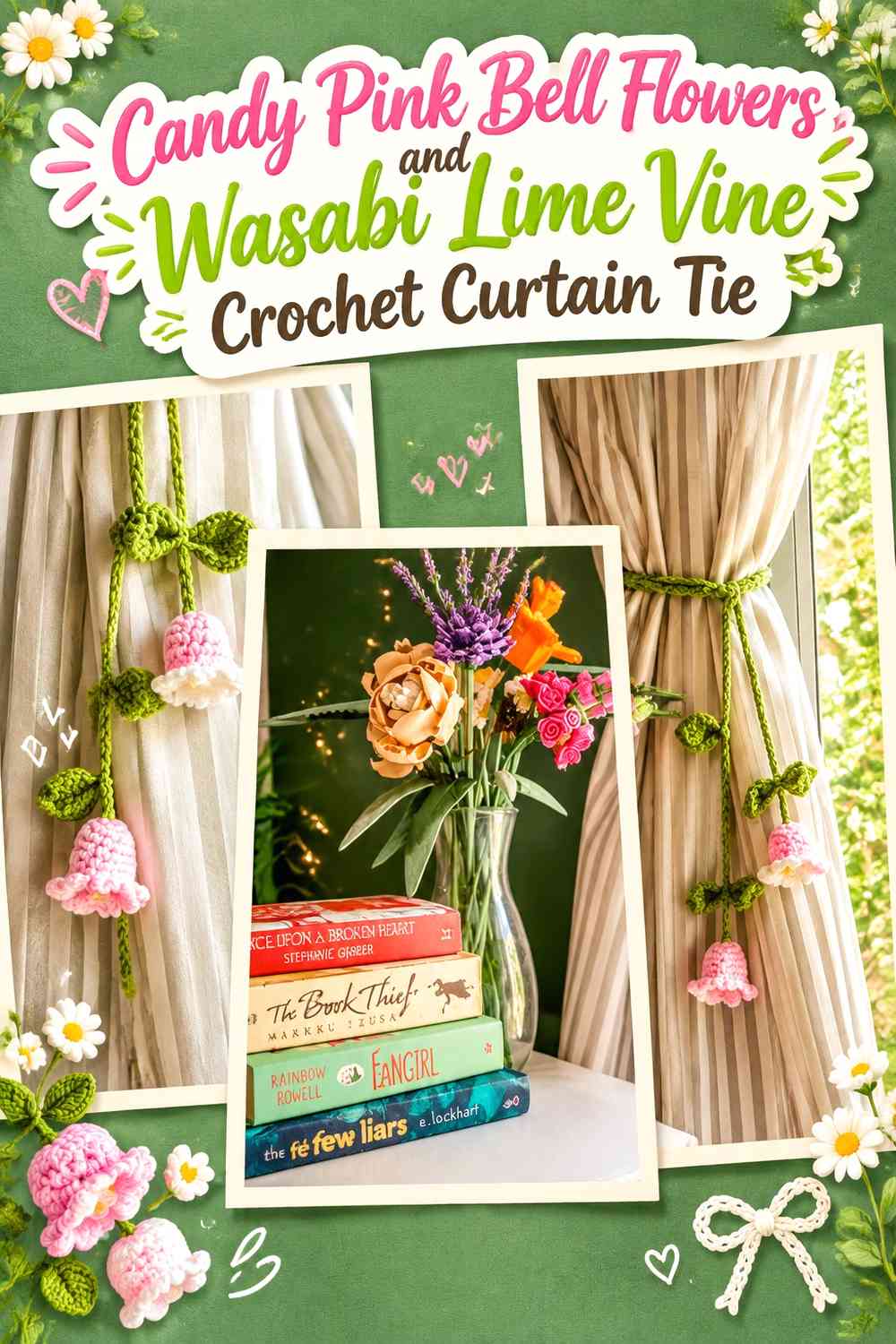
Small hanging flowers spread the palette differently from one oversized bloom. Candy Pink can appear in several repeated flower heads while Wasabi Lime forms the connecting vine or cord. This gives the tie movement and makes the pink appear at intervals rather than as one solid block.
Candy Pink Repetition Keeps Small Flowers Connected
When individual flowers are small, repeat the same Candy Pink consistently enough that they read as one decorative group. Too many unrelated flower colors can weaken the specific Wasabi Lime and Candy Pink direction.
The pink flowers do not need to be evenly spaced, but check the tie around the curtain before final attachment so most of the Candy Pink does not accidentally end up behind the fabric.
Wasabi Lime Gives the Candy Pink Flowers a Continuous Path
Use Wasabi Lime as the visual thread connecting the flowers. The green vine can run around the curtain while the Candy Pink flowers sit mainly on the visible front and side.
If the vine is highly textured, avoid adding too many additional green embellishments. The color already links the motifs, so extra leaves should support the layout rather than hide the small Candy Pink blooms.
Creator Credit: strawberryshort_crochet
5. Wasabi Lime Flower and Candy Pink Petal Edge Crochet Curtain Tie
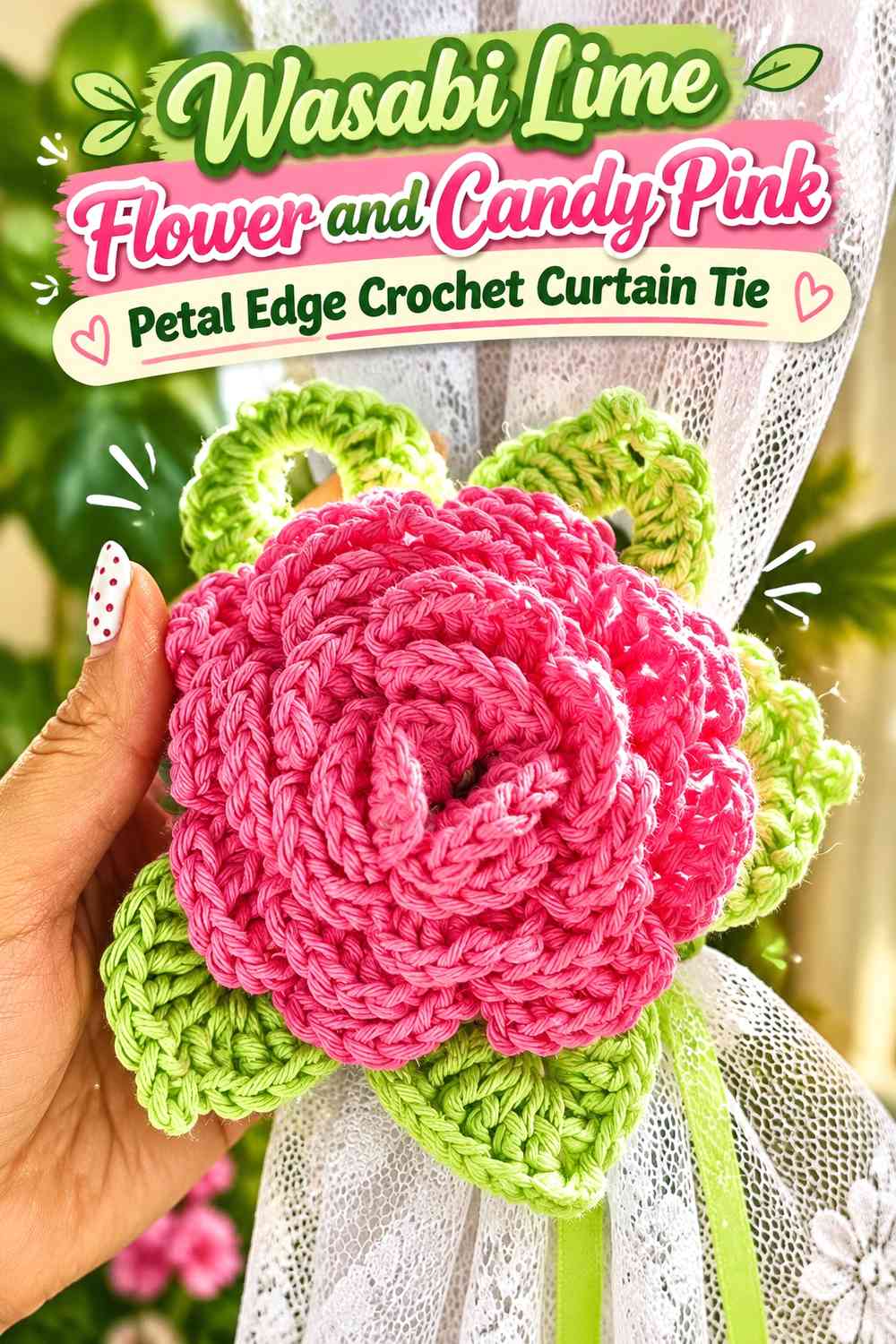
This idea uses Wasabi Lime as the flower itself and Candy Pink only around selected outer details. The color reversal gives the motif an unusual retro look while still keeping both requested shades clearly visible.
Wasabi Lime Needs Enough Area to Establish the Flower Shape
Let Wasabi Lime cover the central body of the motif instead of reducing it to a narrow stripe. If pink occupies most of every petal, the flower will simply read as Candy Pink with green trim.
A broad Wasabi Lime center also creates a useful checkpoint for curtain coordination. Hold the finished motif against the curtain before attaching the tie and confirm that the green does not disappear into surrounding decor.
Candy Pink Edging Can Separate Wasabi Lime Petals From the Curtain
Use Candy Pink along petal tips, an outer round, or another narrow edge when extra definition is needed. This is particularly useful against greenish or botanical-print curtains, where a solid Wasabi Lime flower may blend into the background.
Keep the Candy Pink edge consistent. Random pink sections around only part of the flower can look accidental unless the entire tie intentionally uses an asymmetric layout.
Creator Credit: By Erika Trujillo | Crochet
6. Candy Pink Six-Petal Flower and Wasabi Lime Outline Crochet Curtain Tie
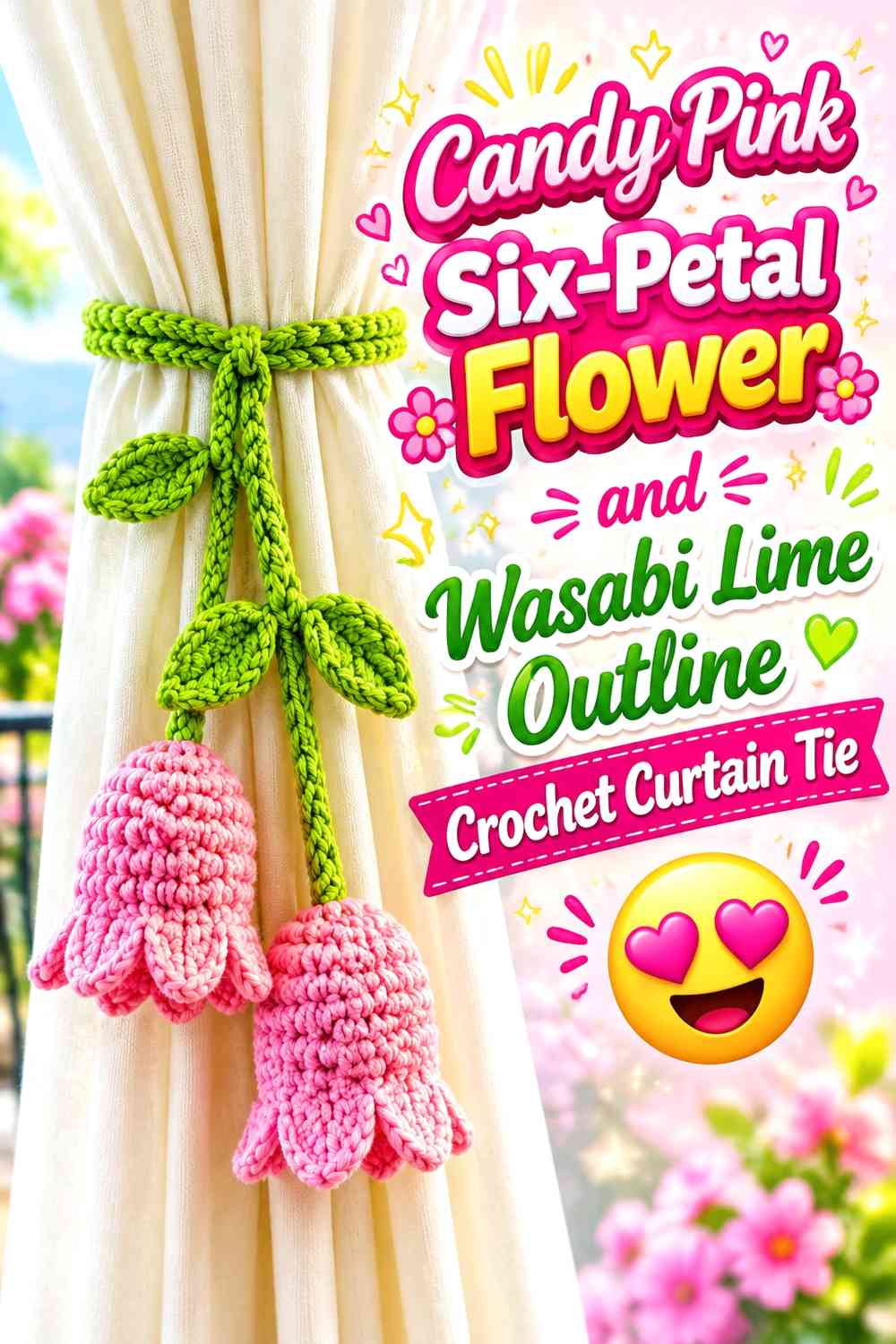
A clear six-petal form is a good place to make the color boundary more graphic. Candy Pink can fill the petals while Wasabi Lime defines the outer edge, center connection, or surrounding holder. This keeps the flower bright without losing its silhouette.
Candy Pink Works Best as One Continuous Petal Field
When the petals already create a strong repeated shape, letting Candy Pink remain continuous gives the motif more impact than changing color on every small section. The petal edges and negative spaces provide visual structure on their own.
If the curtain has a busy pattern, test the flower at its intended height. Candy Pink may need a stronger border when surrounded by other colorful shapes.
Wasabi Lime Can Outline Candy Pink Without Taking Over
A narrow Wasabi Lime edge can make the Candy Pink petal silhouette easier to see while preserving pink as the dominant flower color. Continue a little of that green into the holder so the outline feels connected to the rest of the tie.
Avoid making the green border so wide that it becomes a second set of petals. The point here is definition, not a fifty-fifty split.
Creator Credit: Tejiendo con Rube
7. Wasabi Lime Band and Candy Pink Ruffled Flower Crochet Curtain Tie
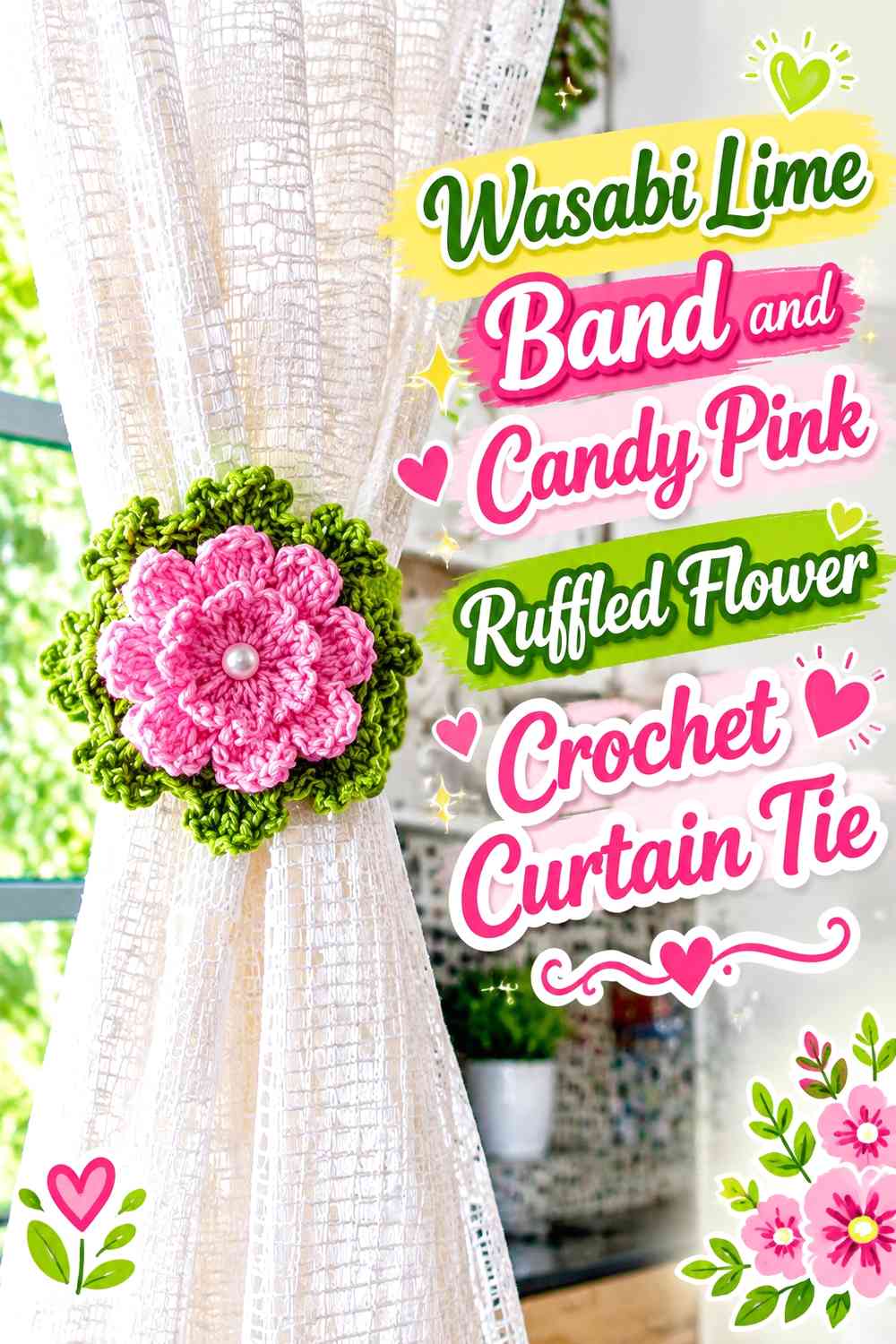
A ruffled flower creates more shadows and overlapping surfaces than a flat motif, so this version can keep the palette relatively simple. Wasabi Lime provides a crisp band behind the gathered curtain, while Candy Pink occupies the dimensional flower at the front.
Candy Pink Ruffles Need Space to Stay Visible
Do not place a dimensional Candy Pink flower so deeply between curtain folds that the outer petals are compressed. Check the finished tie on the actual curtain and rotate the flower toward the room before deciding where to secure it.
Because ruffles already create light and shadow, one Candy Pink yarn can show considerable texture without requiring multiple pink shades.
Wasabi Lime Should Support the Candy Pink Focal Flower
A Wasabi Lime band gives the ruffled flower a bright botanical base, but the green should not cover so much of the visible front that the motif loses priority. Let the band disappear naturally around the curtain while the Candy Pink flower remains exposed.
For a matching pair, compare the amount of green visible on both sides of the window. Similar color exposure can make two handmade ties feel more deliberately coordinated.
Creator Credit: JNY Crochê
8. Candy Pink Mini Flowers and Wasabi Lime Links Crochet Curtain Tie
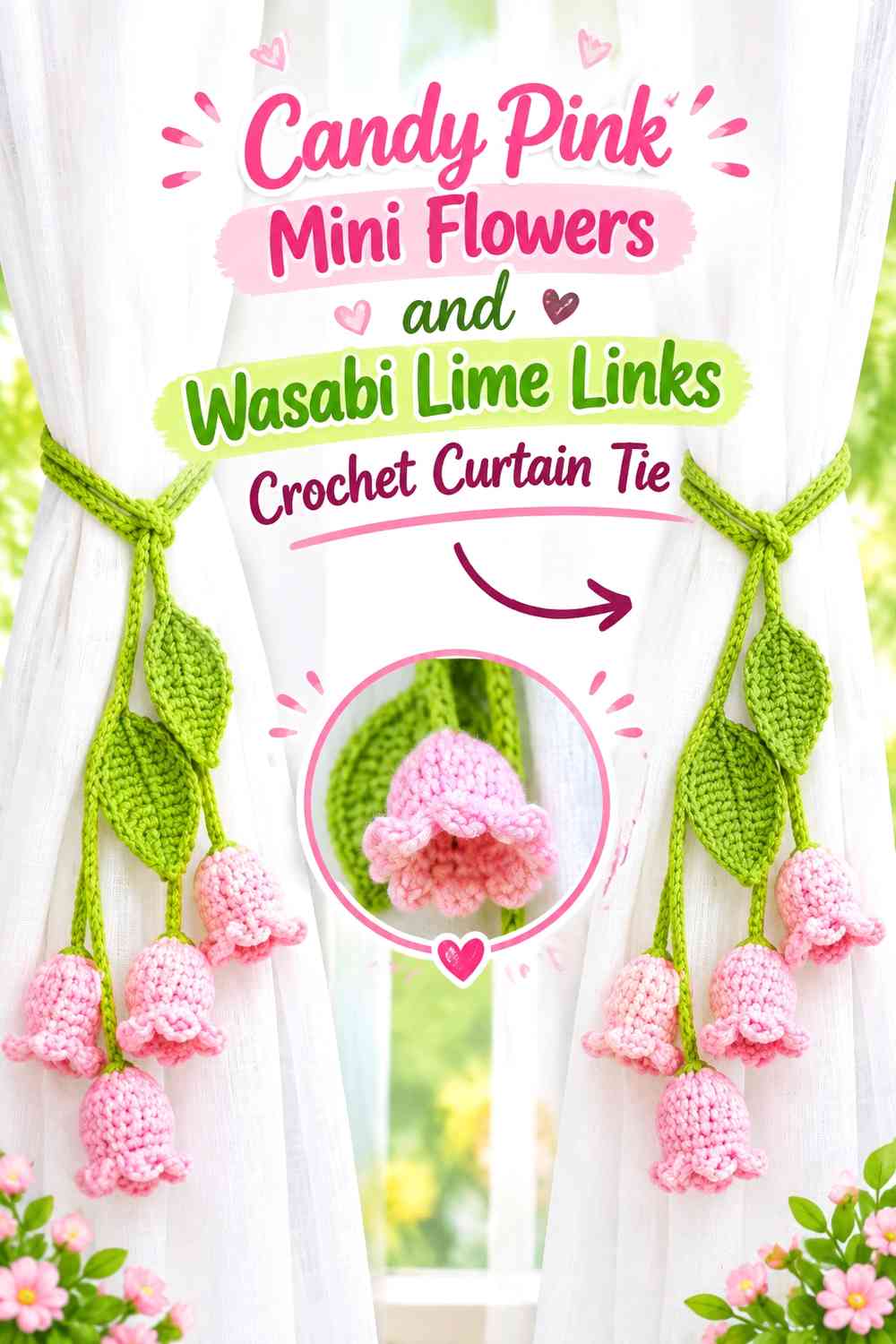
Instead of one central flower, distribute several Candy Pink motifs along the holder and use Wasabi Lime between them. This creates a busier, more obviously funky color rhythm that can work well on plain curtain panels.
Candy Pink Mini Flowers Need Repetition Rather Than Equal Spacing
Repeated Candy Pink flowers establish the main decorative language even when their spacing varies. Before attaching or finishing the motifs, wrap the tie around the curtain and mark the portion that actually faces the room.
Place the strongest pink concentration within that visible zone. Otherwise, several finished flowers may end up hidden behind the gathered panel.
Wasabi Lime Links Keep the Candy Pink Motifs From Becoming One Pink Strip
Use Wasabi Lime between flowers to preserve visible gaps and keep individual motifs identifiable. The green creates separation while also functioning as the botanical or structural color.
If the flowers are very close together, reduce other accents. Candy Pink plus Wasabi Lime already creates a high-energy combination, and too many equally strong additions can make a small curtain tie look crowded.
Creator Credit: zhaia croche
9. Candy Pink Flower, Wasabi Lime Frame, and Charcoal Crochet Curtain Tie
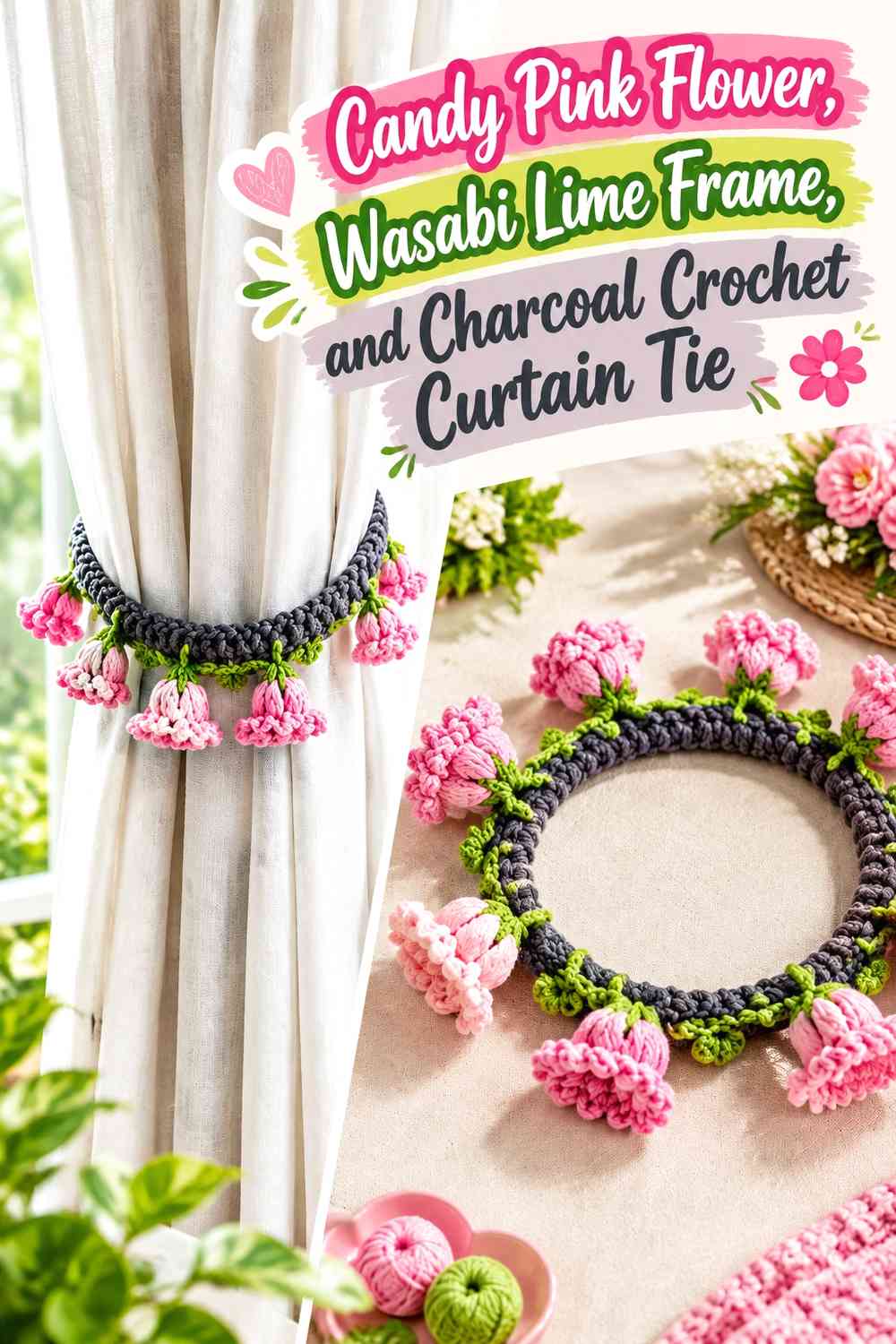
Adding a small charcoal accent changes the palette from purely bright to more graphic. Candy Pink remains the focal flower, Wasabi Lime surrounds or connects it, and charcoal can define a center, fastening detail, or very narrow edge.
Candy Pink and Wasabi Lime Should Still Control Most of the Surface
Treat charcoal as punctuation rather than a third equal color. A small dark detail can increase separation between Candy Pink and Wasabi Lime if the two bright shades are similar in value.
This works particularly well around a flower center or another compact area where a dark line can sharpen the motif without making the curtain tie look predominantly dark.
Charcoal Can Clarify Wasabi Lime and Candy Pink on Patterned Curtains
Patterned curtains may already contain several competing hues. A narrow charcoal detail can visually contain the bright crochet colors and make the flower easier to distinguish.
Check the effect from normal viewing distance. If the flower already reads clearly, additional dark edging may be unnecessary and could make the motif look heavier than intended.
Creator Credit: Handmade by Derya
10. Wasabi Lime Tie and Candy Pink Rose Crochet Curtain Tie
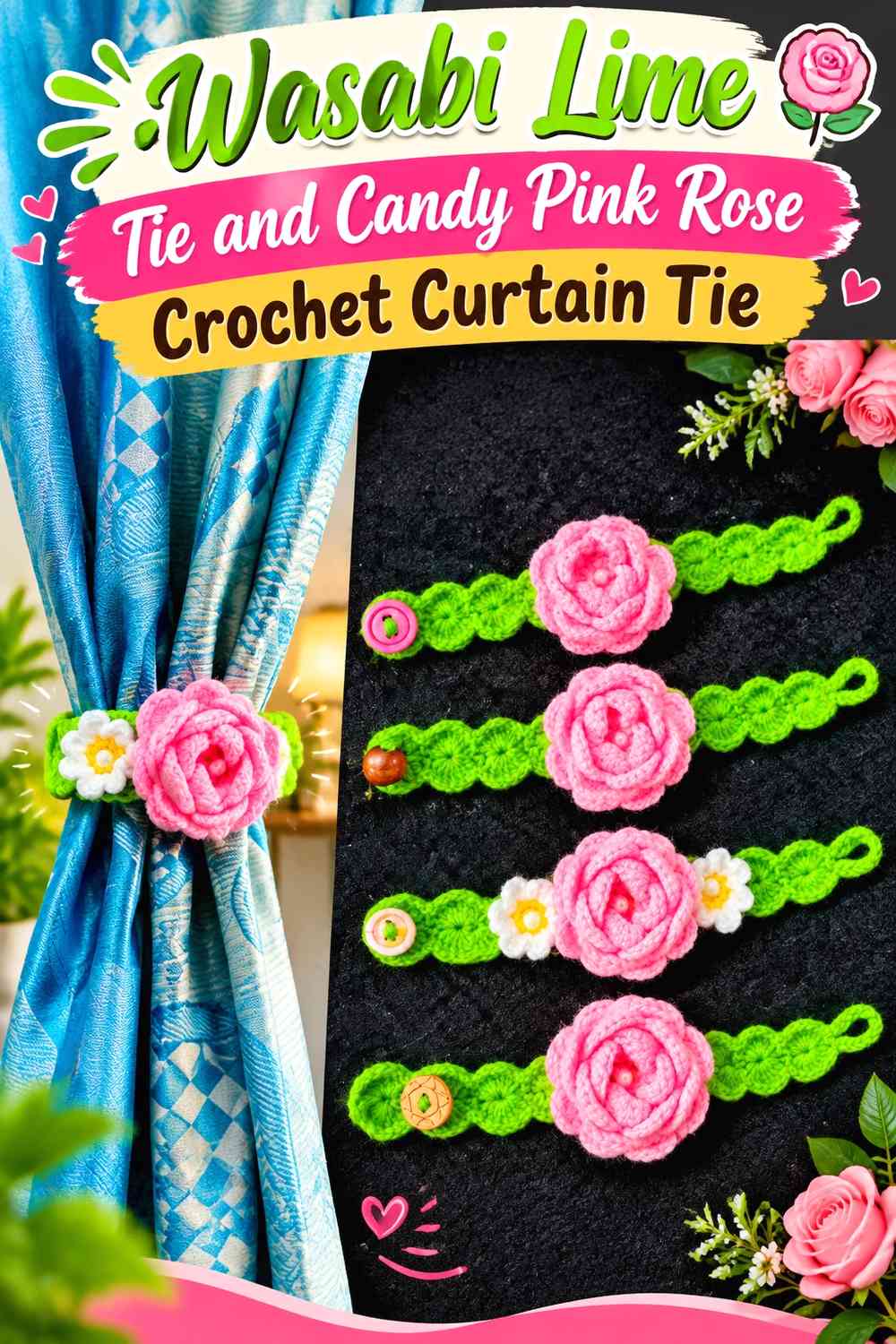
This is a strong two-color version for readers who want to avoid extra accent shades. Wasabi Lime covers most of the functional holder and Candy Pink forms the rose, creating an immediate green-and-flower relationship.
Candy Pink Should Remain the Main Rose Color
Keep Candy Pink across most visible rose layers when the goal is a clear focal bloom. Introducing Wasabi Lime inside every layer may weaken the rose silhouette and make the color distribution feel fragmented.
If more separation is needed between petal layers, rely first on the rose’s raised texture and shadows before adding another color.
Wasabi Lime Can Dominate the Hidden Tie Without Dominating the Finished View
The functional tie may use more yarn or cover more total area than the flower, yet much of it disappears behind the gathered curtain. That means Wasabi Lime can technically occupy more surface while Candy Pink still looks dominant from the front.
Judge the palette on the curtain rather than on a flat table. The visible color balance after wrapping matters more than the raw amount of each yarn used.
Creator Credit: Vaishali’s Crochet
11. Candy Pink and Wasabi Lime Layered Flower Crochet Curtain Tie
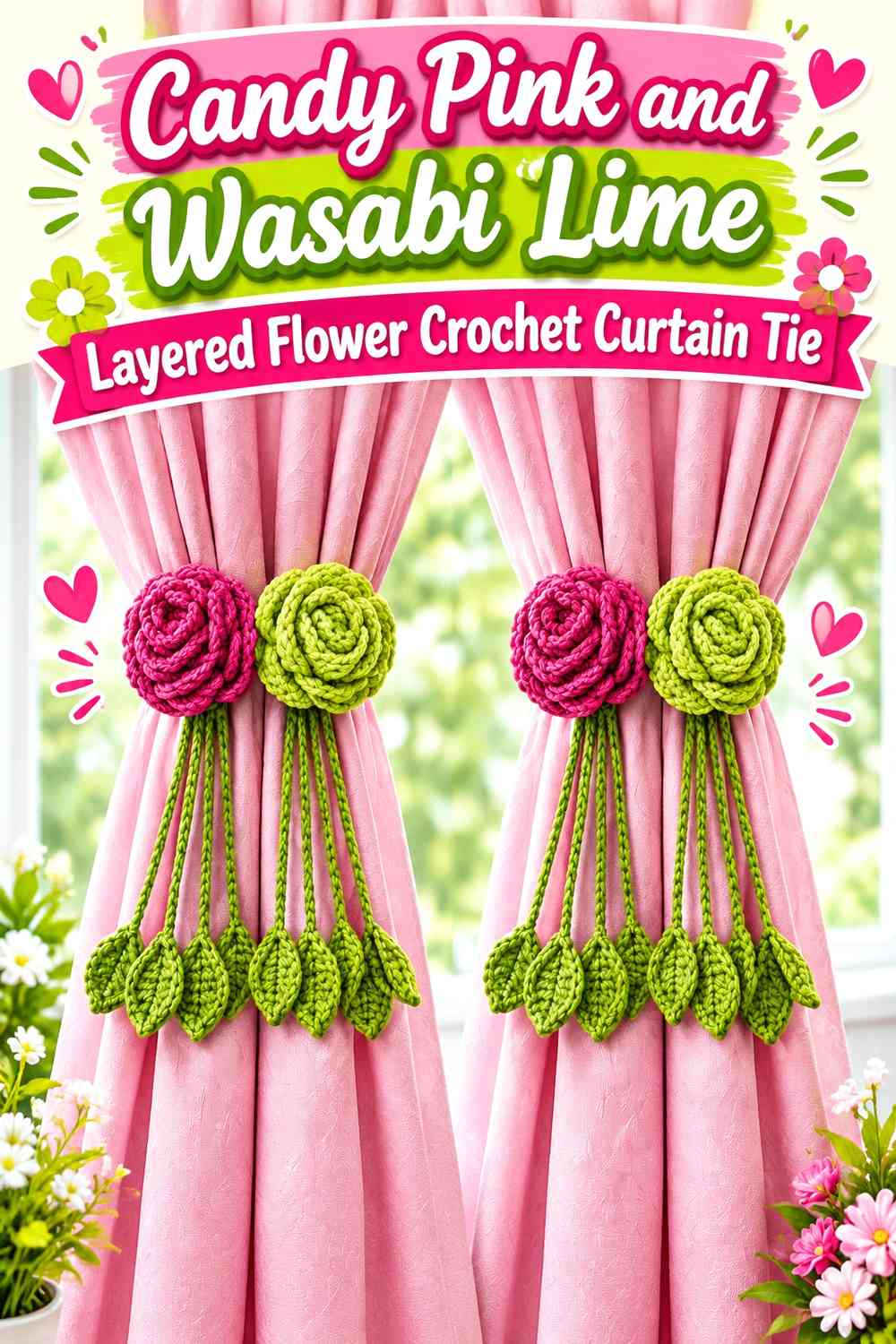
For the most balanced version, use Candy Pink and Wasabi Lime in alternating flower layers while keeping the tie itself comparatively simple. This puts the color interaction directly in the focal motif instead of separating pink into flowers and green into leaves.
Candy Pink and Wasabi Lime Layers Need Clear Visual Hierarchy
Alternating colors does not require equal amounts. Let either Candy Pink or Wasabi Lime occupy the larger outer layer, then use the second shade where it can define the center or inner petals.
Choosing one dominant layer prevents the flower from looking like several unrelated rings stacked together.
Wasabi Lime and Candy Pink Should Be Checked Against the Curtain Before Assembly
A balanced two-color flower can behave differently on different curtain fabrics. Against a pale neutral, both colors may remain clear. Against a colorful print, one layer may disappear while the other becomes unexpectedly dominant.
Lay the unfinished components against the gathered curtain before permanently joining the decorative section. If one shade vanishes, adjust its placement or introduce a very small neutral separator rather than rebuilding the entire palette.
Candy Pink Can Repeat Once Outside the Wasabi Lime Flower Cluster
If the layered flower contains most of both colors, repeat a tiny Candy Pink detail near the closure or end of the Wasabi Lime tie. That small repetition can make the band feel connected to the focal bloom without turning the entire holder into alternating stripes.
Keep the repeat restrained so the layered flower remains the main event.
Creator Credit: 𝐊𝐧𝐢𝐭𝐭𝐢𝐧𝐠 𝐛𝐲 𝐖𝐚𝐣𝐢𝐝𝐚
Which Wasabi Lime and Candy Pink Curtain Tie Direction Should You Choose?
Choose a Candy Pink flower with a Wasabi Lime band when you want the palette to keep a recognizable floral structure. Ideas 1, 3, 4, 7, and 10 use that relationship in different ways, from a large focal rose to scattered hanging blooms.
For a more unconventional result, move Wasabi Lime into the petals as in ideas 2 and 5. The green becomes decorative rather than merely botanical, which pushes the combination further toward a funky retro look.
Ideas 8 and 11 are stronger choices when you want both colors repeated across the visible portion of the tie, while idea 9 adds a small dark accent when the two bright colors need sharper separation.
Conclusion
Wasabi Lime and Candy Pink can create very different crochet flower curtain ties depending on which shade receives the largest visible area. Candy Pink petals with a Wasabi Lime tie give the clearest flower-and-foliage relationship, while green petals, alternating motifs, and layered two-color flowers make the combination less expected.
Before committing to a pair, test the planned flower against the actual gathered curtain. Check which parts of the tie disappear behind the fabric, whether Candy Pink and Wasabi Lime remain distinct from a distance, and whether the main flower still faces into the room. Use the linked creator tutorials for the exact construction methods, then apply the color direction that best suits the window.
Frequently Asked Questions
Should Wasabi Lime or Candy Pink dominate a crochet flower curtain tie?
Either can dominate. Candy Pink as the main petal color gives the tie a more recognizable floral layout, while Wasabi Lime petals create a more unconventional graphic effect. Decide based on which color you want to remain most visible on the front of the gathered curtain.
How can I tell whether Wasabi Lime and Candy Pink have enough contrast?
Place the yarns beside each other under the room’s normal light and look at them from several feet away. A grayscale photo can also reveal whether their light-and-dark values are very similar. If they merge, a small light or dark separator can help.
Can I use only Wasabi Lime and Candy Pink without a neutral?
Yes. A two-color scheme can be particularly effective when one shade clearly dominates the flower and the other handles the band, center, leaves, or edging. Extra neutrals are useful only when you need additional separation or want to change the visual direction.
What curtain colors work with Wasabi Lime and Candy Pink crochet ties?
Neutral or relatively simple curtains give both colors plenty of room to show, but colorful curtains can work too. Test the yarn directly against the fabric rather than assuming a particular curtain color will match. The important issue is whether the flower remains distinguishable once the curtain is gathered.
Should Candy Pink flowers be placed evenly along a Wasabi Lime curtain tie?
Not necessarily. For a mini-flower or garland design, visibility matters more than mathematically even spacing. Wrap the unfinished tie around the curtain first and make sure enough Candy Pink motifs land on the front-facing section.
What should I preserve if I cannot find the exact Wasabi Lime or Candy Pink yarn?
Preserve the relationship between the colors rather than searching for an exact commercial match. For Wasabi Lime, choose a similarly lively yellow-green direction; for Candy Pink, choose a clear, saturated pink that still remains visually distinct from the green. Compare the substitutes together before crocheting the full pair.