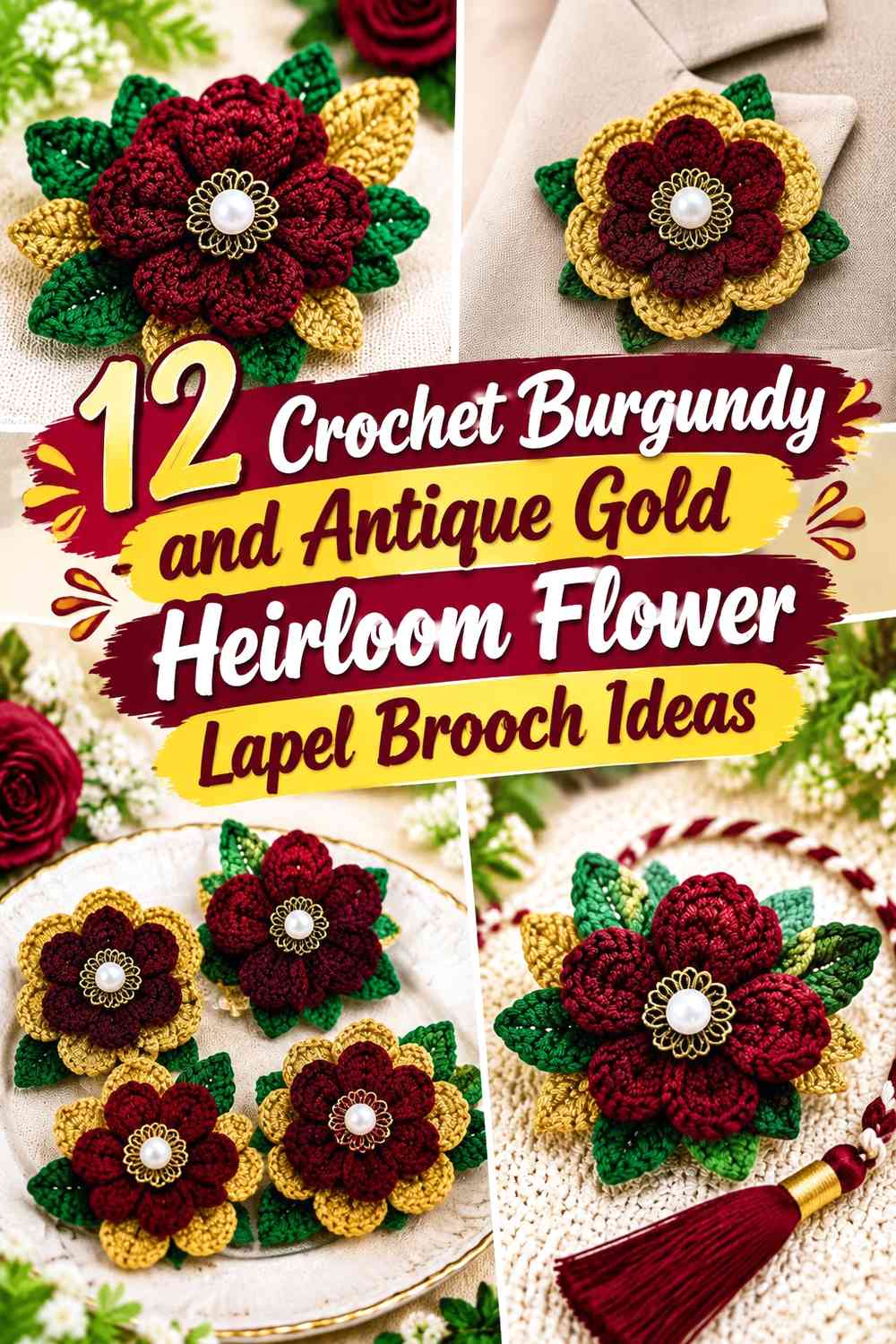

Burgundy and Antique Gold can give a crochet flower lapel brooch the depth of an old textile accessory without requiring a complicated multicolor palette. Burgundy provides the darker visual mass, while Antique Gold can illuminate petal edges, centers, raised details, or smaller secondary layers. Here, Antique Gold describes a muted, aged-gold color direction rather than a specific commercial yarn or metallic fiber.
Because a brooch occupies much less visual space than a cardigan or blanket, proportion matters. An equal split of Burgundy and Antique Gold can look much stronger on a small flower than it would across a large project. Sometimes a gold center is enough; in other designs, outlining whole petals in Antique Gold gives the flower a more decorative, jewelry-like character.
The tutorials used for these ideas support the flower, motif, appliqué, or brooch construction concept. The Burgundy and Antique Gold arrangements are independent color adaptations and should not be attributed to the creators unless their tutorials specifically use them.
Quick List
- Burgundy Layered Flower Crochet Lapel Brooch with Antique Gold Center
- Burgundy and Antique Gold Vintage Layered Crochet Flower Brooch
- Burgundy Rose Crochet Lapel Brooch with Antique Gold Inner Petals
- Antique Gold Spiral Crochet Flower Brooch with Burgundy Outer Petals
- Burgundy Camellia Crochet Brooch with Antique Gold Petal Edging
- Burgundy Daisy Crochet Lapel Brooch with an Antique Gold Center
- Burgundy Pansy Crochet Brooch with Antique Gold Lower-Petal Detail
- Burgundy Orchid Crochet Lapel Brooch with Antique Gold Throat
- Burgundy Irish Lace Crochet Flower Brooch with Antique Gold Knotted Center
- Antique Gold Irish Lace Crochet Brooch with Burgundy Raised Petals
- Burgundy Daffodil Crochet Lapel Brooch with Antique Gold Trumpet
- Burgundy Magnolia Crochet Brooch with Antique Gold Inner Petal Accents
Let Burgundy Establish the Heirloom Flower Shape
Burgundy works especially well across larger petals because its depth gives the flower a defined silhouette on lighter jackets, cardigans, scarves, and lapels. On a dimensional crochet flower, it can also emphasize the shadows between overlapping petals.
The risk is losing small stitch details inside one uninterrupted dark area. If the brooch has tiny petal divisions, a raised center, or several tightly layered sections, Antique Gold can be placed beside those details to create enough light-and-dark separation for the structure to remain visible.
Use Antique Gold Where the Crochet Brooch Needs Definition
Antique Gold does not need to cover half the flower. A small center, narrow petal border, contrasting inner layer, or a few repeated details may provide all the contrast a compact brooch needs.
Before adding more gold, view the flower at the distance from which it will normally be seen on a lapel. If the Burgundy petals and center already separate clearly, additional Antique Gold may make the accessory busier rather than more legible.
Keep Burgundy and Antique Gold Balanced Around the Lapel Pin
Color placement should also respect how the finished flower hangs. A large Antique Gold section on only one side can make an intentionally asymmetrical flower look even more directional. That may be useful for an orchid or botanical spray, but less suitable for a round rose or daisy when a balanced silhouette is the goal.
Finish the visible flower before choosing the final backing position whenever possible. Check the brooch upright on the intended garment so the most decorative Burgundy and Antique Gold details face outward rather than tilting toward the lapel.
1. Burgundy Layered Flower Crochet Lapel Brooch with Antique Gold Center
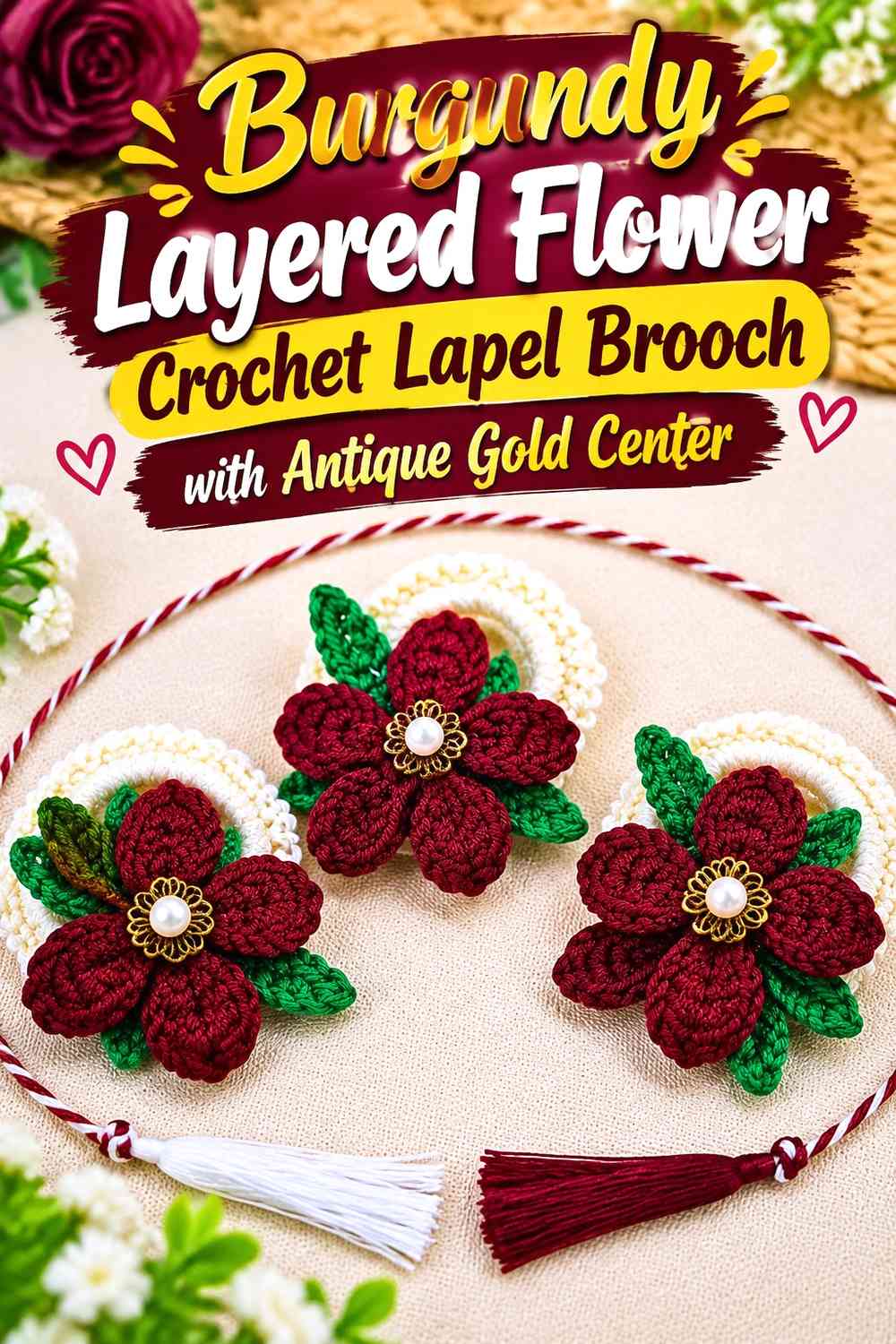
This version gives Burgundy most of the visual area through overlapping petals and reserves Antique Gold for the center. It is one of the simplest ways to make the two-color palette feel controlled because the dark flower remains clearly dominant while the lighter center establishes a single focal point.
Burgundy Should Carry Most of the Layered Crochet Petals
Keep the larger petal layers Burgundy if you want the flower to read as one substantial dark bloom. The overlapping crochet naturally creates shadows between layers, so alternating every petal Burgundy and Antique Gold is not necessary for definition.
If the finished layers start blending together, Antique Gold can appear on one smaller inner layer rather than across the full outer edge. This preserves the Burgundy silhouette while making the flower’s depth easier to see.
Antique Gold Gives the Burgundy Brooch a Concentrated Focal Point
A compact Antique Gold center can direct attention to the middle without dividing the flower into several competing color areas. This is particularly useful on a lapel brooch, where every contrasting detail has more visual weight than it would on a larger crochet project.
Check the center against the completed Burgundy petals before enlarging it. If Antique Gold begins covering much of the innermost petal layer, reduce its visual area so the flower still reads as Burgundy-led.
Creator Credit: Crochet your life
2. Burgundy and Antique Gold Vintage Layered Crochet Flower Brooch
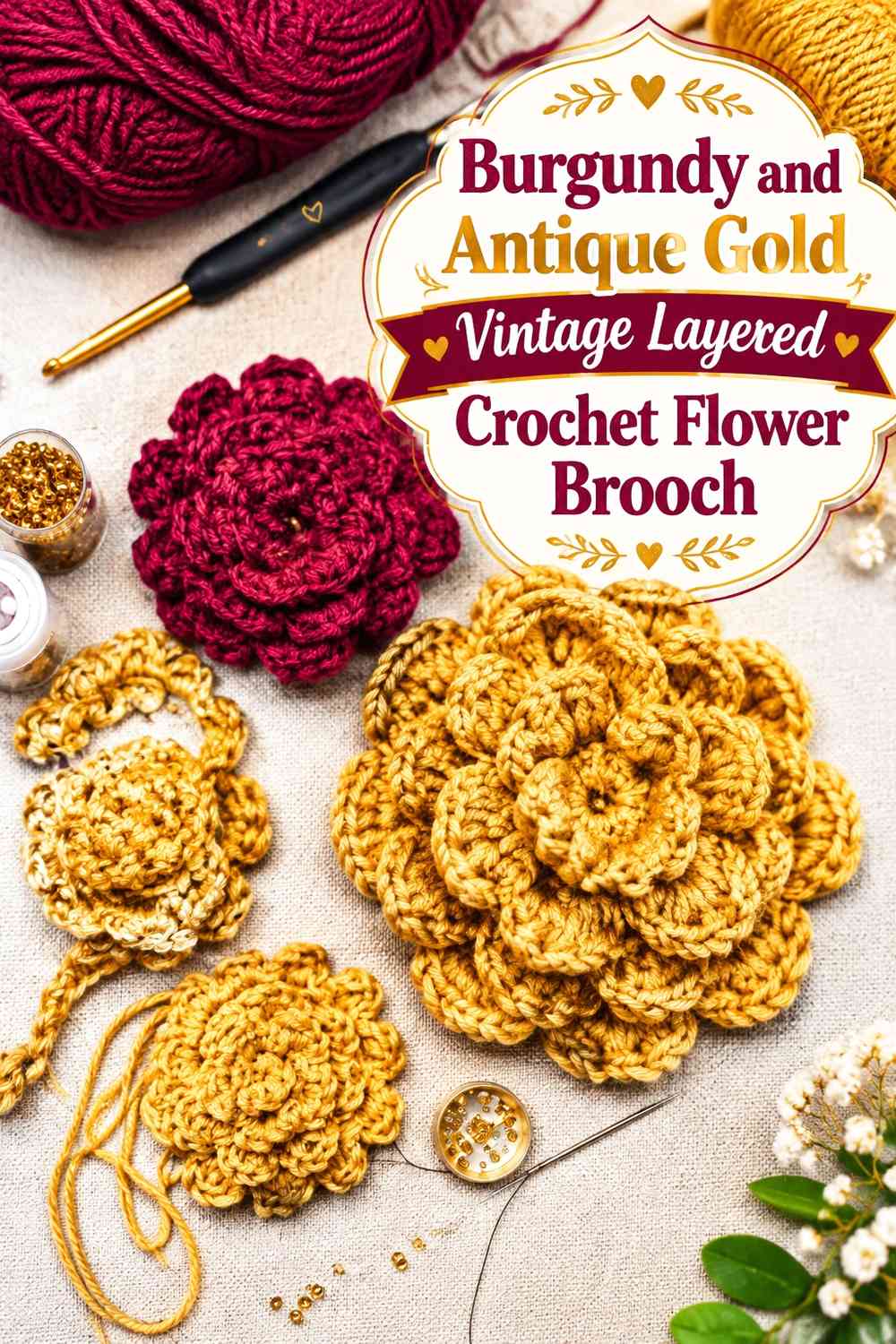
This idea gives both colors more presence by using Burgundy through one petal layer and Antique Gold through another. The important choice is hierarchy: one color should still establish the main silhouette while the other reveals the stacked construction.
Burgundy Can Anchor the Antique Gold Crochet Petal Layer
Use Burgundy on the broader or visually heavier layer so the outside of the brooch remains dark and defined. Antique Gold can then appear on a smaller layer where its lighter value exposes the separation between petals.
Avoid making every layer the same visual width. If the Burgundy and Antique Gold areas become almost equal concentric rings, the flower may look striped rather than naturally layered.
Antique Gold Should Reveal Burgundy Layers Rather Than Hide Them
Offset the Antique Gold petals so some Burgundy remains visible between them. The contrast works because both colors can be seen simultaneously; perfectly covering one dark layer with a lighter one removes much of the reason for using two colors.
This arrangement is especially useful for a vintage-inspired flower with several stacked components because color can make the depth apparent even before the viewer notices the stitch texture.
Creator Credit: Loopy Mabel Crochet
3. Burgundy Rose Crochet Lapel Brooch with Antique Gold Inner Petals
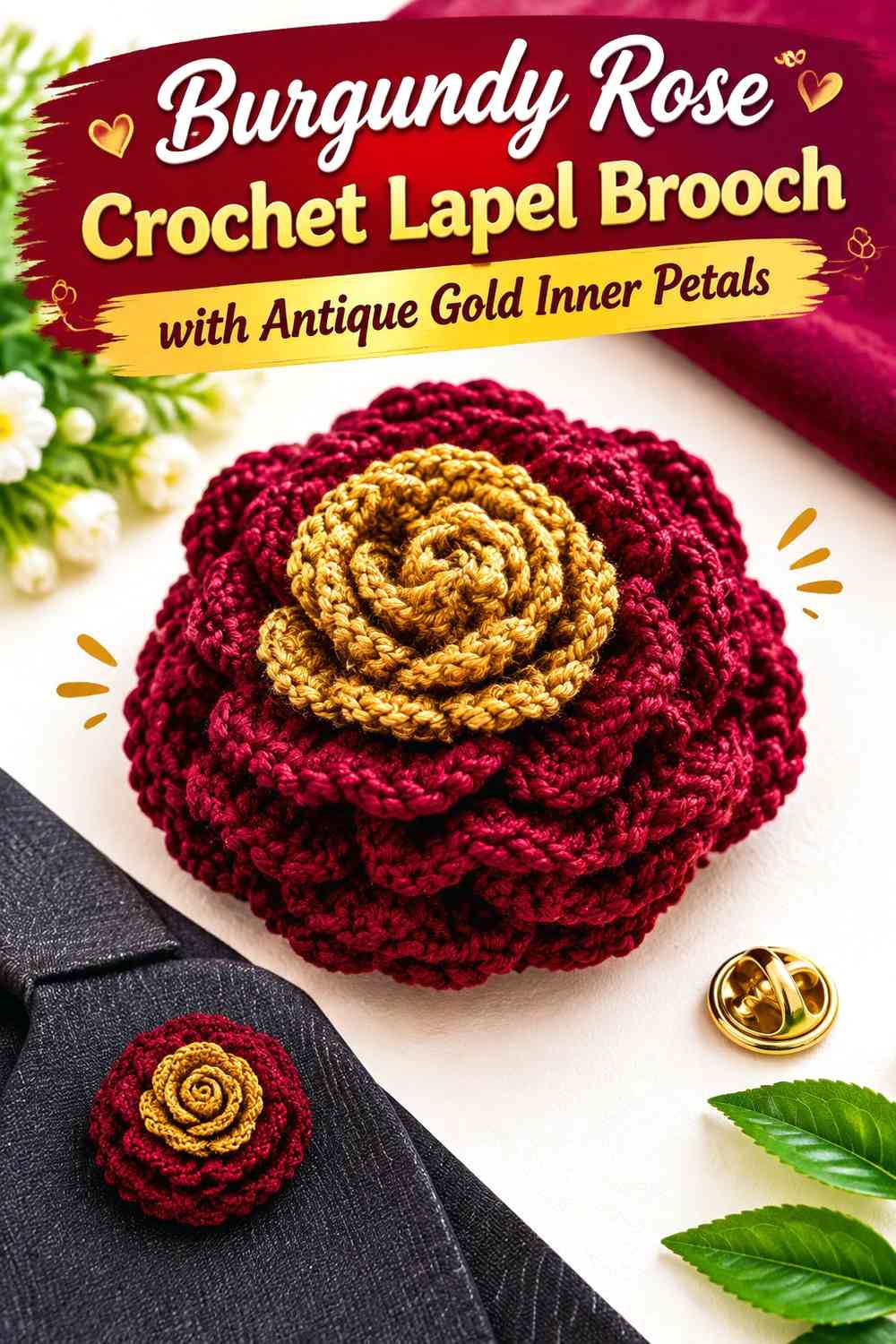
A rose allows the palette to change gradually from center to edge. Antique Gold can occupy the tight inner curl, while Burgundy takes over through the larger outer petals. That creates a light center surrounded by progressively more dark color rather than a sharp two-part split.
Antique Gold Can Illuminate the Burgundy Crochet Rose Center
Keeping Antique Gold near the middle helps the spiral or rolled center remain recognizable when Burgundy dominates the outside. The lighter center also prevents several tightly packed Burgundy folds from merging into one dark mass.
Keep the gold portion relatively compact when you want a Burgundy rose rather than an Antique Gold rose with Burgundy edging.
Burgundy Outer Petals Give Antique Gold More Visual Depth
As the petals open outward, Burgundy creates a darker frame around the lighter middle. This makes the rose look visually deeper because the center and exterior occupy clearly different values.
Before attaching the backing, rotate the completed rose and decide which section shows the Burgundy-to-Antique-Gold transition most clearly. That side should normally face upward when the brooch is worn.
Creator Credit: Frisian Knitting tutorials
4. Antique Gold Spiral Crochet Flower Brooch with Burgundy Outer Petals
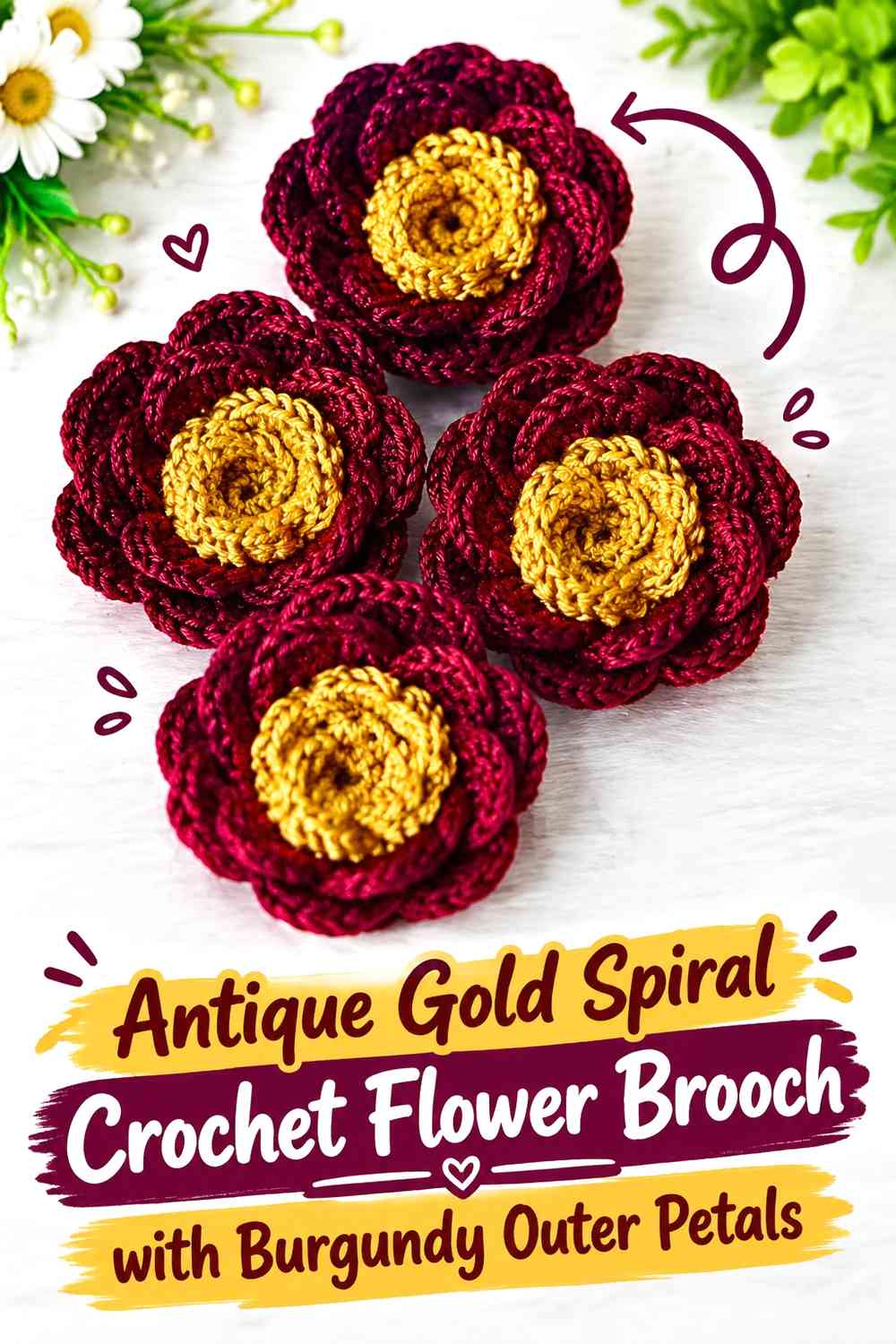
This variation reverses the usual hierarchy. Antique Gold occupies more of the curled or gathered flower surface, while Burgundy is concentrated around the outside. The effect is lighter overall but still retains the depth needed for an heirloom-inspired accessory.
Antique Gold Can Lead Without Removing Burgundy Definition
Allow Antique Gold to cover the inner and middle sections, then introduce Burgundy where the outer flower shape needs a stronger boundary. A dark outside edge can keep a pale gold flower from visually disappearing on cream, camel, or similarly warm clothing.
Because Antique Gold is the dominant color here, resist adding more Burgundy to every internal fold. A cleaner division gives the spiral construction room to show.
Burgundy Gives the Antique Gold Lapel Brooch a Stronger Outer Frame
Burgundy along the exterior can make irregular petal edges easier to distinguish. It also provides a useful connection point if the flower includes a dark leaf or another small supporting detail.
Check that the Burgundy remains visible from the front rather than slipping entirely behind the Antique Gold petals. The border only contributes to the palette when enough of it can be seen while the brooch is worn.
Creator Credit: Crochet con Lillo
5. Burgundy Camellia Crochet Brooch with Antique Gold Petal Edging
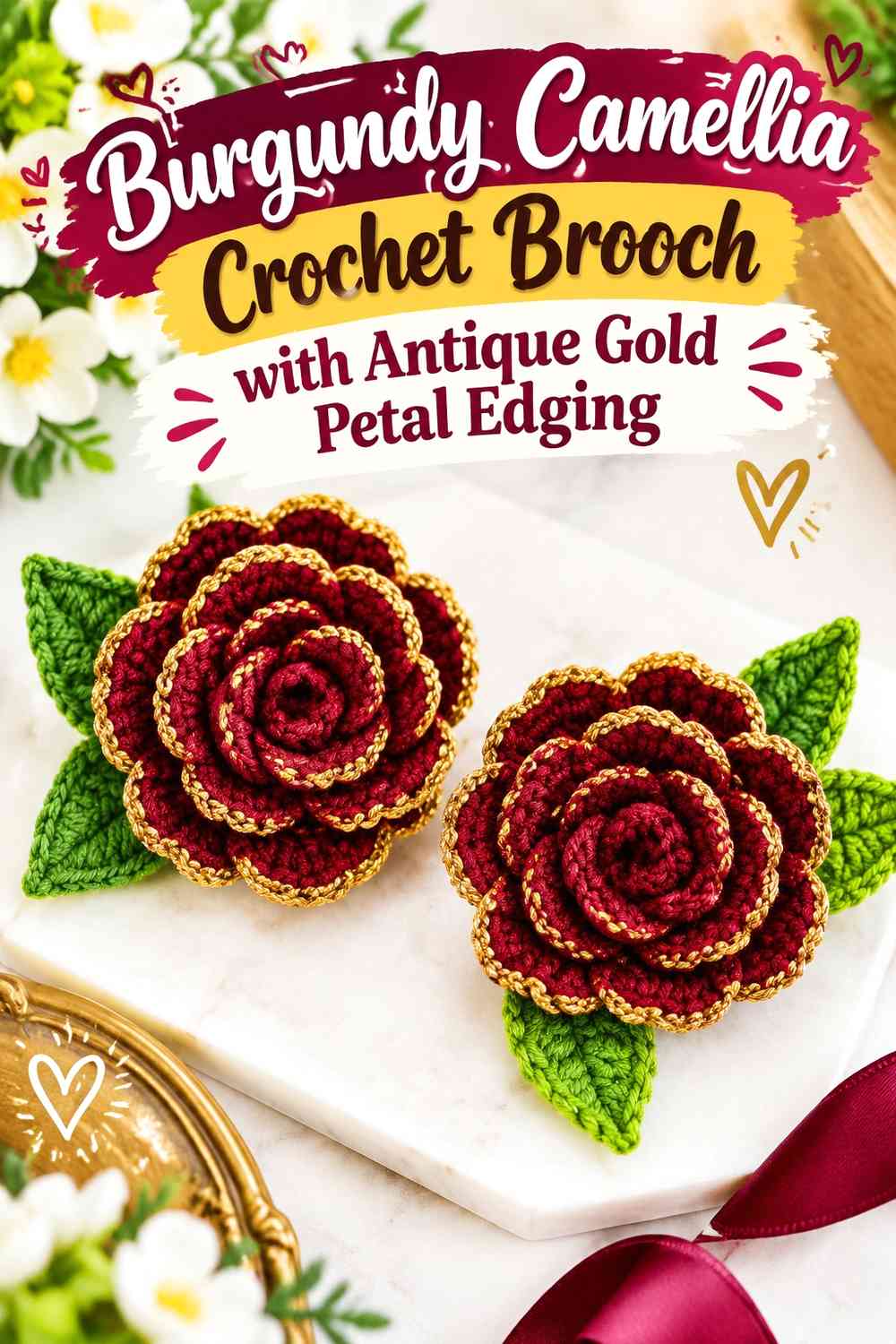
Camellia-style petals create broad surfaces where edge color can be more effective than a contrasting center. Burgundy can fill the petals while Antique Gold traces selected outer curves, giving the bloom a more detailed two-tone outline.
Burgundy Should Remain Continuous Across the Camellia Petals
Using Burgundy across most of each petal keeps the flower visually connected even when the petals overlap. This is useful because large blocks of Antique Gold on alternating petals could break the bloom into separate sections.
If the Burgundy texture already shows clearly, add Antique Gold only where the outer shape needs extra definition.
Antique Gold Edging Can Separate Overlapping Burgundy Petals
A narrow Antique Gold edge can reveal where one Burgundy petal ends and another begins. The contrast is most useful around petal tips and curves that would otherwise sit directly against another dark section.
Do not assume every petal needs the same amount of gold. Leaving some Burgundy edges uninterrupted can prevent the outline from becoming a heavy ring around the whole brooch.
Creator Credit: Dream-Crochet
6. Burgundy Daisy Crochet Lapel Brooch with an Antique Gold Center
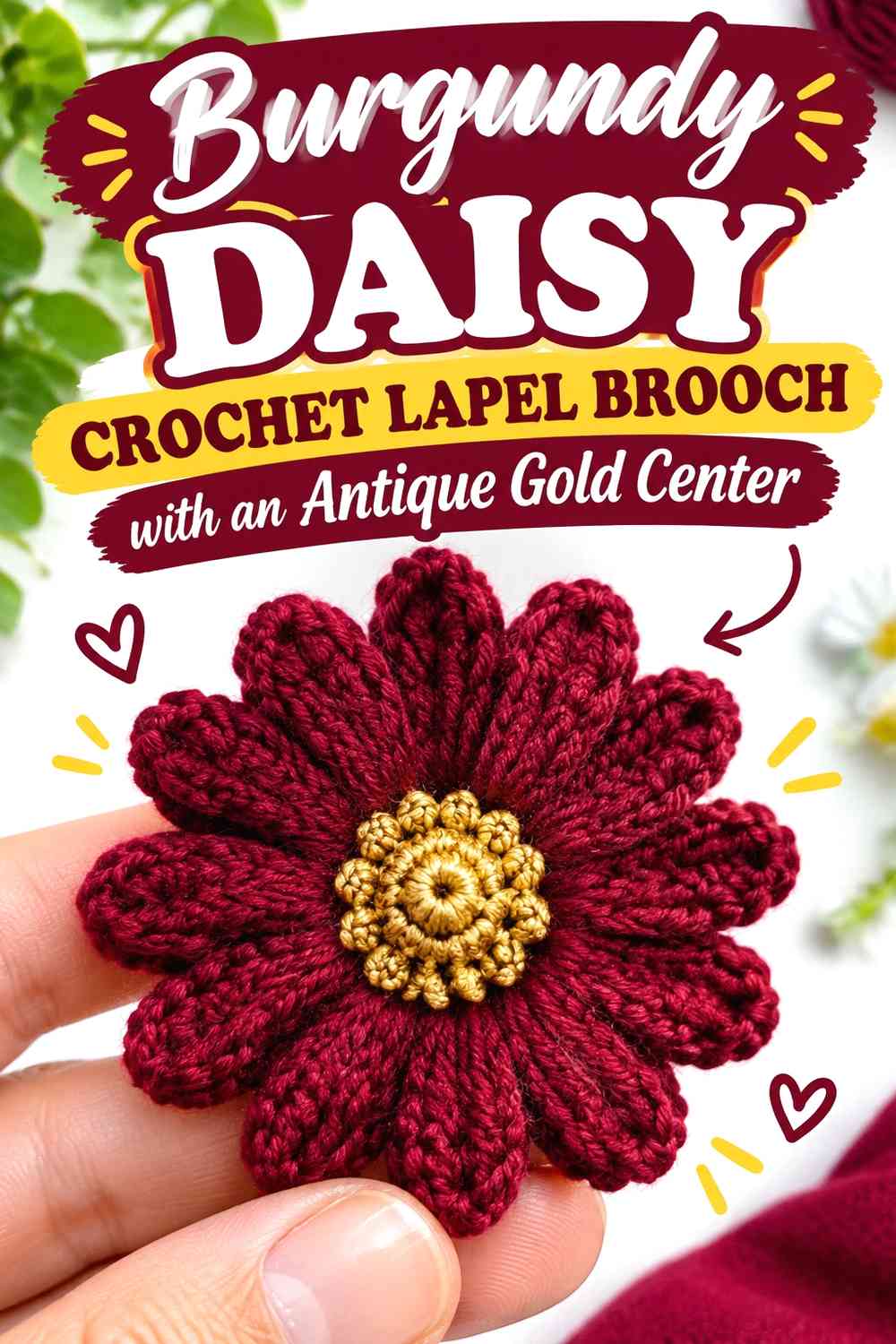
A daisy has a clear center-and-petal structure, making it well suited to a simple Burgundy-dominant palette. Burgundy petals can radiate from a compact Antique Gold center, giving the flower immediate contrast without additional borders or color changes.
Burgundy Petals Need Clear Separation Around the Antique Gold Center
Because multiple petals meet in a small area, check that the Burgundy bases remain individually readable around the lighter middle. If they visually merge, the Antique Gold center can be made slightly more prominent without extending into the petal field.
The aim is to clarify the radial structure rather than enlarge the gold simply because the palette includes two colors.
Antique Gold Works Best as the Burgundy Daisy’s Visual Anchor
Keeping Antique Gold in the center preserves the recognizable flower layout and gives the eye one place to settle. On a small lapel brooch, that restrained placement can feel more polished than outlining every Burgundy petal.
If you want another gold repeat, consider a tiny detail at the backing-facing base rather than another large visible ring.
Creator Credit: The Crochet Circle
7. Burgundy Pansy Crochet Brooch with Antique Gold Lower-Petal Detail
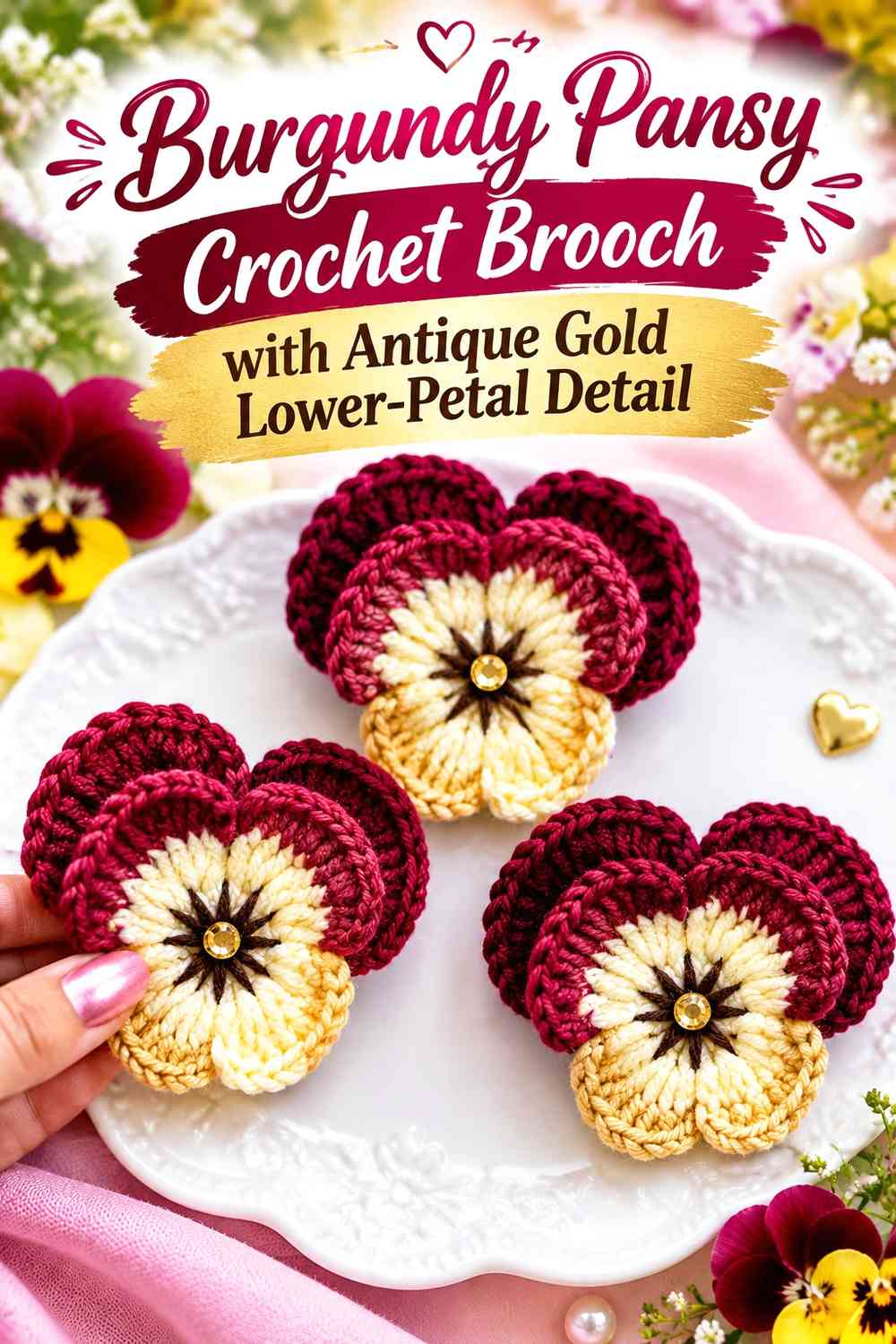
A pansy offers a different color-planning opportunity because its upper and lower areas do not need to carry color in exactly the same way. Burgundy can dominate the broad petals, while Antique Gold is concentrated toward the center and lower section.
Burgundy Can Unify the Pansy’s Unequal Crochet Petals
Using Burgundy across both larger and smaller petals helps the irregular flower remain one visual unit. The varying petal shapes already supply enough complexity, so the color distribution does not need to change dramatically on every section.
This makes the brooch useful when you want a botanical silhouette without giving up the restrained two-color palette.
Antique Gold Can Mark the Burgundy Pansy’s Lower Focal Area
Place Antique Gold where the lower petals meet the center if you want the eye to follow the pansy’s natural directional structure. A small lighter area can make the flower feel more detailed without breaking up every Burgundy petal.
Keep the gold distribution balanced around the center so the brooch does not appear accidentally stained or patchy from a normal viewing distance.
Creator Credit: naztazia
8. Burgundy Orchid Crochet Lapel Brooch with Antique Gold Throat
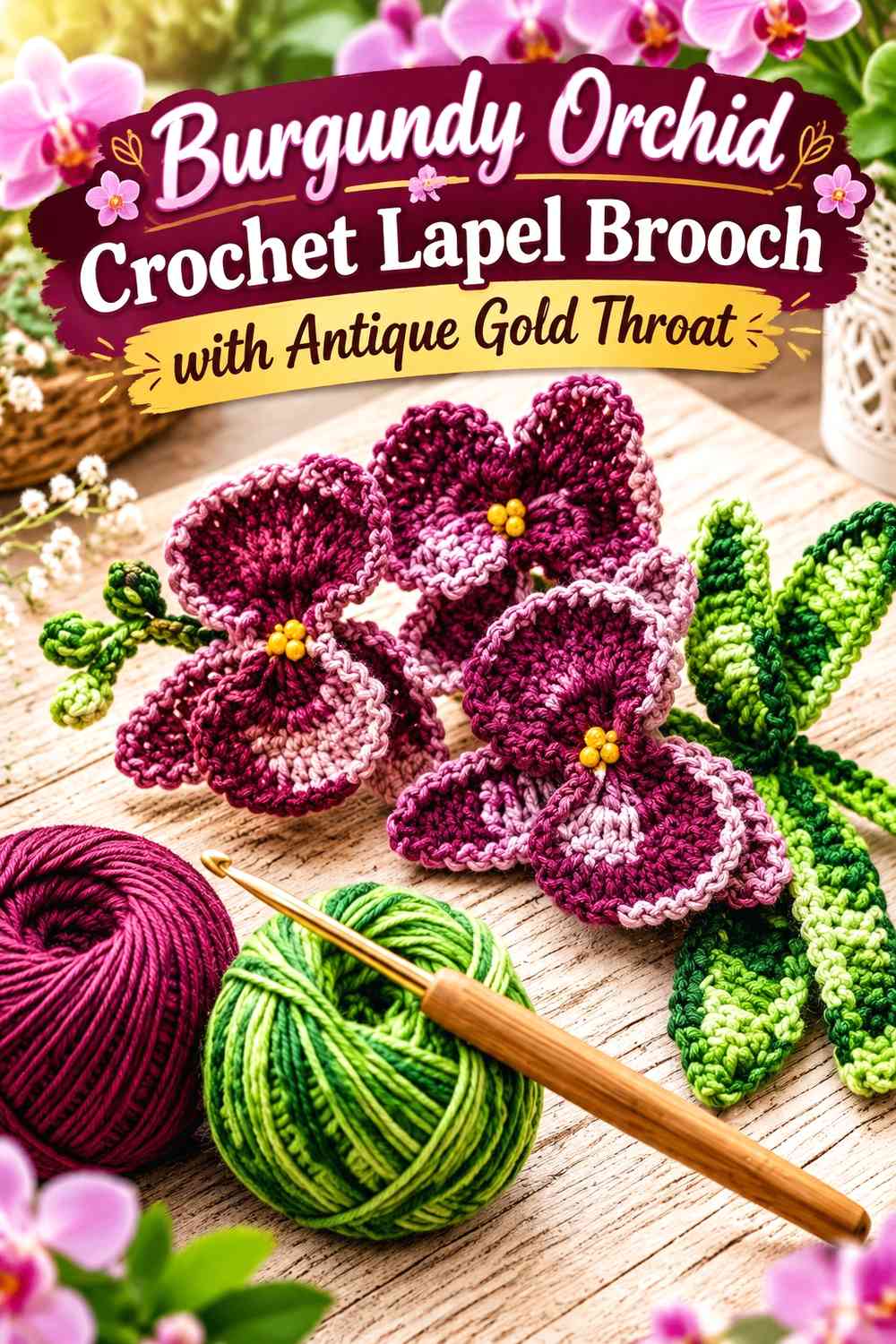
An orchid creates a less symmetrical brooch than a rose or daisy, which makes concentrated color placement especially useful. Burgundy can cover the larger petal forms, while Antique Gold marks the flower’s center or throat and helps establish the intended orientation.
Burgundy Keeps the Orchid Crochet Brooch Visually Cohesive
Use Burgundy across the broad petal sections so the irregular silhouette reads as one flower rather than a collection of different colored pieces. This also prevents Antique Gold from competing with the orchid’s naturally complex shape.
Before adding the second color, lay the completed Burgundy components together and identify which inner details are actually difficult to distinguish.
Antique Gold Can Establish the Burgundy Orchid’s Direction
A gold center or throat gives the viewer an immediate reference point and can help a directional orchid sit naturally on a lapel. Position the brooch so that this contrast remains visible when the garment is upright.
If Antique Gold spreads across too many outer sections, the directional center becomes less obvious. Keep the strongest contrast close to the part of the flower you want to emphasize.
Creator Credit: Catteleya Crochê by Lilian Erlacher
9. Burgundy Irish Lace Crochet Flower Brooch with Antique Gold Knotted Center
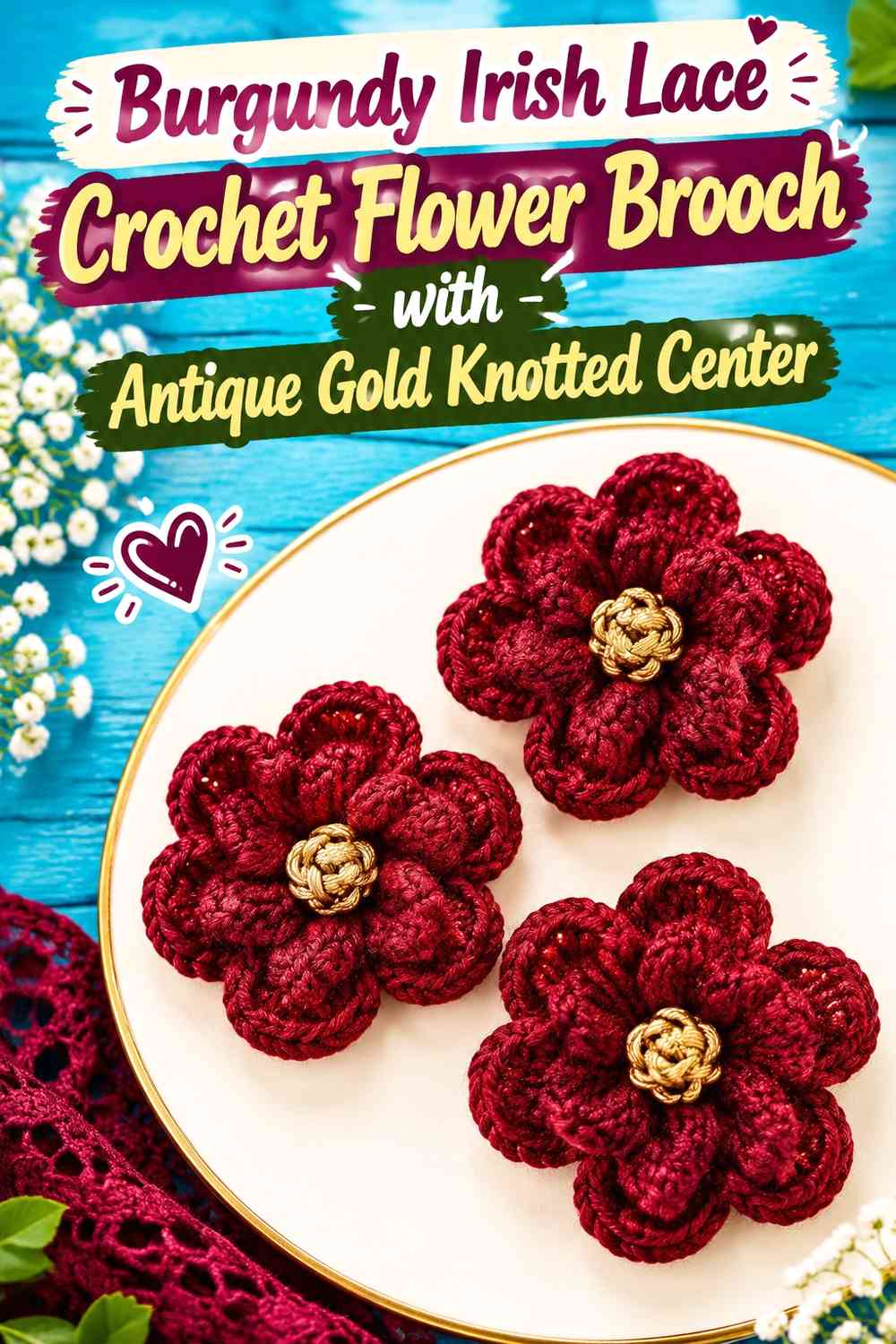
Irish crochet-inspired motifs can contain small raised details that benefit from targeted contrast. Burgundy works well across the main lace petals, while Antique Gold can mark textured center elements and prevent them from disappearing inside a dark flower.
Burgundy Gives the Irish Lace Crochet Brooch a Unified Base
Keep the main arches, petals, or surrounding flower structure Burgundy when you want the motif to look like one piece of textile jewelry. Dark continuity is especially useful in lace because the openings themselves already interrupt the surface.
Using Antique Gold on too many separate lace segments could make the motif appear fragmented rather than intricate.
Antique Gold Can Clarify Burgundy Raised Center Texture
A lighter center allows raised knots or similar dimensional details to stand apart from the Burgundy petals. This is one of the places where a small amount of contrast can do more than a wide decorative border.
Judge the center after the motif is complete. If the texture is already obvious in Burgundy, reduce the Antique Gold to a smaller central accent.
Creator Credit: Irish Lace by Raisa Demidova
10. Antique Gold Irish Lace Crochet Brooch with Burgundy Raised Petals
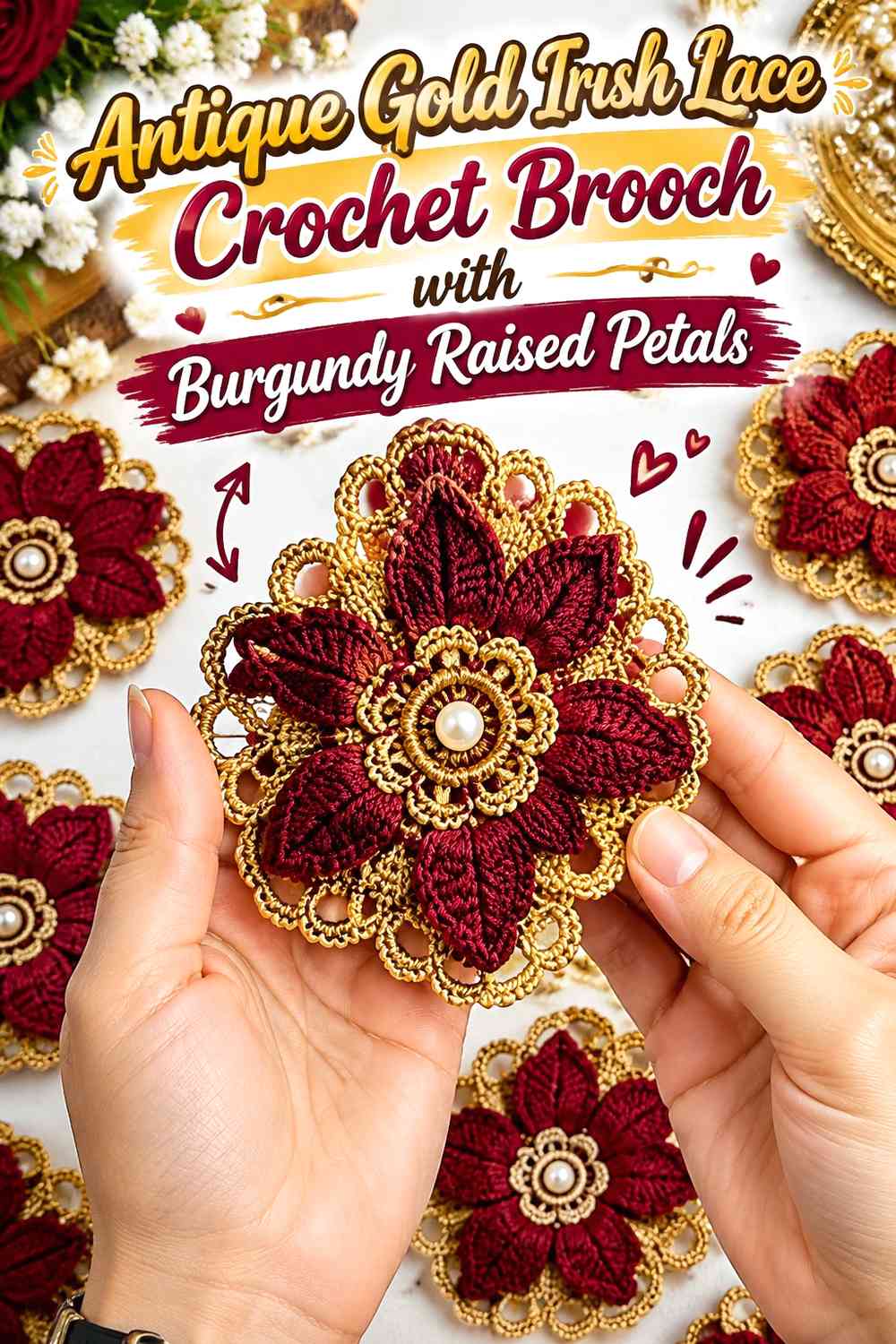
This version reverses the Irish-lace balance by using Antique Gold through more of the underlying motif and Burgundy on raised petals. The dark petals then become the dimensional focal points rather than simply the background.
Antique Gold Can Provide a Lighter Field for Burgundy Crochet Petals
A pale Antique Gold base creates enough value difference for small Burgundy raised sections to remain visible. This is useful when the brooch relies on three-dimensional petal texture rather than a strong outer outline.
Keep the gold background connected so it reads as one motif instead of several isolated highlights.
Burgundy Raised Petals Should Remain the Strongest Details
Use Burgundy on the portions that project forward or define the main flower shape. If the same dark color appears heavily around every border and center, the raised petals lose their special role.
View the brooch slightly from the side as well as straight on. The color contrast should reinforce the three-dimensional structure from both angles.
Creator Credit: 𝑩𝒂𝒎𝒃𝒊 4 𝒄𝒓𝒐𝒄𝒉𝒆𝒕
11. Burgundy Daffodil Crochet Lapel Brooch with Antique Gold Trumpet
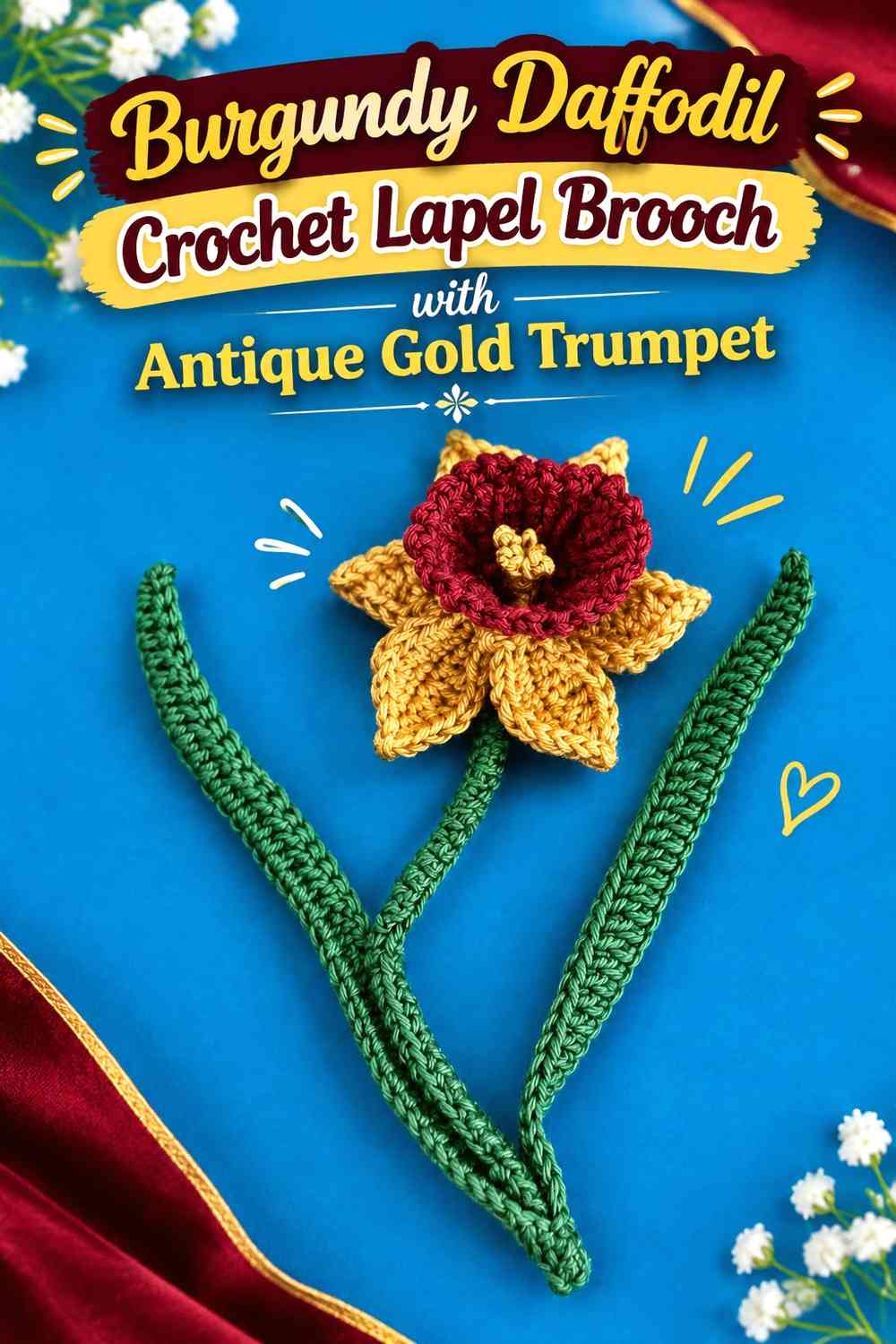
A daffodil separates naturally into an outer petal area and a prominent central trumpet, making the Burgundy and Antique Gold roles especially clear. Burgundy can form the flatter surrounding bloom while Antique Gold is concentrated in the projecting center.
Burgundy Gives the Antique Gold Daffodil Center a Dark Frame
Using Burgundy on the outer petals creates strong separation around the trumpet. This is useful on a lapel because the center projects forward and is already visually dominant through shape.
Keeping the petals consistently Burgundy prevents the two-color treatment from competing with the distinctive flower structure.
Antique Gold Should Emphasize the Burgundy Daffodil Trumpet
Place the strongest gold area in the center rather than scattering it across unrelated sections. The lighter value draws attention to the feature that distinguishes the daffodil silhouette.
Check the flower vertically before fixing the backing position. The Antique Gold trumpet should face outward rather than lean noticeably downward when the brooch is pinned.
Creator Credit: Kerri’s Crochet
12. Burgundy Magnolia Crochet Brooch with Antique Gold Inner Petal Accents
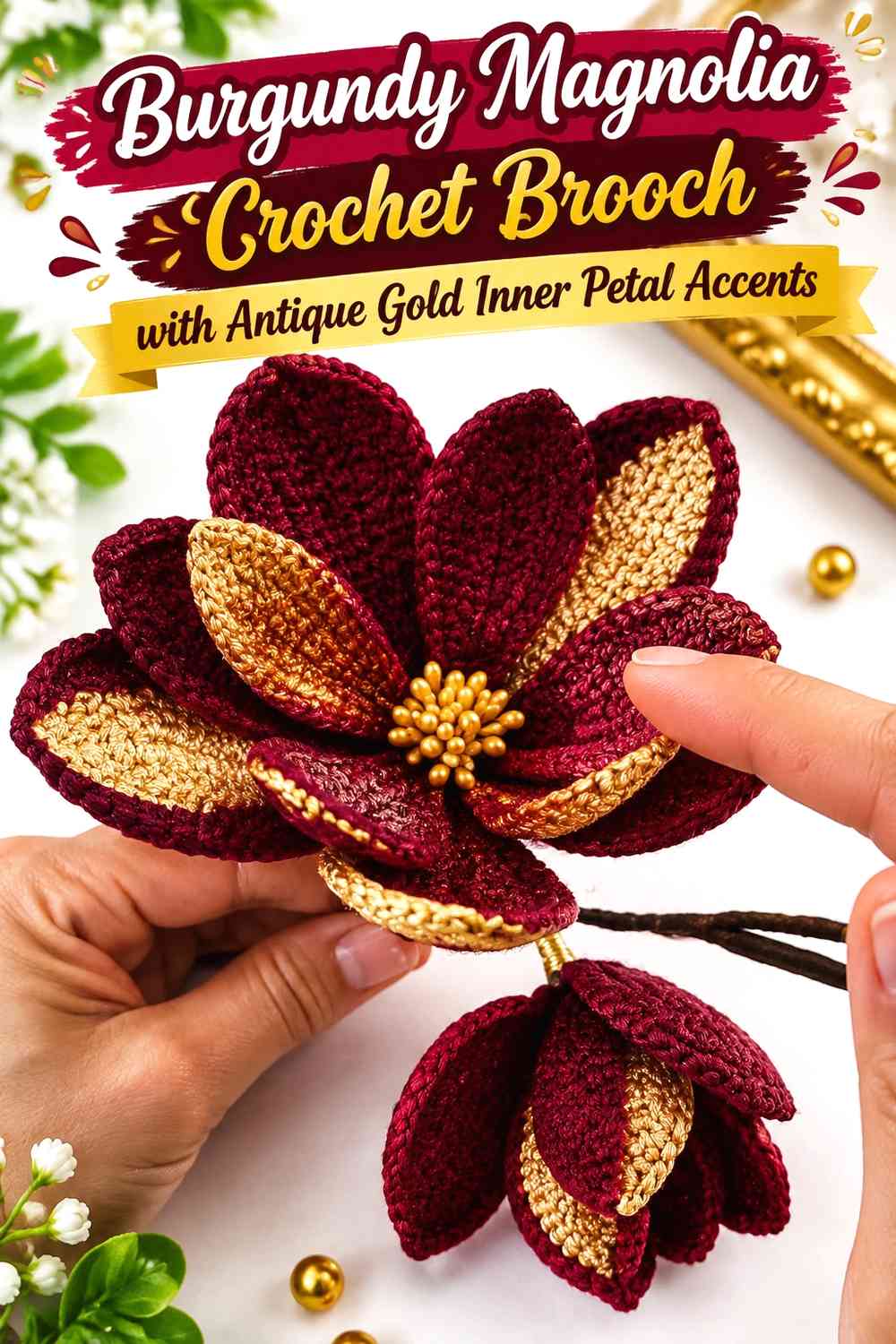
A magnolia provides broad, relatively open petals that can carry a subtler color transition. Burgundy can establish the exterior flower shape, while Antique Gold appears closer to the petal bases or center rather than tracing every edge.
Burgundy Makes the Magnolia Crochet Brooch Feel More Substantial
Covering the broader outer petal area in Burgundy gives the flower enough dark visual weight to work as a statement lapel piece. Because the petals are comparatively large, their shape can remain readable without extensive contrasting outlines.
This allows Antique Gold to be reserved for internal structure rather than becoming a decorative border around the entire flower.
Antique Gold Can Warm the Burgundy Magnolia From the Center Outward
Place Antique Gold near the petal bases or central area to create a gradual transition into the Burgundy exterior. The effect is softer than a sharp gold outline and suits an heirloom-inspired brooch where the two colors should appear integrated.
Keep enough Burgundy between the gold accents and the petal tips so the flower still reads as Burgundy-dominant when viewed from a distance.
Creator Credit: Natagor Finlayson
Which Burgundy and Antique Gold Flower Brooch Has the Strongest Color Contrast?
For the clearest center-and-petal contrast, the Burgundy daisy, Burgundy daffodil, and layered Burgundy flower with an Antique Gold center make the two color roles immediately readable. These are useful when you want the gold to act as one concentrated focal point.
The Burgundy rose and magnolia create a more gradual transition because Antique Gold sits inside a larger Burgundy flower. The camellia moves the contrast outward by placing Antique Gold along the petal edges.
For the most decorative surface treatment, the Irish lace ideas allow Burgundy and Antique Gold to separate raised texture, openings, and smaller motif details. The pansy and orchid are more directional, so color can also help determine which part of the brooch visually points upward on the lapel.
Conclusion
Burgundy and Antique Gold can produce very different crochet lapel brooches even without introducing a third color. The main decision is how much Antique Gold the flower actually needs.
Choose a Burgundy flower with an Antique Gold center when you want a dark, restrained accessory. Use gold edging on Burgundy camellia petals when the outline needs more definition. Roses and magnolias suit gradual center-to-edge transitions, while pansies and orchids benefit from localized Antique Gold details that reinforce their directional flower shapes.
For an especially textural result, use the contrast inside layered or Irish lace flowers, where Antique Gold can separate raised details from a Burgundy base. Whatever style you choose, assess the finished flower upright before attaching the backing, and follow the original creator tutorial for the exact crochet construction.
Frequently Asked Questions
Should Burgundy or Antique Gold Dominate a Crochet Flower Brooch?
Burgundy is a useful dominant choice when you want the brooch to look dark and substantial, with Antique Gold acting as a concentrated highlight. Antique Gold can lead when you prefer a lighter accessory, but keeping Burgundy around important edges or raised petals can preserve definition.
How Much Antique Gold Should I Use With Burgundy on a Small Brooch?
Start by assigning Antique Gold one clear role, such as the center, petal edging, inner layer, or raised detail. A small brooch magnifies contrast, so you may need less Antique Gold than expected. Add more only when the Burgundy sections still need separation.
How Can I Check Whether Burgundy and Antique Gold Have Enough Contrast?
Work small samples or place completed crochet sections together and view them from several feet away. A grayscale photo can also help you compare light-and-dark value without being distracted by hue. If the two shades merge, choose an Antique Gold that is clearly lighter or reduce dark color around the smallest details.
Can Antique Gold Be Used Only Around the Edges of Burgundy Crochet Petals?
Yes. Edge placement is particularly useful for layered camellias and similar broad-petal flowers because it shows where one Burgundy petal ends and another begins. Keep the border narrow if Burgundy should remain the obvious main color.
Does Antique Gold Yarn Need to Be Metallic for an Heirloom Brooch?
No. Antique Gold can simply describe a muted, warm gold color. A metallic effect is optional and should not be assumed from the color name. Choose the yarn based on the texture, drape, and finish you want for the actual brooch.
Where Should I Place the Pin Backing on a Burgundy and Antique Gold Flower Brooch?
Position it only after checking how the completed flower sits upright. Keep the hardware within the flower’s back where practical, make sure the fastening remains accessible, and orient the brooch so the intended Burgundy and Antique Gold focal details face correctly when worn.