

Persimmon Orange and Dusty Lilac give a crochet hooded scarf enough contrast for deliberate retro color blocking without forcing the accessory into a loud multicolor palette. Persimmon Orange has more visual weight, so it can define the hood, pockets, scarf ends, or selected granny-square centers. Dusty Lilac creates a softer counterbalance and works especially well across larger scarf panels, face edging, joins, and alternating motifs.
Placement matters more on a hooded scarf than it does on a flat accessory. A color that looks balanced across two scarf tails can feel much stronger once it surrounds the face, and a contrast pocket can pull attention toward the bottom of the garment. Plan the hood, face opening, scarf tails, and any fringe or pockets as separate visual zones before deciding how much of each shade to use.
The tutorials supporting these ideas cover tapered scarves, buttoned wraps, detachable hoods, textured fabrics, pockets, infinity styles, separate rectangles, and granny-square constructions. The Persimmon Orange and Dusty Lilac palettes below are independent color adaptations rather than claims about the colors used by the tutorial creators.
Quick List
- Persimmon Orange and Dusty Lilac Tapered Crochet Hooded Scarf
- Dusty Lilac and Persimmon Orange Simple Crochet Hooded Scarf
- Persimmon Orange and Dusty Lilac Buttoned Crochet Hooded Scarf
- Dusty Lilac and Persimmon Orange Detachable-Hood Crochet Scarf
- Persimmon Orange and Dusty Lilac Textured Crochet Hooded Scarf
- Dusty Lilac and Persimmon Orange Pocket Crochet Hooded Scarf
- Persimmon Orange and Dusty Lilac Cable Crochet Hooded Scarf
- Dusty Lilac and Persimmon Orange Extended-Stitch Crochet Pocket Scoodie
- Persimmon Orange and Dusty Lilac Crochet Hooded Infinity Scarf
- Dusty Lilac and Persimmon Orange Two-Rectangle Crochet Hooded Scarf
- Persimmon Orange and Dusty Lilac Striped Crochet Hooded Scarf
- Persimmon Orange and Dusty Lilac Large-Square Crochet Hooded Scarf
- Dusty Lilac and Persimmon Orange Joined Granny Square Crochet Hooded Scarf
- Persimmon Orange and Dusty Lilac Contrast-Join Crochet Granny Hooded Scarf
Give Persimmon Orange and Dusty Lilac Different Jobs on the Hooded Scarf
A two-color wearable usually looks clearer when one shade controls a large area and the other has a defined supporting role. For example, Persimmon Orange can cover the hood and repeat at the scarf ends while Dusty Lilac fills most of the long scarf panels. That creates repetition without alternating colors every few rows.
You can reverse the hierarchy for a softer result. A Dusty Lilac hood and scarf body can carry narrower Persimmon Orange edging, pockets, stripes, or granny-square centers. The important checkpoint is whether the accent appears in enough places to feel connected without dividing the garment into too many competing blocks.
Check Persimmon Orange and Dusty Lilac Around the Face Before Finishing
The hood opening is one of the most visually important areas because the color sits directly beside the face. A broad Persimmon Orange hood can become the strongest part of the whole accessory, while a Dusty Lilac face border can soften that concentration and define the hood opening.
If the hood already contains both colors in stripes or motifs, consider using a single color around the final edge. A continuous Dusty Lilac border can unify a busy Persimmon Orange-and-Lilac hood, while a Persimmon Orange border can sharpen an otherwise pale hood. Check the edge while the hood is actually worn; color balance can look different when the fabric curves around the head.
1. Persimmon Orange and Dusty Lilac Tapered Crochet Hooded Scarf

A tapered scarf gives the palette progressively less surface area toward each tip, which makes color placement at the ends especially noticeable. Let Persimmon Orange dominate the hood and upper scarf, then introduce Dusty Lilac as the scarf narrows so the lighter shade visually reduces the weight of the long ends. This construction is supported by a fitted, tapered hooded-scarf tutorial rather than a rectangular scarf adaptation.
Dusty Lilac Can Lighten the Persimmon Orange Tapered Crochet Ends
If Persimmon Orange covers the hood and central neck area, changing to Dusty Lilac toward the tapered points creates a clear transition from dark visual weight to a softer finish. Keep the change symmetrical if you want the two scarf tails to feel balanced when they hang down the front.
A second option is to keep the tails Persimmon Orange and use only a narrow Dusty Lilac outline. That preserves a stronger orange-led look while still making the tapered silhouette easy to see against a dark coat.
Persimmon Orange Needs Dusty Lilac Separation Around the Crochet Hood Opening
A full Persimmon Orange hood can become one large uninterrupted block. Adding Dusty Lilac around the face opening gives the hood a visible boundary and connects it back to the lighter scarf ends.
Keep the trim relatively narrow if Persimmon Orange is intended to remain dominant. A very broad Lilac band can visually split the hood into two equal color zones instead of functioning as an accent.
Creator Credit: VivCrochets
2. Dusty Lilac and Persimmon Orange Simple Crochet Hooded Scarf

A straightforward hood-and-scarf silhouette is a good place to let the palette do most of the visual work. Use Dusty Lilac across the majority of the hood and scarf, then place Persimmon Orange at the hood border and lower scarf ends. The uncomplicated construction gives the color blocks room to read clearly without competing with cables or motifs.
Dusty Lilac Can Carry the Main Crochet Hood and Scarf Surface
Using Dusty Lilac as the continuous background gives this version the softest overall direction in the collection. It also creates enough uninterrupted fabric for Persimmon Orange accents to look intentional rather than scattered.
If you want a stronger retro effect, keep the orange sections broad enough to read as blocks—for example, one substantial section at each scarf end—rather than adding many narrow stripes.
Persimmon Orange Can Frame the Dusty Lilac Crochet Hood
A Persimmon Orange face edge gives the lighter hood a more defined outline. Repeat that same Orange near the scarf ends so the trim does not appear to be an isolated detail around the head.
If both tails are visible at the front, compare their Orange sections before fastening off. Unequal color-block lengths can make an otherwise symmetrical scarf appear unbalanced.
Creator Credit: JMCrochet
3. Persimmon Orange and Dusty Lilac Buttoned Crochet Hooded Scarf

A buttoned hooded scarf creates overlap at the front, so the palette needs to work when one scarf section sits over another. Persimmon Orange can lead the main body while Dusty Lilac marks the overlap edge, fastening area, or opposite end. The supporting tutorial uses an asymmetrical scarf with a button fastening, giving this color layout a different wearing behavior from two equal hanging tails.
Dusty Lilac Can Clarify the Persimmon Orange Crochet Overlap
When two Persimmon Orange sections overlap, the front can become one large dark-orange field. A Dusty Lilac edge along the fastening section makes the overlap easier to see and gives the button area a distinct visual boundary.
Continue a small amount of Lilac onto another part of the scarf—such as the hood edge—so the fastening detail feels integrated into the whole accessory.
Persimmon Orange Should Remain Visible When the Dusty Lilac Scarf Is Buttoned
Plan color placement with the scarf in its fastened position, not only laid flat. A Persimmon Orange block that looks prominent on an open tail may disappear underneath once the scarf is wrapped and buttoned.
Pin or temporarily position the finished sections before committing to the final color distribution. The most useful arrangement is one in which both Persimmon Orange and Dusty Lilac remain visible in the wearing style you expect to use most.
Creator Credit: Winding Road Crochet
4. Dusty Lilac and Persimmon Orange Detachable-Hood Crochet Scarf
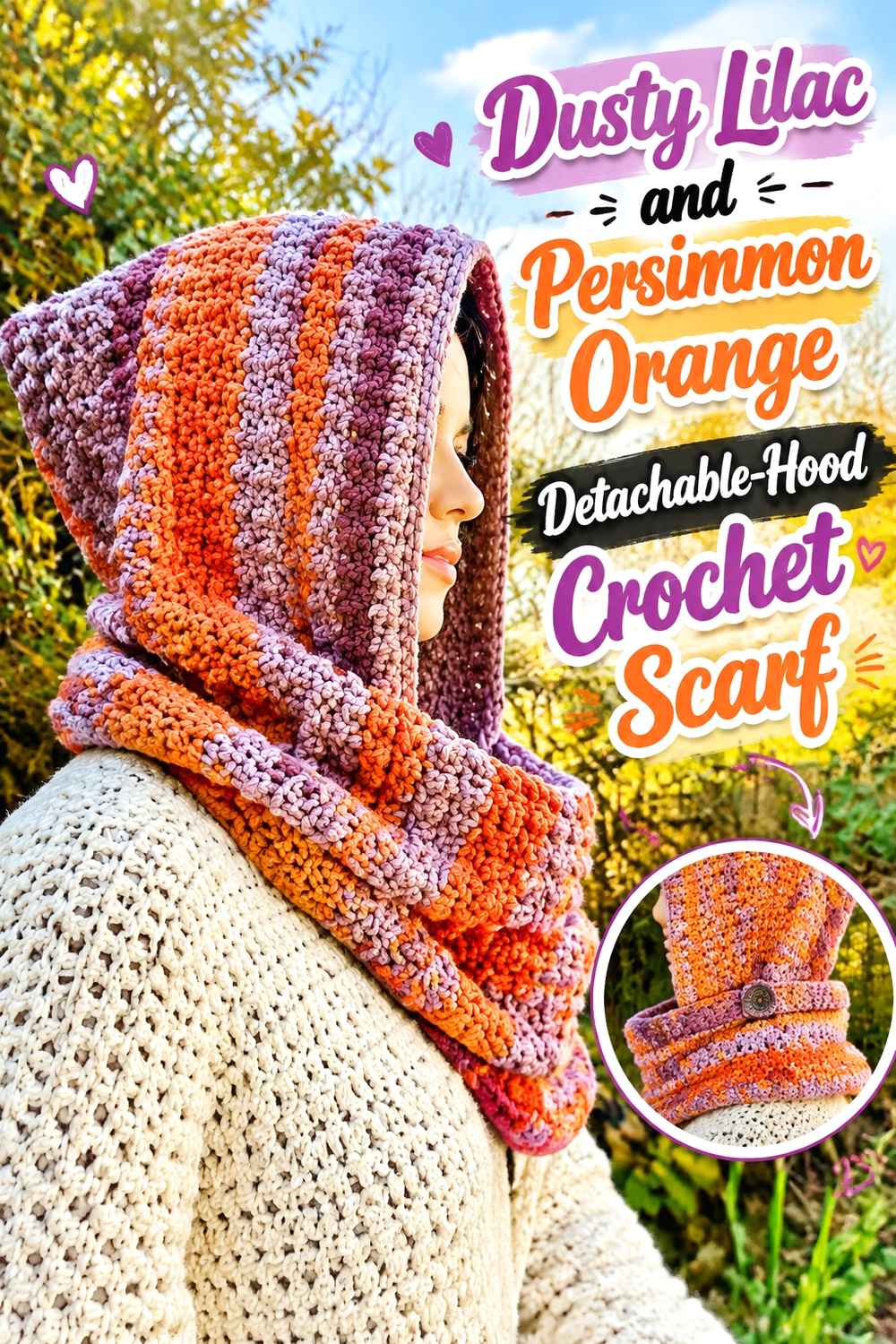
A detachable hood creates an unusual color-planning problem because the scarf must still look intentional when the hood is removed. Make the main scarf Dusty Lilac and the hood Persimmon Orange, then repeat a small amount of each color on the opposite component so they coordinate both together and separately. The supporting tutorial specifically uses a scarf with a removable hood.
Persimmon Orange Can Make the Detachable Crochet Hood a Separate Focal Piece
Let Persimmon Orange cover most of the hood if you want the detachable section to read as a deliberate accessory rather than an extension of the scarf. Dusty Lilac edging around the face can then connect it to the scarf when both pieces are worn together.
Check the hood on its own as well. If the Dusty Lilac appears only at an attachment point hidden behind the neck, the color relationship disappears once the scarf is removed.
Dusty Lilac Should Keep the Persimmon Orange Crochet Scarf Coordinated Without the Hood
A predominantly Dusty Lilac scarf can carry a Persimmon Orange border or end section so the orange remains part of the accessory after the hood is detached. This is more useful than putting all the Persimmon Orange exclusively on the hood.
Keep the repeated Orange section smaller on the scarf if you want the removable hood to remain the strongest color statement when the two components are combined.
Creator Credit: Bag-O-Day Crochet
5. Persimmon Orange and Dusty Lilac Textured Crochet Hooded Scarf
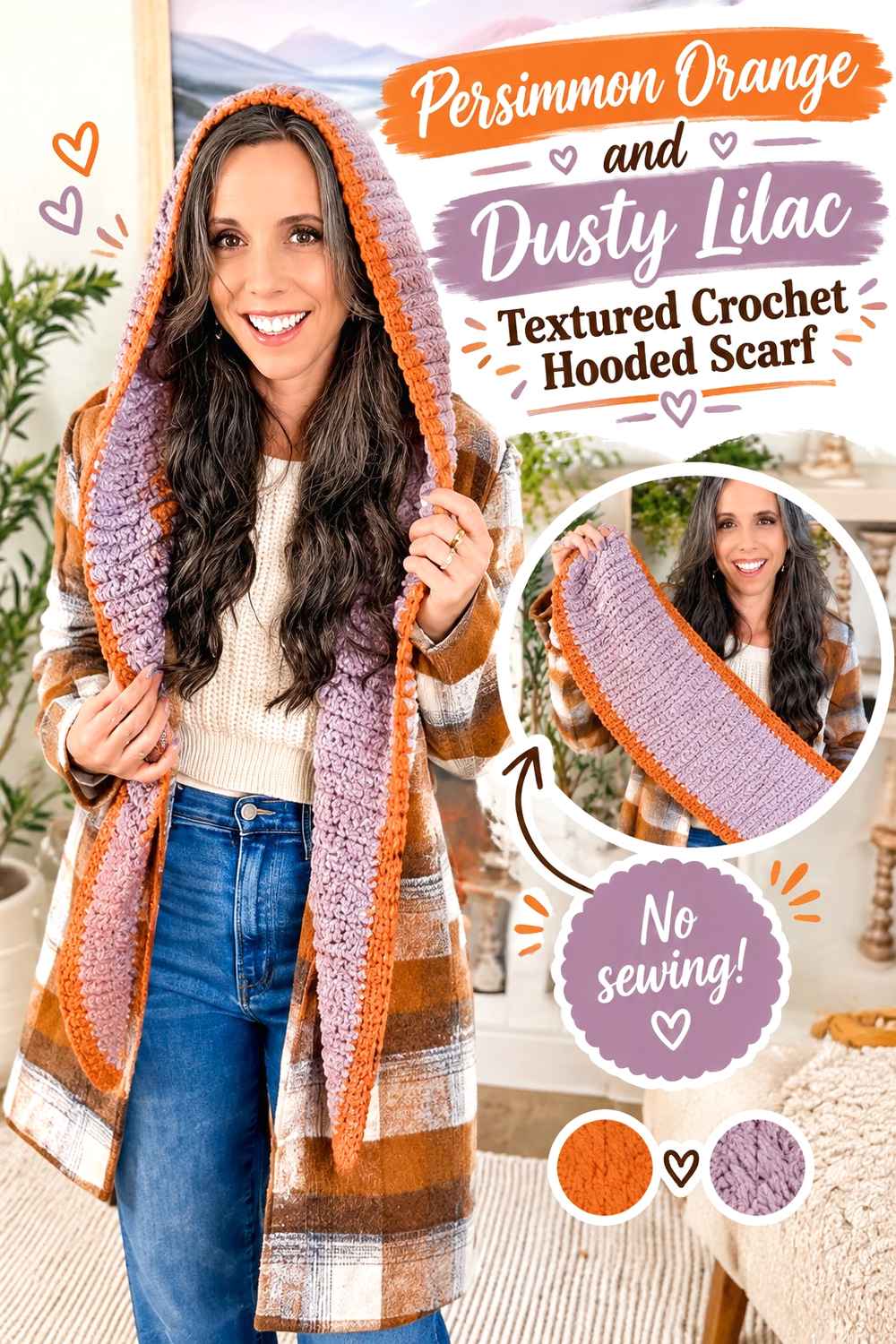
Strong stitch texture needs enough uninterrupted color to remain visible. Use Persimmon Orange across the textured hood and main scarf panels, then reserve Dusty Lilac for narrower edges or end blocks. The tutorial supporting this idea centers on a textured Wheat Stitch hooded scarf, so the palette should support rather than obscure the surface pattern.
Persimmon Orange Gives the Crochet Texture a Continuous Main Field
Long Persimmon Orange sections allow raised or patterned stitchwork to read as a surface rather than being repeatedly interrupted by color changes. If texture is the main feature, avoid changing between Orange and Lilac every short repeat.
Place the scarf under normal room lighting and look at it from several feet away. If the texture is difficult to see, adding more color changes will rarely solve the problem; a calmer color field is usually more useful.
Dusty Lilac Works Better as a Persimmon Orange Crochet Border Than a Busy Stripe
A Dusty Lilac edge can define the hood opening and scarf perimeter without cutting across the textured fabric. This makes the second color visible while leaving the main stitch pattern uninterrupted.
You can also place Dusty Lilac at the final section of each scarf tail. Keep those blocks long enough to look intentional rather than resembling an accidental yarn change.
Creator Credit: Briana K
6. Dusty Lilac and Persimmon Orange Pocket Crochet Hooded Scarf
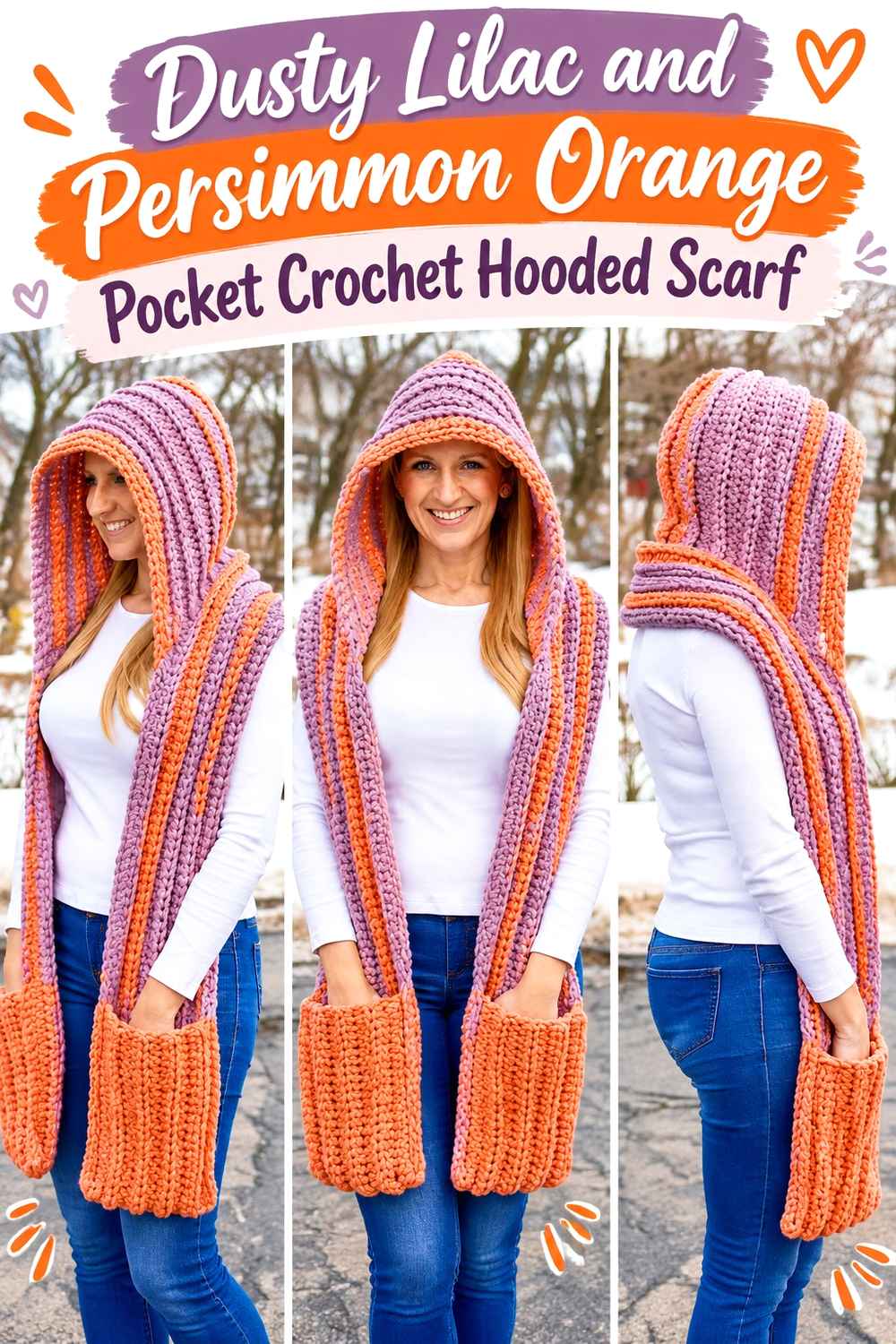
Pockets create natural color-blocking areas at the ends of a hooded scarf. Let Dusty Lilac dominate the scarf and rounded hood, then use Persimmon Orange for both pockets and the hood opening. This repeats the stronger color at the upper and lower parts of the wearable without covering the entire central scarf. The supporting tutorial combines a rounded hood, long scarf sections, and pockets.
Persimmon Orange Pockets Give the Dusty Lilac Crochet Scarf a Strong Lower Anchor
Matching Persimmon Orange pockets create two visible blocks when the scarf hangs down the front. Because pockets already add thickness and structure, using the darker color there further emphasizes the ends.
If the pockets feel too visually heavy, keep their upper edge Dusty Lilac. That small interruption can connect them more smoothly to the scarf body above.
Dusty Lilac Can Keep the Persimmon Orange Crochet Hood Opening From Competing With the Pockets
If the pockets are fully Orange, avoid making the entire hood Orange as well unless you want a very high-contrast design. A Dusty Lilac hood with a Persimmon Orange face edge repeats the pocket color without creating three equally large Orange blocks.
Check the scarf while worn with hands inside the pockets. Their position changes the way the lower color blocks sit, so judge the palette in use rather than only on a flat surface.
Creator Credit: naztazia
7. Persimmon Orange and Dusty Lilac Cable Crochet Hooded Scarf
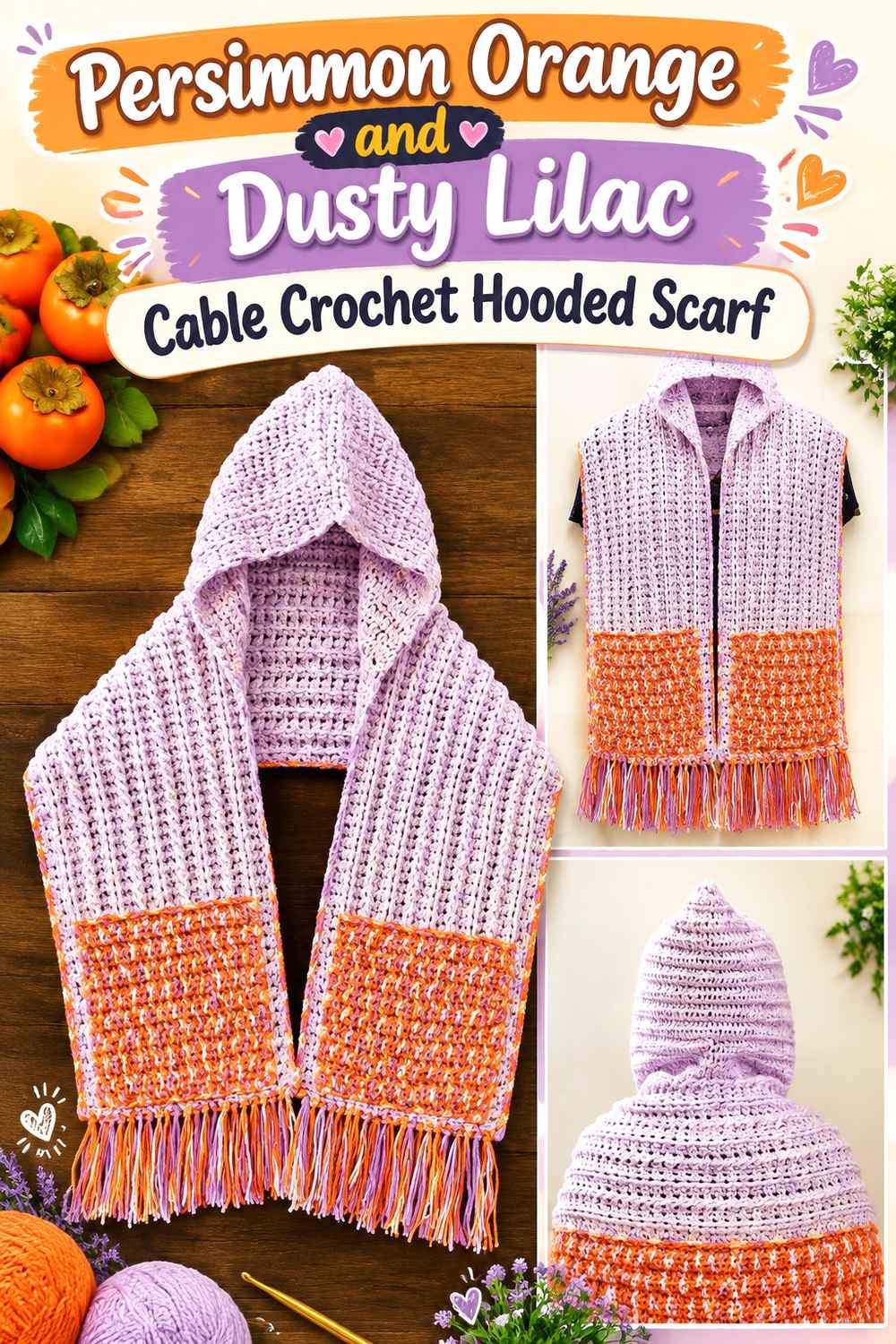
Cable texture, pockets, fringe, and a hood already provide several visual features, so the color scheme needs a strict hierarchy. Use Persimmon Orange for the cable-rich body and Dusty Lilac for pockets or fringe rather than alternating both shades across every textured section. The supporting tutorial includes cables, pockets, a hood, border work, and fringe.
Persimmon Orange Should Stay Continuous Across the Crochet Cable Texture
Cables are easier to follow visually when the main textured section remains one color. Persimmon Orange can cover the cable panel from the scarf into the hood, giving the raised surface a consistent background.
If Dusty Lilac is introduced directly through the cable repeat, make the change a deliberate broad section rather than frequent narrow stripes. Too many transitions can compete with the relief of the stitches.
Dusty Lilac Can Control the Persimmon Orange Crochet Pockets and Fringe
Use Dusty Lilac on the pockets if you want them to stand apart from the cable body. Repeat Lilac in part of the fringe so the pocket color appears again at the scarf ends.
Avoid splitting the fringe evenly into alternating Orange and Lilac strands if the rest of the scarf is already detailed. A mostly Lilac fringe with a few Persimmon Orange strands, or the reverse, produces a clearer hierarchy.
Creator Credit: Let’s All Crochet
8. Dusty Lilac and Persimmon Orange Extended-Stitch Crochet Pocket Scoodie

This pocket scoodie offers a flatter texture than the cable version, so broader color blocking can carry more of the retro effect. Let Dusty Lilac cover most of the long scarf and use Persimmon Orange across the hood, pocket edges, or pocket faces. The supporting design uses extended half double crochet with hood shaping and pockets.
Persimmon Orange Can Separate the Crochet Hood From the Dusty Lilac Scarf
Making the hood Persimmon Orange and the scarf Dusty Lilac creates a clear upper-versus-lower division. Repeat a small Orange band on each pocket so the hood does not look like a completely separate accessory.
If that contrast feels too abrupt at the neck, add a narrow Dusty Lilac hood edge to create a transition where the two main components meet.
Dusty Lilac Gives Persimmon Orange Crochet Pockets More Definition
A Dusty Lilac scarf body makes Orange pockets immediately visible. That is useful when you want the pocket construction to become part of the retro color design rather than blending into the long scarf tails.
Keep both pockets in the same color distribution unless intentional asymmetry is part of your plan. Because they sit on opposite sides of the body, mismatched color blocks can pull the visual balance to one side.
Creator Credit: TCDDIY
9. Persimmon Orange and Dusty Lilac Crochet Hooded Infinity Scarf

An infinity scarf removes the two separate tails, so color is seen as a continuous wrapped loop. Use Dusty Lilac around most of the loop and Persimmon Orange on the hood or on one broad segment that remains visible after wrapping. The supporting Trailhead design combines a double-wrapped infinity scarf with an attached hood.
Dusty Lilac Should Stay Connected Around the Persimmon Orange Crochet Infinity Loop
A continuous Dusty Lilac section gives the wrapped scarf visual continuity. If Persimmon Orange is used in isolated short blocks around the loop, those sections may stack unpredictably when the scarf is doubled.
For more control, keep Orange concentrated on the hood or in one larger section of the infinity loop. Test the wrapped position before deciding where that block should begin and end.
Persimmon Orange Can Give the Dusty Lilac Crochet Hood More Presence
If most of the neck loop is Dusty Lilac, a Persimmon Orange hood creates a strong upper focal point. A narrow Lilac border around the face can reconnect the hood to the scarf below.
When the hood is lowered, check where the Orange fabric sits behind the neck. The palette should still look intentional in both hood-up and hood-down positions.
Creator Credit: Kay Krochets
10. Dusty Lilac and Persimmon Orange Two-Rectangle Crochet Hooded Scarf
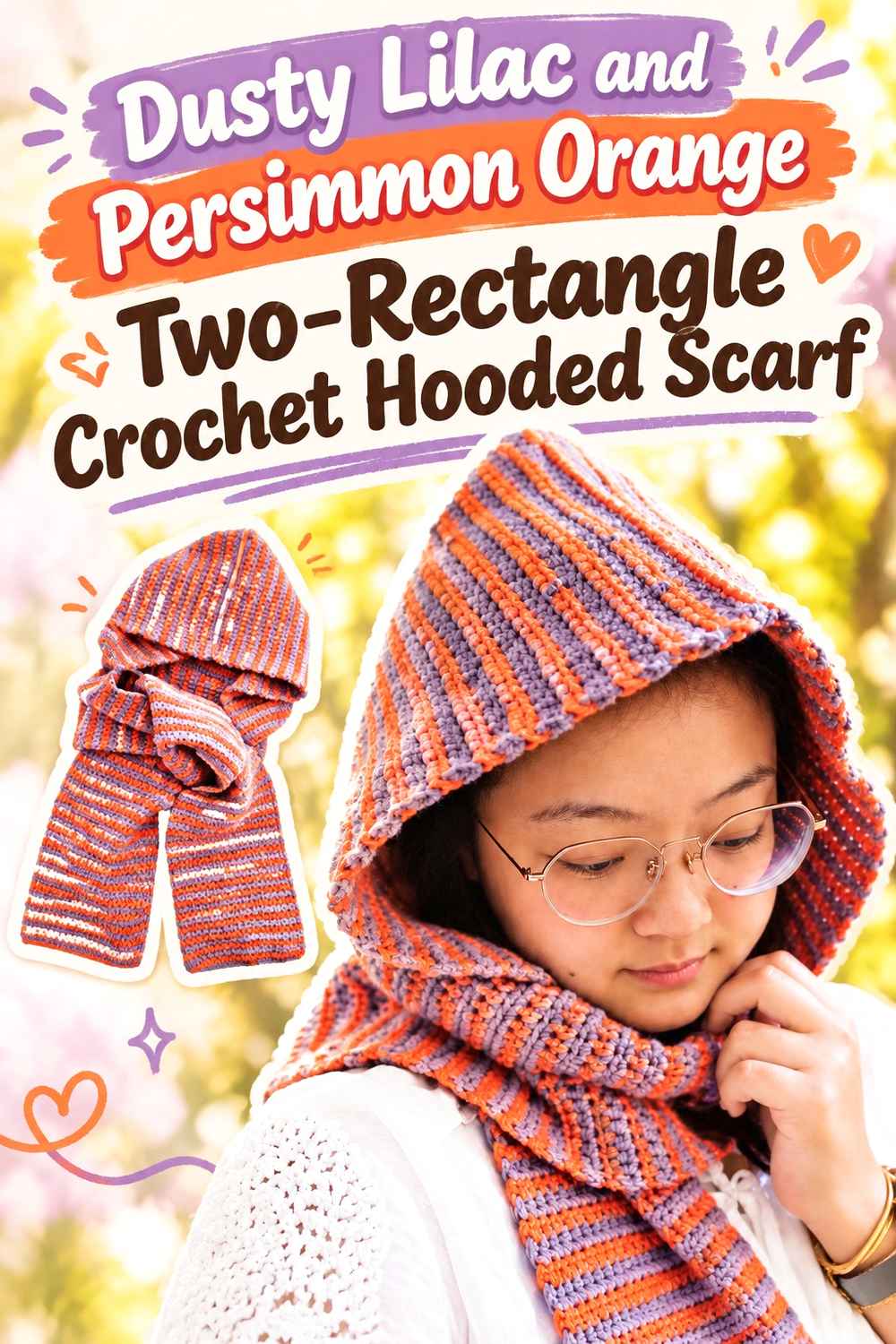
A separate hood rectangle and scarf rectangle make color planning unusually easy to preview before assembly. Use Dusty Lilac for the hood rectangle and Persimmon Orange for most of the scarf rectangle, then add a small amount of the opposite color to each piece. The underlying tutorial specifically builds the hooded scarf from two rectangles before joining them.
Dusty Lilac Can Define the Crochet Hood Before It Meets Persimmon Orange
A Dusty Lilac hood creates a softer frame around the face, while Persimmon Orange below gives the long scarf more visual weight. Before joining, lay the two rectangles together to see whether the color division at the neck feels too abrupt.
A narrow Persimmon Orange border on the hood can bridge the transition without changing the main Lilac-led direction.
Persimmon Orange Can Repeat Dusty Lilac Through the Crochet Scarf Ends
Add Dusty Lilac end blocks, stripes, or edging to the Persimmon Orange scarf rectangle so the two components share both colors. Because the construction is rectangular, color blocks can be planned symmetrically before the hood is attached.
Check that the hood is centered relative to those blocks. A perfectly symmetrical color plan can still appear uneven if the scarf tails do not hang at similar lengths.
Creator Credit: Crochetnotes
11. Persimmon Orange and Dusty Lilac Striped Crochet Hooded Scarf

A two-color tutorial makes this construction especially suitable for deliberate retro striping. Instead of using many narrow bands, alternate broader Persimmon Orange and Dusty Lilac sections so the palette reads clearly across both the scarf and hood. The supporting tutorial works through a scarf and shaped hood before connecting the components.
Persimmon Orange and Dusty Lilac Stripes Need a Clear Crochet Rhythm
Choose a repeat that looks intentional across the long scarf without forcing the hood to contain awkward partial stripes. Wider blocks generally give the two colors more visual authority than constant narrow changes.
Before starting the hood, check where the current color will land around the face. A stripe sequence that looks balanced along a flat scarf may place an unexpectedly strong Persimmon Orange section directly across the hood opening.
Dusty Lilac Can Give Persimmon Orange Crochet Stripes a Softer Face Edge
If the hood contains several Orange-and-Lilac bands, finish the face opening in one continuous Dusty Lilac color. That single edge can visually organize the striped fabric and prevent the opening from looking fragmented.
For a stronger finish, reverse the idea and use Persimmon Orange edging. Choose one continuous border color rather than continuing every stripe through the trim.
Creator Credit: Anna Greene
12. Persimmon Orange and Dusty Lilac Large-Square Crochet Hooded Scarf
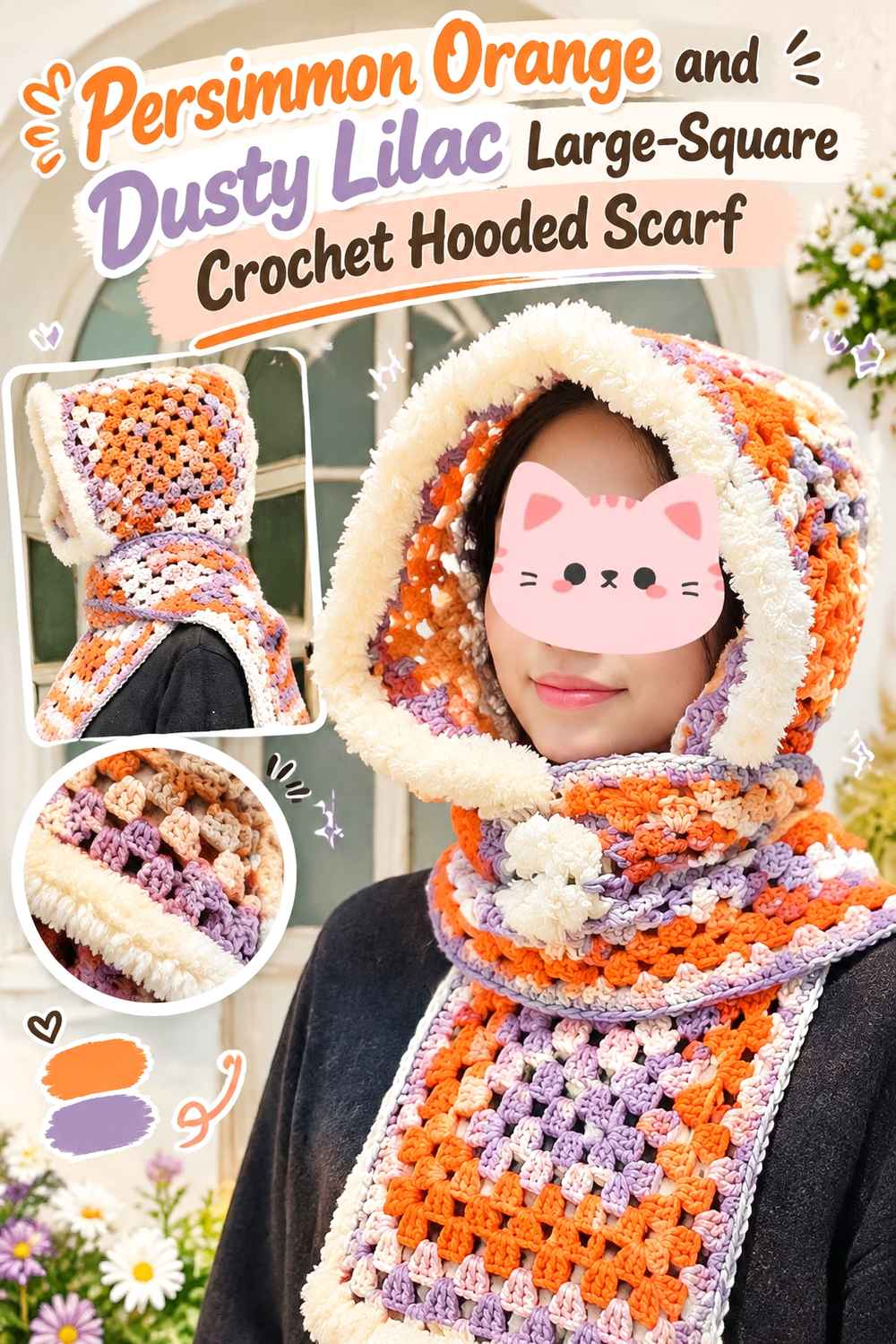
Large granny squares create bigger color fields than a scarf made entirely from small motifs. Use Persimmon Orange at the centers of the two large hood squares and Dusty Lilac on their outer rounds, then reverse that order on smaller scarf squares. The supporting tutorial uses two large granny squares together with smaller squares to create the hooded scarf.
Persimmon Orange Should Anchor the Large Crochet Hood Squares
The larger motifs already carry more visual weight, so placing Persimmon Orange at their centers emphasizes the hood without requiring the entire square to be orange. Dusty Lilac outer rounds can soften the transition into the scarf motifs.
Lay the two large squares beside each other before joining. Matching color order across both keeps the hood from appearing darker or heavier on one side.
Dusty Lilac Can Reverse the Persimmon Orange Crochet Motif Order on the Scarf
For the smaller scarf squares, start with Dusty Lilac centers and move into Persimmon Orange outer rounds. The reversal creates variety while preserving the same two-color system.
Keep at least one repeated round position consistent across all motifs. If every square changes its color order independently, the hooded scarf can move from retro patchwork into visually unstructured color scatter.
Creator Credit: Crochet Musings
13. Dusty Lilac and Persimmon Orange Joined Granny Square Crochet Hooded Scarf

A hooded scarf built entirely from repeated granny squares makes motif layout the main color decision. Alternate Dusty Lilac-led and Persimmon Orange-led squares, but use the same outer-round color across groups that will be joined together. The supporting tutorial constructs the hooded scarf from granny squares and addresses the hood layout and joining process.
Dusty Lilac Can Keep Persimmon Orange Crochet Granny Squares From Becoming Too Heavy
Use more Dusty Lilac around the face and upper scarf if Persimmon Orange appears strongly in the motif centers. The lighter outer rounds create separation between adjacent Orange centers and keep the hood from reading as one dense block.
Photograph the full square layout before joining. That makes it easier to spot areas where several Persimmon Orange-heavy motifs have accidentally clustered together.
Persimmon Orange Can Repeat Through Dusty Lilac Crochet Square Centers
A consistent Persimmon Orange center is one of the simplest ways to connect many Dusty Lilac-dominant motifs. The repeated center gives the eye a predictable color to follow from the hood into the scarf tails.
If you reverse a few motifs, do so in mirrored positions. Symmetrical reversals can look deliberate, while a single isolated color reversal may appear accidental.
Creator Credit: Käthe
14. Persimmon Orange and Dusty Lilac Contrast-Join Crochet Granny Hooded Scarf
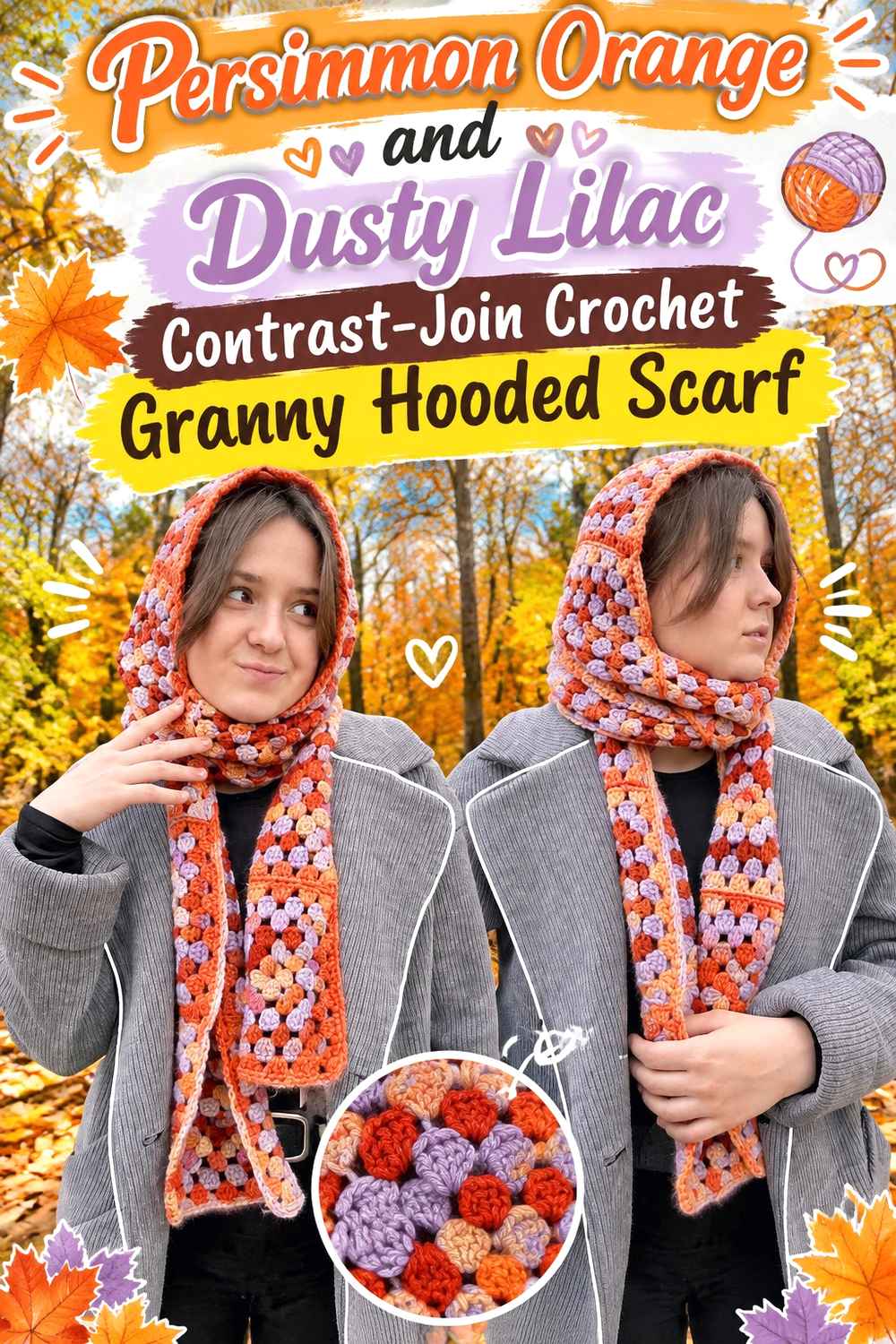
This final direction makes the joining color part of the palette instead of treating joins as something to hide. Build mainly Dusty Lilac granny squares with Persimmon Orange centers, then use Persimmon Orange joins so the connection lines create a visible grid across the hood and scarf. The supporting tutorial includes granny-square hooded construction and alternative joining approaches, making the joins themselves a useful color-planning feature.
Persimmon Orange Joins Can Organize Dusty Lilac Crochet Granny Squares
A Persimmon Orange joining line gives every Lilac-led square a clear boundary. This can strengthen the retro geometric effect because the construction grid remains visible rather than disappearing into the motif background.
Test the join on two spare squares first. The visual width of the Persimmon Orange line depends on the joining method, and a very prominent join can compete with the centers of the motifs.
Dusty Lilac Should Still Occupy More Space Than Persimmon Orange in the Crochet Hood
If Orange appears in both the motif centers and the joins, let Dusty Lilac cover most outer rounds. Otherwise the darker warm shade can spread across so many boundaries that the individual squares lose their lighter breathing space.
Around the face, consider finishing with Dusty Lilac rather than another Orange edge. That gives the hood opening a calmer boundary while the Persimmon Orange grid remains visible across the rest of the garment.
Creator Credit: fiorafana
Which Persimmon Orange and Dusty Lilac Crochet Hooded Scarf Direction Should You Choose?
For the clearest large-scale color blocking, start with the tapered scarf, detachable hood, two-rectangle design, or pocket styles. Their larger uninterrupted panels give Persimmon Orange and Dusty Lilac distinct areas and make it easier to control which shade dominates.
Choose the cable or textured versions when stitch definition matters as much as color. In those designs, keep the palette changes broader and less frequent so the surface texture remains visible.
The granny-square hooded scarves offer the most opportunities for repeated retro geometry. The large-square version creates bold focal motifs, the joined-square version gives you a more even patchwork rhythm, and the contrast-join version allows Persimmon Orange to become part of the visible construction lines.
The infinity scarf changes the color problem completely because there are no separate hanging tails. Plan that palette while the loop is wrapped and the hood is both raised and lowered, since the visible color sections can shift considerably between those positions.
Conclusion
Persimmon Orange and Dusty Lilac work especially well on hooded scarves when the colors are assigned to specific garment zones rather than distributed evenly everywhere. Persimmon Orange can provide weight through hoods, pockets, scarf ends, joins, cable panels, or granny-square centers, while Dusty Lilac can open up larger scarf surfaces, borders, outer motif rounds, and face edges.
For a cleaner retro look, use broad blocks and repeated placements. For a more playful patchwork direction, use granny squares but maintain a consistent center, outer round, or joining color so the palette still feels connected.
Before finishing any version, wear the hood with the scarf arranged as intended and look at the full accessory in a mirror. Check whether one color crowds the face, whether the scarf tails feel balanced, whether pockets pull too much attention downward, and whether both shades remain visible in the way the scarf will actually be worn. Use the credited tutorial for the exact construction while treating the Persimmon Orange and Dusty Lilac placement as your independent color plan.
Frequently Asked Questions
Should Persimmon Orange or Dusty Lilac dominate a retro crochet hooded scarf?
Persimmon Orange is useful as the dominant shade when you want the hood, pockets, or scarf ends to have stronger visual weight. Dusty Lilac makes a softer dominant field and allows Orange borders, joins, motifs, or stripes to stand out more clearly. Choose the dominant color based on which part of the wearable you want noticed first.
Where should Persimmon Orange go on a Dusty Lilac crochet hooded scarf?
Useful locations include the hood opening, pockets, scarf ends, granny-square centers, joining lines, or one broad stripe section. Repeating Orange in at least two separated areas usually connects the palette better than using it once as an isolated accent.
Can Persimmon Orange and Dusty Lilac be striped across the entire crochet hooded scarf?
Yes, but broader stripes generally preserve the identity of both colors more clearly on a large wearable. Check where the stripe sequence lands around the hood opening and scarf ends before committing to the full repeat. A solid-color border can help organize a striped hood.
How can I make Persimmon Orange and Dusty Lilac granny squares look less busy?
Give the motifs one repeated rule. For example, keep every center Persimmon Orange, every outer round Dusty Lilac, or every join Persimmon Orange. Repetition creates structure even when individual square interiors vary.
Should the crochet hood edge match the scarf or contrast with it?
Either can work. A matching Dusty Lilac edge can soften and unify a Lilac-led scarf, while a Persimmon Orange border can define the face opening more strongly. The border should not be so tight that it changes how the hood sits, regardless of the color you choose.
How can I check whether Persimmon Orange and Dusty Lilac have enough contrast?
Place the yarns side by side and view them from several feet away. A grayscale phone photo can help reveal whether their light-dark values are sufficiently different. If they merge more than expected, use one color in larger uninterrupted areas and place a clearer boundary around important details such as pockets, motifs, or the hood opening.
What is the easiest way to keep a two-color crochet hooded scarf balanced?
Repeat each color intentionally across the upper and lower parts of the accessory. If Persimmon Orange appears around the hood, echo it at the scarf ends or pockets. If Dusty Lilac fills the scarf body, repeat it around the face or in granny-square outer rounds. This prevents either shade from looking confined to one disconnected part of the garment.