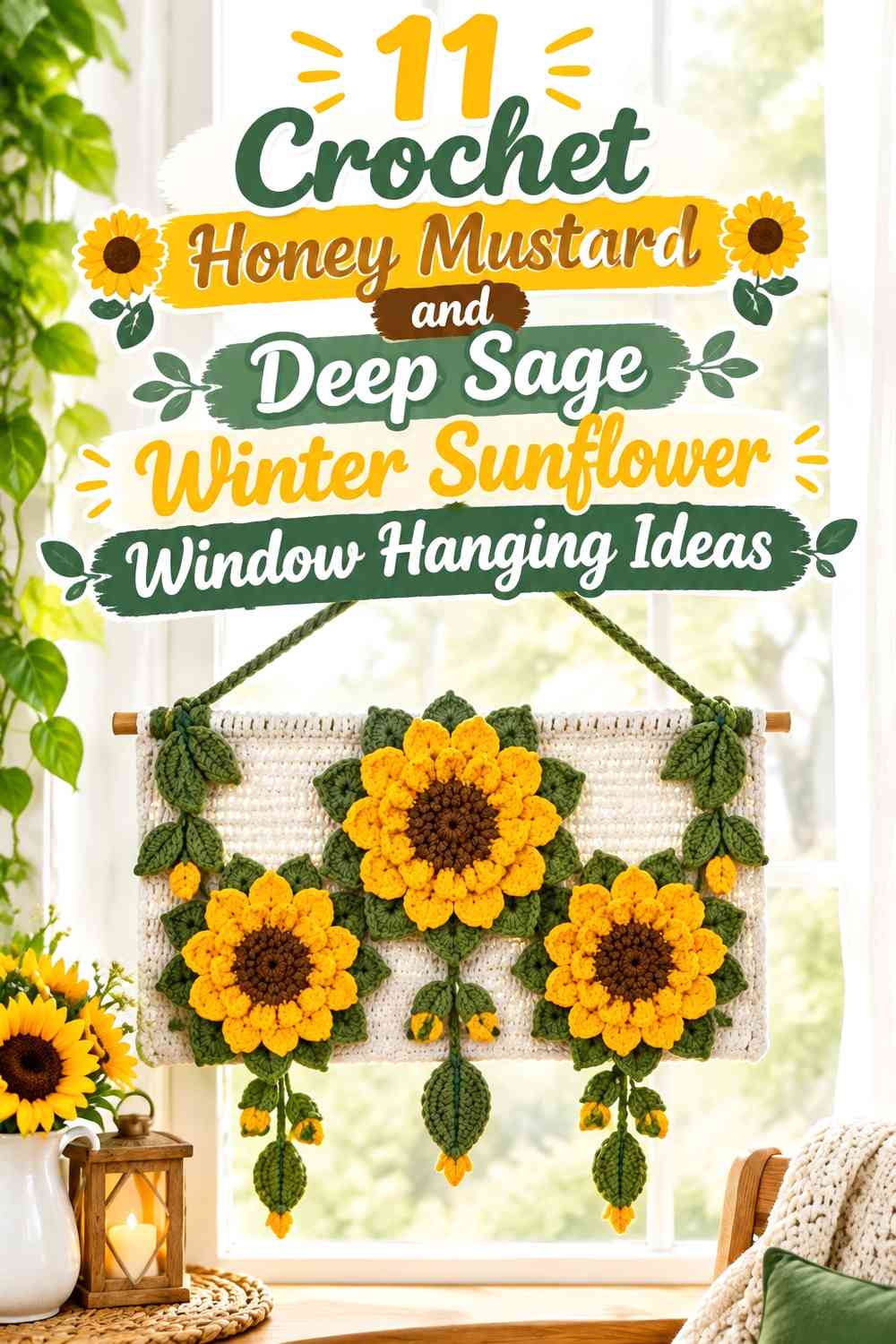

Honey mustard and deep sage give crochet sunflowers a quieter winter direction than bright yellow petals with fresh spring green. Honey mustard can still make the flower recognizable, but its softened warmth feels more subdued against deep sage leaves, stems, borders, and hanging cords.
A window hanging also changes how the colors behave. Sunlight and backlighting can make open crochet appear lighter, while a dark deep-sage border may become more silhouette-like against a bright pane. Honey mustard therefore needs enough visual area in the petals to remain distinct instead of becoming a thin halo around a dark center.
The credited tutorials below support sunflower wall hangings, individual sunflower motifs, appliqués, round flowers, and sunflower squares that can be adapted into suspended window decor. The honey mustard and deep sage palettes are independent editorial adaptations and are not presented as the creators’ original color choices.
Quick List
- Honey Mustard Sunflowers and Deep Sage Stem Crochet Winter Window Hanging
- Honey Mustard Sunflower Panel and Deep Sage Frame Crochet Winter Window Hanging
- Honey Mustard 3D Sunflower and Deep Sage Leaf Crochet Winter Window Hanging
- Honey Mustard Sunflower Appliqués and Deep Sage Vine Crochet Winter Window Hanging
- Honey Mustard Round Sunflowers and Deep Sage Hanging Cord Crochet Winter Window Hanging
- Honey Mustard Sunburst Squares and Deep Sage Join Crochet Winter Window Hanging
- Honey Mustard Sunflower Squares and Deep Sage Outer Frame Crochet Winter Window Hanging
- Honey Mustard Sunflowers and Deep Sage Botanical Square Crochet Winter Window Hanging
- Honey Mustard Lace Sunflower and Deep Sage Border Crochet Winter Window Hanging
- Honey Mustard Statement Sunflower and Deep Sage Trailing Leaves Crochet Winter Window Hanging
- Honey Mustard Sunflower Grid and Deep Sage Joining Crochet Winter Window Hanging
Let Honey Mustard Stay Visible Against a Bright Winter Window
A sunflower that looks strongly colored on a table can appear much lighter once it is suspended against daylight. Give honey mustard petals enough width and repetition to preserve their shape from across the room.
Deep sage usually has more visual weight, so use it strategically. A thin sage stem or leaf can support a mustard flower, while a very wide sage surround may make the flower seem smaller than expected.
Test one finished motif against the actual pane before producing a full set. The wall color around the window, curtains, and direction of daylight can all change how strongly the two shades appear.
Use Deep Sage to Connect Honey Mustard Sunflower Motifs
The green shade does not need to appear inside every petal section. Deep sage is often more useful as the connecting element: stems, leaves, joining cords, square borders, hanging loops, and the top support line.
That gives a multi-motif hanging continuity. Even if the honey mustard flowers vary in size or position, the repeating sage structure makes them read as one botanical display.
For the calmest winter palette, avoid adding numerous extra flower colors. A dark brown or similarly subdued center can be considered where needed, but honey mustard and deep sage should remain the clear visual identity.
Plan Honey Mustard and Deep Sage Around Window Hardware
Decide where the hanging will sit before determining its final shape. A vertical sunflower strand may work in a narrow pane, while a horizontal garland or framed panel may suit a wider window.
Keep crochet clear of handles, hinges, blind cords, latches, and moving window sections. If condensation regularly forms on the glass, place the textile where it will not rest continuously against the damp surface.
The suspension method should support the complete finished hanging without pulling individual flower motifs out of shape.
1. Honey Mustard Sunflowers and Deep Sage Stem Crochet Winter Window Hanging
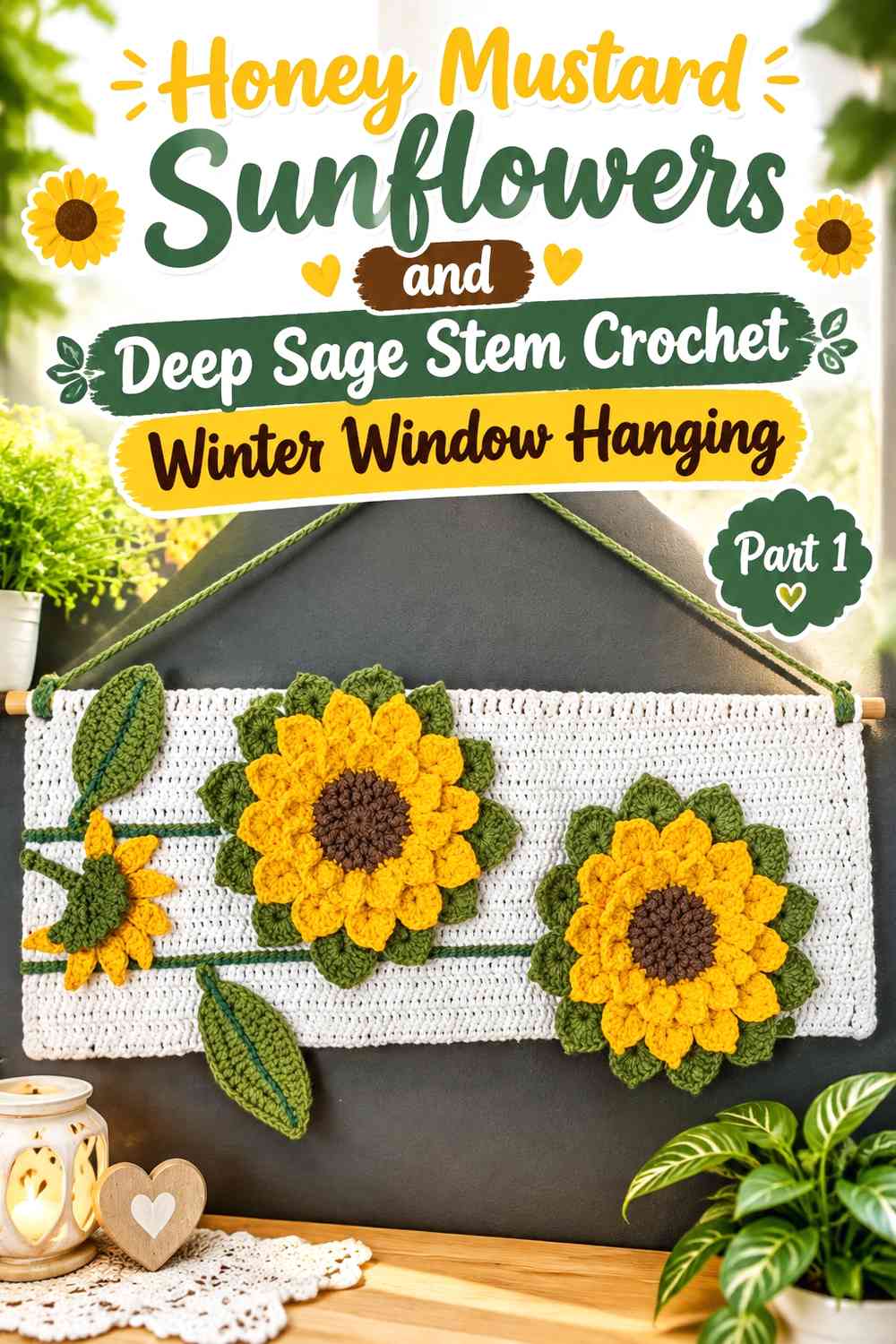
This vertical botanical arrangement uses honey mustard for the flower heads and deep sage for the stem, leaves, and connecting structure. It gives the strongest plant-like silhouette in the collection and works well when the window has a tall narrow section available for decor.
Let Honey Mustard Sunflowers Lead the Deep Sage Vertical Hanging
Keep honey mustard across the broadest visible petal sections so each bloom remains recognizable against the light. If several flowers are used, vary their position before varying their color; one consistent mustard shade keeps the arrangement connected.
Place the largest flower where it can remain fully visible rather than directly behind a window divider or curtain edge.
Use Deep Sage to Connect the Honey Mustard Flowers
Carry deep sage through the stems and leaves so the separate blooms read as one sunflower plant. The green line can remain relatively narrow because continuity, rather than surface area, is its main job.
Avoid making every leaf extremely large. Too much dark green between flowers can interrupt the vertical mustard rhythm.
Keep Deep Sage Leaves Away From Honey Mustard Petal Edges
Leave a little visual separation where possible. A dark leaf overlapping a petal can obscure the flower outline when the window is brightly backlit.
Creator Credit: Make It Yourself By Papari
2. Honey Mustard Sunflower Panel and Deep Sage Frame Crochet Winter Window Hanging
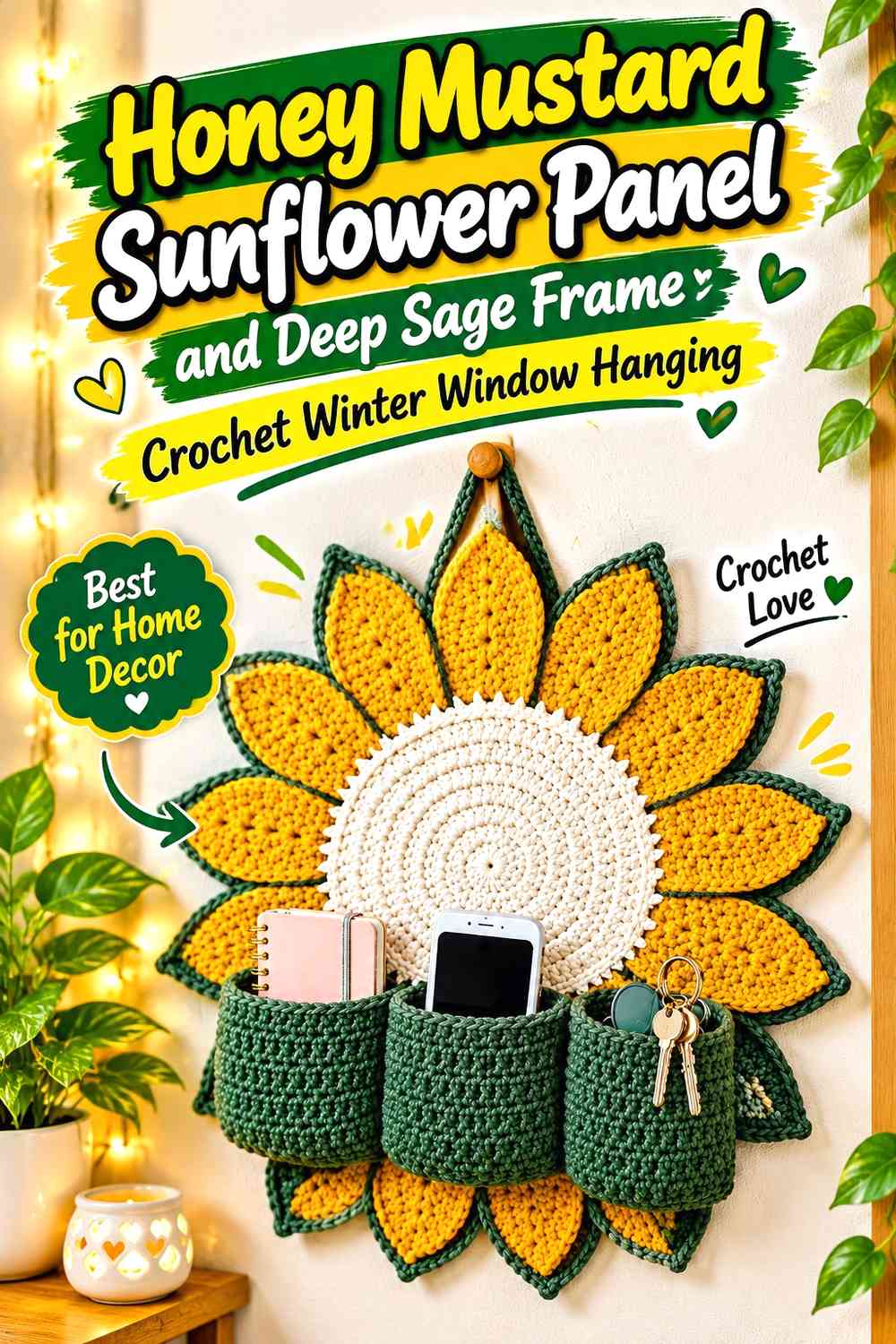
A broader wall-hanging construction can be adapted into a rectangular or gently elongated window panel. Honey mustard supplies the focal sunflower, while deep sage establishes enough surrounding structure to make the piece readable as a hanging rather than a loose flower.
Keep Honey Mustard Central Inside the Deep Sage Window Panel
Use the flower as the primary focal point and give it open space around the petals. A sunflower pushed too close to every edge loses some of its circular definition.
This is particularly important against a window, where the frame and muntins may already create several strong geometric lines.
Use Deep Sage Around the Honey Mustard Sunflower Perimeter
A deep sage border can define the panel against the glass and visually connect leaves or stems to the outside frame. Keep the border proportional to the sunflower rather than making it the widest part of the composition.
Repeat Honey Mustard Sparingly Inside the Deep Sage Frame
A small lower flower, bud, or limited accent can echo the main sunflower without turning the panel into an evenly distributed mustard pattern.
Creator Credit: ALL HOME TECHNIC
3. Honey Mustard 3D Sunflower and Deep Sage Leaf Crochet Winter Window Hanging
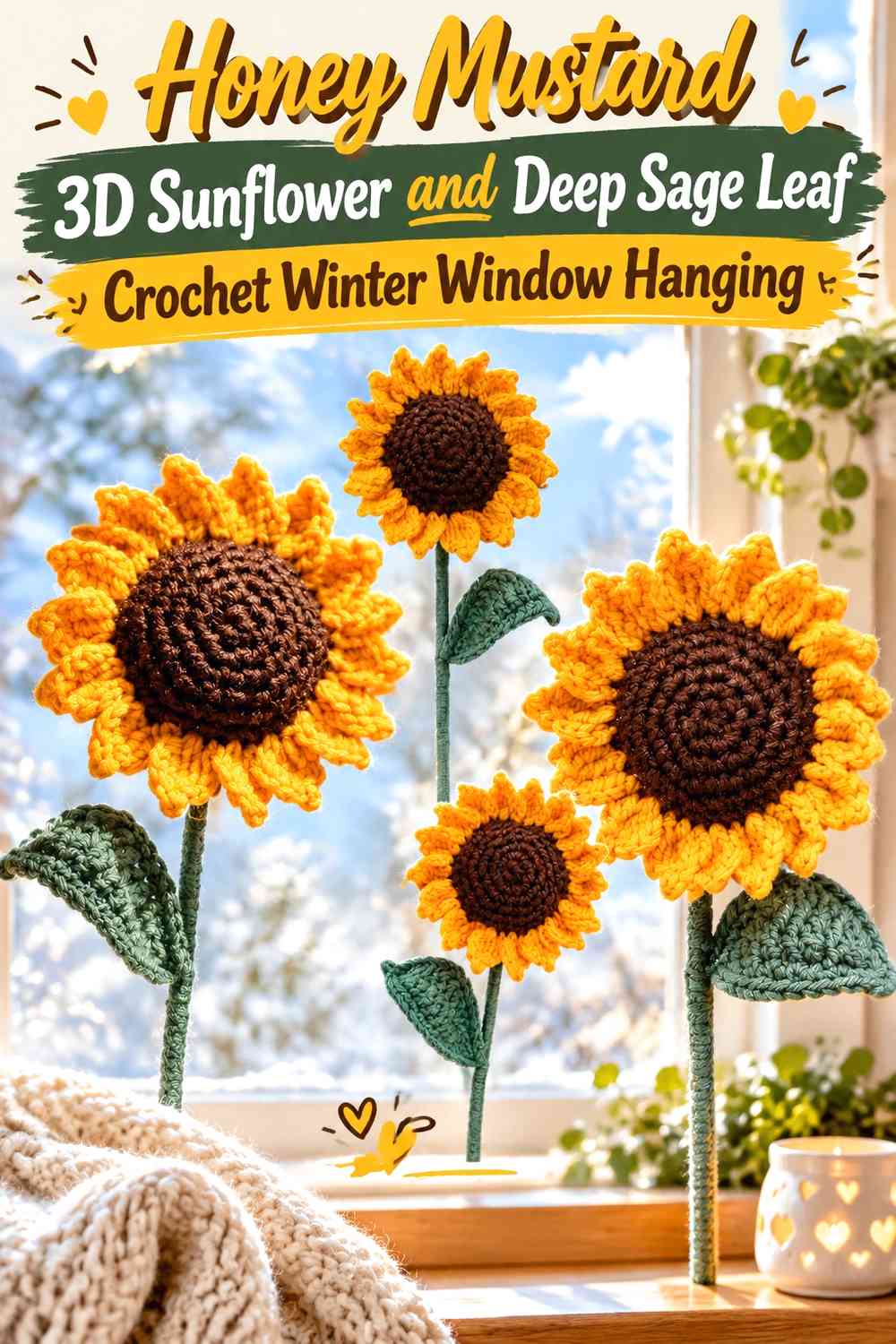
A dimensional sunflower creates strong daytime texture even when there is little direct light through the window. Honey mustard can cover the raised petals, while deep sage remains concentrated in leaves and the suspension system.
Let Honey Mustard Carry the Raised Sunflower Petals
Use one continuous mustard shade through the dimensional petal layers. Shadows between the petals already create tonal variation, so frequent color changes are unnecessary.
If the flower projects significantly from the hanging, check that it does not rub against blinds or curtains.
Keep Deep Sage Leaves Flatter Than Honey Mustard Flowers
A flatter green leaf treatment lets the mustard flower remain the main dimensional element. This contrast between projection and flatness can make the sunflower easier to read from the side as well as straight on.
Use Deep Sage Above the Honey Mustard Flower for Suspension
A sage loop, stem, or upper connector visually extends the botanical structure into the actual hanging mechanism. Keep it centered enough that the weight of the dimensional bloom does not make the display appear tilted.
Creator Credit: Brunaticality
4. Honey Mustard Sunflower Appliqués and Deep Sage Vine Crochet Winter Window Hanging
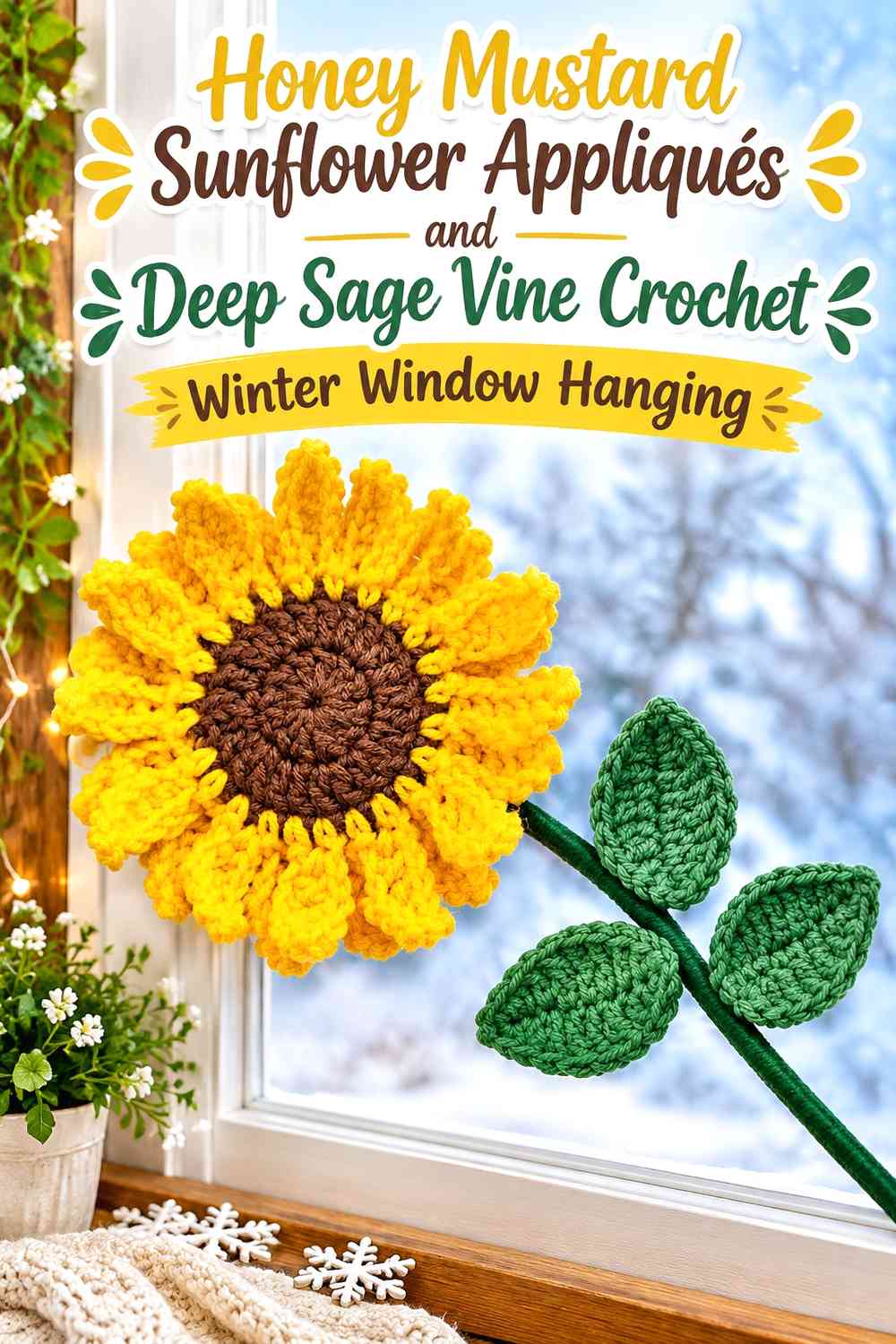
Flat sunflower appliqués can be spaced along a flexible green vine to create a lighter garland-style window treatment. Honey mustard provides repeated focal points without the bulk of heavily dimensional flowers.
Space Honey Mustard Appliqués Along the Deep Sage Vine
Leave visible stretches of sage between blooms. If every mustard flower touches the next, the individual petal outlines can merge into one irregular yellow band when viewed against daylight.
Slightly uneven spacing can feel botanical, but keep the overall visual weight balanced across the window.
Let Deep Sage Form the Continuous Honey Mustard Garland Line
The vine should remain identifiable from one end of the hanging to the other. This is what turns separate sunflower appliqués into one window decoration.
Use Honey Mustard More Heavily Near Deep Sage Focal Points
A larger sunflower at the center or at two balanced outer positions can give a long vine more structure. Keep smaller flowers elsewhere so every motif does not compete equally.
Creator Credit: naztazia
5. Honey Mustard Round Sunflowers and Deep Sage Hanging Cord Crochet Winter Window Hanging
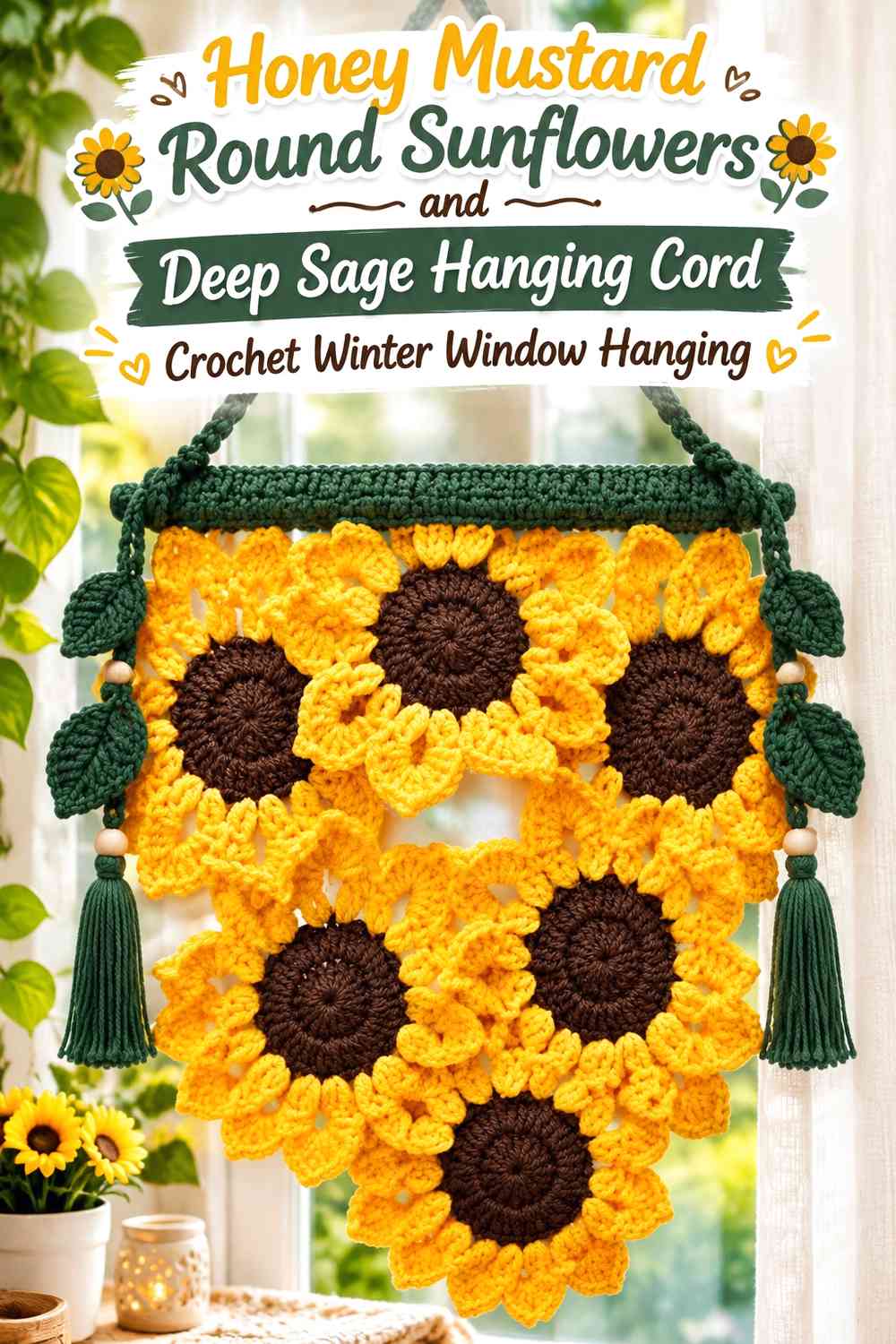
Flat round sunflower motifs can be suspended individually from one deep-sage top cord. This creates an airy design with more glass visible between motifs than a continuous rectangular panel.
Keep Honey Mustard Broad Across the Round Sunflower Motifs
The circular flower shape should remain clear even if the motifs turn slightly in a draft. Give mustard enough petal area around the center so the sunflower can be recognized from more than one angle.
Suspend Honey Mustard Flowers From Deep Sage at Different Lengths
Slight variation in drop length can produce a softer arrangement than one perfectly level row. Keep the differences controlled so the display still feels balanced.
Leave Deep Sage Space Between Honey Mustard Hanging Discs
The negative space matters as much as the motif itself. A window hanging benefits from visible light between the flowers instead of becoming a solid curtain of crochet.
Creator Credit: Weavedin, Crocheting and Knitting Platform
6. Honey Mustard Sunburst Squares and Deep Sage Join Crochet Winter Window Hanging
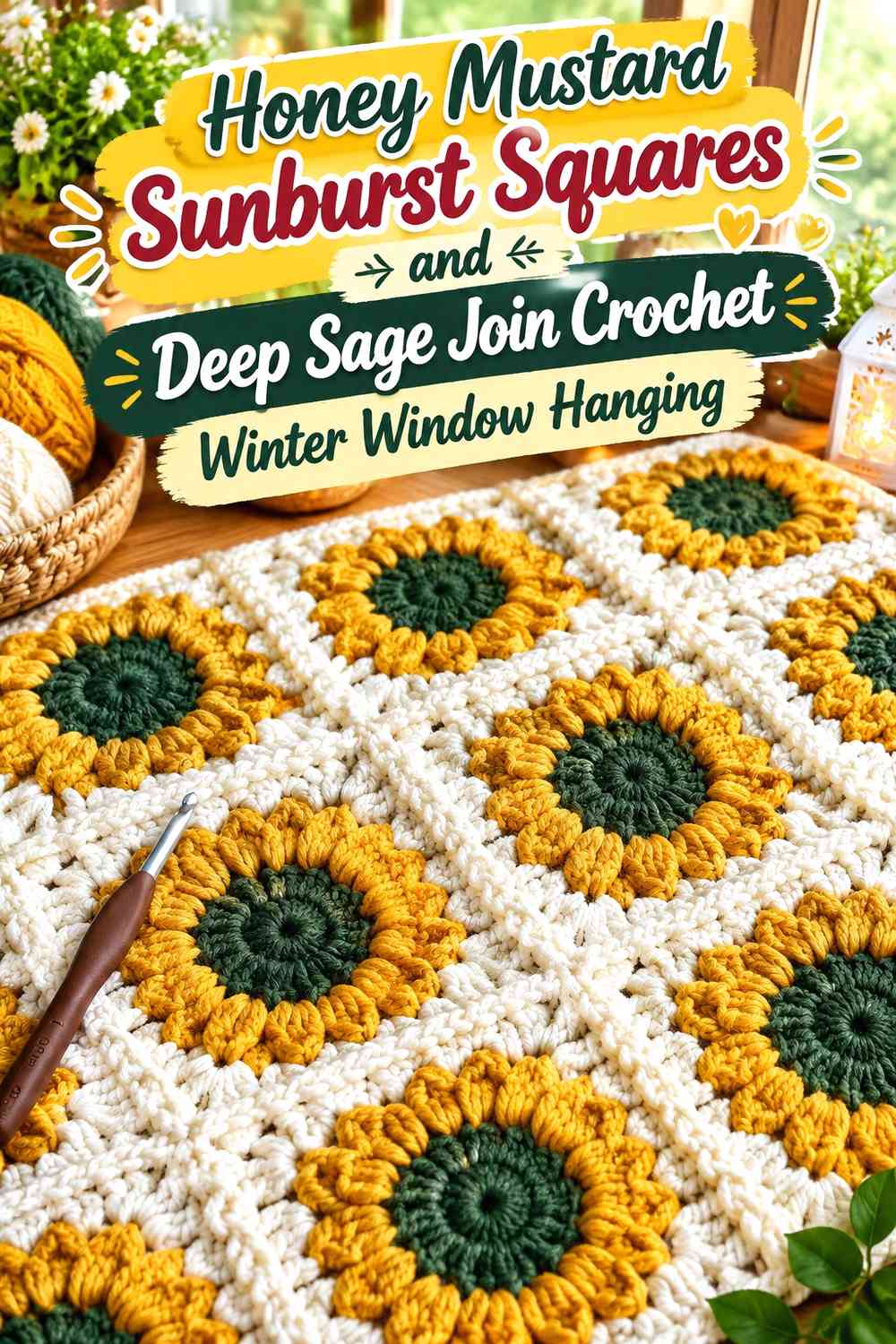
Sunburst-style squares turn the sunflower idea into a more geometric hanging. Honey mustard can occupy the radiating floral center, while deep sage forms the joining system between repeated motifs.
Keep Honey Mustard in the Same Position Across Every Deep Sage Square
Repeating mustard through the sunburst centers creates a clear visual rhythm. Changing its placement from square to square can make a narrow window strip look patchwork rather than botanical.
Use Deep Sage Joins to Organize Honey Mustard Sunbursts
Visible green joining lines can become part of the design, particularly when several squares form one vertical or horizontal row.
Keep those joins narrow enough that the flowers remain more prominent than the grid.
Check Honey Mustard Sunburst Scale Against Deep Sage Window Divisions
Before joining many squares, hold one against the pane. If a window muntin cuts directly through each sunflower center, shifting the full hanging slightly may improve the finished appearance.
Creator Credit: Hooked by Robin
7. Honey Mustard Sunflower Squares and Deep Sage Outer Frame Crochet Winter Window Hanging
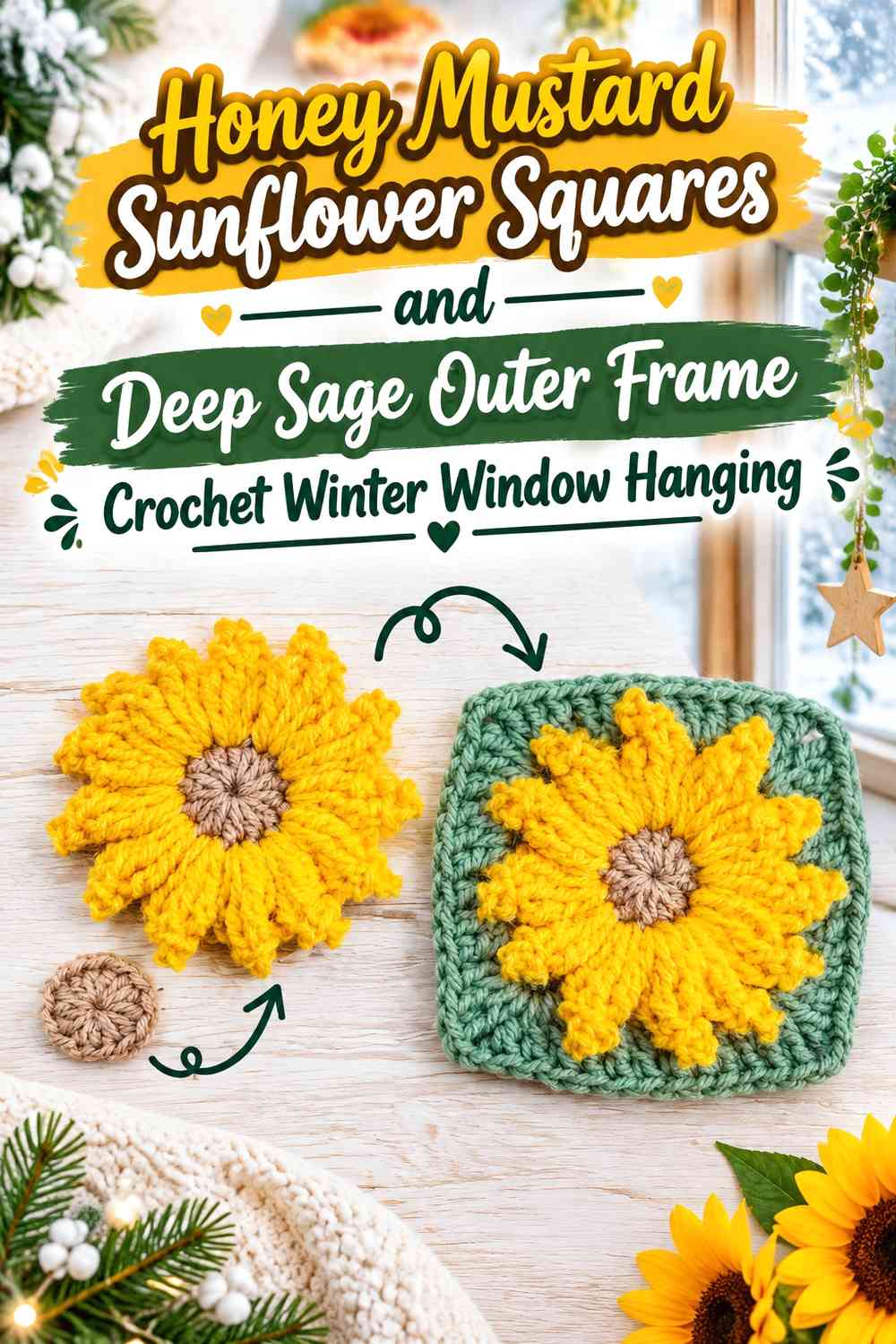
This idea uses sunflower squares inside one larger deep-sage perimeter. The extra frame creates a more finished panel effect and gives the hanging a strong outline when viewed from outside the room as well as inside.
Let Honey Mustard Repeat Across the Deep Sage Framed Panel
Keep each flower consistent enough that the eye reads a sunflower series rather than unrelated floral blocks. The repeated mustard centers or petals become the main internal rhythm.
Use Deep Sage as Both Join and Outer Honey Mustard Frame
Repeating the same green in the internal connections and outer boundary ties the panel together. If the outer border is much wider than the joins, the entire piece can become green-heavy.
Leave Honey Mustard Motifs Away From an Overwide Deep Sage Edge
If more framing is needed for stability or appearance, increase it gradually and reassess against the window. The sunflower motifs should still occupy most of the visual interior.
Creator Credit: Crafting Happiness Crochet
8. Honey Mustard Sunflowers and Deep Sage Botanical Square Crochet Winter Window Hanging
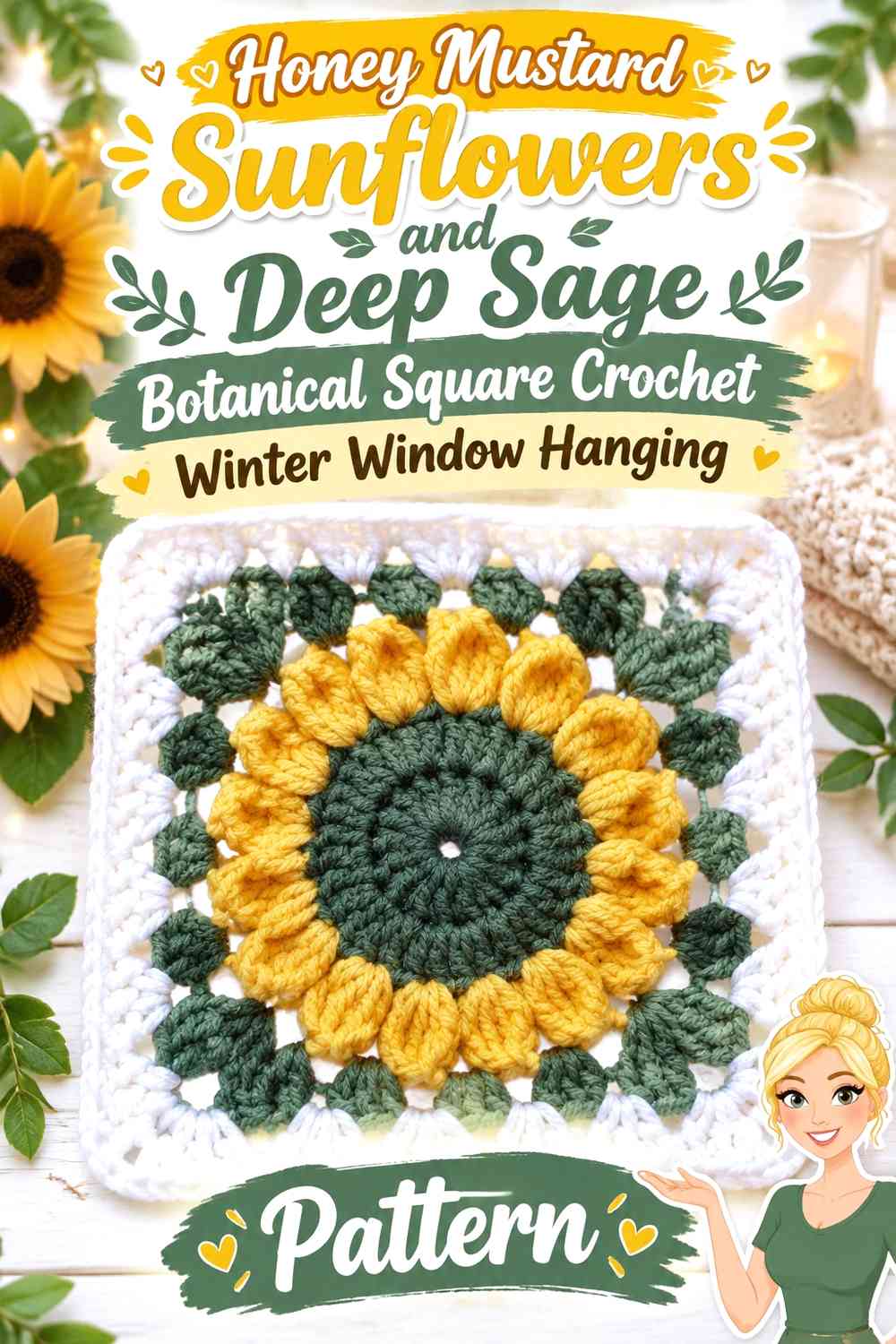
A flatter sunflower-square treatment creates a tidy modular design suitable for a narrow strip, corner panel, or a group of suspended squares. Honey mustard supplies the floral center while deep sage can extend farther into the square background.
Keep Honey Mustard Distinct Inside the Deep Sage Botanical Square
Give the sunflower enough mustard area to remain recognizable after the green surround is added. If the sage begins too close to the center, the flower may appear smaller than intended.
Let Deep Sage Create More Background Around Honey Mustard
This idea can use more green than the previous framed panel. A substantial sage square gives the motif a botanical rather than purely floral appearance and produces a darker winter result.
Repeat Honey Mustard at Regular Intervals Across Deep Sage
If the squares are hung separately, keep similar distances between the mustard focal points. The negative space between individual panels becomes part of the overall pattern.
Creator Credit: Secret Yarnery
9. Honey Mustard Lace Sunflower and Deep Sage Border Crochet Winter Window Hanging
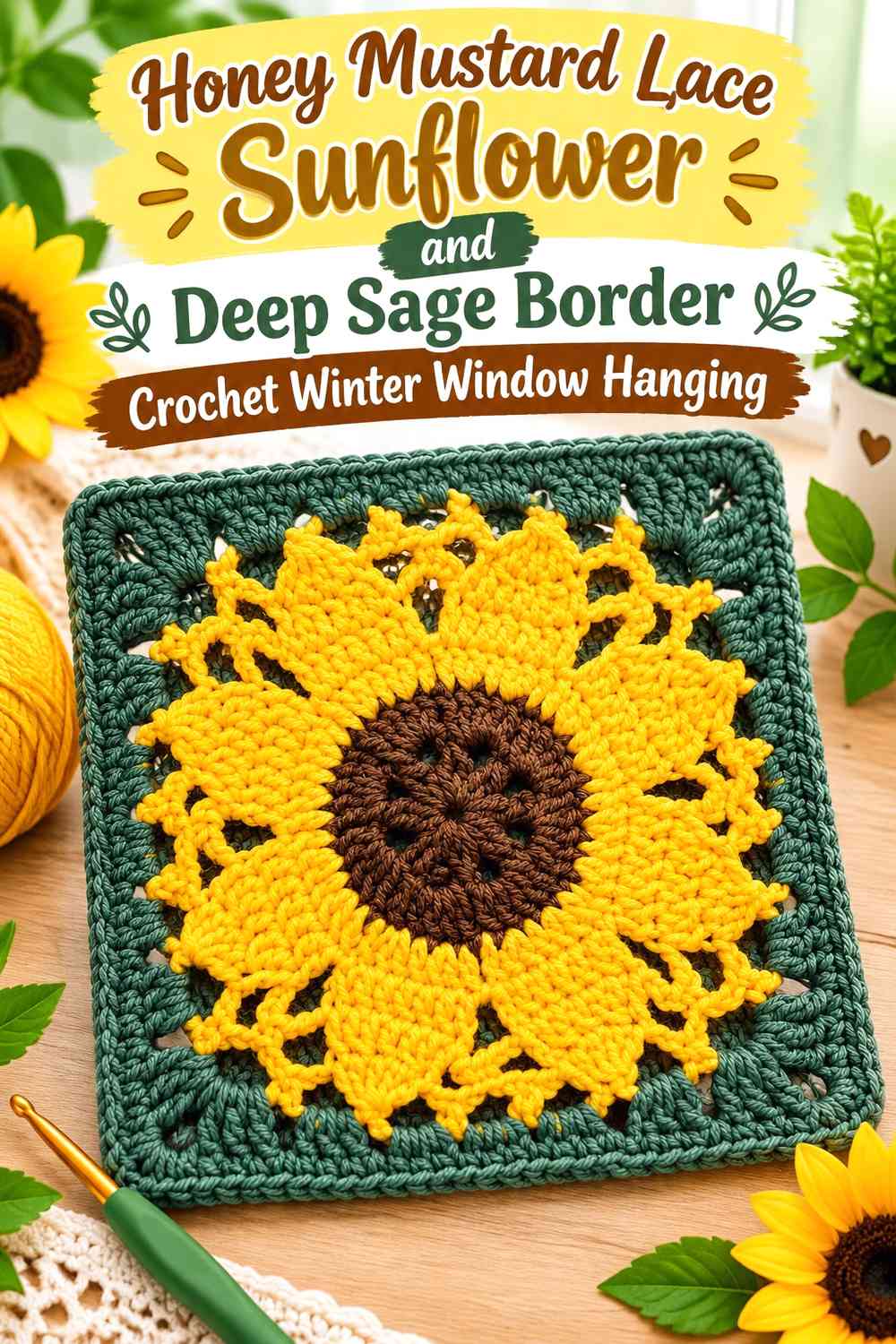
A more open sunflower motif makes particular sense against a window because light can pass through the crochet. Honey mustard can define the radiating flower while deep sage creates a controlled boundary around the open sections.
Let Light Pass Through the Honey Mustard Sunflower Motif
Avoid filling every internal opening simply to make the mustard appear stronger. The contrast between yarn and window light is part of the hanging’s appeal.
Instead, increase the visual width of important petal sections if the flower needs more definition.
Put Deep Sage Around the Honey Mustard Lace Edge
A darker green perimeter can contain the openwork and keep it from visually dissolving into the pane. This is especially useful on bright windows where fine mustard stitches may appear lighter.
Keep Deep Sage Secondary to Honey Mustard Radiating Detail
If the border becomes too broad, the hanging may read as a green disc with a small yellow center. Reduce the outer green area when the sunflower shape stops being the first feature noticed.
Creator Credit: Lenysea
10. Honey Mustard Statement Sunflower and Deep Sage Trailing Leaves Crochet Winter Window Hanging
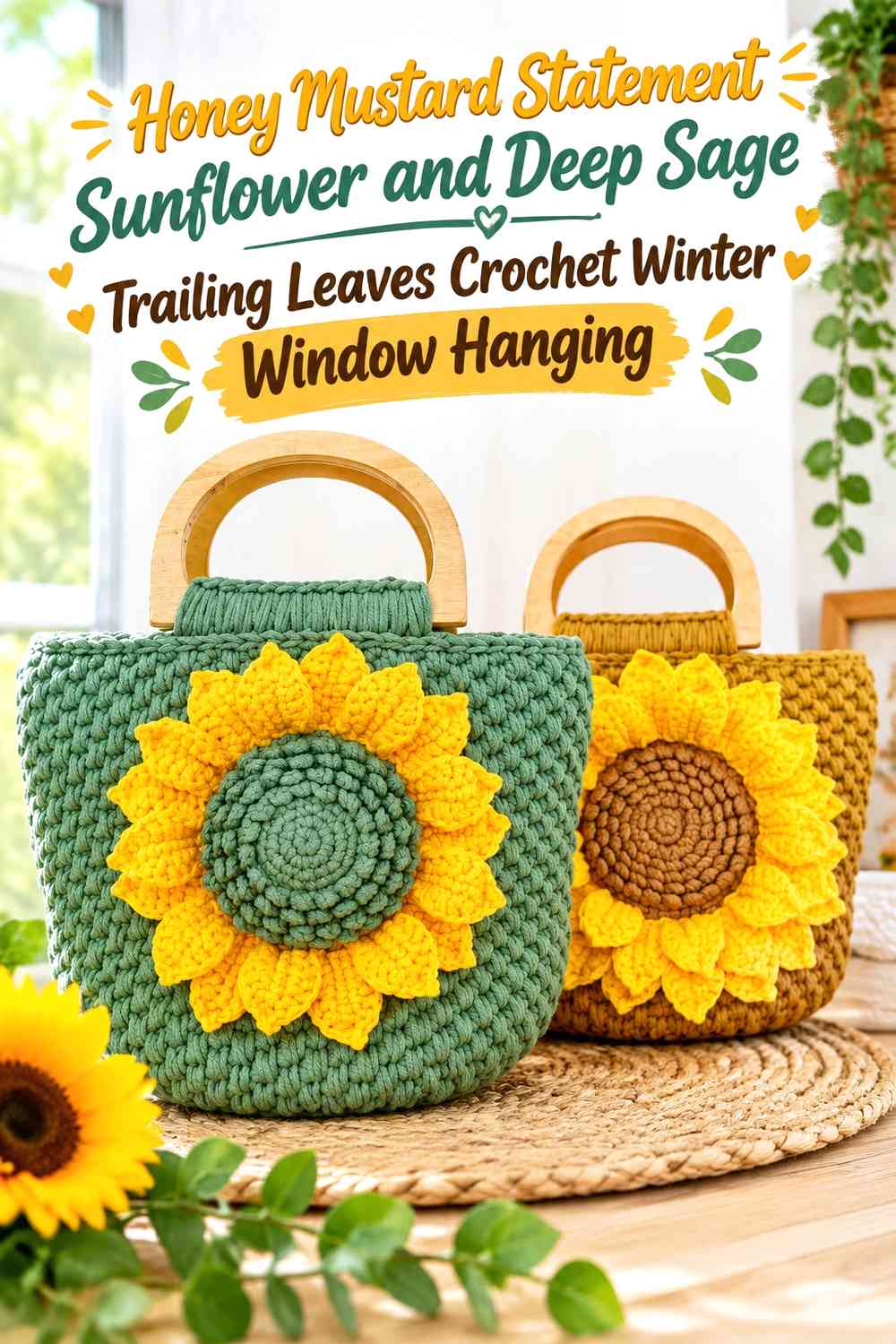
One large sunflower can be more effective than a row of small motifs on a compact window. Honey mustard becomes a single dominant focal point, while deep sage leaves trail below or to one side to create vertical movement.
Give Honey Mustard the Largest Visual Area in the Window Hanging
Allow the sunflower to dominate instead of surrounding it with equally large sage leaves. Its scale is what distinguishes this idea from the repeated-motif versions.
Trail Deep Sage Away From the Honey Mustard Flower
Place leaves beneath or beside the flower so the green creates direction without covering the petals. An asymmetrical trail can work well if the sunflower remains visually balanced against the open side.
Keep Honey Mustard Clear Where Deep Sage Approaches the Window Edge
A large flower placed too close to the frame can look cropped. Leave enough space around its outer petals for the full circular shape to remain visible.
Creator Credit: Lingzhi Handmade
11. Honey Mustard Sunflower Grid and Deep Sage Joining Crochet Winter Window Hanging
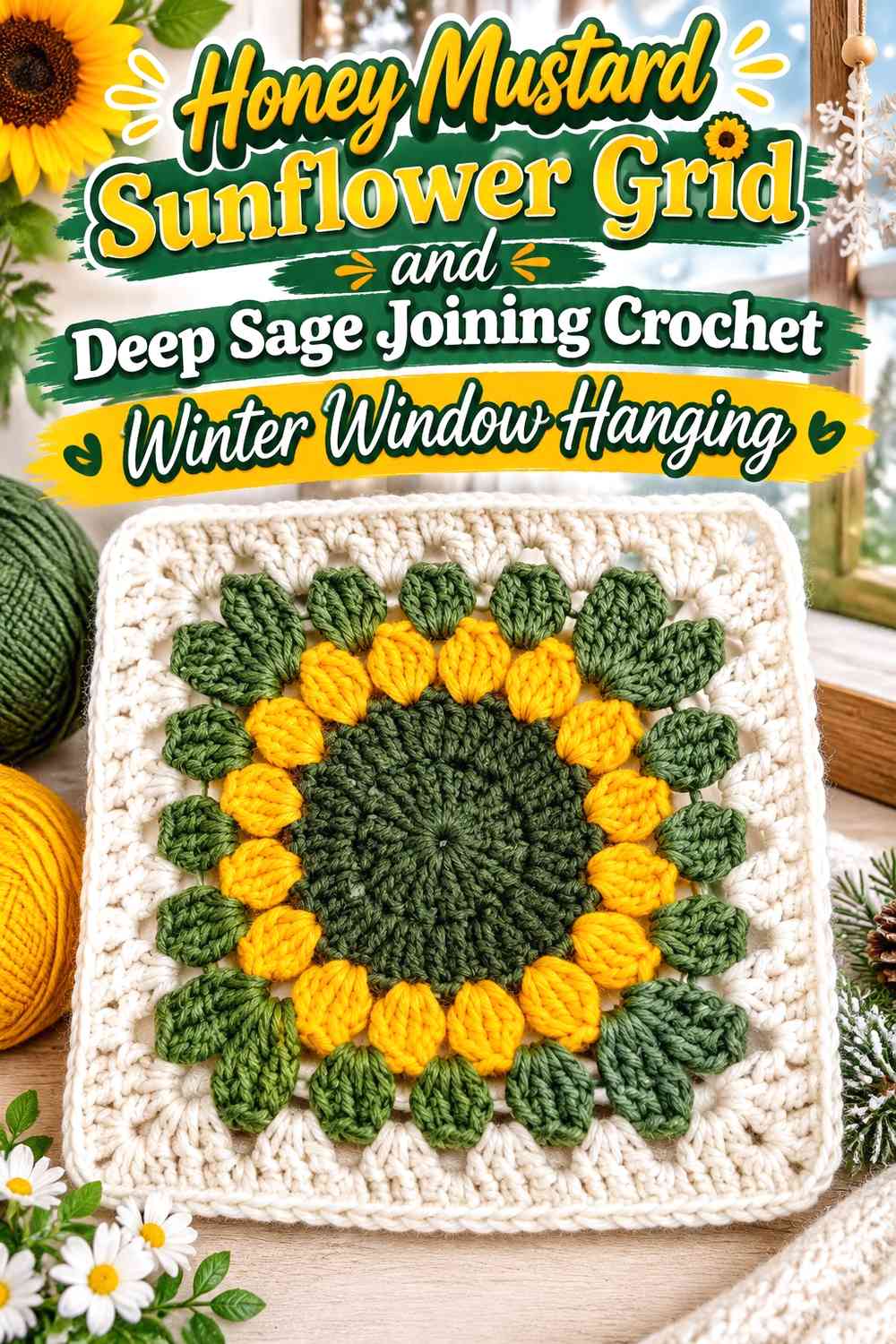
The final idea uses repeated sunflower squares to create a more structured window panel. Instead of emphasizing one flower, honey mustard repeats across a deliberate grid while deep sage keeps the units connected.
Repeat Honey Mustard Consistently Across the Deep Sage Grid
Use the same mustard role in every motif so the flowers form an orderly sequence. The grid itself already provides variety through repetition and window light, so random flower colors are unnecessary.
Keep Deep Sage Joins Narrow Between Honey Mustard Flowers
A broad joining color can visually separate the sunflowers into isolated blocks. Narrower sage connections let the eye move from one mustard motif to the next.
Use Deep Sage Around the Outer Honey Mustard Grid
A final green boundary can contain the modular layout and distinguish it from an unfinished strip of squares. Keep that edge proportional to the internal joins so the border does not become unexpectedly heavy.
Creator Credit: Jayda InStitches
Comparing the Honey Mustard and Deep Sage Window Hanging Directions
For the strongest natural sunflower-plant silhouette, ideas 1 and 10 place honey mustard flowers with clearly visible deep-sage stems or trailing foliage. Idea 1 is more vertical and botanical, while idea 10 relies on one larger statement bloom.
Ideas 4 and 5 produce lighter window treatments. The appliqué vine creates a flexible garland, while separately suspended round flowers leave more glass and daylight visible between motifs.
Ideas 6, 7, 8, and 11 use square-based construction. Choose idea 6 for a sunburst effect with noticeable joins, idea 7 for a fully framed panel, idea 8 when deep sage should occupy more background area, or idea 11 for the strongest repeated grid.
Idea 9 is useful when light-through openwork is part of the visual goal. Ideas 2 and 3 put greater emphasis on a single decorative panel or dimensional flower rather than a repeating pattern.
Conclusion
Honey mustard and deep sage can move a crochet sunflower window hanging away from bright summer coloring and toward a softer winter botanical palette. Honey mustard works most effectively when it is given enough area to preserve the sunflower silhouette, while deep sage can connect the composition through stems, leaves, borders, hanging cords, and joins.
Choose idea 1 for a tall botanical arrangement, ideas 4 or 5 when you want more visible glass between motifs, and idea 10 for a single statement flower. Ideas 6 through 8 and 11 suit a more structured modular display, while idea 9 makes the strongest use of light passing through open crochet.
Before completing the full hanging, test one flower or panel at the actual window during daylight. Check the mustard-and-sage contrast, the amount of glass covered, how the piece relates to curtains and window divisions, and whether handles or other moving parts remain accessible. Then use the credited tutorials for their original construction guidance while applying the honey mustard and deep sage palette independently.
Frequently Asked Questions
Should Honey Mustard or Deep Sage Dominate a Crochet Sunflower Window Hanging?
Honey mustard should usually occupy the largest part of the flower motifs if you want the sunflowers to remain immediately recognizable. Deep sage can dominate the stems, leaves, joins, hanging cord, or surrounding frame. For a darker winter panel, increase the sage background while keeping each mustard sunflower large enough to remain visible.
How Can Honey Mustard Sunflowers Stay Visible Against a Bright Window?
Use sufficiently broad petal areas and test the actual yarn against daylight. Very fine mustard details can appear washed out when backlit. A deep-sage border or darker center can provide additional definition without requiring a brighter yellow.
Where Should Deep Sage Go in a Honey Mustard Sunflower Hanging?
Useful placements include stems, leaves, joining cords, square backgrounds, hanging loops, panel borders, and the upper support line. Giving sage structural roles usually creates a more coherent botanical display than scattering green randomly through the flower petals.
How Can Honey Mustard and Deep Sage Look More Wintry Than Summery?
Keep both colors softened rather than highly saturated and use deep sage in substantial structural areas. More negative space, darker green foliage, and restrained mustard flowers can give the arrangement a quieter seasonal direction than a dense display of bright yellow blooms.
Are Honey Mustard Sunflower Squares Suitable for a Window Hanging?
Yes. Sunflower squares can be joined into a narrow strip, a small panel, or hung separately. Check the size of one finished square against the actual window before making the full set so the motifs do not cover more glass than intended.
Should Honey Mustard Sunflowers Hang Individually or on a Deep Sage Garland?
Individual flowers leave more open glass and can create a light, suspended effect. A deep-sage garland provides a clearer continuous botanical line. Choose according to whether you want separate floating motifs or one connected arrangement.
How Do I Keep a Deep Sage Window Hanging From Looking Too Heavy?
Reduce the width of green joins and borders before changing the main palette. Leave visible spaces between motifs and let honey mustard occupy broad petal sections. A dark shade can still work around a bright window when it is used as structure rather than filling every available area.