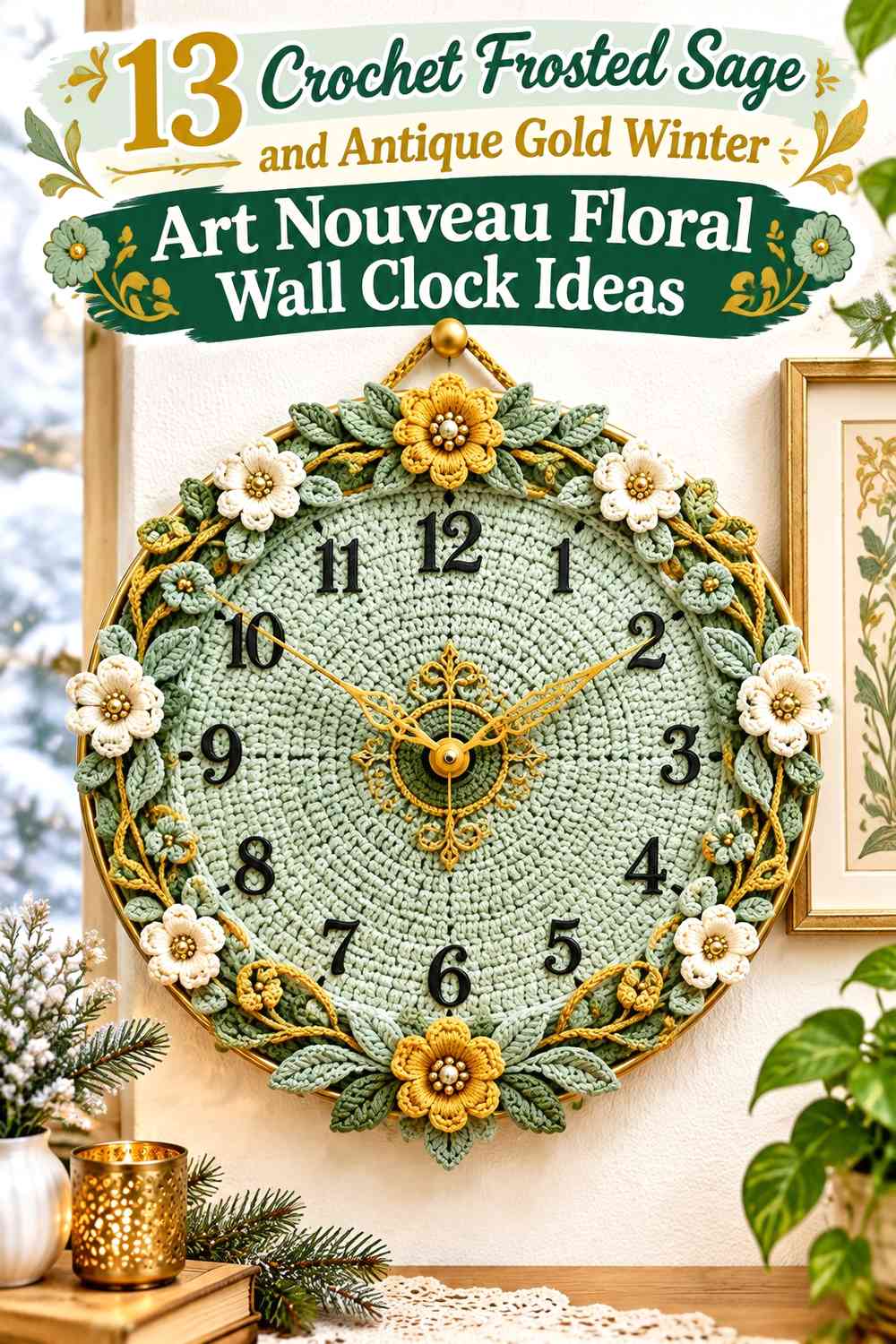
13 Crochet Frosted Sage and Antique Gold Winter Art Nouveau Floral Wall Clock Ideas

Frosted sage and antique gold create a restrained winter palette for an Art Nouveau-inspired crochet wall clock. Frosted sage can cover the main clock face or botanical background without making every decorative element compete for attention, while antique gold can define flower centers, hour positions, vine outlines, borders, and the area around the hands.
A functional crochet clock needs more color discipline than a purely decorative mandala. Flowers and scrolling leaves should frame the time display rather than obscure it, and raised crochet near the center needs to be planned with the clock hands and mechanism in mind. The best palette is therefore not necessarily the one with the most gold; it is the one that uses gold where definition is genuinely useful.
The creator references below include functional crochet clocks as well as round floral, mandala, lace, and wreath constructions that can inspire the crochet face. When a tutorial is not itself a clock, use it only for the relevant crochet structure or floral layout and plan the clock mechanism separately.
Quick List
- Frosted Sage and Antique Gold Crochet Floral Wall Clock With an Antique Gold Hour Ring
- Antique Gold and Frosted Sage Crochet Art Nouveau Petal Wall Clock
- Frosted Sage and Antique Gold Crochet Floral Mandala Wall Clock
- Antique Gold and Frosted Sage Crochet Lace-Ring Wall Clock
- Frosted Sage and Antique Gold Crochet Vintage Lace Floral Wall Clock
- Frosted Sage and Antique Gold Crochet Pointed-Petal Wall Clock
- Frosted Sage and Antique Gold Crochet Rose-Vine Art Nouveau Wall Clock
- Frosted Sage and Antique Gold Crochet Six-Petal Floral Wall Clock
- Frosted Sage and Antique Gold Crochet Scalloped Flower Wall Clock
- Antique Gold and Frosted Sage Crochet Vintage Doily Wall Clock
- Frosted Sage and Antique Gold Crochet Layered Floral Mandala Wall Clock
- Frosted Sage and Antique Gold Crochet Hoop-Style Floral Wall Clock
- Antique Gold and Frosted Sage Crochet Flower-Wreath Wall Clock
Let Frosted Sage Create Space for Antique Gold Details
Frosted sage works particularly well as the larger color field because an Art Nouveau-inspired clock can already contain flowers, leaves, curves, and openwork. A consistent sage background gives those elements somewhere to sit without every section demanding equal attention.
Antique gold is more useful when it has a defined job. It can mark the twelve primary hour positions, outline selected petals, frame the dial, or emphasize a central floral element. Spreading it through every vine, leaf, flower, and border may reduce the hierarchy that makes the clock readable.
Keep Frosted Sage and Antique Gold Away From the Moving Clock Hands
Decorative crochet should not interfere with the clock’s moving components. Before committing to raised flowers or dimensional leaves near the center, check the clearance required by the mechanism and hands you actually plan to use.
A practical color strategy can help. Keep the central movement area relatively flat in frosted sage or antique gold, then move dimensional floral details toward the outer dial. This creates a visual transition from functional center to decorative perimeter without sacrificing the Art Nouveau botanical character.
Use Antique Gold to Clarify the Hours, Not Decorate Every Gap
Floral wall clocks do not need twelve large numerals to remain readable, but the hour positions should have some visual logic. Antique gold dots, petals, small motifs, or repeated border changes can supply that structure against a frosted sage face.
Check the complete clock from normal viewing distance before adding more ornament. A detail that seems subtle while crocheting can become surprisingly dominant once it repeats twelve times around the dial.
1. Frosted Sage and Antique Gold Crochet Floral Wall Clock With an Antique Gold Hour Ring
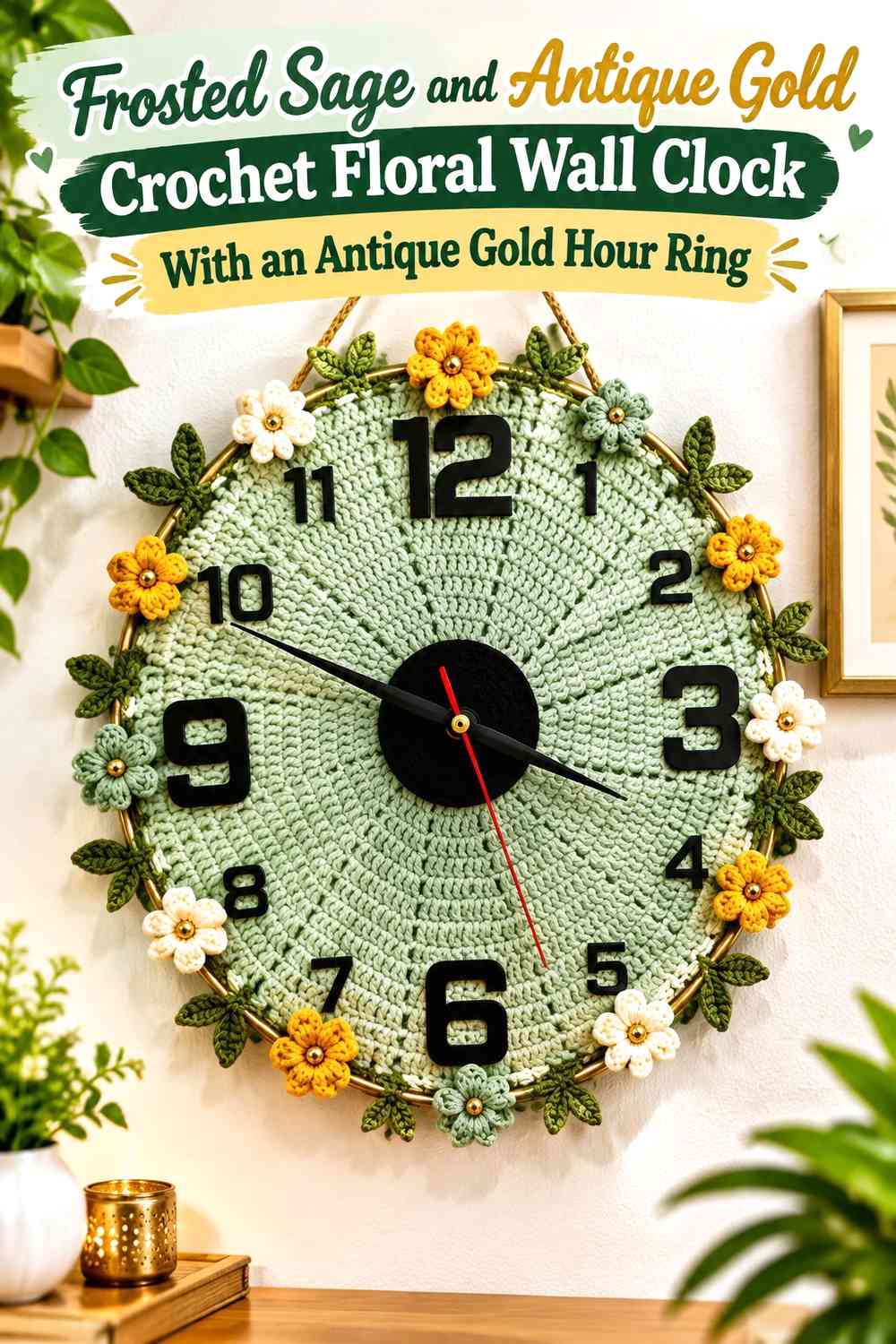
This is the most direct interpretation of the palette. Frosted sage covers most of the circular crochet face, while antique gold defines a ring of floral or raised accents around the hour positions. Keeping the middle comparatively quiet gives the clock hands room to remain visually important.
Let Frosted Sage Dominate the Crochet Clock Face
Use frosted sage across the largest uninterrupted area of the dial. The muted green creates a consistent backdrop for flowers and hour markers without dividing the face into competing color wedges.
If the crochet surface has prominent texture, resist changing colors at every textured section. The sage field can carry that texture while antique gold is saved for information-bearing details.
Position Antique Gold Around the Frosted Sage Hour Marks
Antique gold can appear at the twelve primary positions as small flowers, raised points, or carefully repeated accents. Consistency matters more than size; the viewer should be able to follow the circular rhythm without searching for each marker.
Keep the gold marks outside the central movement area so decorative crochet does not crowd the hands.
Use Antique Gold Sparingly at the Frosted Sage Floral Border
A narrow antique gold border can connect the hour markers to the outer floral edge. If both areas already contain substantial gold, keep the remaining flowers mostly sage so the clock does not become visually ringed by several equally strong gold bands.
Creator Credit: Crochet Academy
2. Antique Gold and Frosted Sage Crochet Art Nouveau Petal Wall Clock
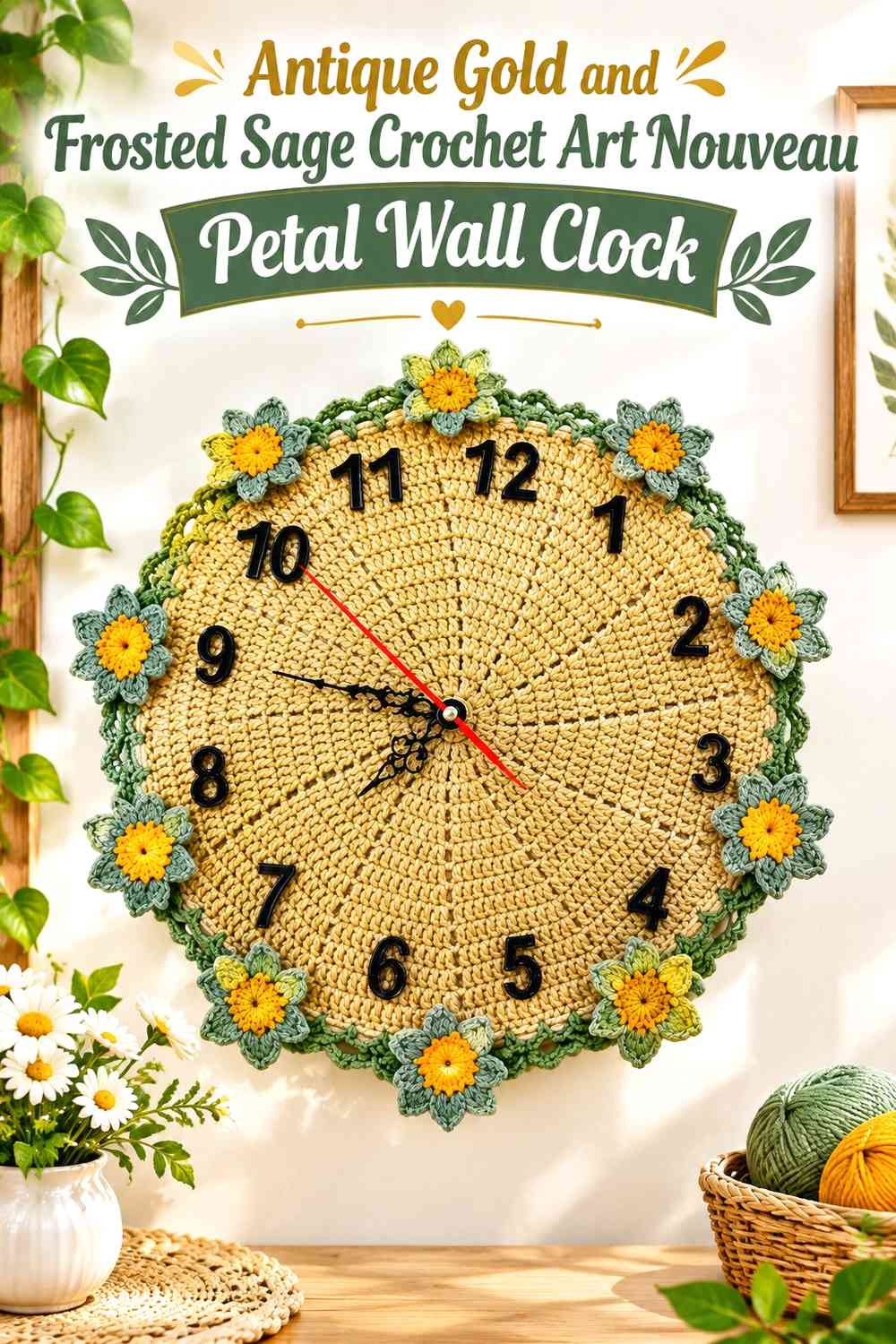
Here, antique gold takes a larger role by forming the main petal structure around the dial. Frosted sage stays closer to the center and reappears as leaves or narrow spaces between the petals. The effect is warmer than a sage-dominant clock while still retaining enough green to keep the botanical design distinct.
Keep Antique Gold Petals Around the Outer Crochet Clock
Place the most decorative antique gold petals toward the perimeter rather than close to the hands. This gives the clock a floral silhouette without turning the working center into a dense three-dimensional arrangement.
Repeating the same gold around the circumference also creates continuity even when individual petal shapes are elaborate.
Use Frosted Sage Between Antique Gold Crochet Petals
Frosted sage can appear as leaves, separators, or narrow background sections between the gold flowers. The cooler secondary color helps individual petals remain visible rather than merging into one uninterrupted antique gold wreath.
Keep the sage placements repeated enough that they look intentional from all sides of the clock.
Let Frosted Sage Calm the Antique Gold Clock Center
A simpler sage center gives the eye somewhere to rest and provides stronger separation from gold-toned outer petals. If gold is also used for hour positions, a sage central field prevents the accent from covering every visual layer.
Creator Credit: Crafting Wheel
3. Frosted Sage and Antique Gold Crochet Floral Mandala Wall Clock
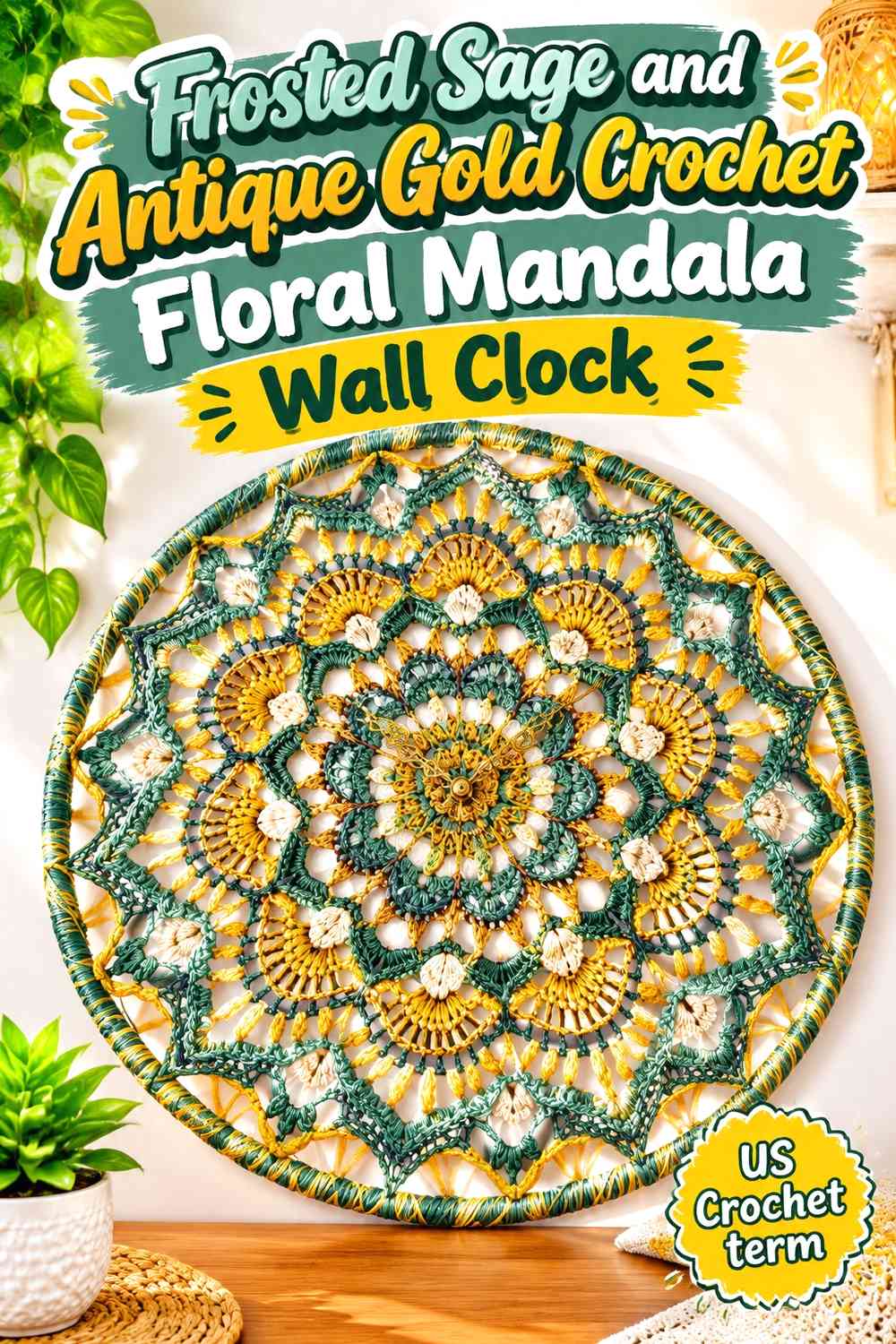
A floral mandala is a useful foundation for an Art Nouveau-inspired clock because the repeating radial structure already provides natural places for hour markers. Make frosted sage the main mandala field and use antique gold to emphasize selected radial points rather than every round.
Use Frosted Sage to Connect the Crochet Mandala Rounds
Repeating frosted sage across several rounds keeps the clock face unified even when stitch texture changes outward from the center. Too many alternating gold and sage rounds can turn the face into concentric stripes rather than a floral dial.
Let the crochet structure create the complexity while the main color provides continuity.
Align Antique Gold With the Frosted Sage Clock Rhythm
Choose repeated antique gold details that can correspond visually with the hour positions. They do not have to be literal numbers; a consistent petal tip or small raised feature can provide enough organization.
Check that the gold rhythm remains obvious after the clock hands are added.
Keep Antique Gold Away From an Overly Raised Frosted Sage Center
If the mandala construction creates substantial texture in the middle, consider simplifying the color treatment there rather than adding another gold layer. The practical priority is leaving adequate visual and physical space for the clock mechanism.
Creator Credit: Luna Crochet Designs (a.k.a. Luna the Ladybird)
4. Antique Gold and Frosted Sage Crochet Lace-Ring Wall Clock
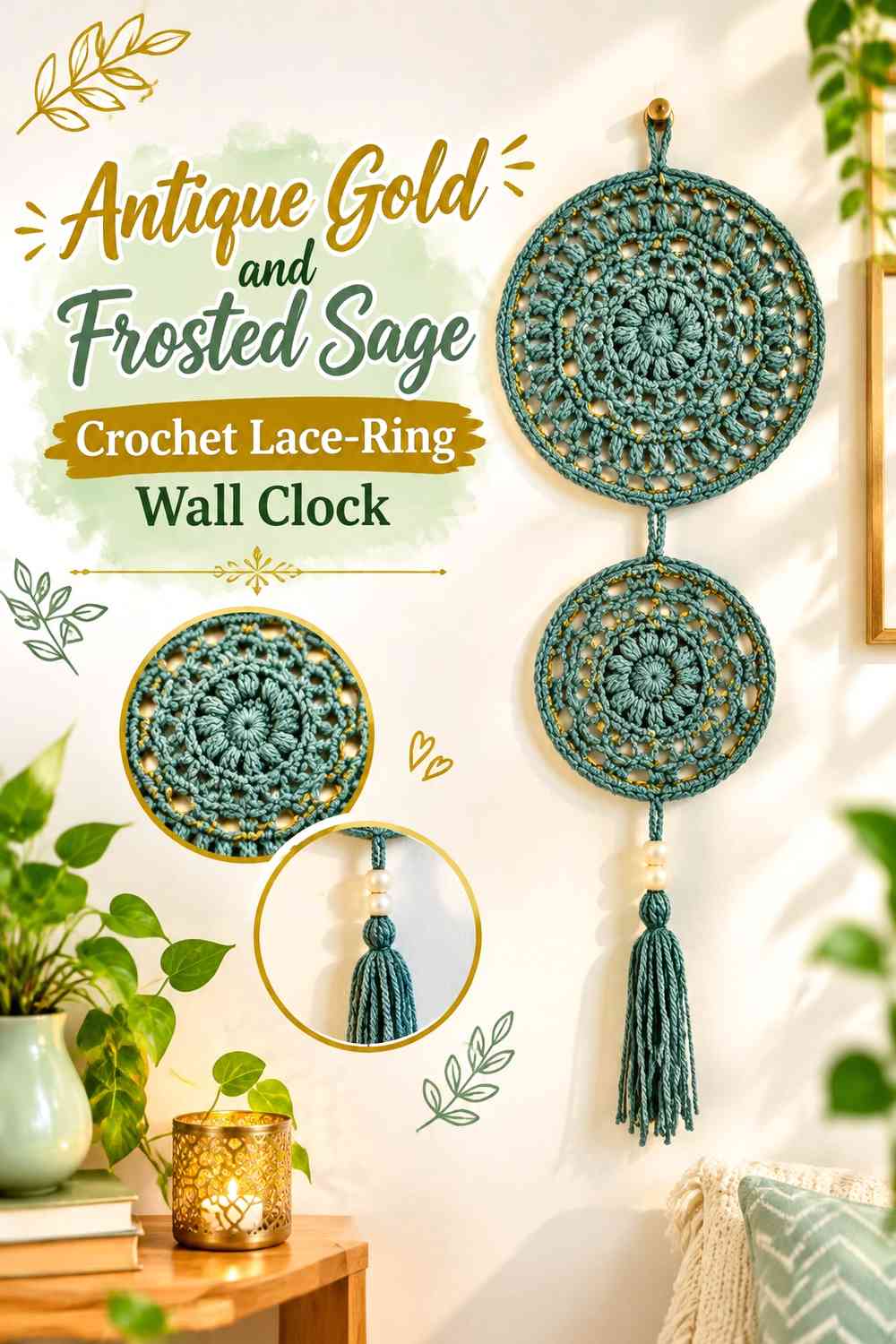
This idea uses an open circular structure rather than a dense solid face. Antique gold can define the inner lace ring, while frosted sage covers the supporting outer section or hoop treatment. The openwork gives the clock a lighter winter appearance and can make the wall color part of the design.
Let Antique Gold Define the Crochet Inner Ring
Use antique gold where the eye needs to understand the clock’s circular center. A consistent inner lace ring can frame the hands without requiring large numerals or heavy surface decoration.
Avoid adding dimensional flowers directly over that inner boundary if they reduce the clarity of the dial.
Use Frosted Sage to Frame the Antique Gold Crochet Ring
Frosted sage can occupy the outer hoop, surrounding motifs, or secondary circular section. The green softens the transition from the gold center to the wall and provides another place for floral details without overwhelming the functional dial.
Repeat Antique Gold Selectively Through the Frosted Sage Outer Circle
Small gold accents around the perimeter can connect the outer sage section to the dial. Use them at deliberate intervals rather than outlining every open space.
Creator Credit: mum2makes
5. Frosted Sage and Antique Gold Crochet Vintage Lace Floral Wall Clock
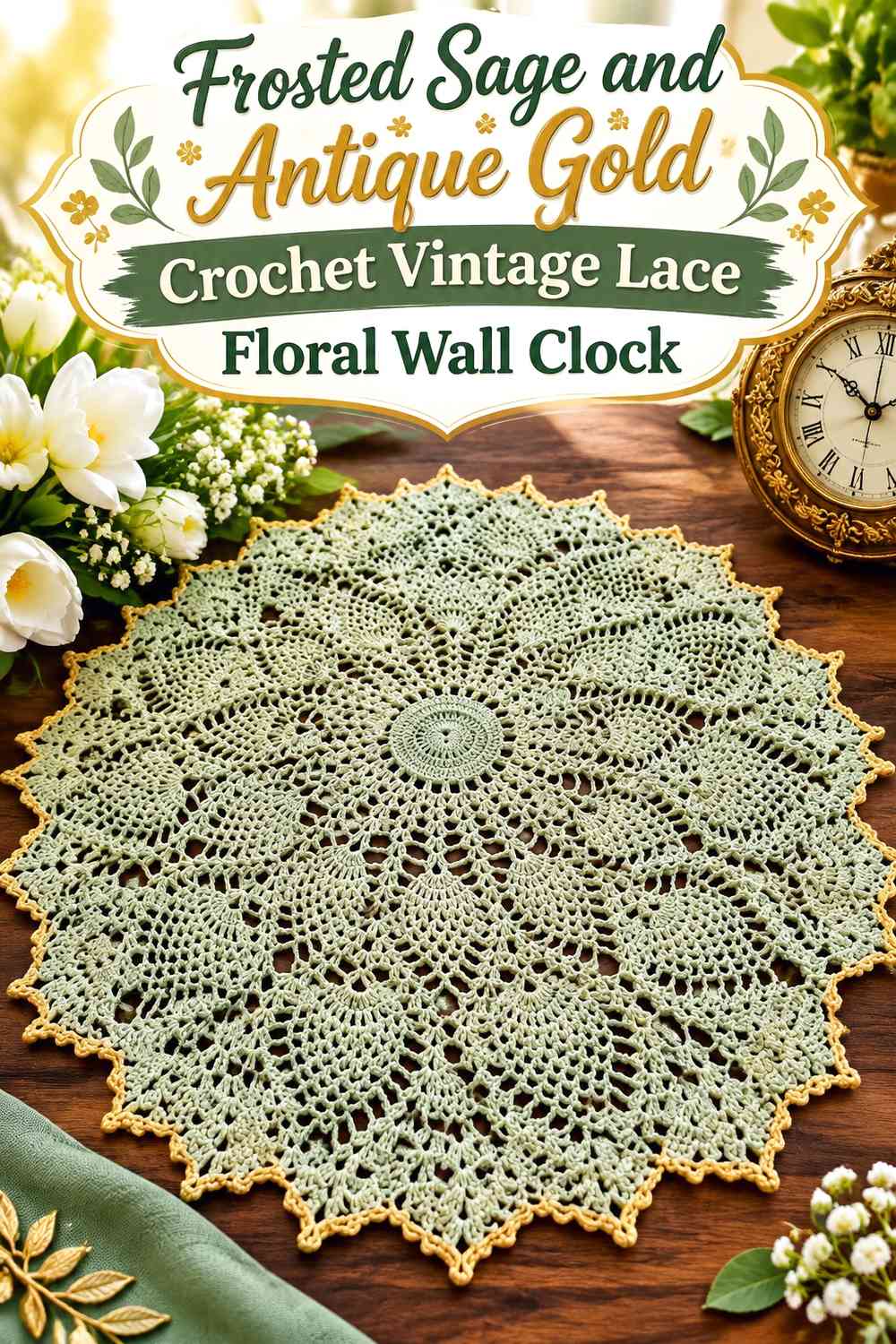
Vintage-style lace gives the clock a softer, more ornamental face. Use frosted sage through most of the lace and antique gold only where the pattern needs stronger definition, such as the center, selected points, or outer scallops.
Let Frosted Sage Show the Crochet Lace Structure
A mostly sage lace field keeps the individual openings connected into one clock face. Changing colors too often through detailed openwork can make individual stitch sections compete with the overall floral shape.
The sage also gives antique gold enough quiet background to stand out in small quantities.
Use Antique Gold on Selected Frosted Sage Lace Points
Choose a limited set of repeating points or scallops for antique gold. If those positions correspond with the clock hours, the accent becomes both decorative and functional.
Avoid coloring every scallop gold if the lace already has a complex outline.
Keep Antique Gold Simple at the Frosted Sage Clock Center
A small gold center can provide a visual anchor for the hands without requiring a large raised flower. This is especially useful when the surrounding sage lace is already highly decorative.
Creator Credit: Crochet World Creations
6. Frosted Sage and Antique Gold Crochet Pointed-Petal Wall Clock
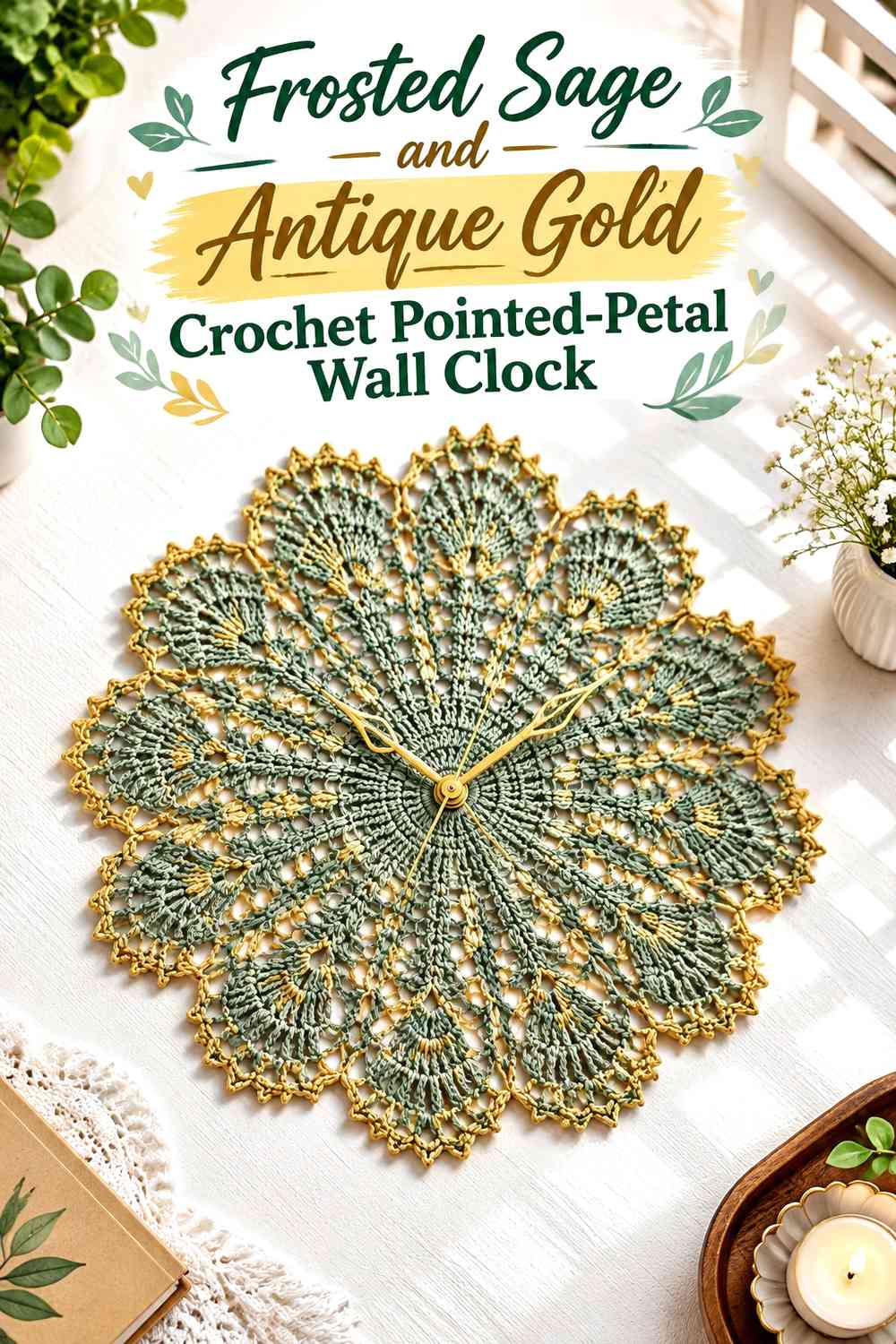
A pointed round motif can create a stylized floral clock face with strong directional movement. Frosted sage can form the main petal bodies, while antique gold touches only the tips or the spaces between them.
Keep Frosted Sage Continuous Across the Crochet Petals
Using frosted sage on every main petal allows the radial shape to remain unified. Alternating full gold and sage petals would produce a stronger striped wheel effect that may compete with the Art Nouveau floral direction.
Let the pointed outline create the movement instead.
Add Antique Gold to the Frosted Sage Petal Tips
Small antique gold tips can mark repeated positions around the circumference and make the pointed edge more visible against the wall.
If the design contains more points than useful clock divisions, do not automatically color every one gold. Choose a rhythm that supports the dial rather than fighting it.
Use Antique Gold Near the Frosted Sage Center Only if Readability Needs It
A second gold accent at the center can connect the inner and outer details, but it is optional. If the gold petal tips already give the clock enough definition, keeping the center sage may produce a calmer result.
Creator Credit: crochet by changmy
7. Frosted Sage and Antique Gold Crochet Rose-Vine Art Nouveau Wall Clock
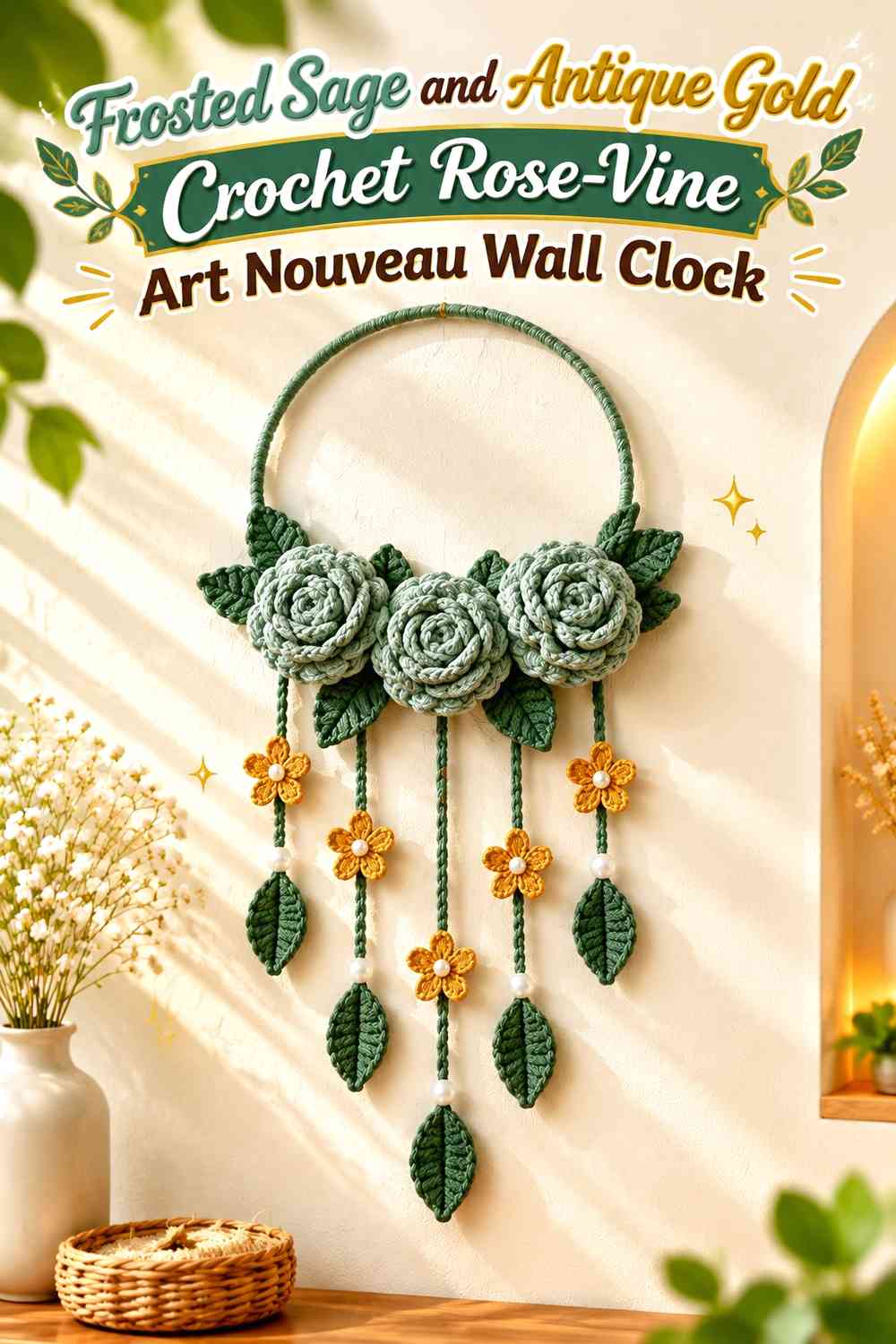
Roses and trailing leaves suit a more overtly botanical treatment. Keep the clock face frosted sage, then arrange antique gold roses or rose centers asymmetrically around one side of the outer ring. The uneven floral placement can suggest an Art Nouveau poster-like composition while the dial itself remains orderly.
Keep Frosted Sage Clear Around the Crochet Clock Hands
Even with an asymmetric floral arrangement, preserve a relatively open sage area through the central dial. This keeps the time display distinct from the decorative rose cluster.
Do not extend large flowers so far inward that they overlap the visual path of the hands.
Cluster Antique Gold Roses Against the Frosted Sage Outer Edge
Instead of spacing identical flowers at every hour, group antique gold floral elements toward the upper or lower side of the frame. That creates an ornamental focal section while leaving the rest of the dial easier to read.
Repeat a small amount of gold elsewhere so the cluster does not look completely detached from the clock face.
Thread Frosted Sage Leaves Through the Antique Gold Crochet Roses
Sage leaf forms can break apart a dense gold floral group and connect it back to the main face color. Keep their direction flowing around the circle rather than pointing randomly toward the center.
Creator Credit: 𝐊𝐧𝐢𝐭𝐭𝐢𝐧𝐠 𝐛𝐲 𝐖𝐚𝐣𝐢𝐝𝐚
8. Frosted Sage and Antique Gold Crochet Six-Petal Floral Wall Clock
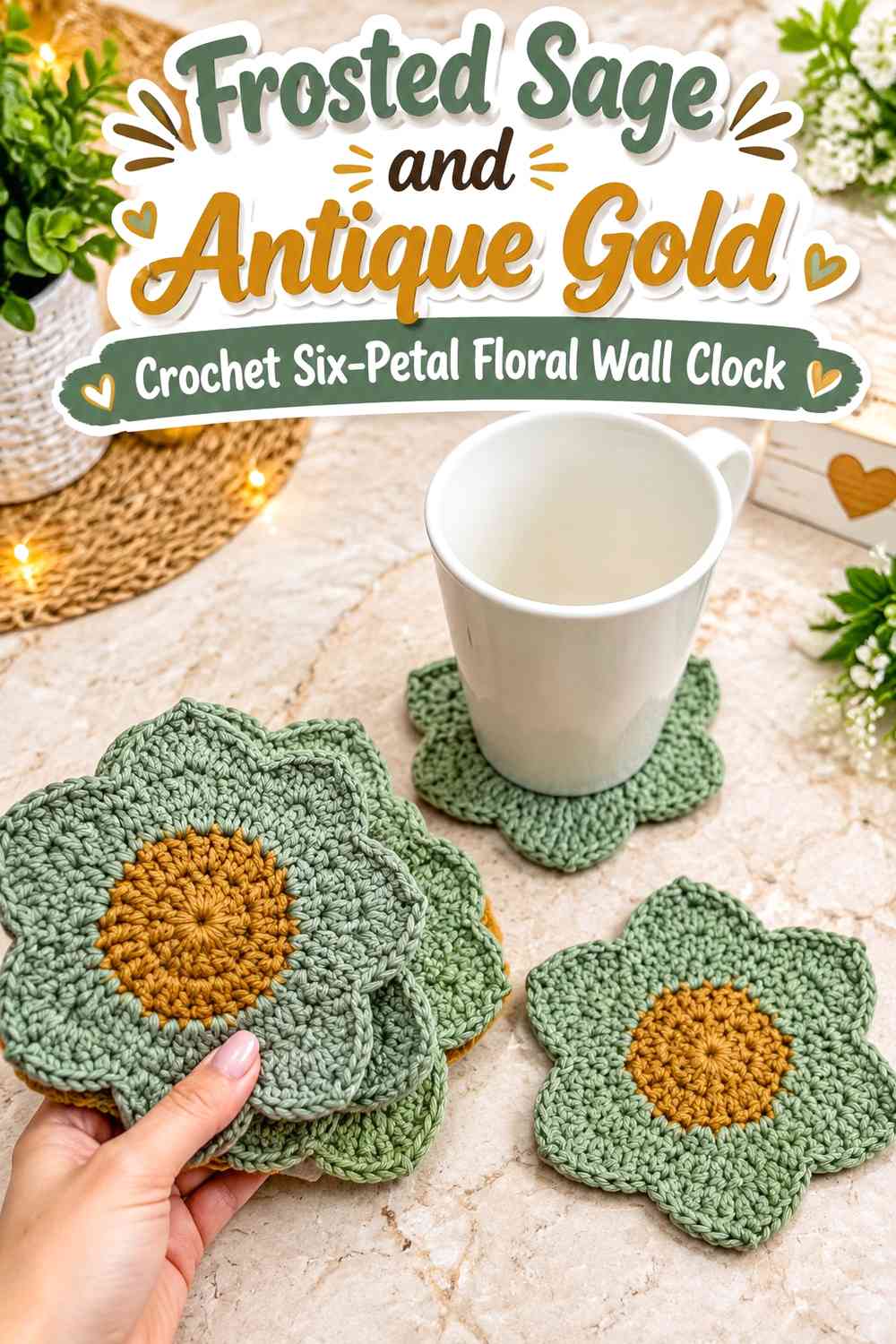
A simple rounded flower motif can be scaled conceptually into a cleaner clock design. Use frosted sage for the broad petal field and antique gold for a center ring and selected hour accents. Because the petals themselves are visually strong, the color arrangement should stay restrained.
Let Frosted Sage Carry the Large Crochet Petals
A single sage color across the petals keeps the clock recognizable as one flower rather than a collection of separate colored segments.
This also leaves room for the hour positions to be marked independently instead of forcing every petal junction to perform that job.
Use Antique Gold Around the Frosted Sage Crochet Center
A compact gold center creates a warm focal point and can help visually anchor the clock hands. Keep it relatively flat if the mechanism sits directly behind that area.
Repeat Antique Gold Lightly Across the Frosted Sage Outer Dial
Small gold markers can link the center to the perimeter. Avoid turning every edge into gold trim; the sage petals should remain the dominant feature.
Creator Credit: VivCrochets
9. Frosted Sage and Antique Gold Crochet Scalloped Flower Wall Clock
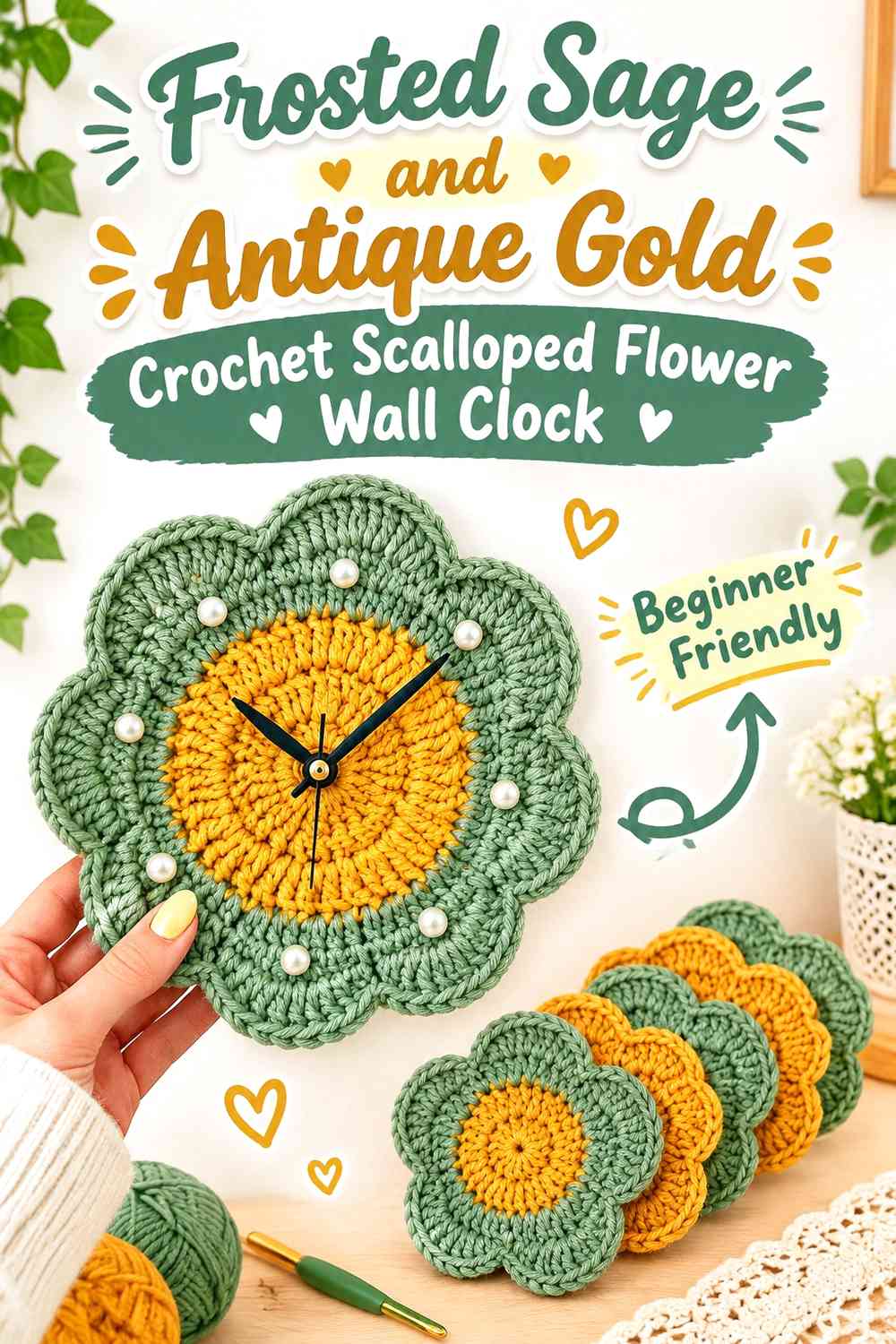
This variation uses softer rounded scallops instead of sharply pointed petals. Frosted sage can define the full floral silhouette while antique gold occupies the center and perhaps four or twelve repeated edge details.
Use Frosted Sage Around the Entire Crochet Scalloped Outline
Keeping all scallops sage gives the clock a continuous soft border. If each scallop changes color, the eye may focus more on the alternating edge than on the clock face itself.
A single outer color also makes the silhouette easier to appreciate against a winter wall.
Let Antique Gold Mark the Frosted Sage Clock’s Strongest Positions
Choose antique gold for the positions you want to read most clearly—perhaps the main quarter points or a full set of restrained hour markers.
The markers should remain smaller than the scallops so the edge still reads as floral rather than numeric.
Keep the Antique Gold Center Controlled Against Frosted Sage
A gold center can tie the hour accents together, but a large dimensional flower may interfere visually with the hands. Use the center as an anchor rather than the largest decorative feature.
Creator Credit: ElyseCrochets 💌
10. Antique Gold and Frosted Sage Crochet Vintage Doily Wall Clock
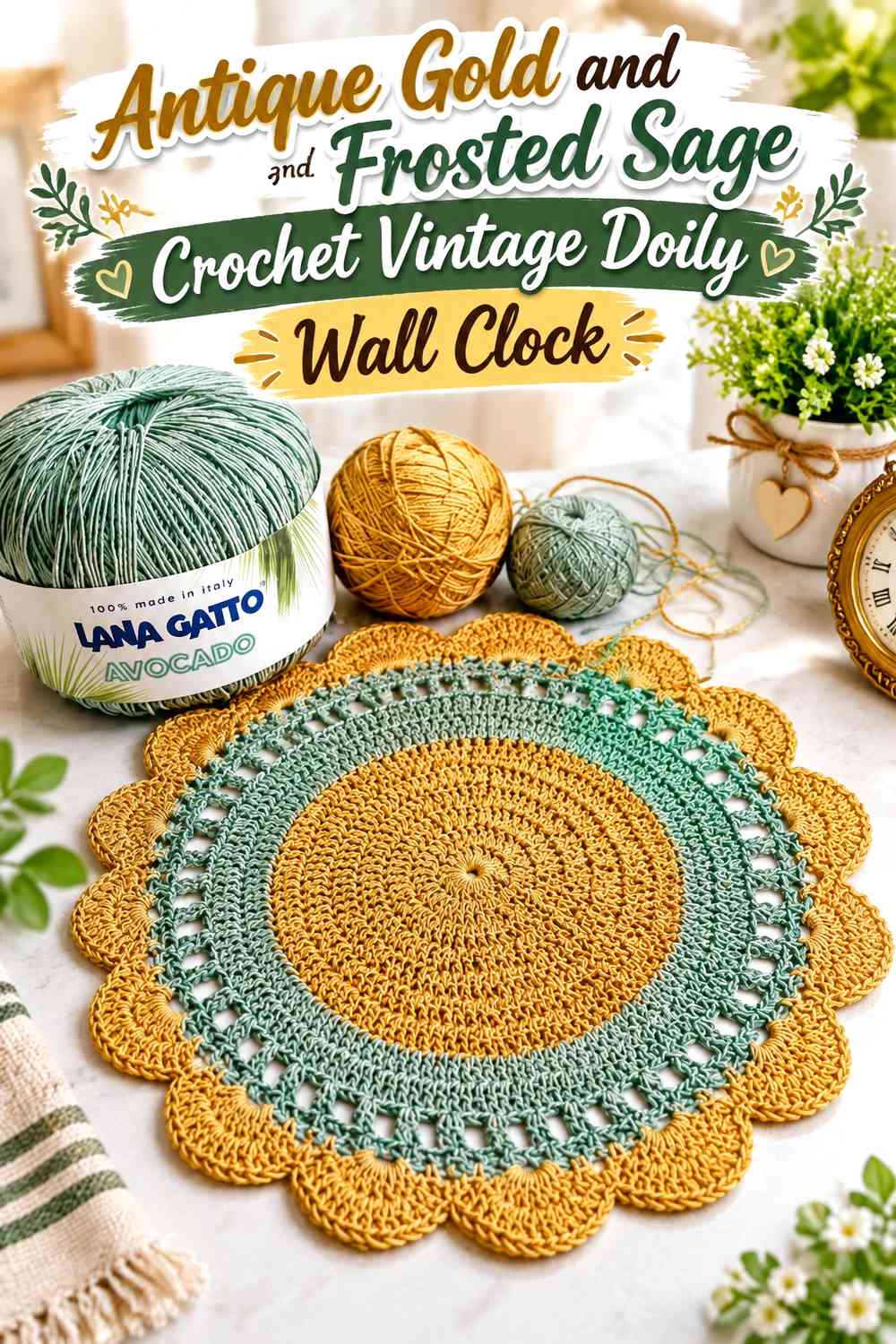
This idea gives antique gold more prominence through a decorative lace field while using frosted sage to separate sections and calm the outer edge. It produces a richer winter result than a sage-dominant clock but still retains enough green to make the botanical palette clear.
Let Antique Gold Carry the Decorative Crochet Lace
Use antique gold through the sections with the most intricate openwork when you want the lace itself to become the focal feature. Large areas of gold can work here because the open spaces prevent the color from becoming a completely solid block.
Keep the central mechanism area visually simpler than the surrounding lace.
Add Frosted Sage Between Antique Gold Crochet Sections
Frosted sage can interrupt the gold through selected bands or motif transitions, making individual lace layers easier to distinguish.
Avoid inserting sage at every round; a few larger sections create a calmer hierarchy than numerous narrow color changes.
Use Frosted Sage at the Antique Gold Outer Border
A sage outer edge can visually contain the richer antique gold center and connect the clock to other muted winter decor. It also provides a clear finishing boundary around intricate lace.
Creator Credit: Viktoria e Svitlana Marongiu
11. Frosted Sage and Antique Gold Crochet Layered Floral Mandala Wall Clock
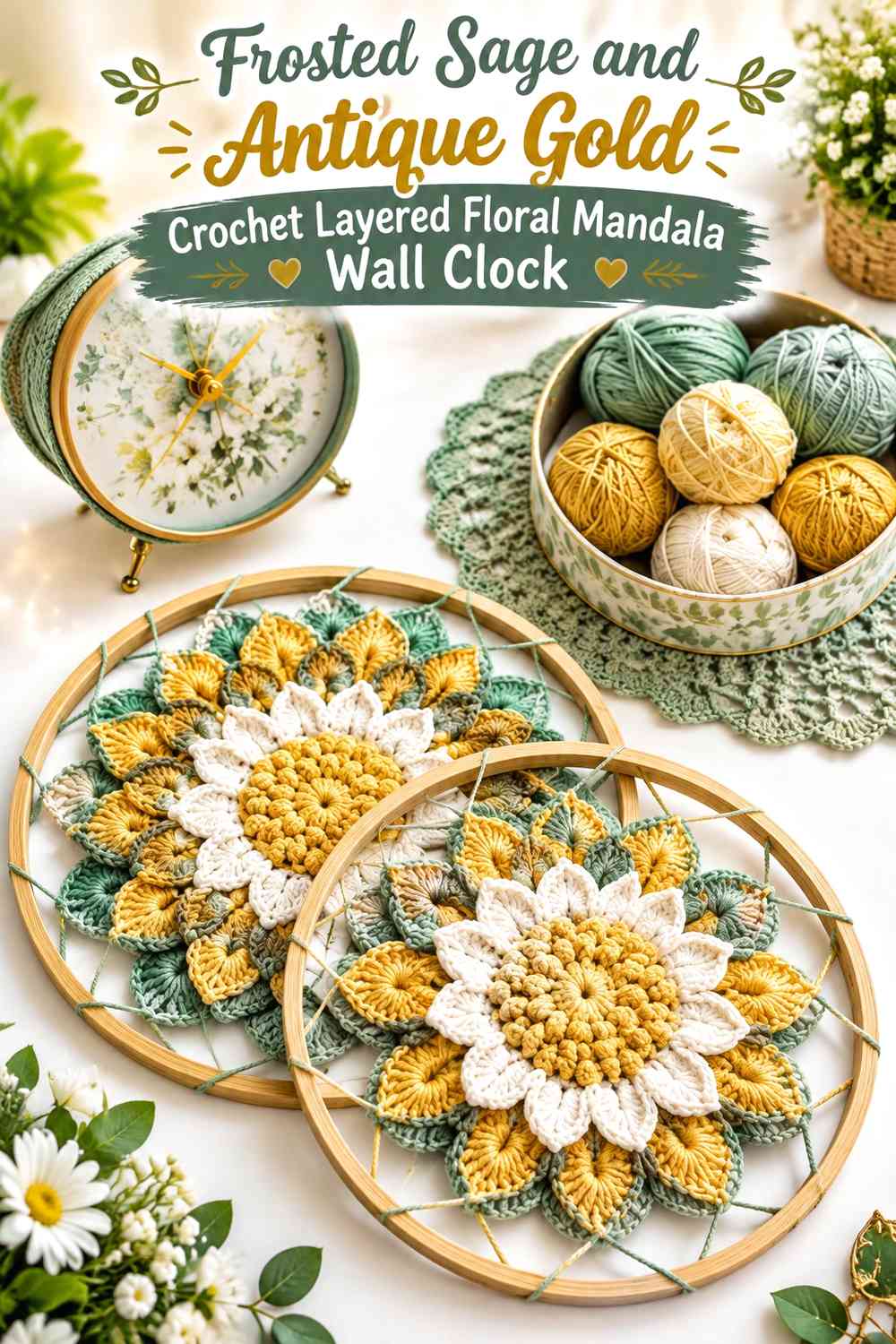
A layered floral mandala allows the palette to shift gradually from center to edge. Frosted sage can dominate the broad middle sections, while antique gold appears in a few radial rings or petal tips to establish rhythm.
Keep Frosted Sage Across the Broad Crochet Mandala Layers
Use sage through the widest sections so the radial design does not become a sequence of equally strong colored rings. This provides a stable background for both the hands and the botanical texture.
Place Antique Gold Where the Frosted Sage Mandala Changes Direction
Gold can be especially useful where one floral layer transitions into another. A narrow accent around those changes separates the structures without covering them.
The same concept can be used at selected hour positions if the repeated motif naturally supports it.
Reserve Antique Gold for the Most Visible Frosted Sage Details
Stand back from the finished crochet face before adding the final gold accents. If the existing gold already reads clearly at normal clock-viewing distance, adding more may reduce rather than improve the hierarchy.
Creator Credit: The Knot Studio
12. Frosted Sage and Antique Gold Crochet Hoop-Style Floral Wall Clock
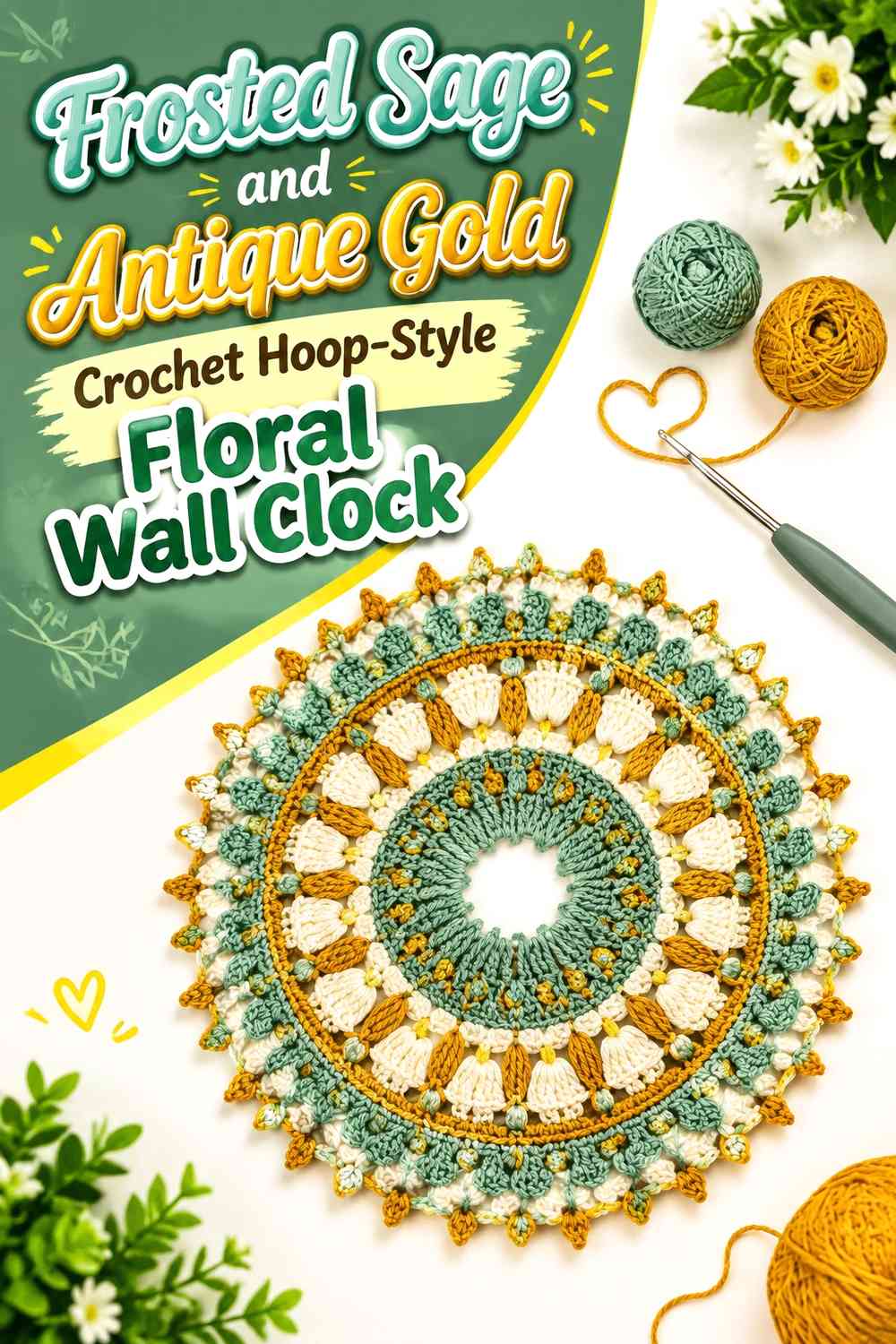
A hoop-supported circular design can give the clock a lighter, airier outline. Use frosted sage through the majority of the crochet center and antique gold around the hoop or selected radial motifs. The visible frame becomes part of the composition instead of being hidden behind dense crochet.
Let Frosted Sage Fill the Main Crochet Hoop Clock Area
Keeping the center predominantly sage gives the eye a consistent dial and separates the time display from the structural outer ring.
If the design includes open sections, make sure the wall behind the clock does not reduce the visibility of the hands or hour positions.
Trace the Frosted Sage Hoop With Antique Gold Crochet Accents
Antique gold can emphasize the outer circular frame through a narrow crochet treatment or repeated motifs. A consistent gold perimeter works particularly well when the inner dial remains subdued.
Keep Antique Gold Details Outside the Frosted Sage Hand Path
Treat the central sweep of the hands as functional negative space. Decorative gold should frame that space rather than intrude into it.
Creator Credit: Crochê no ponto
13. Antique Gold and Frosted Sage Crochet Flower-Wreath Wall Clock
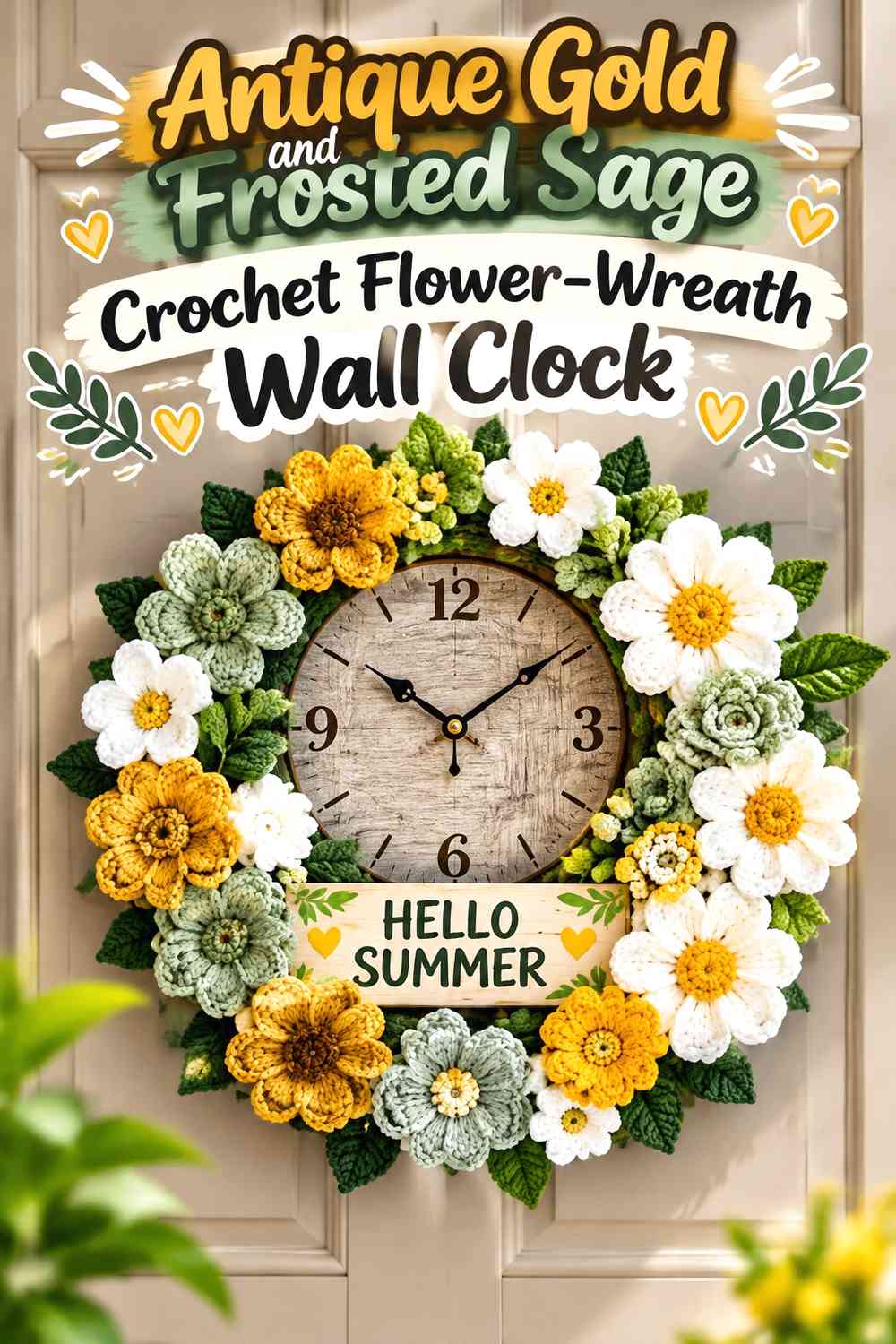
The final idea makes the clock resemble a floral wreath surrounding a restrained inner dial. Antique gold flowers can occupy the outer ring while frosted sage leaves weave between them and continue into the inner clock face.
Keep Antique Gold Flowers Around the Crochet Clock Perimeter
Place the most dimensional flowers outside the active clock face. This gives the wreath a rich antique-gold presence without surrounding the hands with raised obstacles.
Varying flower position can create a more organic botanical frame, but the overall ring should still feel balanced around the clock.
Use Frosted Sage Leaves to Break Up Antique Gold Flowers
Sage leaves provide visual pauses between gold blooms and prevent the entire wreath from becoming one warm-colored border.
Let some leaves follow the circular direction of the clock to reinforce the flowing botanical movement.
Keep the Frosted Sage Inner Dial Simpler Than the Antique Gold Wreath
A relatively quiet sage center allows the surrounding flower ring to be decorative without compromising readability. If additional hour markers are needed, small antique gold details can echo the wreath without reproducing full flowers inside the dial.
Creator Credit: My Creative Obsession
Which Frosted Sage and Antique Gold Art Nouveau Clock Direction Should You Choose?
For the clearest functional clock face, choose the frosted sage floral clock, six-petal clock, scalloped flower clock, or hoop-style design. These ideas keep most ornament away from the hands and give antique gold a controlled role as an hour marker or border.
For a more decorative wall feature, the rose-vine, flower-wreath, layered mandala, and vintage lace ideas allow more botanical detail around the perimeter. The mandala options work particularly well when you want radial crochet structure to help organize the clock face without relying on large applied numerals.
If antique gold should dominate, the petal and vintage-doily directions provide more warm color while still using sage to separate floral sections. For the palest, calmest result, keep frosted sage across most of the dial and reserve gold for only the center, hour points, and outer frame.
Conclusion
Frosted sage and antique gold can give a crochet wall clock an Art Nouveau-inspired floral character without sacrificing the basic job of showing time. Frosted sage is especially useful for broad dial areas, leaves, and quieter background sections, while antique gold can bring definition to flower centers, hour positions, borders, and selected botanical curves.
The strongest designs keep decorative hierarchy in mind. A rose wreath can be elaborate at the perimeter while the center stays quiet; a mandala can contain complex stitch texture while using only a few gold accents; and a simple flower clock can rely on its silhouette rather than covering every petal with a second color.
Most importantly, plan the mechanism before placing dimensional crochet near the center. Use the linked creator tutorials for their demonstrated crochet structures, and where a source teaches a mandala, doily, flower, or wreath rather than a functional clock, treat that construction as inspiration for the decorative face rather than as clock-assembly instructions.
Frequently Asked Questions
Should Frosted Sage or Antique Gold Dominate a Crochet Art Nouveau Wall Clock?
Frosted sage is a practical dominant color when the clock contains many flowers, leaves, or textured sections because it gives the design a calmer visual field. Antique gold can dominate when you want a warmer ornamental clock, but keep enough sage separation that floral sections and the dial remain easy to distinguish.
Where Should Antique Gold Go on a Frosted Sage Crochet Clock?
Useful locations include hour markers, the center ring, selected flower centers, petal tips, a narrow outer border, or one repeating botanical detail. Choose a few roles rather than using gold on every flower, leaf, and stitch transition.
How Can I Keep a Floral Crochet Clock Easy to Read?
Preserve clear space around the moving hands and create a consistent hour rhythm. You can use small repeated color accents instead of large numerals. Check the clock from the distance where it will normally be viewed, not only while holding it in your hands.
Can Raised Frosted Sage Flowers Go Near the Clock Hands?
Only if the specific clock mechanism provides enough clearance. Do not assume that a dimensional crochet flower will fit beneath or beside the hands. Plan the mechanism first and move raised flowers toward the outer dial when clearance is uncertain.
Does Antique Gold Need to Be Metallic Yarn?
No. Antique gold describes the color direction here, not a required fiber or finish. A warm muted gold-colored yarn can fill the same palette role. Choose the yarn based on the project’s construction needs rather than assuming a metallic material is necessary.
How Can I Substitute Frosted Sage Without Losing the Art Nouveau Palette?
Choose another softened green that remains visibly different from the antique gold. Preserve the muted botanical character and the light-dark relationship between the two colors rather than trying to match a commercial shade name exactly.
Can a Crochet Mandala or Doily Be Adapted Into a Wall Clock?
It can provide a useful decorative face concept, but a mandala or doily tutorial does not automatically explain clock assembly. Check the finished crochet structure, support, central opening, hanging method, hand clearance, and mechanism requirements independently before converting it into a functional clock.