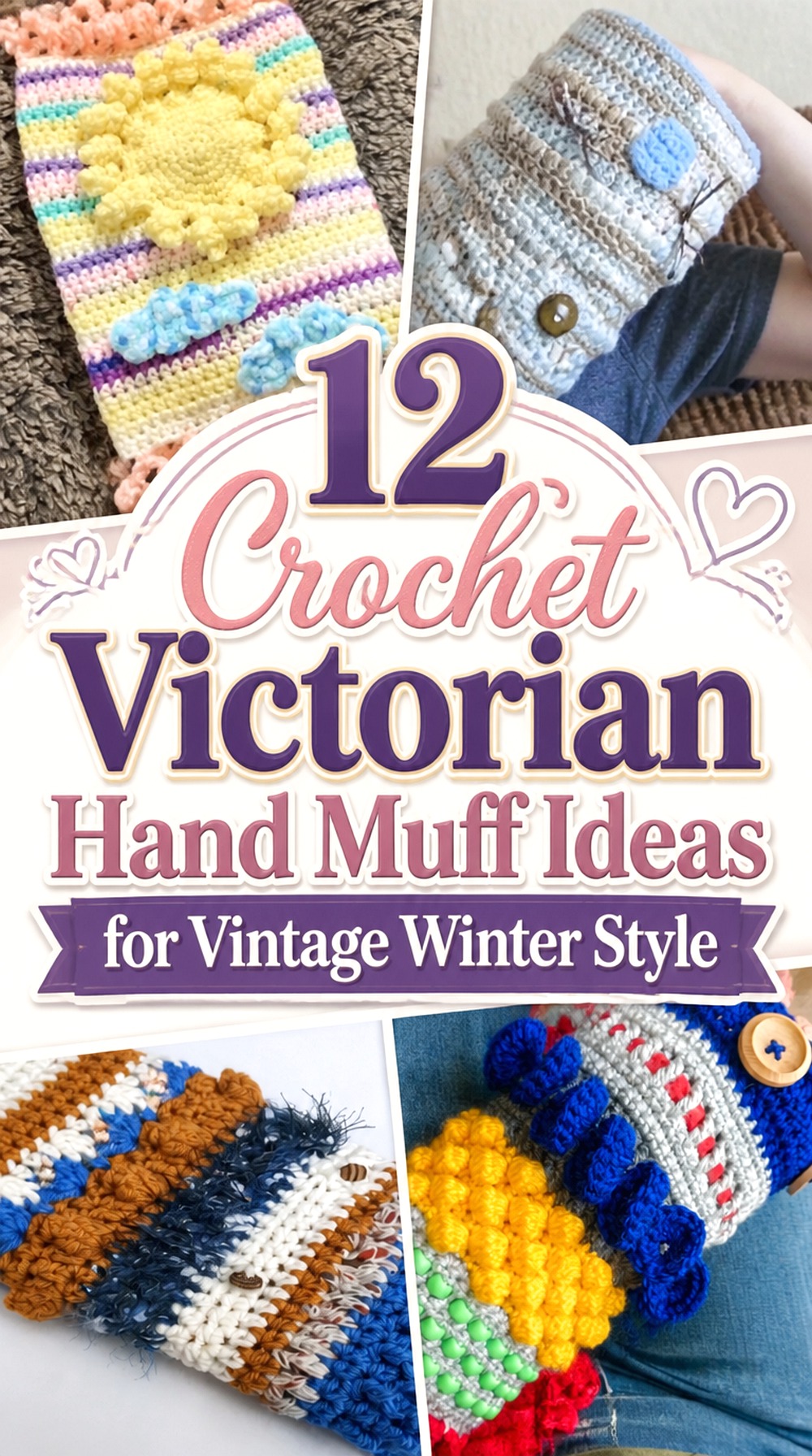

A Victorian-inspired hand muff can be much more than a simple crochet tube. Shape, texture, lining, carrying method, decorative placement, and even a concealed pocket can shift the finished piece from practical winter accessory to bridal accent, evening muff, or statement piece for historical-style dress.
True Victorian muffs were commonly made from materials such as fur, silk, and velvet rather than crochet, so the projects below are best treated as Victorian-inspired crochet interpretations, not reproductions of specific museum pieces. Several linked tutorials teach modern fashion muffs, while others demonstrate sensory or fiddle-muff constructions that provide useful references for tubes, layers, texture, and embellishment. The Victorian details suggested here are independent styling adaptations; use each original creator’s tutorial for exact construction.
Quick List
- Hidden-Pocket Crochet Victorian Muff Purse
- Jewel-Stripe Crochet Victorian Hand Muff
- Plush-Texture Crochet Victorian Evening Muff
- Sampler-Band Crochet Victorian Hand Muff
- Rosette-Trim Crochet Victorian Hand Muff
- Double-Layer Crochet Victorian Winter Muff
- Layered-Texture Crochet Victorian Parlor Muff
- Gothic-Accent Crochet Victorian Hand Muff
- Floral-Motif Crochet Victorian Hand Muff
- Tassel-Cord Crochet Victorian Hand Muff
- Heirloom Scrap-Texture Crochet Victorian Muff
- Raised-Bobble Crochet Victorian Hand Muff
What Makes a Crochet Muff Look Victorian-Inspired?
The basic muff silhouette is historically appropriate: a muff is a tubular hand covering with openings at both ends. Nineteenth-century examples varied substantially in scale and were made from materials including fur, silk, and velvet. The Metropolitan Museum of Art, for example, holds an American fur-and-silk muff dated about 1885 and a European silk-and-fur example from the 1850s.
For crochet, the most convincing approach is often to translate the visual qualities rather than imitate fur literally. Dense plush texture, restrained floral work, scalloped edging, ribbon accents, dark jewel tones, cream, black, or muted rose can all create a period-inspired mood. Keep the central silhouette recognizable; too many dangling decorations can make the piece read as a sensory muff rather than a fashion accessory.
Plan the Opening, Lining, and Carrying Method First
Before choosing decorative stitches, decide how the muff will actually be carried. A simple open cylinder works when it will mostly be held in front of the body. A neck or wrist cord changes the balance, while an internal pocket adds another functional layer. Pocketed muffs also have genuine historical precedent: fashion-history sources note that card-case and purse pockets appeared in women’s muffs during the 1880s, when muff-handbags became a recognizable variation.
Check the hand openings before committing to elaborate edging. Thick borders, tight joins, or bulky trims can make an otherwise roomy tube uncomfortable. A lining may also be worth considering when the crochet is highly textured, stretchy, or open enough for jewelry and fingernails to catch.
Choose Texture Without Hiding the Muff Shape
Victorian collections contain fur and feather muffs, and London Museum records include fur muffs owned by Princess Louise, Queen Victoria’s daughter. A photograph from 1864 also shows her carrying a muff. Crochet can suggest that richness through loops, plush yarn, clustered stitches, shells, bobbles, or selectively raised bands without requiring actual fur.
Texture has practical consequences, though. Dense stitches produce a more substantial-looking cylinder, while very open decorative work can read more like lace unless backed or lined. Fuzzy fibers soften stitch definition; smooth yarn makes shells, bands, and floral motifs easier to see. Decide whether the focal point should be the yarn itself or the crochet texture before combining both.
Hidden Pocket Crochet Victorian Muff Purse
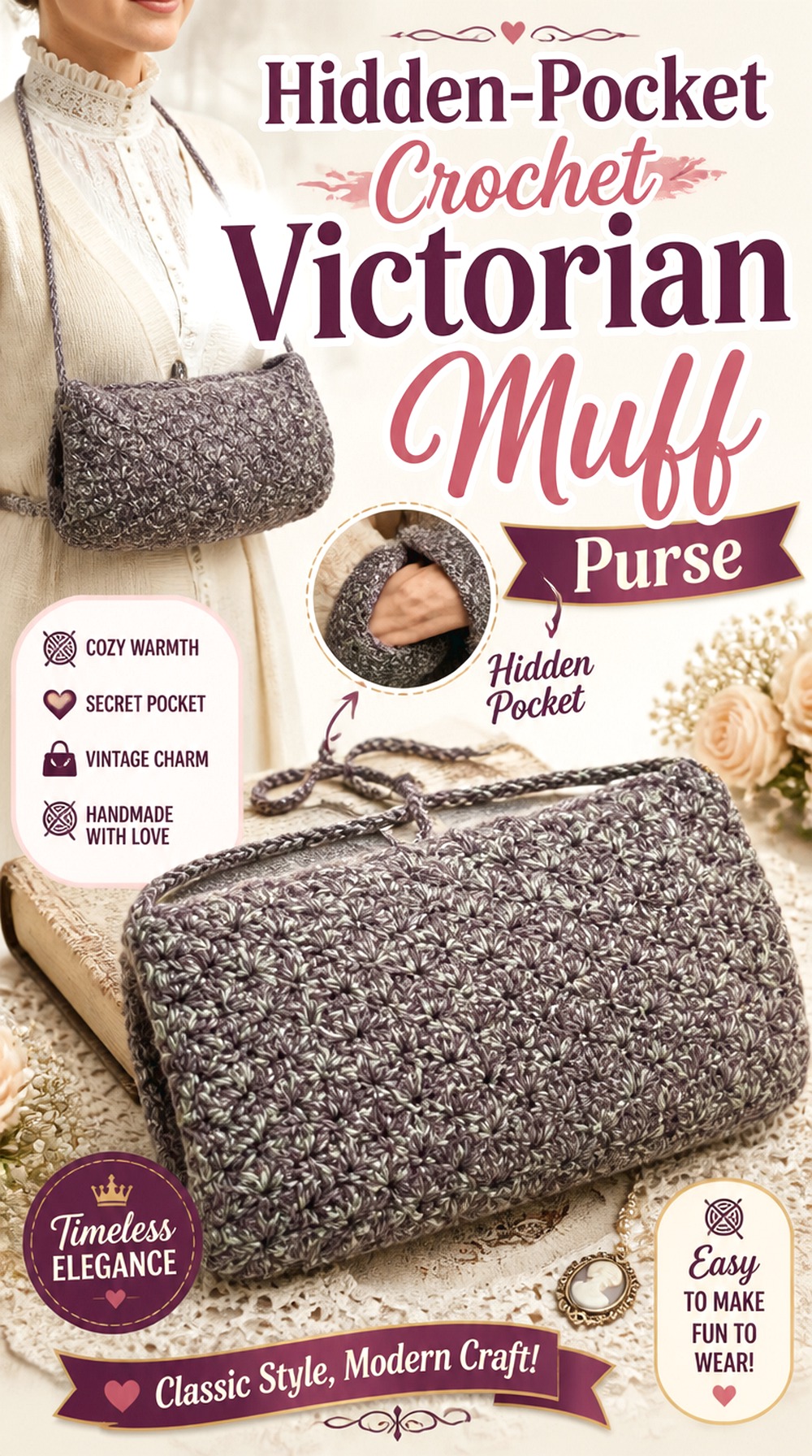
This version combines two functions that suit the historical inspiration especially well: a hand-warmer and a concealed purse. The JoannesWeb tutorial demonstrates a crocheted shell-texture muff with a hidden zippered bag and carrying cord, making it the closest fashion-muff match in this collection.
For a Victorian-inspired interpretation, consider a restrained solid such as burgundy, forest green, cream, charcoal, or plum so the shell texture provides most of the decoration. This is a practical choice for winter outings or costume events where carrying a separate handbag would interrupt the silhouette.
Let the Hidden Pocket Determine the Final Structure
A pocket changes the muff from a soft tube into a multi-layer accessory. Before adapting the exterior, check where the internal bag sits and how its zipper relates to the hand openings. Decorative trim should not obstruct access.
If you substitute a different inner pouch, compare it with the finished crochet shell before final attachment. A pouch that is too wide can distort the outer cylinder, while one that is too small may pull awkwardly at its attachment points.
A Carrying Cord Should Support the Centered Position
The muff looks most natural when both hands can meet comfortably near the center of the body. A cord that places the piece too high can crowd the arms; one that hangs too low makes it less convenient to use.
Treat cord length as a personal fitting decision rather than a universal measurement. Try the unfinished muff with the clothing it will accompany, especially if it will be worn over a coat, cape, or full-skirted costume.
Shell Texture Can Replace Excess Ornament
Because this construction already has visible shell texture, it does not need layers of unrelated embellishment. A narrow edging, small bow, or discreet crocheted rosette can reinforce the vintage styling without concealing the fabric.
If you add decoration near the pocket, keep it clear of the zipper path. Function should remain obvious once the muff is in use.
Jewel Stripe Crochet Victorian Hand Muff
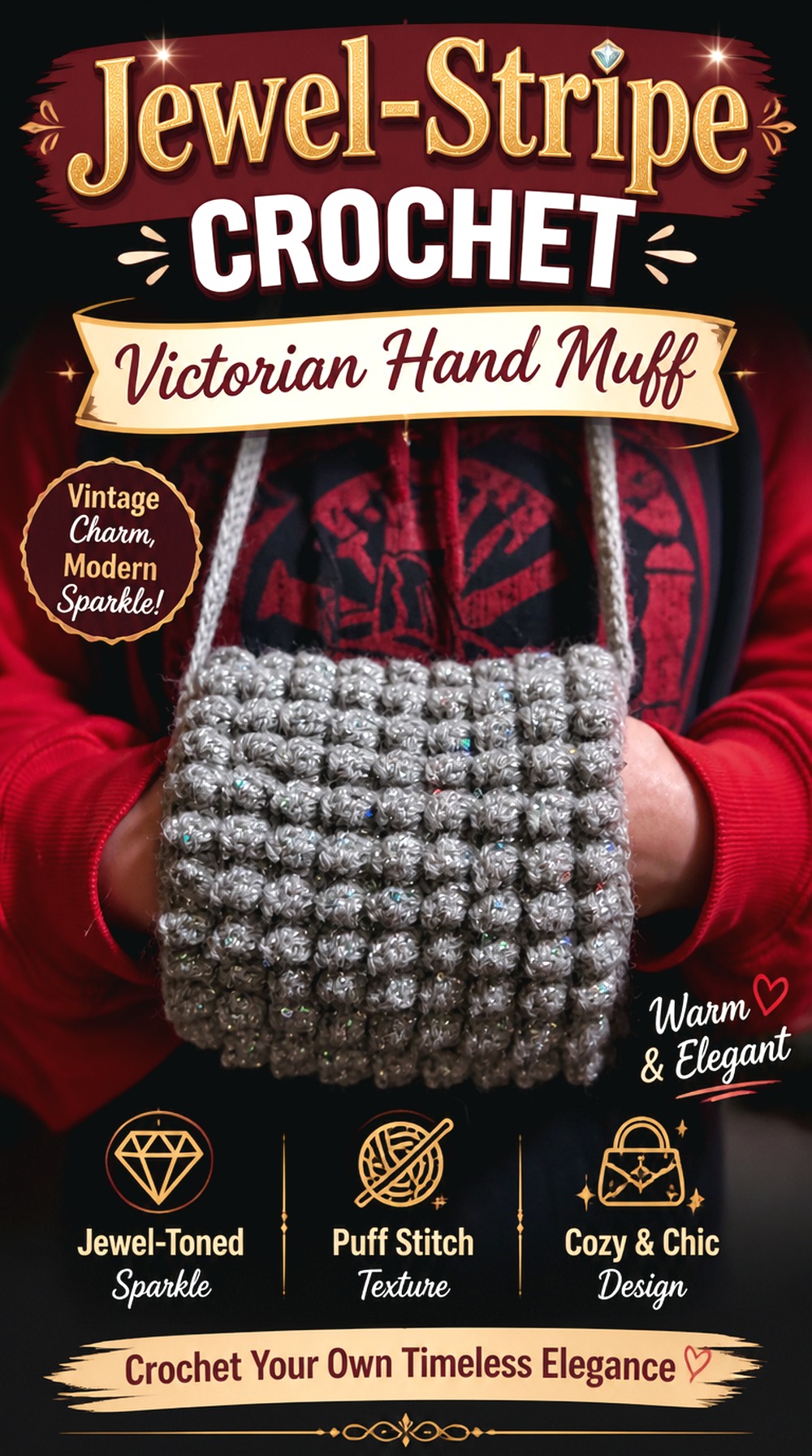
A striped muff offers a different route to Victorian-inspired styling: instead of relying on flowers or lace, the surface is divided into deliberate color bands. Bixby Legend’s tutorial presents an old-fashioned-style rainbow hand warmer, giving you a clear muff form that can be recolored for a more subdued historical mood.
Rather than using a full rainbow, try building a palette around two or three related jewel tones, muted neutrals, or one dominant color with narrow contrasts. The result still keeps the graphic rhythm of the tutorial while making the finished piece easier to coordinate with a coat, cloak, or costume.
Narrower Color Changes Create a More Refined Rhythm
Large blocks make a muff look bold and contemporary. Narrower or more carefully repeated bands can create a quieter surface, especially when the colors are close in value.
Before crocheting the full tube, place the yarns beside the garment you expect to wear. This simple comparison prevents a beautiful standalone palette from competing with patterned fabric, elaborate trim, or a strongly colored coat.
Keep the End Openings Visually Related
Stripes can make uneven openings more noticeable because the eye naturally follows the horizontal lines. Check that the two ends have a similar visual weight once any edging is added.
One option is to reserve the same color for both borders. That small repetition can make an otherwise varied striped design feel intentional without requiring additional ornaments.
Use Color Instead of Adding More Surface Decoration
This muff already gets its personality from repeated color. Adding flowers, tassels, bows, lace, and textured bands at the same time can make the surface difficult to read.
If you want one Victorian-style accent, choose a single focal detail—perhaps a narrow ribbon bow or small rosette—and let the stripes remain the primary design feature.
Original Tutorial and Creator Credit
Creator: Bixby Legend
Plush Texture Crochet Victorian Evening Muff

For an evening-style muff, surface softness can do more work than elaborate color changes. The LoveCrafts twiddlemuff tutorial demonstrates how multiple crochet textures can be combined across a hand-warming tube. For this fashion adaptation, the useful idea is the textured base rather than the sensory embellishments.
Limit the exterior to a coordinated set of soft textures in one color family—black, ivory, deep wine, or smoky gray would all let the silhouette remain prominent. Removing brightly contrasting attachments shifts the same general construction concept toward an evening accessory.
Select One Plush Texture as the Main Surface
A muff can become visually bulky when every band uses a different dramatic stitch. For an evening version, choose one dominant plush or softly raised surface and use secondary textures only as accents.
If your chosen yarn is very fuzzy, remember that intricate stitch details may disappear. In that case, let the fiber create the richness and simplify the stitch pattern rather than fighting for definition.
A Smooth Interior Can Make Textured Crochet Easier to Use
Raised stitches and fuzzy fibers are attractive outside but may not be the surface you want rubbing against rings, bracelets, or delicate gloves. Consider whether an inner crochet layer or fabric lining would make the finished piece more comfortable.
Do not assume every lining material will behave the same way. Check stretch, seam bulk, and care instructions before permanently combining different materials.
Keep Evening Embellishment Concentrated
Instead of decorating the entire circumference, place one small feature where it will face outward when the muff is carried. A crocheted flower cluster, narrow ribbon treatment, or vintage-style brooch attachment point can create a defined front.
That orientation also helps when taking photographs or pairing the muff with formal clothing because the intended display side is immediately clear.
Original Tutorial and Creator Credit
Creator: LoveCrafts
Sampler Band Crochet Victorian Hand Muff
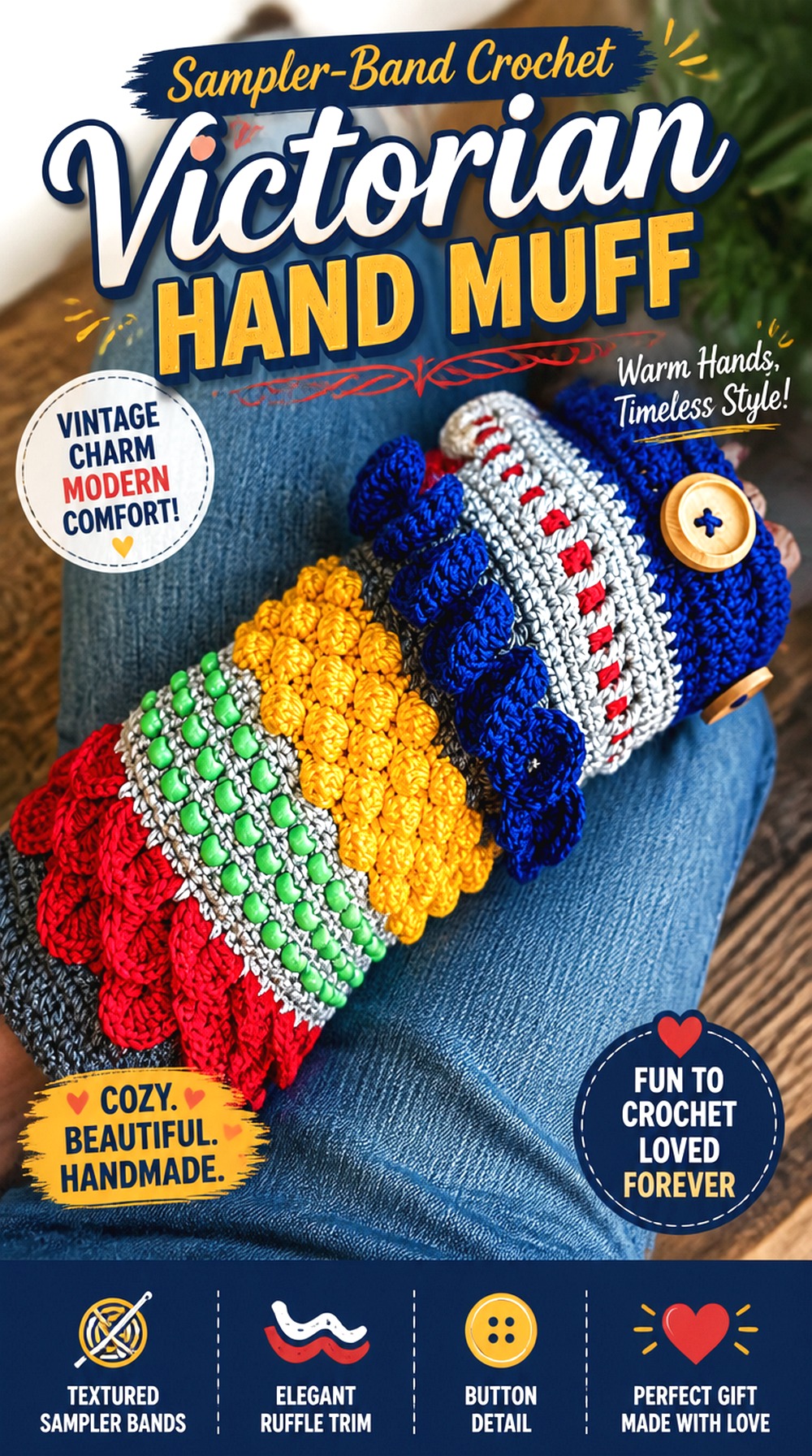
A sampler muff uses changes in stitch texture as deliberate horizontal decoration. Heart Hook Home’s twiddle-muff tutorial works with varied crochet stitches and colors, providing a useful one-piece construction reference. For a Victorian-inspired fashion version, replace conspicuous sensory attachments with a controlled sequence of raised and flatter bands.
This design works especially well when you want an ornate surface without sewing on many separate motifs. Using one color keeps the different stitch structures sophisticated; two closely related shades can make individual bands easier to distinguish while retaining a cohesive appearance.
Plan the Texture Sequence Before the Tube Gets Busy
Alternating every possible stitch can make the finished surface look random. Sketch a simple visual rhythm first: flatter section, raised focal band, quieter section, then another accent.
The exact stitch choices can come from the creator’s tutorial or your own compatible crochet knowledge. What matters editorially is the hierarchy—some bands should recede so the most decorative texture has somewhere to stand out.
Raised Bands Affect the Outer Circumference
Dimensional stitches can make sections feel thicker than adjacent fabric even when the stitch count remains unchanged. Look at the muff from the side as well as straight on while working.
If one band projects dramatically, repeating it symmetrically or keeping it near the center can make the extra volume look intentional instead of accidental.
Monochrome Yarn Highlights Construction
Working sampler texture in a single shade changes the emphasis from color to shadow. This can suit a Victorian-inspired accessory because shells, ridges, and relief stitches become the ornament.
Before choosing black or another very dark yarn, consider visibility while crocheting. Strong stitch texture can look striking in dark colors, but the stitches themselves may be harder to inspect while you work.
Original Tutorial and Creator Credit
Creator: Heart Hook Home
Rosette Trim Crochet Victorian Hand Muff
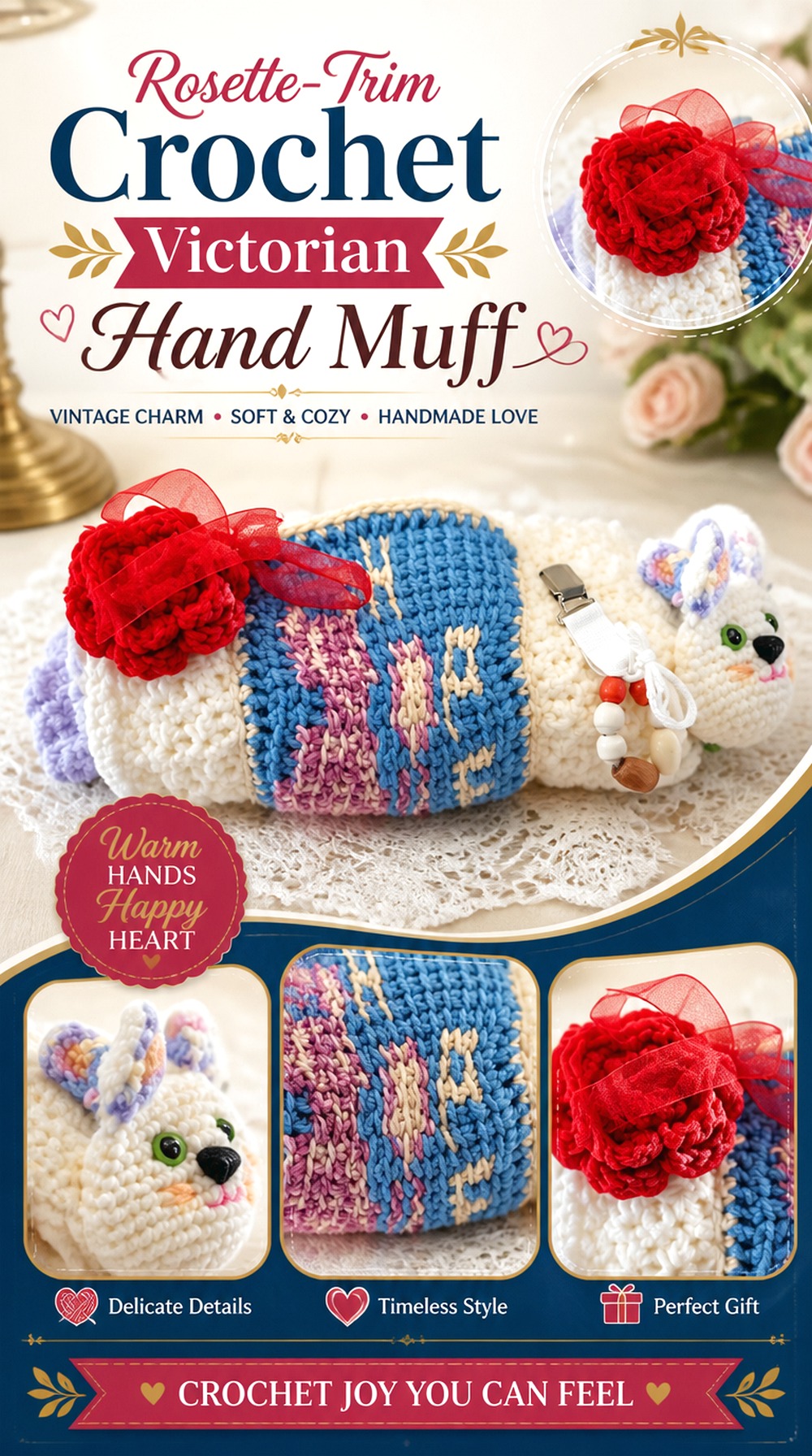
A floral focal point gives the muff a romantic look without requiring floral texture over the entire surface. HelenMay Crochet’s tutorial shows several crocheted sensory activity muffs, which makes it useful for studying how separate decorative elements can be positioned on a cylindrical base.
For this adaptation, keep the main tube relatively quiet and arrange a small group of crochet rosettes on the outward-facing center. The flowers might sit beside a ribbon-inspired band or narrow leafy accents, but leaving generous undecorated space prevents the piece from turning into a heavily embellished sensory project.
Place Rosettes Where Hands Will Not Constantly Crush Them
The center front is usually a better decorative zone than either opening because the hands repeatedly move through the ends. Pin or temporarily place the flowers before sewing anything permanently.
Then insert both hands and mimic normal use. If the motifs fold under the palms or snag sleeves, move them farther toward the outward-facing surface.
Vary Flower Scale Rather Than Adding Too Many
A small cluster containing one focal rosette and smaller companions often creates more depth than a row of identical flowers around the entire muff.
The goal is not to reproduce a historical floral arrangement but to create a period-inspired focal point. Keep enough of the underlying crochet visible that the muff still reads as a hand-warmer rather than a floral display piece.
Secure Decorative Pieces for the Intended Wearer
Any three-dimensional motif needs firm attachment, particularly when the muff will be carried frequently. Avoid leaving long unsecured loops where jewelry can catch.
If the piece is being adapted for a child or someone who may pull at small components, reassess detachable decorations entirely. A flat crocheted motif incorporated into the fabric may be more appropriate than beads or loosely attached ornaments.
Original Tutorial and Creator Credit
Creator: HelenMay Crochet
Double Layer Crochet Victorian Winter Muff
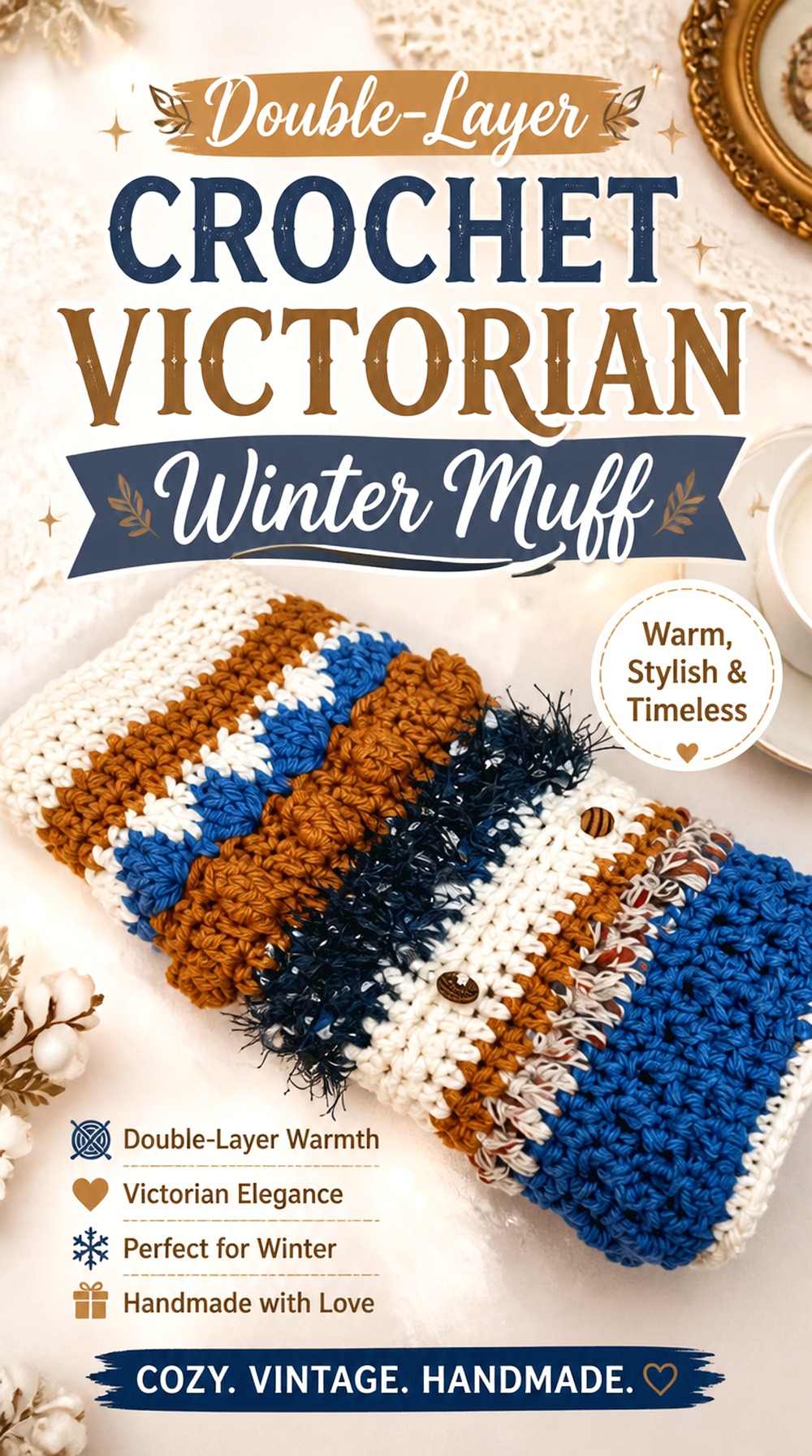
This option prioritizes depth and structure rather than surface decoration. Girlybunches demonstrates a crochet twiddle muff assembled from two parts, providing a useful reference when you want the finished hand-warmer to feel more substantial than a single open tube.
For a Victorian-inspired version, make the exterior the decorative layer and keep the hand-facing surface comparatively smooth. The contrast can be subtle: a textured outer shell over a plain inner crochet tube, for example. The result is visually quiet but has more body than the lighter designs in the list.
The Inner and Outer Layers Need Compatible Dimensions
Two attractive pieces do not automatically make a comfortable double muff. If the inner tube is much smaller, it can pull the exterior inward; if it is significantly larger, excess fabric may bunch inside.
Compare both layers before final joining. Place one inside the other, insert your hands, and inspect the openings. That fitting check is more useful than assuming that identical starting measurements will behave identically in different stitch textures.
Put the Smoothest Surface Toward the Hands
A decorative exterior can carry ridges, loops, or strong texture while the inside stays comparatively simple. This separation is useful when you want visual richness without having every raised stitch against the skin.
It also gives you more freedom to choose an outer stitch for appearance rather than softness alone, provided both materials have compatible care requirements.
Joining Should Not Turn the Openings Rigid
The two tube edges have to be connected, but a very tight joining method can remove the flexibility that made the individual layers comfortable.
Check each opening after only a short portion is joined. If the edge begins to draw inward, correct the tension before finishing the entire circumference.
Original Tutorial and Creator Credit
Creator: Girlybunches
Layered Texture Crochet Victorian Parlor Muff

Where the previous idea uses separate layers for body, this parlor-style version makes visible layers of texture the design feature. Lark Design Make’s twiddle-muff series demonstrates working different crochet layers and textures, giving a useful starting point for a decorative but controlled tube.
Imagine a cream, dusty mauve, or muted blue muff with a denser central body and overlapping-looking texture bands near the front. Keep the visual effect soft rather than heavily dimensional so the muff can coordinate with a dress, capelet, or indoor historical-style ensemble.
Build Depth Around One Central Display Area
Layered crochet looks most deliberate when the strongest texture is concentrated rather than scattered. Decide which side will face outward and treat that section almost like the front of a small handbag.
A central layered band can visually widen the muff, so leave calmer fabric near the openings to keep the overall cylinder balanced.
Avoid Letting Decorative Layers Close the Hand Passage
Any texture that folds, ruffles, or projects from the surface should be checked from the inside as well. If working it changes the tube’s flexibility, the decorative effect may come at the expense of comfortable access.
Slip both hands through periodically rather than waiting until the finishing stage to discover that an attractive border has become restrictive.
Soft Contrast Suits a Parlor-Inspired Version
Instead of sharply contrasting stripes, use neighboring tones or one solid color with changes in stitch texture. That lets light and shadow define the layered work.
This approach is especially useful when the accompanying clothing already has floral prints, lace, braid, or other strong ornament that could compete with a multicolored muff.
Original Tutorial and Creator Credit
Creator: Lark Design Make
Gothic Accent Crochet Victorian Hand Muff

A black or very dark muff creates a completely different effect from cream bridal and floral versions. Sooz In The Shed’s fiddle-muff tutorial provides the underlying crochet hand-muff concept; for this fashion adaptation, simplify the exterior and concentrate on dark texture with one lace-like or scalloped accent.
“Gothic Victorian” here describes the modern styling direction rather than a claim that a particular black crochet design reproduces period mourning rules. Use matte black, charcoal, oxblood, or another deep shade, then introduce contrast through texture instead of piling on bright color.
Dark Yarn Makes Edge Definition More Important
Complex stitches can disappear visually in black yarn, particularly under indoor lighting. If the main body is dark, a clearly defined border or raised central band gives the viewer something to read.
Test a small section under the lighting where the muff will actually be worn or photographed. A texture that looks obvious in bright work light may appear almost flat at an evening event.
Lace-Like Trim Works Better as an Accent Than the Main Tube
Open crochet can give a refined decorative edge, but a very open entire muff changes both the appearance and function of the accessory. Use openwork selectively unless you intend to add a separate inner layer.
Keeping the hand-warming body denser also makes the trim more noticeable because the eye can distinguish the contrast between solid fabric and decorative edge.
Black Does Not Require Heavy Ornament
It can be tempting to add beads, flowers, ribbons, tassels, and metallic details because the base is neutral. Restraint usually gives a stronger silhouette.
Choose one feature—a scalloped opening, dark floral applique, or narrow cord—and allow the rest of the muff to remain visually quiet.
Original Tutorial and Creator Credit
Creator: Sooz In The Shed
Floral Motif Crochet Victorian Hand Muff
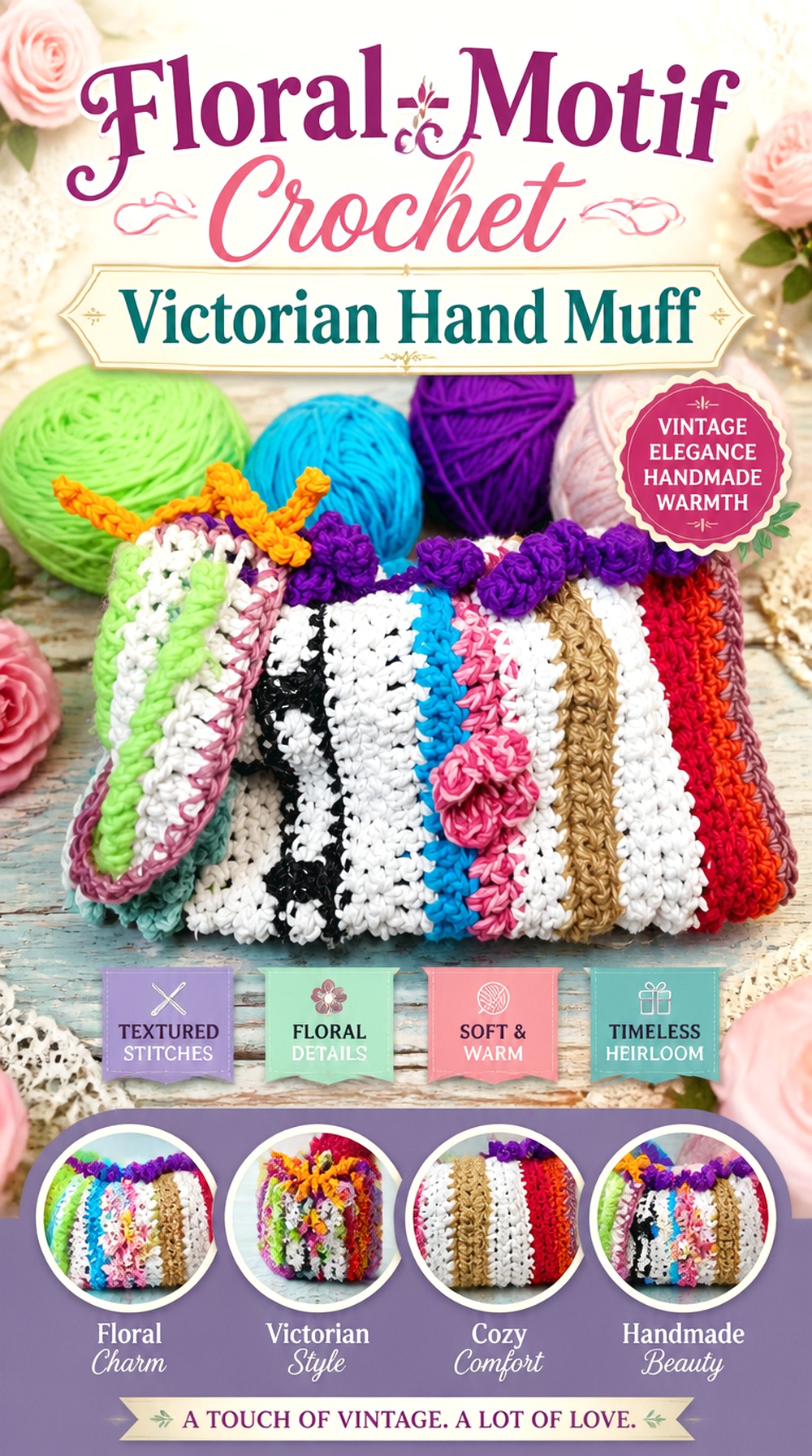
This version treats crochet flowers and small motifs as part of a richer surface rather than a single rosette cluster. Cukicrochet’s sensory-muff tutorial visibly incorporates different textures, fibers, motifs, flowers, and tassel-like elements around a cylindrical crochet form.
For a Victorian-inspired fashion muff, edit that abundance down to a coordinated floral composition. A vine-like group of flat leaves and flowers could cross one front corner, or several motifs could form a central medallion. Limiting the color palette keeps the result decorative without looking like a modern activity muff.
Flat Motifs Interfere Less With Everyday Handling
Highly dimensional flowers can be crushed every time the muff is set down. Flatter motifs preserve the floral theme while keeping the silhouette easier to manage.
Lay the tube flat in its natural resting position and check which surface actually touches the table. Keep the most detailed flowers away from that pressure point whenever possible.
Plan the Motif Direction Before Sewing
Flowers that look upright when the muff lies on a worktable may rotate sideways when it hangs from a cord or is held with both hands.
Temporarily pin the arrangement, put the muff in its intended carrying position, and view it in a mirror. That orientation check can save considerable finishing work.
Limit Fiber Variety for a Fashion Version
The source tutorial deliberately explores varied sensory fibers and textures. A Victorian-style fashion adaptation has a different goal.
Using one main yarn family and letting the flowers provide contrast can make the surface more cohesive. If you introduce fuzzy or metallic-look yarn, keep it to a small accent unless you want that material to dominate the entire design.
Original Tutorial and Creator Credit
Creator: Cukicrochet
Tassel Cord Crochet Victorian Hand Muff
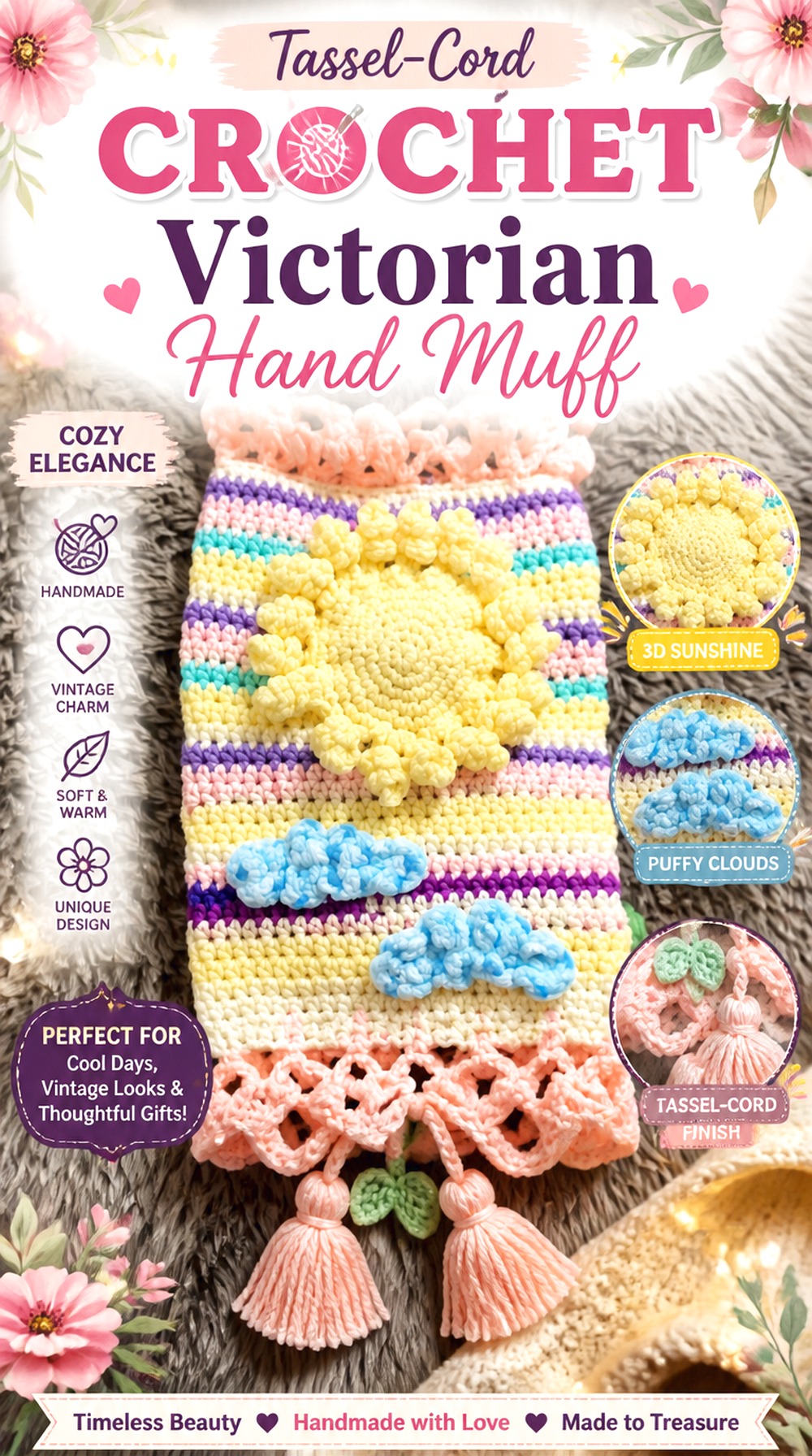
A carrying cord changes the character of a muff immediately. This design uses a relatively simple crochet body and makes the suspension detail the focal point. Jacqueline’s Life offers a multipart twiddle-muff tutorial; Part 1 provides a useful construction reference for beginning the muff itself.
For the Victorian-inspired adaptation, add a coordinated crochet cord or ribbon-style carrying treatment and finish its attachment points neatly. Small tassels can mark the ends or center, but they should remain secondary to the tube rather than covering the hand openings.
Decide Between Neck Cord and Short Carry Loop
A long cord allows the muff to rest in front of the body while the hands are free to enter and leave it. A shorter loop behaves more like a handbag handle and keeps the piece under more direct control.
Neither is automatically better. Try both positions with the coat, cape, or dress you intend to wear before permanently attaching anything.
Tassel Weight Can Pull on Crochet Fabric
A tassel may look small when lying flat but can pull downward once the muff hangs. Attach decorative weight to a structurally sound area rather than a delicate open stitch.
If the fabric begins stretching around the attachment point, reinforcement or a lighter embellishment may be preferable.
Keep the Cord Clear of the Hand Openings
A decorative cord that crosses an opening can catch fingers, bracelets, or gloves. Before finishing, place both hands inside and move them in and out several times.
The cord should support the muff without becoming part of the route the hands have to navigate.
Original Tutorial and Creator Credit
Creator: Jacqueline’s Life
Heirloom Scrap Texture Crochet Victorian Muff

Not every vintage-inspired project has to be monochrome. A carefully edited scrap-yarn muff can suggest an heirloom piece assembled from treasured remnants, especially when the colors stay within a deliberate palette. Kazzalistic Crochet’s video shares a crocheted twiddle muff and offers useful visual inspiration for combining texture within this type of hand-warmer.
For a fashion adaptation, choose scraps by relationship rather than simply using everything available. Dusty rose, cream, brown, muted green, and wine could form one group; black, gray, plum, and silver-gray could form another.
Sort Scraps by Visual Weight Before Crocheting
Two yarns can have similar thickness yet look completely different once worked. Fuzzy, shiny, marled, and solid fibers attract different amounts of attention.
Arrange the yarns in sequence before starting and decide which should become focal bands. This prevents a dramatic novelty yarn from accidentally dominating the finished muff.
Repeat One Color to Hold the Mixed Surface Together
A recurring base shade can connect otherwise unrelated scraps. For example, returning to cream or deep burgundy between textured sections gives the eye a predictable anchor.
This is especially useful when adapting a sensory-inspired construction into a fashion accessory because repetition creates more visual discipline.
Check Care Compatibility Across the Yarn Mix
A scrap project combines materials that may not share the same washing or drying instructions. Before committing a sentimental or delicate yarn, check its label and consider how the finished piece will be maintained.
When care requirements conflict significantly, save the incompatible fiber for a removable trim rather than building it permanently into the main tube.
Original Tutorial and Creator Credit
Creator: Kazzalistic Crochet (Karen Hales)
Raised Bobble Crochet Victorian Hand Muff
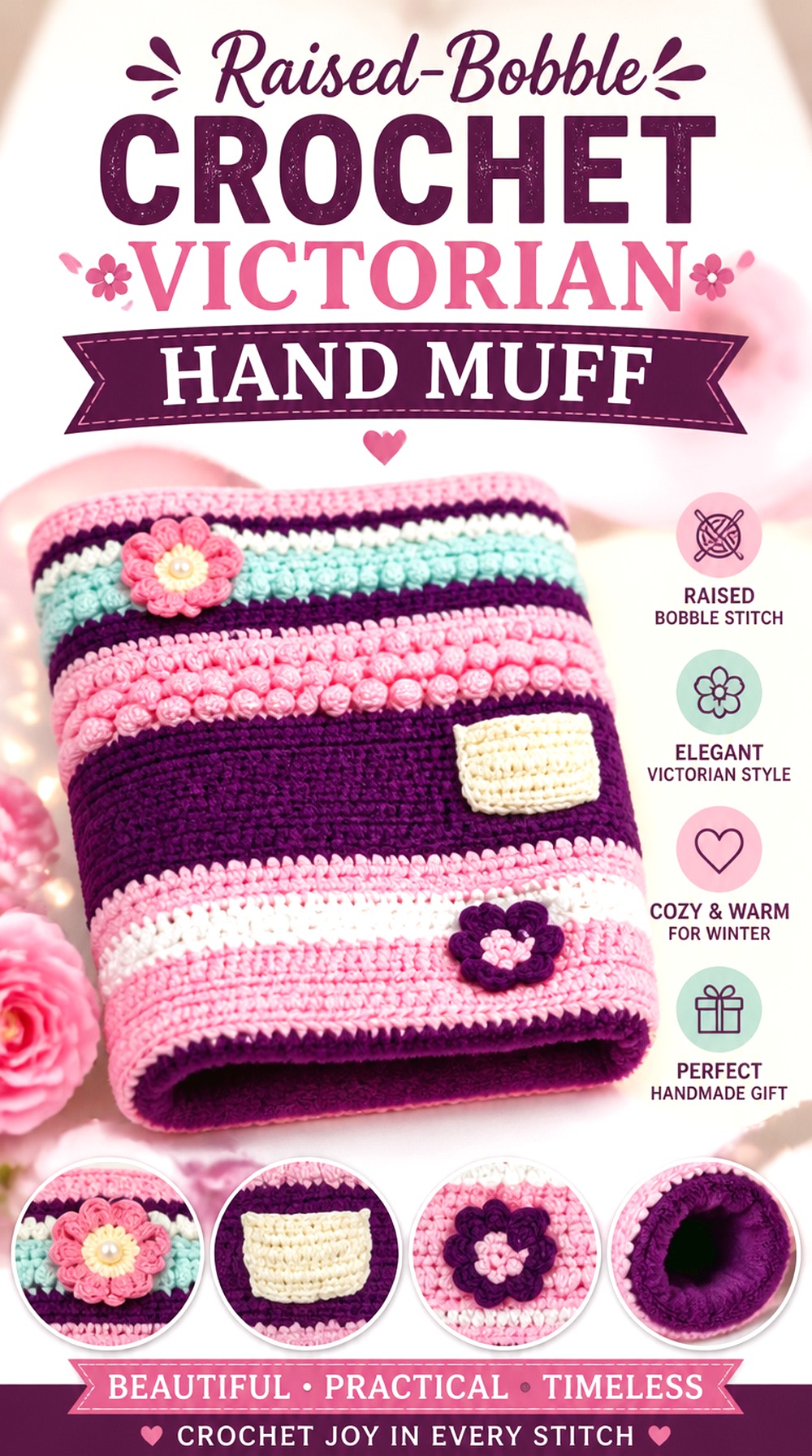
The final idea uses three-dimensional crochet itself as the ornament. Prince William Public Libraries describes its fidget muff as a crocheted hand muff with textured stitches and bobbles, making the video a useful reference for a pronounced raised surface.
For a Victorian-inspired fashion version, remove the sensory context from the styling and arrange bobbles in a controlled band, medallion-like field, or symmetrical repeat. A single solid shade works particularly well because the raised stitches create their own shadows. This option suits readers who want a decorative muff without attaching separate flowers, ribbons, or jewelry-like pieces.
Concentrated Bobbles Avoid Excess Bulk
Covering every inch with raised stitches can make a small muff feel visually heavy. A broad central band or repeated narrow lines gives the texture room to stand out.
Consider where the palms naturally rest as well. A heavily bobbled underside may feel less convenient to hold than a smoother surface with the texture concentrated toward the front.
Symmetry Makes Raised Texture Feel More Formal
Random bobbles work well for sensory crochet, but a fashion muff benefits from a clearer arrangement. Mirror the texture around a central line or repeat the same band near both ends.
You do not need a complicated motif. Consistent spacing and a recognizable rhythm can create the formal impression without reconstructing a creator-specific pattern.
Finish the Openings More Quietly Than the Center
When the body has strong dimensional texture, elaborate ruffles at both ends can compete with it. A clean border allows the raised center to remain the focal feature.
Check the finished border for stretch before considering it complete. Even a beautiful edge is unsuccessful if it makes the hand passage noticeably tighter.
Which Victorian-Inspired Muff Style Should You Choose?
Choose the hidden-pocket muff purse when function matters as much as appearance. The double-layer or plush evening versions make sense when you want a more substantial surface, while the jewel-stripe and sampler-band ideas create decoration directly through the crochet.
For costume styling, the rosette, floral-motif, Gothic-accent, and tassel-cord muffs give you the clearest focal details. If you prefer something less ornate, the double-layer version keeps most of its interest in the construction. The raised-bobble and layered-texture options sit between those extremes: visually decorative without depending on multiple sewn-on embellishments.
Conclusion
The most convincing crochet Victorian hand muff is not necessarily the one with the most decoration. Start with the function you need: a hidden pocket for outings, a carrying cord for hands-free positioning, two layers for a more substantial tube, or a simple surface that can support floral or Gothic-inspired accents.
For a quieter historical mood, focus on silhouette, rich texture, and restrained color. For a statement accessory, make one element—flowers, shells, bobbles, or a cord—the clear focal point. The linked original tutorials are the place to follow each creator’s exact construction details; the Victorian-inspired adaptations here are meant to help you choose and plan the finished look.
Frequently Asked Questions
Were crochet hand muffs actually common in the Victorian era?
Muffs themselves were established Victorian accessories, but surviving museum examples are frequently made from fur, silk, and related luxury materials rather than resembling today’s crochet tutorials. The Met records examples from the 1850s, about 1885, and the late nineteenth century in fur and silk.
It is therefore more accurate to describe these projects as Victorian-inspired crochet muffs unless you are working directly from a documented period crochet pattern.
What yarn gives a crochet muff the most Victorian-looking texture?
There is no single historically correct modern crochet yarn. Decide which characteristic you are translating instead. A fuzzy fiber can suggest the visual softness of historical fur, while smooth yarn gives shells, relief stitches, flowers, and scalloped borders clearer definition.
If combining fibers, check their care instructions and how much each stretches. A beautiful contrast is less useful if one section grows dramatically or requires incompatible maintenance.
Should a Victorian-inspired crochet muff be lined?
A lining is optional, but it can be useful when the exterior is open, very textured, fuzzy, or prone to stretching. It may also create a smoother surface for rings and bracelets.
Before adding one, check the complete circumference and opening size. A bulky inner layer can reduce usable space. Also confirm care compatibility between the crochet yarn and lining material rather than assuming both can be washed the same way.
How do I know whether the hand openings are large enough?
Use the intended wearer rather than a universal measurement. The hands should enter without forcing the border, and the wrists should be able to rest naturally inside while both elbows remain comfortable.
Test the tube again after edging, lining, or joining layers because each finishing choice can reduce flexibility. If the muff will be worn with gloves, perform the fitting while wearing them.
Can I add a hidden pocket without making the muff look modern?
Yes. A concealed pocket is compatible with the historical concept: fashion-history references note that card-case and purse pockets were introduced in women’s muffs in the 1880s, and muff-handbags were a recognized adaptation.
Keep the closure visually discreet if you want the exterior to remain period-inspired. The pocket should also sit where it does not interfere with the hands or distort the crochet shell.
How many flowers, bows, or tassels should I add?
There is no required number. Use the muff’s existing texture to decide. A heavily textured shell may need only one small focal decoration, while a smooth tube can support a larger floral arrangement.
Temporarily pin embellishments before sewing them. Hold the muff in its actual carrying position and check both balance and hand access. Removing one unnecessary detail often makes the remaining decoration look more intentional.
Can a sensory-muff tutorial be used to make a fashion hand muff?
It can provide useful construction ideas—tube formation, layering, textural crochet, joining, and embellishment placement—but the intended use is different. Sensory muffs are deliberately designed around tactile activity, while a Victorian-inspired fashion muff prioritizes silhouette, wearability, and visual coordination.
Do not simply remove safety considerations or assume every sensory construction will suit fashion use. Adapt the appearance cautiously and continue to rely on the original creator’s tutorial for the construction it actually teaches.