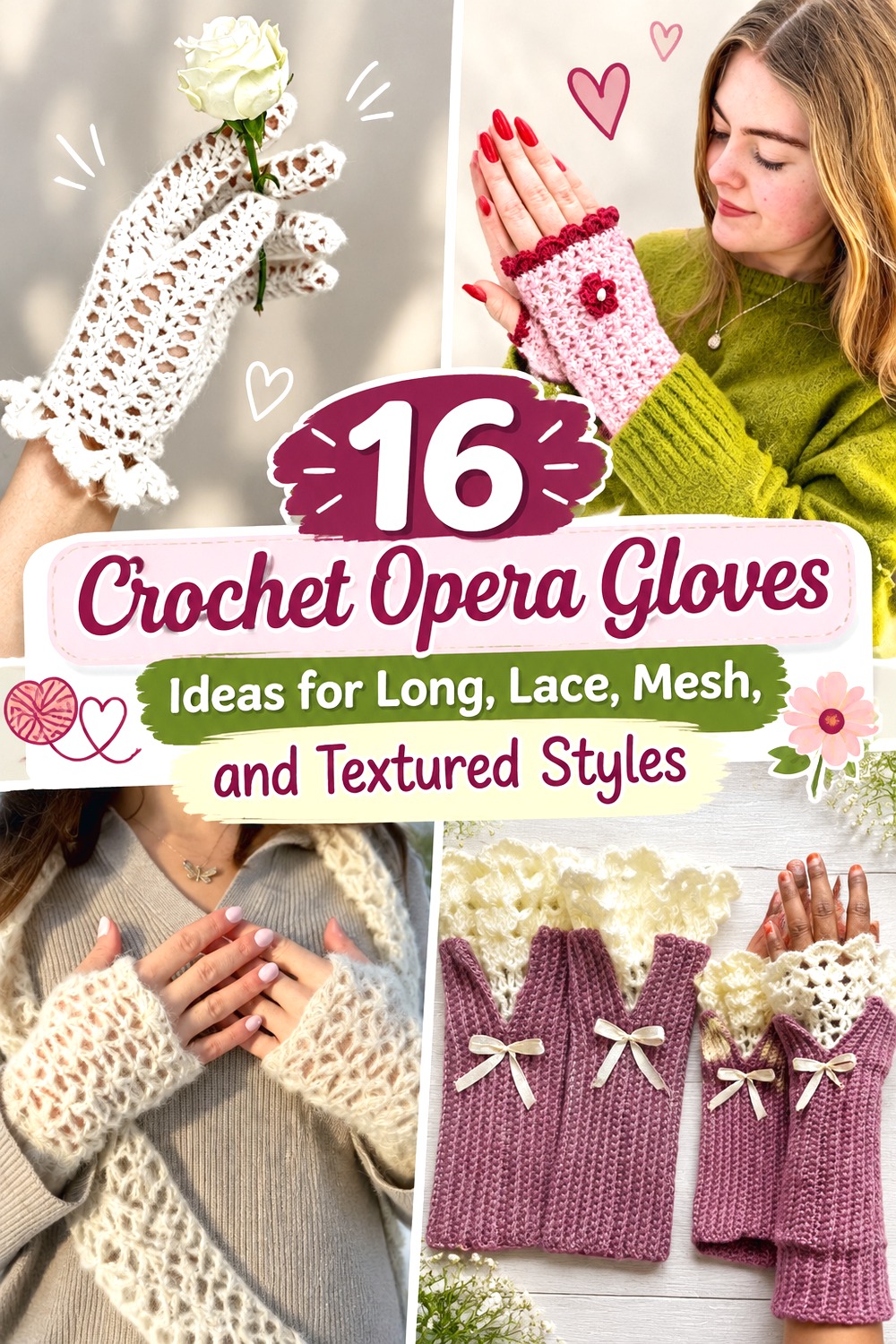

Crochet opera gloves can be far more varied than one long fingerless tube. Some designs use stretch and ribbing for a close forearm fit, while others rely on fishnet, vintage lace, dimensional texture, scallops, flowers, or bows to make the gloves the focal point of an outfit. There are also important differences between a tutorial that already produces a long arm warmer and a shorter glove that needs a separately planned opera-length extension.
These 16 ideas cover both routes. You can compare hand coverage, forearm structure, openwork, embellishment, upper-edge behavior, and styling before choosing a tutorial. Where the original project is shorter than opera length, the added forearm is treated as an adaptation rather than presented as something the creator already teaches.
Quick List
- Crochet Sleek Long Fingerless Opera Gloves
- Crochet Ribbed Elbow-Grazing Opera Mitts
- Crochet Almond-Texture Statement Opera Gloves
- Crochet Everyday Ribbed Opera Arm Warmers
- Crochet Flat-Panel Minimal Opera Gloves
- Crochet Clean-Column Opera Arm Warmers
- Crochet Custom-Length Trimmed Opera Gloves
- Crochet Bow-Accent Balletcore Opera Gloves
- Crochet Soft Vintage Lace Opera Gloves
- Crochet Starlight V-Stitch Opera Gloves
- Crochet Victorian-Inspired Opera Gloves
- Crochet Scalloped Flower Opera Gloves
- Crochet Full-Finger Mesh Opera Gloves
- Crochet Shell-Stitch Opera Gloves
- Crochet Autumn-Leaf Textured Opera Gloves
- Crochet Fishnet Evening Opera Gloves
Opera Length Changes More Than the Amount of Crochet
A wrist-length mitt mainly needs to work around the hand, thumb, and wrist. Extending the same idea toward the elbow brings several more fit points into play because the forearm usually changes circumference along its length.
Before settling on a long construction, decide where you want the upper edge to stop and compare that point with your wrist and fuller forearm. Pay attention to the actual crochet fabric as well. Ribbing may accommodate changing circumference more easily than a firm decorative stitch, while open mesh may stretch enough to fit but become visually distorted.
Elbow movement matters if the glove finishes high on the arm. Test the developing piece with your arm bent rather than evaluating it only while standing with the arm straight.
Match Yarn Behavior to the Look You Want
Opera gloves put a large area of crochet on display, so stitch behavior becomes part of the design. A resilient ribbed fabric can support a fitted silhouette, while soft drape may create a more relaxed look. Lace and fishnet intentionally expose skin, but the openings can change shape dramatically when stretched.
Raised cables, shells, flowers, and other dimensional textures add visual depth and may also create more thickness. That matters if the gloves will sit underneath fitted sleeves or alongside bracelets and cuffs.
Instead of choosing yarn only by color, make enough fabric to check skin feel, stretch, recovery, stitch definition, and how the material behaves after repeated handling. If you substitute yarn in a tutorial, reassess the fit rather than assuming the creator’s proportions will transfer unchanged.
Using Short Glove Tutorials for an Opera-Length Adaptation
Several tutorials below already teach long gloves or arm warmers. Others are included because their lace, floral, shell, Victorian, or full-finger construction offers a distinct design direction.
For those shorter sources, establish the original hand and thumb fit first. Then treat the additional forearm as its own planning problem. Compare circumference at more than one point, determine whether the decorative stitch can accommodate gradual width changes, and decide where a complete motif repeat can end cleanly.
Avoid making the first glove and then relying on memory for the second. Compare the pair while both are still easy to adjust. Long gloves make differences in thumb position, motif alignment, upper width, and total length particularly visible.
Crochet Sleek Long Fingerless Opera Gloves
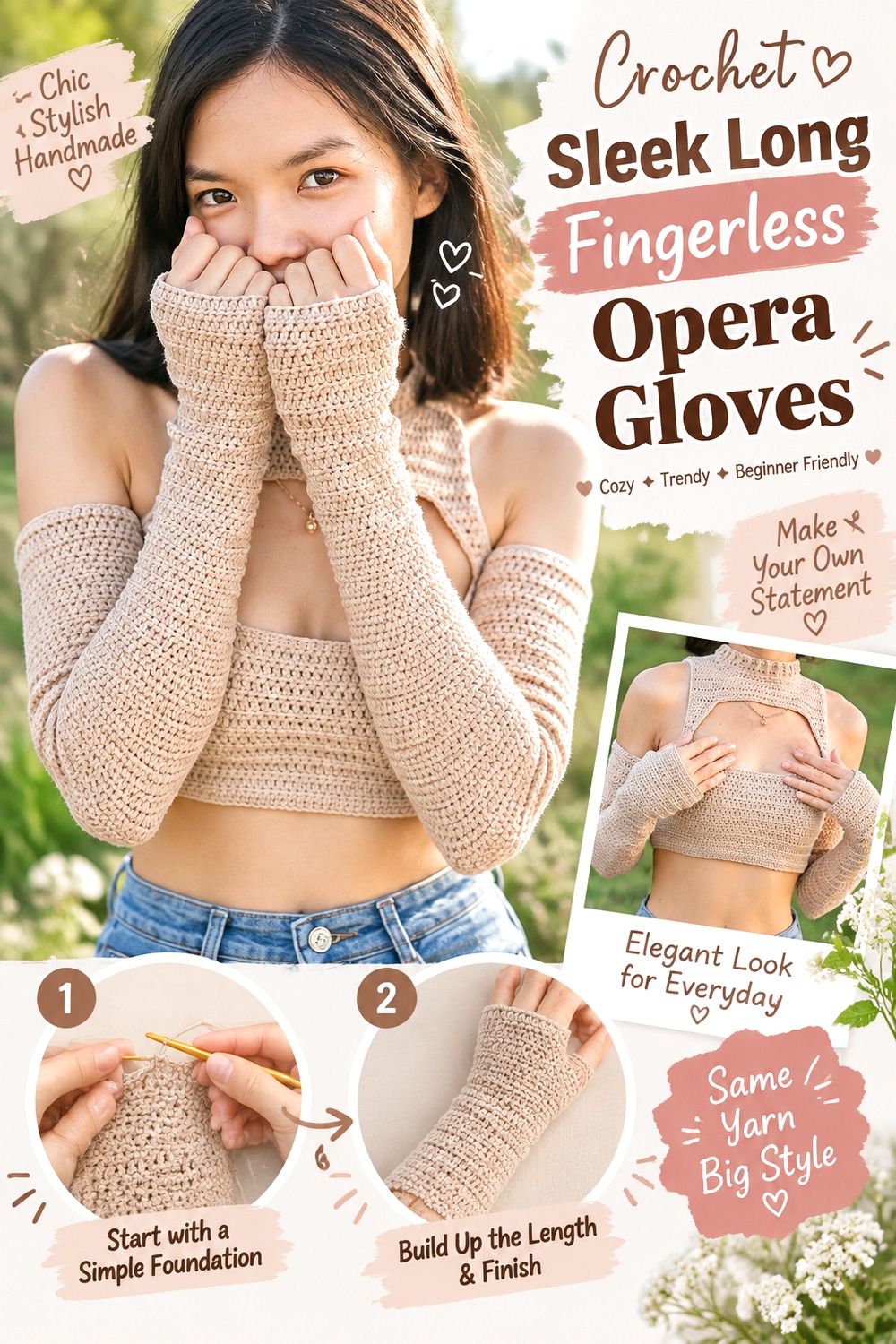
A streamlined long fingerless glove is one of the clearest interpretations of the crochet opera-glove idea. Chenda DIY’s tutorial already focuses on long fingerless gloves, so the extended silhouette is part of the source project rather than an invented addition.
This approach keeps ornament to a minimum and lets proportion become the main styling feature. It can pair naturally with sleeveless clothing, short sleeves, costumes, or layered outfits where the long glove should create a continuous line up the forearm. Because the surface is relatively restrained, uneven taper or mismatched glove lengths can be easier to notice than on heavily textured alternatives.
Let the Forearm Line Stay Smooth
A clean glove benefits from gradual changes in width. If the wrist is much narrower than the upper forearm, check the developing fabric at both points rather than depending on one circumference measurement. An abrupt width change can interrupt the otherwise sleek silhouette.
The useful checkpoint is how the fabric looks while worn, not simply whether it can stretch around the arm. Excessive stretching may flatten the stitch definition or make one portion noticeably tighter than another.
Watch the Relationship Between Thumb and Wrist
The thumb opening establishes how the entire glove sits on the hand. If it pulls the fabric sideways, that twist can continue visibly through a long forearm section.
Follow the creator’s construction for the hand, then put the glove on before judging the upper section. Check whether the forearm fabric rises in a straight line when your hand is relaxed and when you rotate your wrist naturally.
Make the Upper Edge Secure, Not Restrictive
A long glove needs enough stability near the top to avoid constantly sliding, but an extremely tight border can create an obvious pressure point.
Test the final upper area while moving your arm. If the main glove is too loose, tightening only the last edge may not solve the underlying fit problem. Overall taper and fabric recovery matter as much as the finish.
Original Tutorial and Creator Credit
Creator: Chenda DIY
Crochet Ribbed Elbow Grazing Opera Mitts
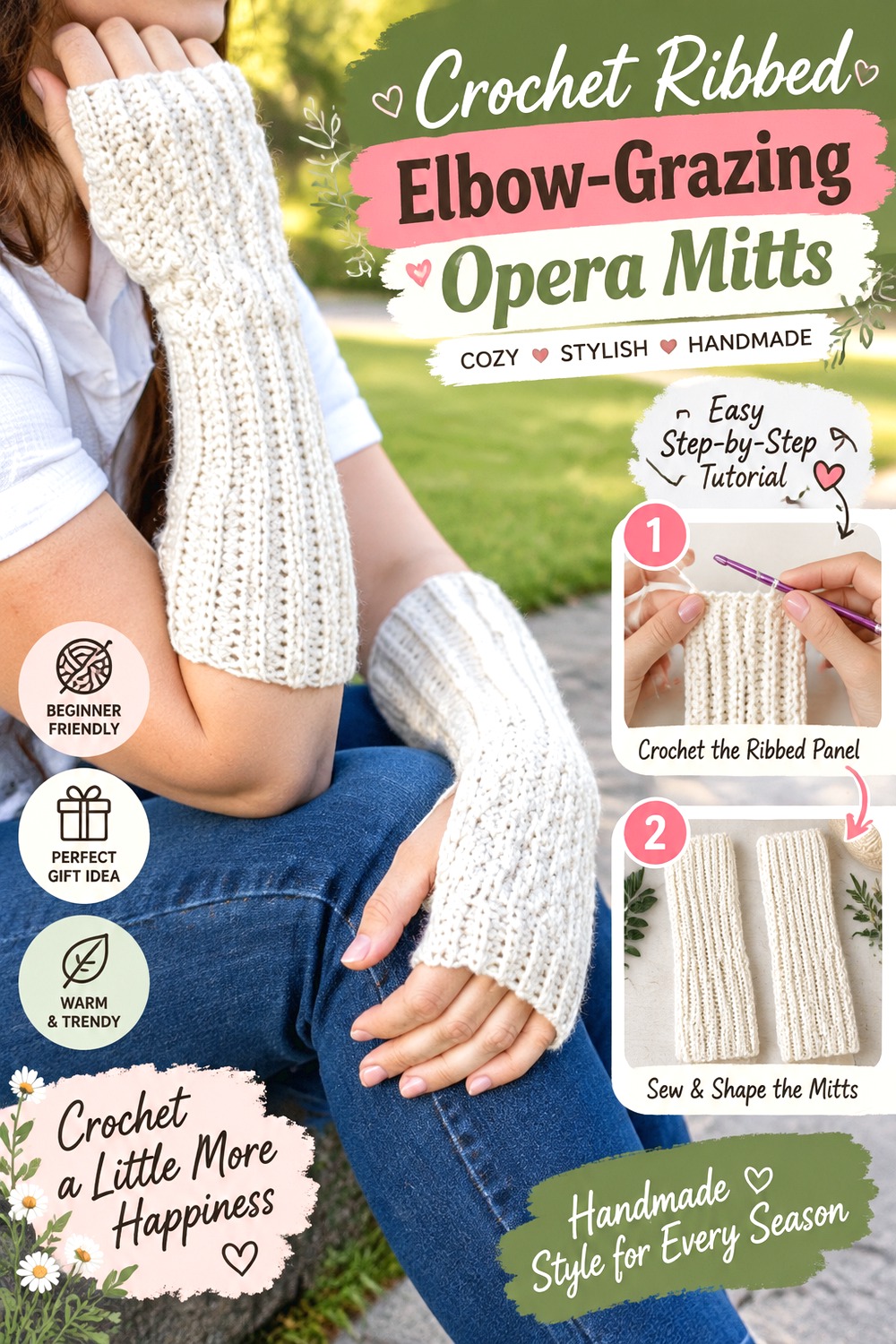
Winding Road Crochet’s long wrist-warmer tutorial provides another useful starting point for substantial forearm coverage. The appeal is a longer, cozy silhouette that feels closer to an arm warmer than delicate evening lace.
This direction works well when you want opera-glove proportions but prefer an everyday or cool-weather appearance. The uninterrupted length also makes fabric recovery important. A long stretchy warmer may accommodate changes in forearm circumference efficiently, but the upper section should still remain comfortable when the elbow bends. Compared with decorative floral or shell options, this idea puts function and continuous texture ahead of embellishment.
Decide How Close to the Elbow You Really Want to Go
A glove that stops comfortably below the elbow behaves differently from one that approaches the joint. Before finalizing length, bend your arm fully and notice where fabric begins to bunch.
Longer is not automatically better. A slightly lower stopping point may preserve a cleaner line and make the gloves easier to combine with short sleeves or coat cuffs.
Keep Any Long Join From Becoming a Tight Line
If a long construction includes a seam or joined edge, that area should remain compatible with the stretch of the surrounding fabric.
After joining, put the glove on and check whether the seam stays straight or causes twisting. A seam that is significantly firmer than the rest of the warmer can change both fit and appearance over a much larger area than it would on a short wrist mitt.
Original Tutorial and Creator Credit
Creator: Winding Road Crochet
Crochet Almond Texture Statement Opera Gloves
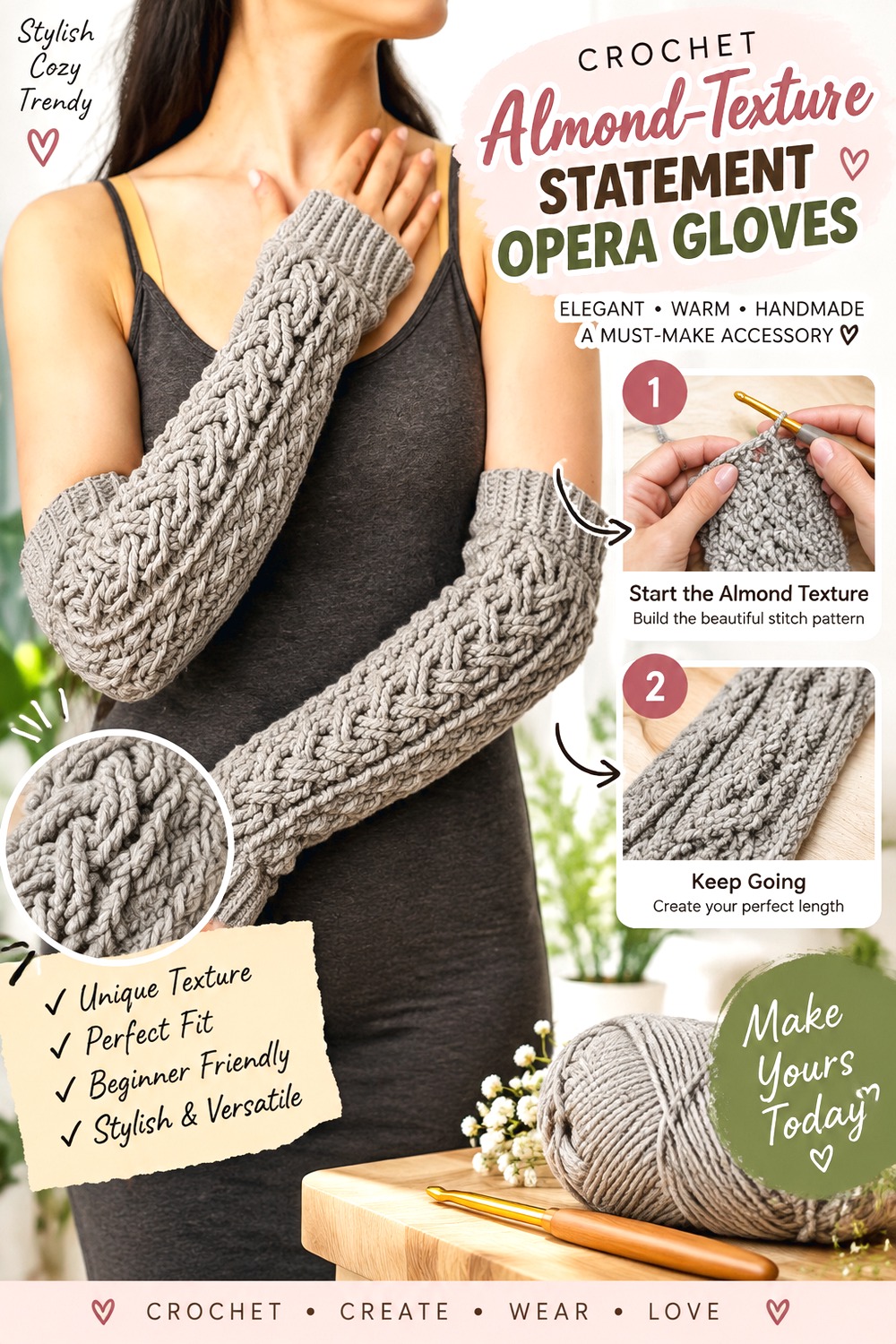
For a more substantial fashion accessory, TCDDIY’s arm-warmer tutorial introduces strong surface texture rather than relying on a plain tube or airy lace. The source centers on textured arm warmers, making it a useful reference when the crochet fabric itself should become the statement.
An opera-length interpretation can look dramatic alongside simple dresses, tank tops, or fitted sleeves, but dimensional fabric also has consequences. Raised texture can appear visually thicker and may behave differently around the wider forearm than flatter stitches. This idea is therefore less about achieving maximum delicacy and more about creating a clearly handmade, structured arm accessory.
Raised Texture Changes Sleeve Compatibility
A textured glove may fit your arm perfectly and still feel awkward under a fitted sleeve. If you intend to layer the warmers beneath clothing, test the combination before completing both pieces.
Surface dimension can also make a glove appear fuller than its actual measurement suggests. That visual effect is worth considering if you want a narrow, formal opera-glove line.
Give the Main Motif a Clear Direction
Strong stitch architecture naturally creates a front or focal side. Decide how that feature should run relative to the back of the hand and forearm.
When starting the second glove, compare the two in worn orientation rather than simply laying them side by side. A directional texture makes accidental rotation much easier to notice.
Finish the Long Repeat at an Intentional Point
If you alter the length of a prominent textured repeat, avoid stopping where the design looks visually interrupted.
First identify a comfortable upper-edge position on your arm. Then see which nearby complete repeat produces the cleaner ending. A small adjustment in final length may look more intentional than forcing the fabric to end at an arbitrary measurement.
Original Tutorial and Creator Credit
Creator: TCDDIY
Crochet Everyday Ribbed Opera Arm Warmers
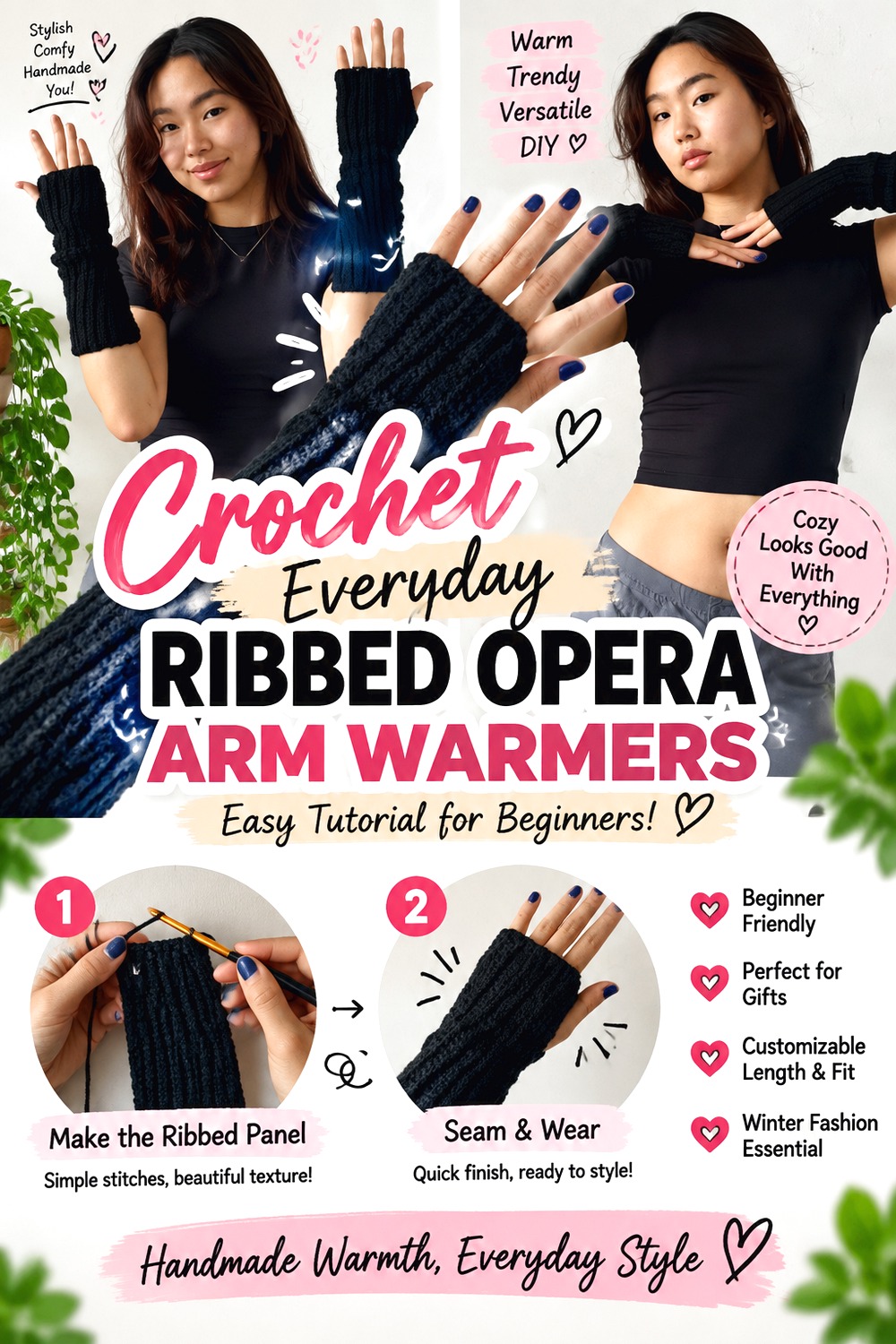
Ariel Tong’s arm-warmer and fingerless-glove tutorial offers a relatively restrained foundation for a long crochet glove. The source specifically presents arm warmers/fingerless gloves, making the elongated shape relevant to the project rather than an unrelated modification.
This is a useful direction for readers who like an understated accessory that can move between casual, cozy, and streetwear styling. Without flowers, shells, or heavy lace dominating the surface, the important decisions become fit, length, and how much the fabric must stretch around the upper forearm.
Let Ribbing Stretch Without Flattening Completely
Ribbed fabric is useful because it can accommodate changing circumference, but there is still a practical limit.
Try the glove at its widest intended point. If the ribs have to stretch almost completely flat to fit, the fabric may not look or recover the way you expected. A little additional width can produce a more balanced result than simply depending on maximum stretch.
Coordinate the Ending Point With Your Sleeves
Minimal opera gloves make the gap between glove and clothing especially noticeable.
Put on the type of top or dress you expect to wear with them and decide whether you want a clear section of exposed arm, a nearly continuous line, or intentional overlap. That styling decision can be more useful than choosing length from the glove alone.
Original Tutorial and Creator Credit
Creator: Ariel Tong
Crochet Flat Panel Minimal Opera Gloves
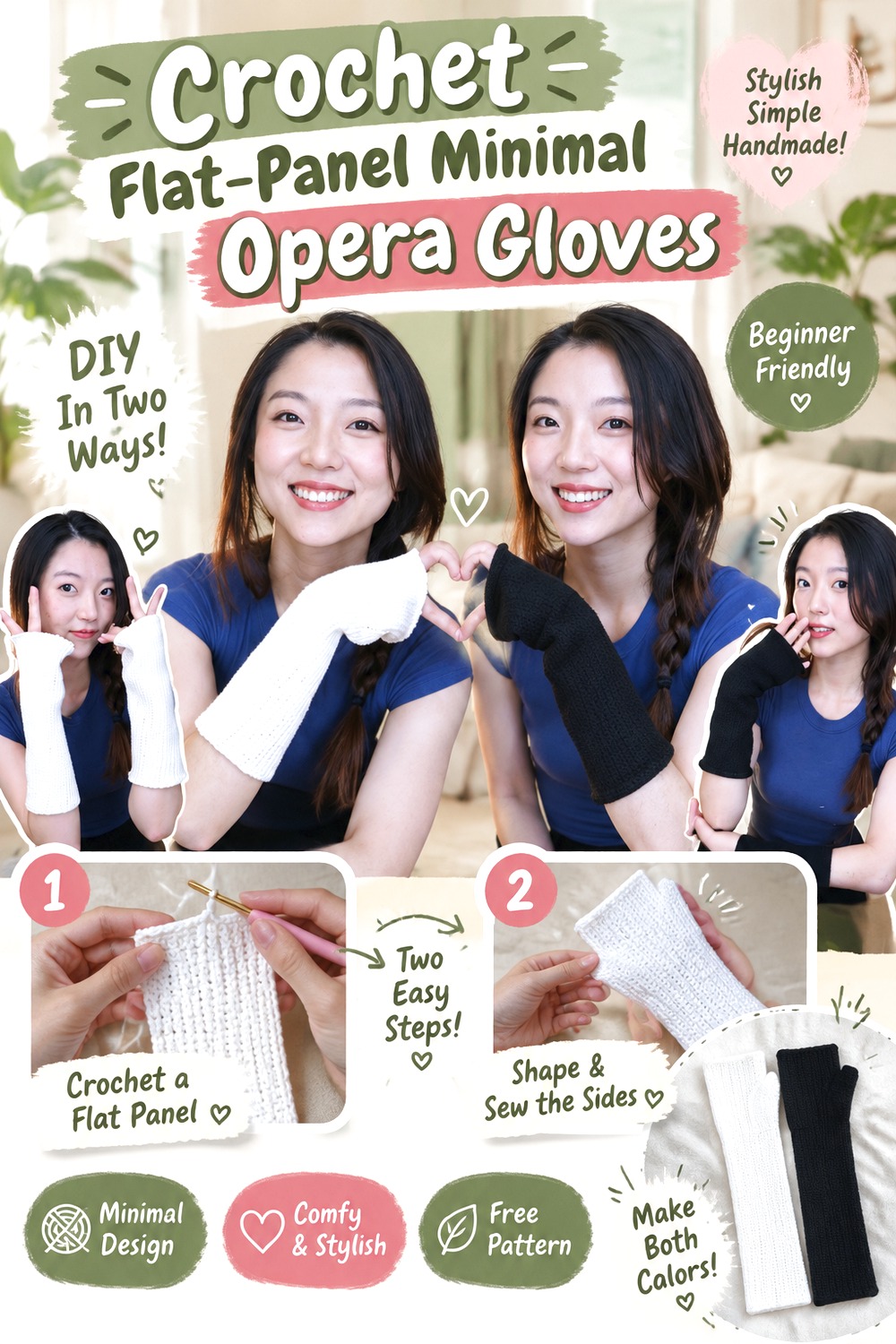
Yaejiyea’s arm-warmer video contains both knitted and crocheted versions, with the crochet section providing the relevant reference for this idea. The resulting direction is clean and contemporary rather than overtly vintage or formal.
A flat or straightforward construction can be helpful when you want to visualize the fabric against your arm before the piece is fully joined. For opera length, that makes width changes easier to assess than they might be in a highly decorative design. The finished look can stay intentionally simple or become a base for later color blocking and limited embellishment.
Flat Fabric Makes Width Easier to Compare
Before final joining, place the fabric around the wrist and fuller forearm while accounting for its stretch.
This can reveal whether the same relaxed width is practical across the entire glove. Avoid judging fit by pulling the fabric as tightly as possible; the goal is a comfortable worn surface that still retains the intended stitch appearance.
Separate Crochet Instructions From the Knit Version
Because the source includes more than one craft, keep the crochet segment clearly separated while following it.
The finished objects may share a similar visual purpose, but knitted and crocheted constructions are not interchangeable. This becomes especially important when returning to the video later to make the second glove.
Original Tutorial and Creator Credit
Creator: yaejiyea
Crochet Clean Column Opera Arm Warmers
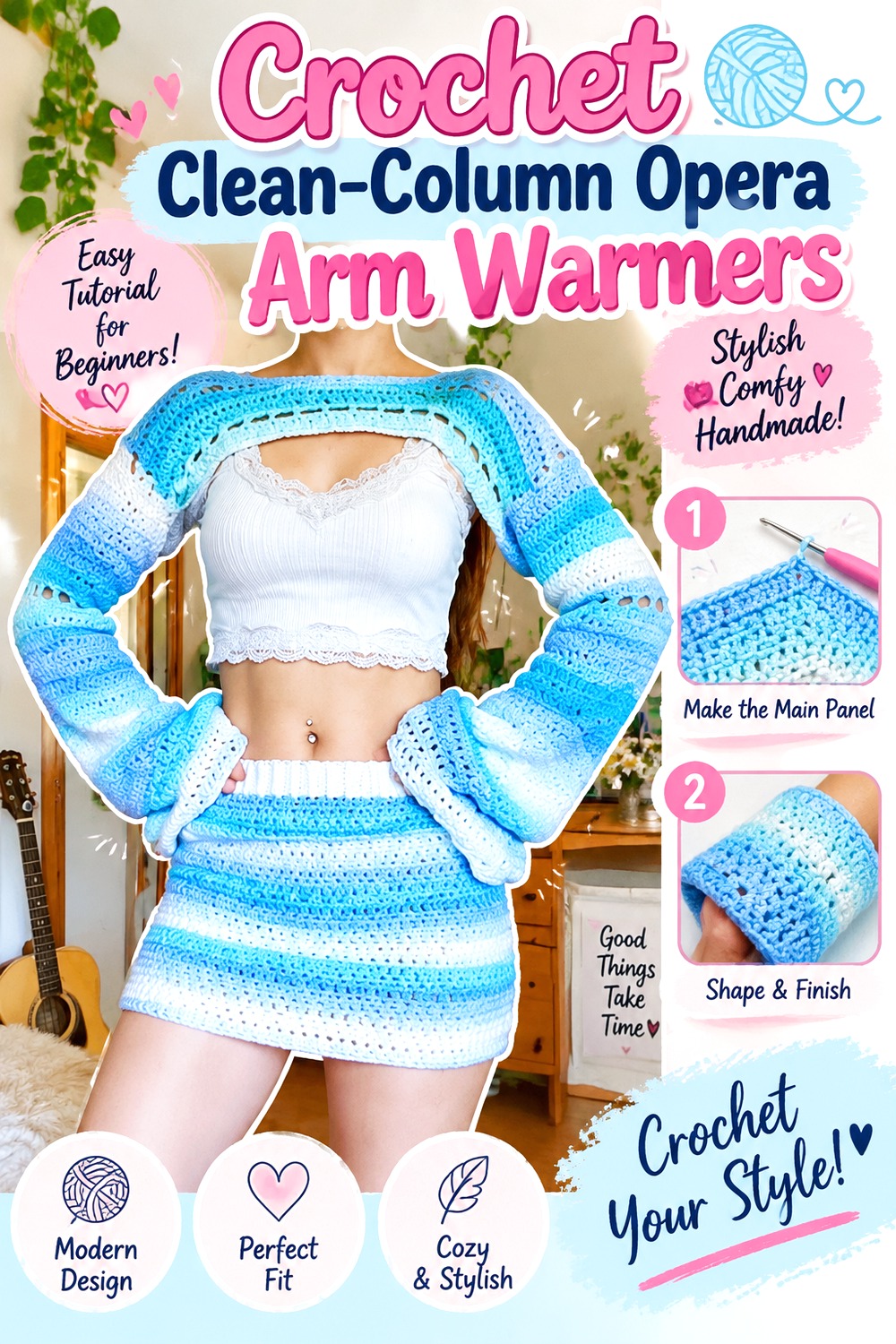
Gabrielle McAuley’s arm-warmer tutorial provides a straightforward source for readers who want the long silhouette itself to do most of the design work. The video is specifically titled as an arm-warmer tutorial rather than a decorative short wrist project.
This minimal approach can suit monochrome outfits, coordinated crochet sets, or styling where a heavily patterned glove would compete with the clothing. It also makes fit errors harder to disguise. If the wrist sags, the upper edge flares, or one glove ends higher than the other, there are fewer motifs to distract from those differences.
Choose Between a Straight and Tapered Appearance
A nearly straight tube can create a relaxed column shape, while a closer glove follows the narrowing wrist more distinctly.
Neither effect is universally better. Decide which look fits the outfit and then see whether the source fabric has enough stretch to accommodate the difference between wrist and forearm without excessive compression.
Compare Both Pieces Before Finishing
Minimal gloves make length discrepancies particularly visible.
Lay the pair together before final finishing and compare thumb position, relaxed length, upper width, and the point where the hand transitions into the forearm. Small corrections are easier before every end has been woven in and every edge treated as final.
Original Tutorial and Creator Credit
Creator: Gabrielle McAuley
Crochet Custom Length Trimmed Opera Gloves
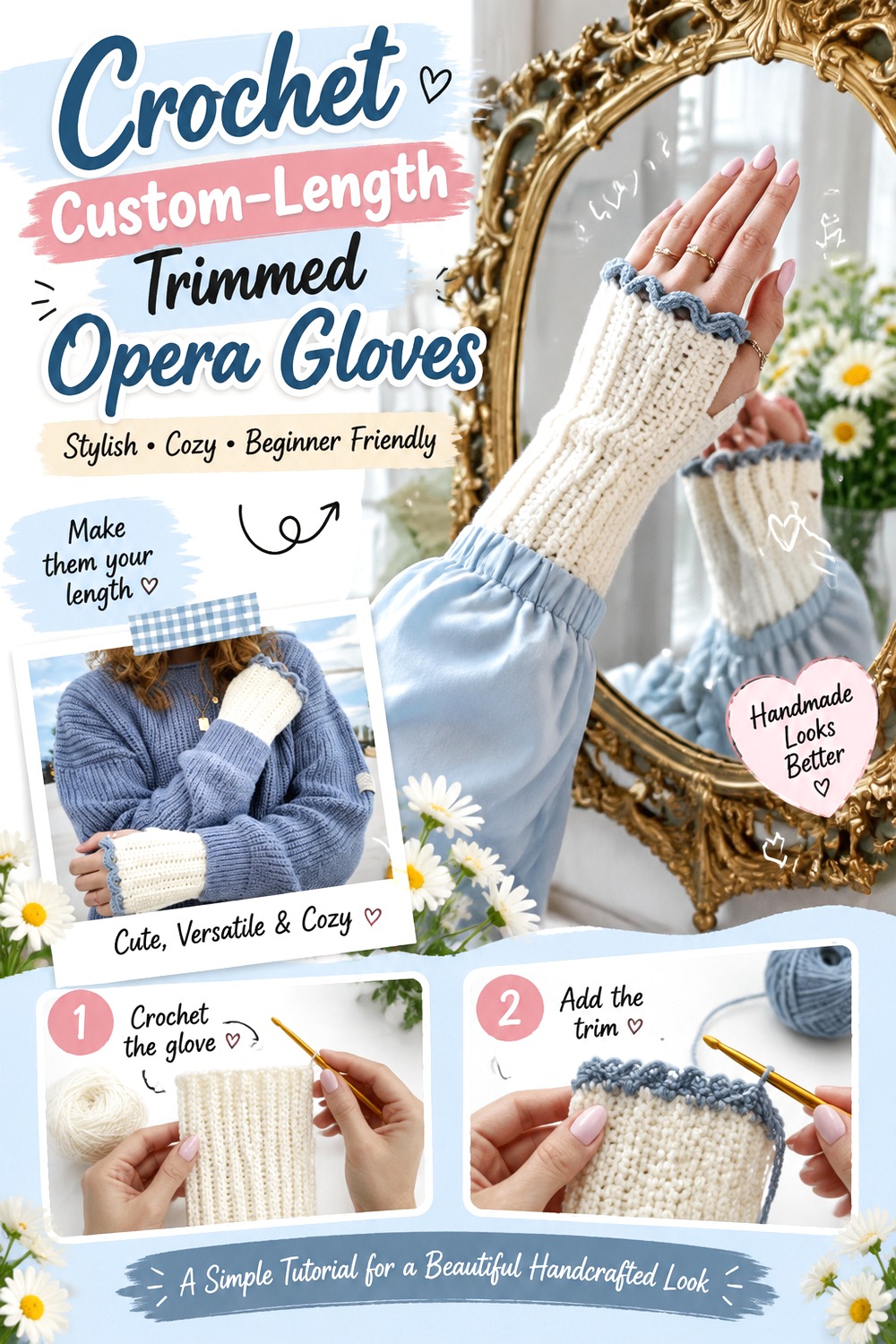
Savannah Fletcher’s fingerless-glove tutorial is particularly relevant to opera-length adaptation because the project is described as modifiable into longer arm warmers.
That gives this idea a flexible design role. You can keep the finished glove restrained, use contrasting edging, or treat the longer forearm as space for carefully planned color changes. The important distinction is that customization should follow fit rather than replace it. Establish how the hand, thumb, wrist, and upper forearm work together first; decorative borders are easier to place once those proportions are stable.
Add Length Before You Commit to the Border
Decorative edging can change stretch and visual proportion at the end of a glove.
Work out the desired stopping point first and try the plain glove on. Once the length and circumference feel appropriate, decide whether a contrasting trim should emphasize the upper edge or remain a quiet finishing detail.
Changing Stitch Texture Means Rechecking Width
A customization can alter more than appearance. Switching from a flexible stitch to a denser or more open one changes the behavior of the fabric.
If you redesign the added forearm section, measure and try it independently rather than assuming the original glove dimensions still apply.
Use Color Changes to Mark Structure Deliberately
A contrast section can visually divide hand, wrist, and forearm.
If that is your goal, position the color transition where it supports the silhouette rather than making changes at arbitrary intervals. Compare both gloves in worn orientation so the transitions line up intentionally.
Original Tutorial and Creator Credit
Creator: Savannah Fletcher
Crochet Bow Accent Balletcore Opera Gloves
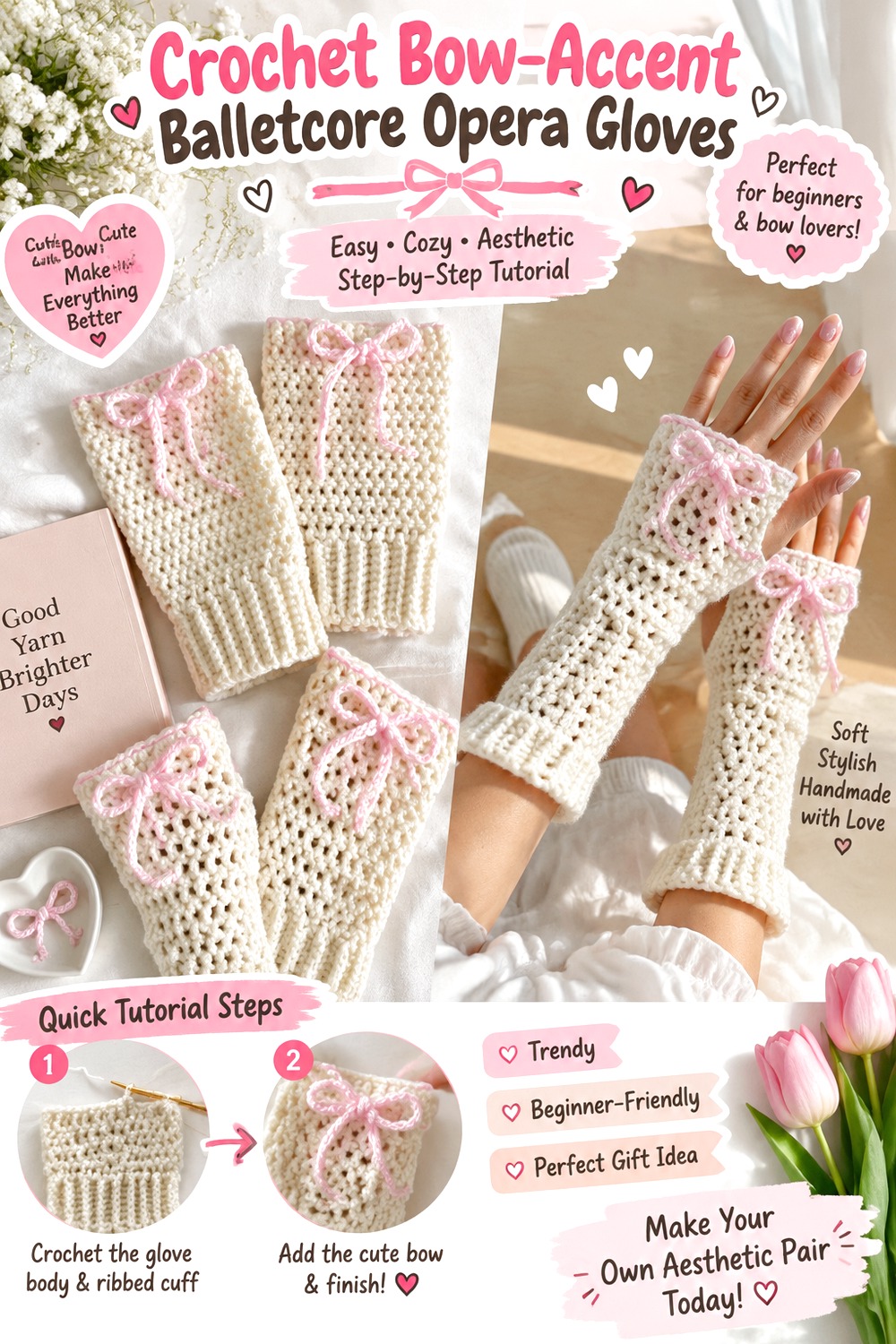
A bow changes the personality of a long crochet glove without requiring complicated all-over texture. Mahum’s tutorial combines fingerless gloves with matching accessory styling and visible bow details, providing a playful reference for a balletcore-inspired opera version.
For a much longer glove, the main question becomes placement. A single bow near the hand keeps the accent concentrated, while a bow at the upper forearm draws attention to the opera length itself. Repeating bows can create a stronger statement, but too many attachments may interfere with sleeves, bags, or ordinary hand use.
Position the Bow After Testing Real Hand Movement
Before attaching a decorative element permanently, wear the plain glove while carrying a bag, bending the wrist, and moving the thumb.
An embellishment placed on a high-friction surface may quickly become inconvenient. The back or outer side of the glove often provides more visual exposure, but the best location depends on the finished construction and how you plan to wear it.
Keep the Base Glove Responsible for the Fit
A bow should decorate the glove, not hold a loose glove in position.
Resolve wrist looseness or upper-edge slipping in the underlying construction first. That allows the accent to keep its shape without being pulled or distorted by structural tension.
Opera Length Changes the Scale of a Small Accent
A small bow that looks prominent on a short glove can appear much quieter once the forearm section becomes dramatically longer.
View the whole glove before deciding whether to resize, repeat, or reposition the accent. Balance matters more than filling every available section with decoration.
Original Tutorial and Creator Credit
Creator: mahum 🎀
Crochet Soft Vintage Lace Opera Gloves
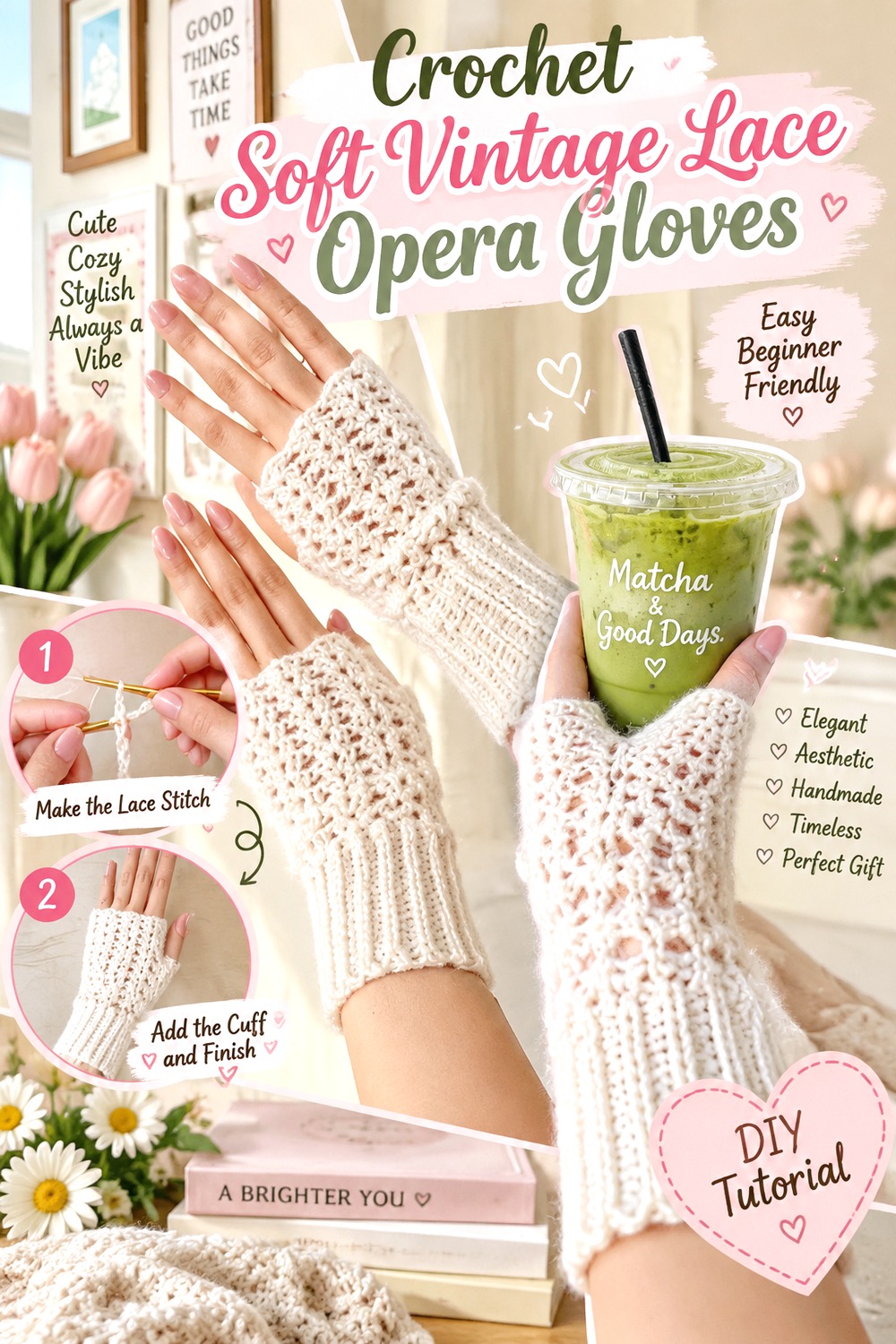
Mucie Studio’s lace fingerless gloves provide a delicate, vintage-looking source for an opera-glove adaptation. The tutorial itself teaches lace fingerless gloves rather than an already elbow-length pair, so the additional forearm needs its own fit planning.
What makes this direction useful is the contrast between a more stable cuff area and lighter lace. You do not necessarily need to repeat the most decorative fabric over the entire arm. A restrained lower section with a longer lace panel can create a more balanced vintage silhouette while allowing different parts of the glove to perform different jobs.
Judge Lace While It Is Stretched on the Arm
Openwork changes appearance when worn. Holes that look small and even on a table can become much larger around a fuller forearm.
Try the lace at its intended circumference before deciding how far to extend it. The goal is not only to make the glove fit but also to preserve the visual proportions of the lace.
Use Solid Sections to Control Visual Density
An opera glove made entirely from ornate lace can be beautiful, but it can also become visually busy.
Consider letting a plain cuff or calmer transition section frame the openwork. This provides contrast and can prevent every inch of the glove from competing for attention.
Finish Both Lace Panels at Matching Motif Points
Repeated openwork creates obvious visual landmarks.
When making the second glove, compare where prominent repeats finish near the upper edge. Matching the overall pattern position can make the pair look more deliberate even when minor tension differences remain.
Original Tutorial and Creator Credit
Creator: Mucie Studio
Crochet Starlight V Stitch Opera Gloves
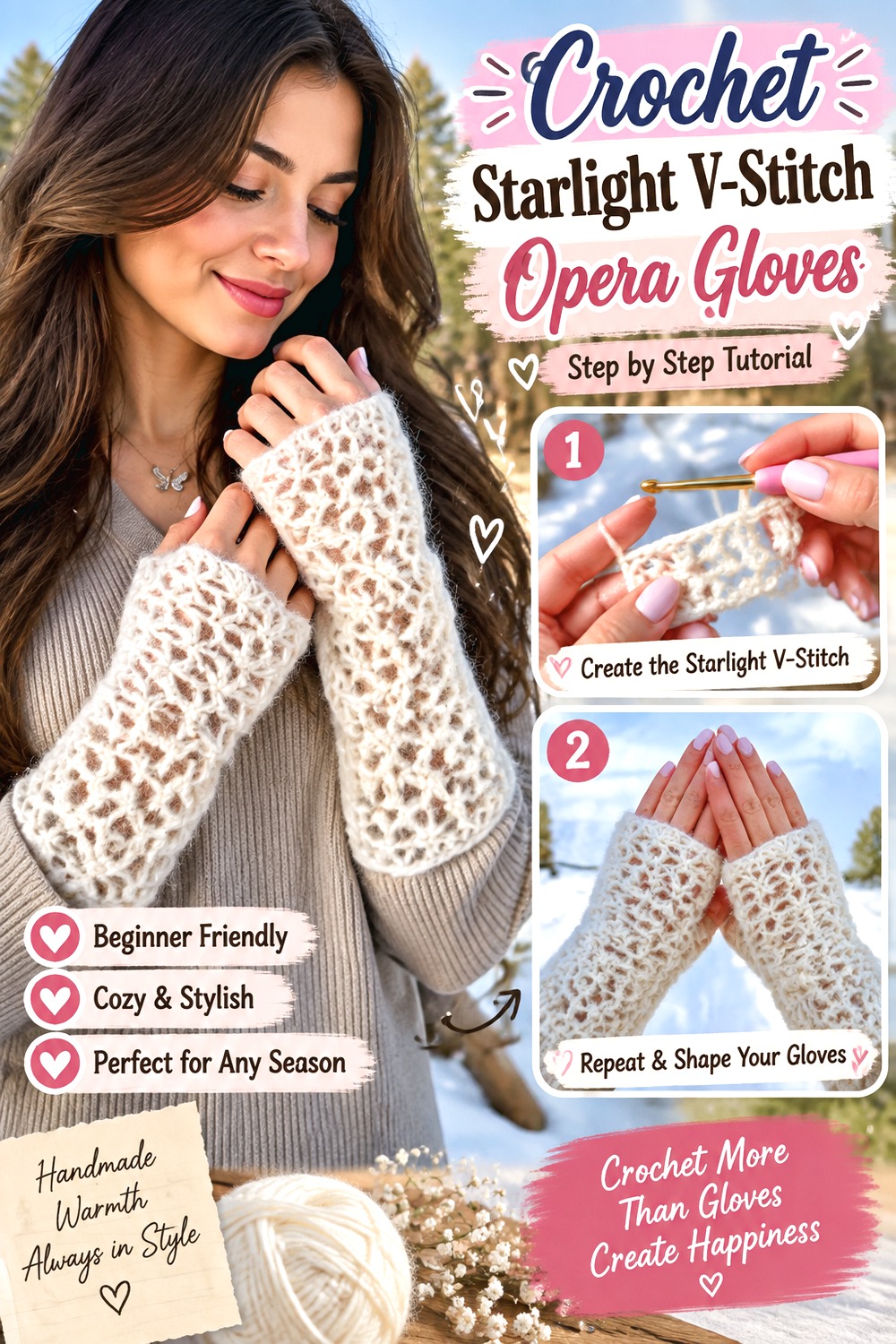
HookedOnViktoriya’s Starlight hand-warmer design offers a more geometric form of lace, using an airy openwork appearance rather than dense vintage texture. The creator’s channel identifies the project as a Starlight lace fingerless-glove tutorial.
For opera length, this direction works when you want plenty of negative space without moving into a true fishnet look. The regular V-shaped appearance can create a lighter silhouette, but any circumference adjustment needs to respect the visible repeat. A sudden change is likely to be more noticeable in structured lace than in plain crochet.
Protect the Shape of the Open V-Stitch
Openwork should not have to stretch so aggressively that the recognizable repeat disappears.
Check how the fabric looks around the widest section of your forearm. If the V shapes become dramatically distorted, reconsider width instead of relying on additional stretch.
Treat Decorative Edging as a Destination
A shell-like or decorative edge naturally tells the eye that the glove has finished.
Choose the final opera length before adding a strong upper border. Relocating the same decorative concept higher on the arm may also change how much it flares because the circumference is different there.
Keep the Thumb Zone Less Crowded
The thumb and wrist are high-movement areas.
If you extend or customize the lace, avoid adding excessive decoration around that region merely to keep the entire glove visually consistent. A cleaner hand transition can improve mobility while the longer forearm carries the main lace statement.
Original Tutorial and Creator Credit
Creator: HookedOnViktoriya
Crochet Victorian Inspired Opera Gloves
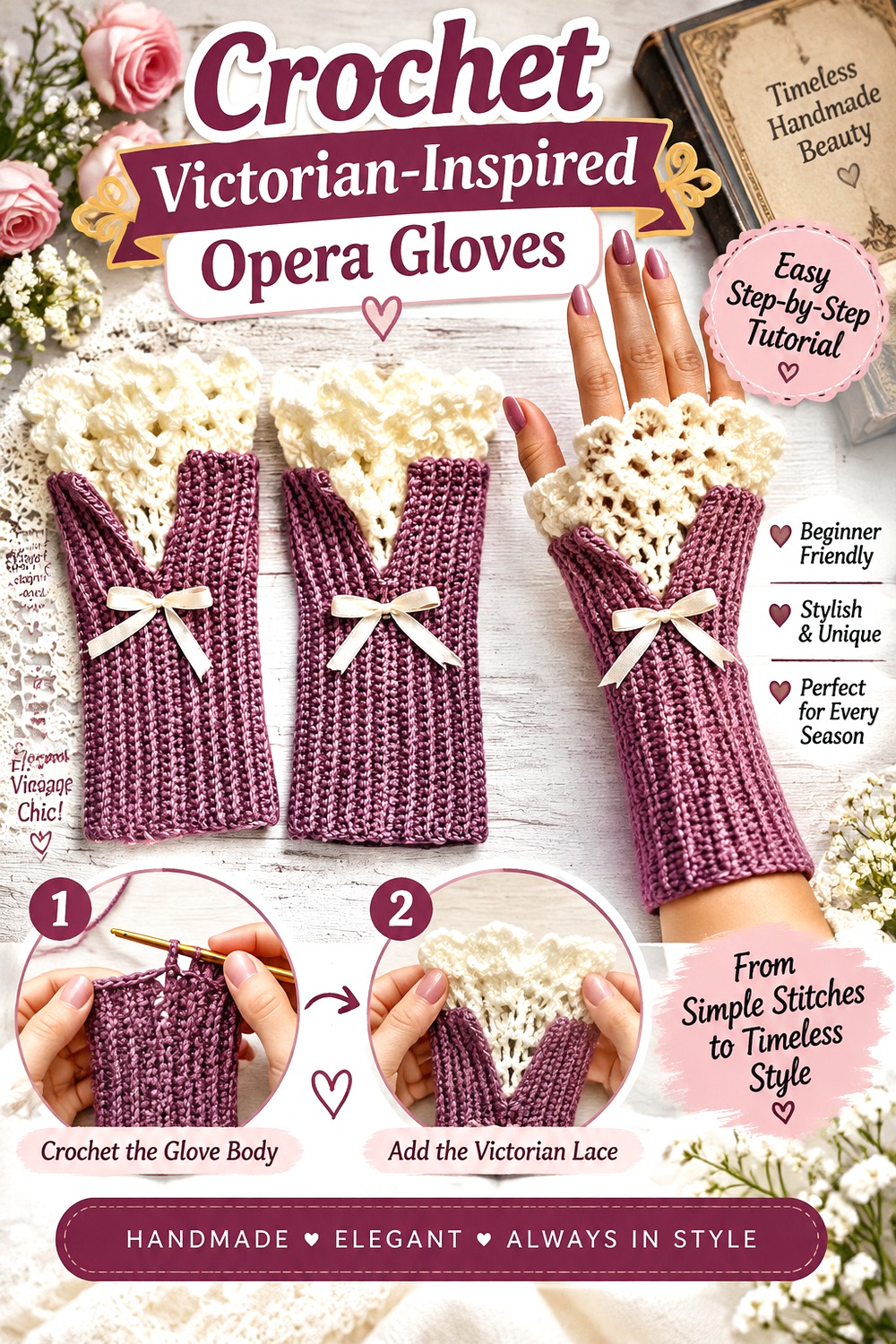
Ooty knitting and crochet’s Victorian-style vintage fingerless-glove tutorial gives this idea a distinctly historical-romantic starting point. The source is a shorter glove, so a full opera-length forearm should be planned as an adaptation.
Unlike a plain lace glove, the success of this version depends on overall proportion and styling. Decorative cuffs, edge treatments, and vintage details can establish the character without covering the entire arm in ornament. That restraint can be useful when the gloves will accompany ruffled sleeves, jewelry, a period-inspired dress, or costume accessories.
Build the Vintage Look Around Focal Areas
Historical-inspired styling does not require decoration everywhere.
Choose whether the hand, wrist, or upper edge will carry the strongest detail. Leaving some calmer fabric between focal points can make those features easier to see and keep a long glove from becoming visually overloaded.
Check the Gloves Beside the Intended Sleeves
A decorative glove may look perfectly balanced on a bare arm but crowded beside lace, cuffs, or jewelry.
Try the developing piece with the clothing you plan to wear. This lets you see whether the upper edge should move higher, lower, or become simpler before the second glove is completed.
Keep Embellishment Consistent With the Long Silhouette
As a glove becomes longer, a very wide cuff can occupy more visual space than expected.
View the entire piece rather than judging individual details close up. If one border dominates the silhouette, reducing its visual weight can make the length feel more elegant.
Original Tutorial and Creator Credit
Creator: Ooty knitting and crochet
Crochet Scalloped Flower Opera Gloves
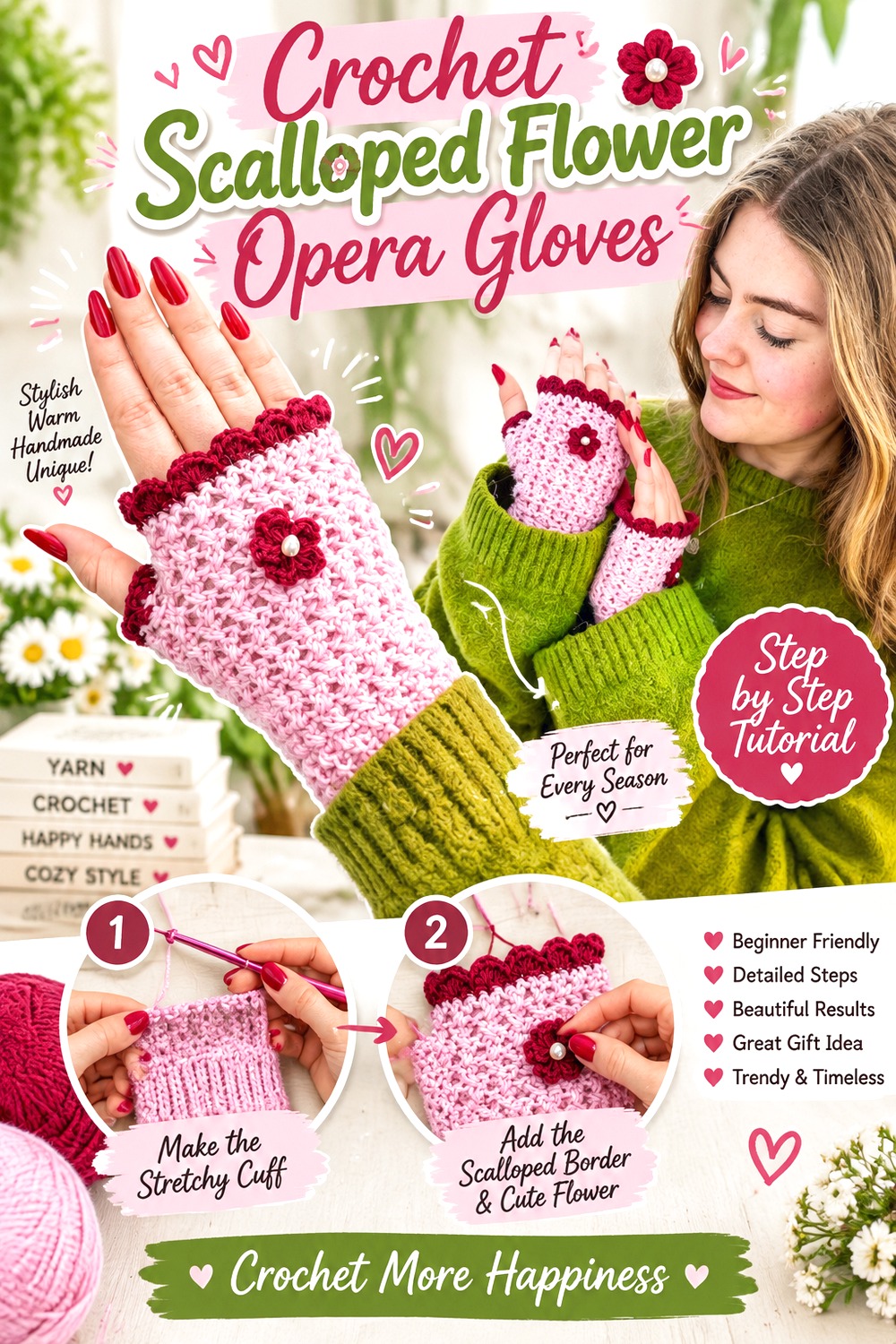
Crochet with Linni’s fingerless-glove tutorial combines lace-like crossed texture, a scalloped border, and a small decorative flower. That combination gives an opera-length adaptation several possible focal points without forcing the same ornament over the entire forearm.
Because the original gloves are shorter, decide which features should remain around the hand and which, if any, should travel upward. A simple extension can make the flower and scalloped edge more noticeable, while repeating every detail may produce a busier statement glove.
Keep the Flower Away From Constant Friction
Wear the undecorated glove and notice where your bag strap, desk, sleeves, or opposite hand regularly touch it.
Attach a dimensional flower where it can remain visible without being crushed constantly. Placement should follow real use instead of symmetry alone.
Decide Whether Scallops Belong at the Hand or Upper Arm
A scalloped border creates a clear silhouette change.
On a longer adaptation, you can preserve it near the original glove edge or reinterpret the idea at the opera-length ending. If moving a decorative border, check how it behaves around the larger upper-forearm circumference before making both gloves.
Crossed Texture Makes Pair Alignment More Noticeable
A patterned surface gives the eye more reference points than plain crochet.
Compare the two gloves with the thumbs positioned correctly and check where major texture sections begin and finish. That is more reliable than comparing two pieces that happen to be lying in opposite orientations.
Original Tutorial and Creator Credit
Creator: Crochet with Linni
Crochet Full Finger Mesh Opera Gloves
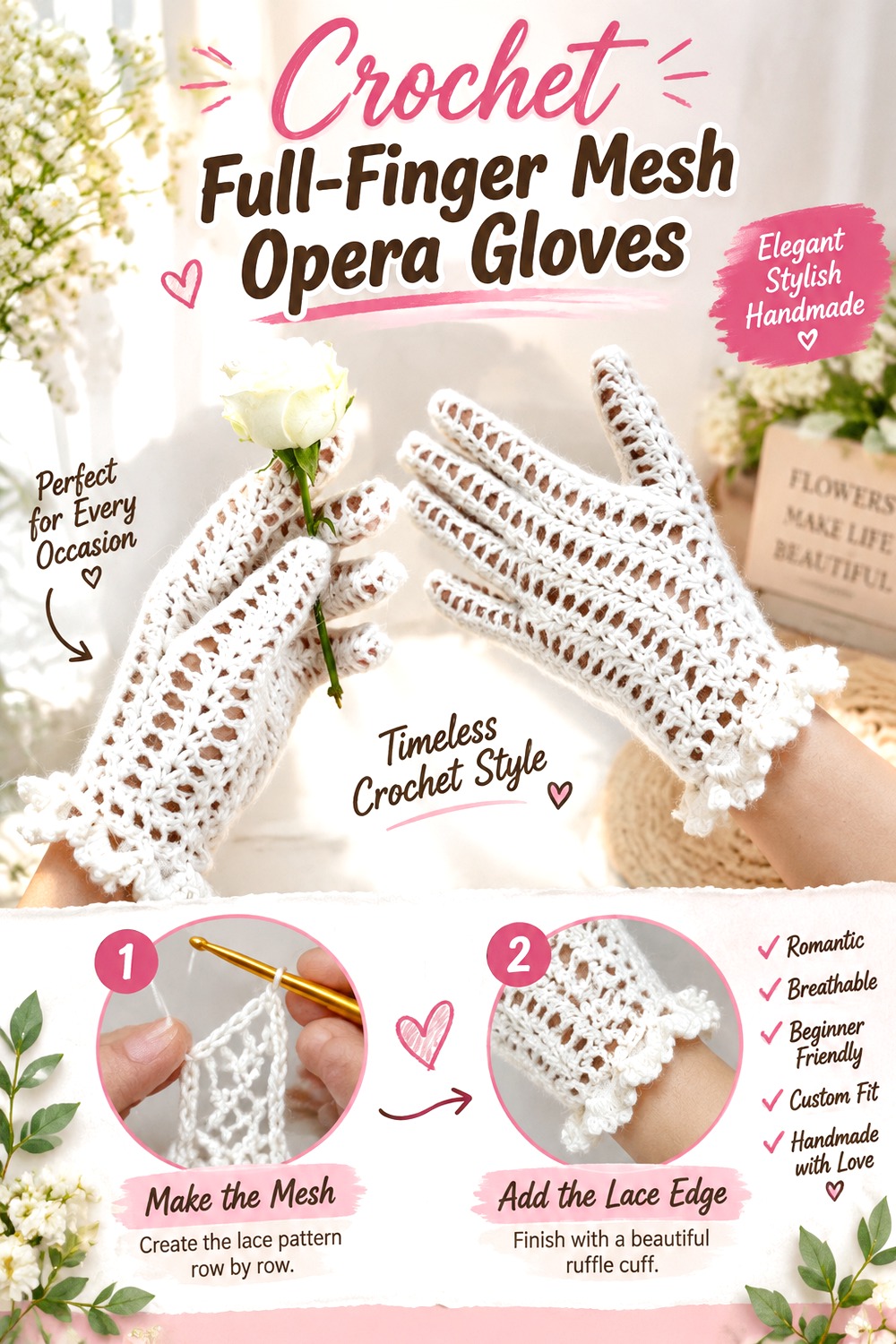
Most crochet opera-glove ideas in this collection are fingerless, which makes DIYGuru’s mesh glove tutorial an important structural alternative: the source includes individual fingers and a lace edge rather than stopping at the knuckles.
Extending a full-finger glove toward opera length creates a more traditional glove-like silhouette while retaining visible crochet texture. The hand is substantially more fitted and complex than a simple thumb-hole warmer, so establish that section from the tutorial before making independent changes to the forearm. This style is useful for formal, costume, retro, or theatrical looks where additional hand coverage matters.
Finger Fit Comes Before Forearm Drama
Individual fingers create several fit points that do not exist in a standard fingerless tube.
Follow the creator’s glove construction for those areas and move your fingers naturally before concentrating on opera length. A beautiful forearm extension cannot compensate for uncomfortable finger openings or a hand section that twists.
Mesh Expansion Should Stay Even Across the Hand
Open fabric can look very different across narrow fingers, the palm, and the wider forearm.
Judge each zone in its worn state. If the mesh opens dramatically in one section but remains compressed elsewhere, the visual transition may be more noticeable on a full-finger glove than a simpler warmer.
Relocate Lace Edging Only With Care
The source includes a lace edge as part of its finished appearance. If you use the concept at a much higher opera-length boundary, remember that the new circumference is different.
Test the proposed border before committing to both gloves. A finish that sits neatly at one position may flare more noticeably somewhere else.
Original Tutorial and Creator Credit
Creator: DIYGuru
Crochet Shell Stitch Opera Gloves
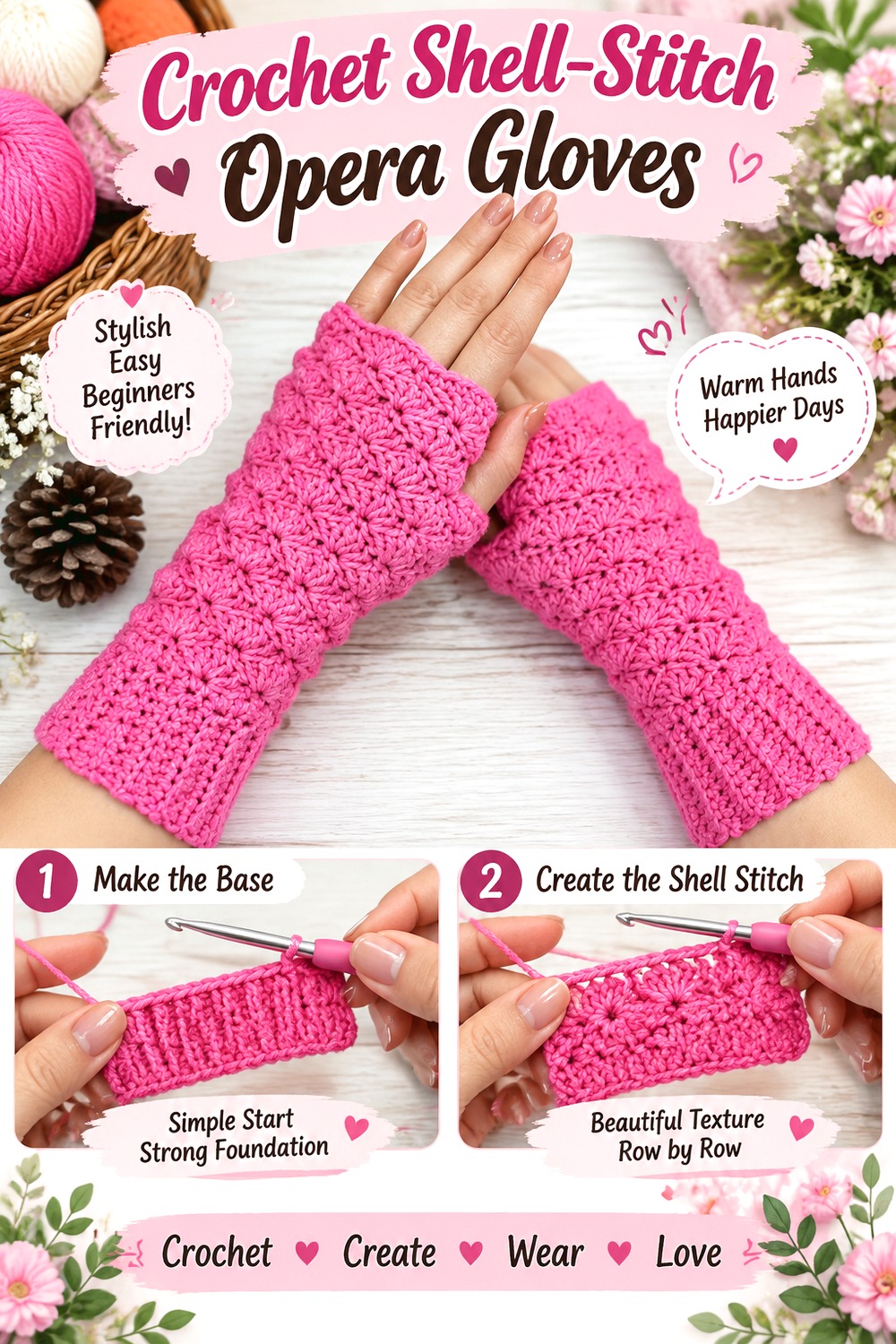
Crochet with GG’s shell-stitch fingerless gloves introduce a repeated decorative cluster pattern rather than separate embellishments. The channel identifies the design as a shell-stitch fingerless-glove tutorial.
For opera length, shell texture can create a rhythmic ornamental forearm, but repeating it over a much larger area also changes the visual weight of the glove. A shell-filled hand with a calmer extension is one option; continuing the texture upward creates a more elaborate result. Whichever approach you choose, the source glove should remain the construction reference for the portion it actually teaches.
Shells Can Create More Apparent Width
Grouped stitches may make an area look fuller than a narrow ribbed surface.
Before covering a long forearm in the same texture, hold the fabric against your arm and view it from a distance. The stitch may be exactly what you want for a romantic statement or more volume than expected for a sleek formal silhouette.
Give the Wrist Enough Visual Control
The wrist is usually narrower than the hand and upper forearm.
If a shell pattern naturally creates flare, use the source’s structural logic as your guide and avoid adding decorative fullness where you actually want a close transition. A defined wrist can give a long textured glove more shape.
Finish at a Complete Shell Boundary
A recognizable repeat looks cleaner when the glove ends at a logical part of the motif.
When choosing opera length, compare nearby stopping positions instead of forcing the exact first measurement you wrote down. A modest difference in length may be worthwhile if it gives the upper edge a cleaner patterned finish.
Original Tutorial and Creator Credit
Creator: Crochet with GG
Crochet Autumn Leaf Textured Opera Gloves
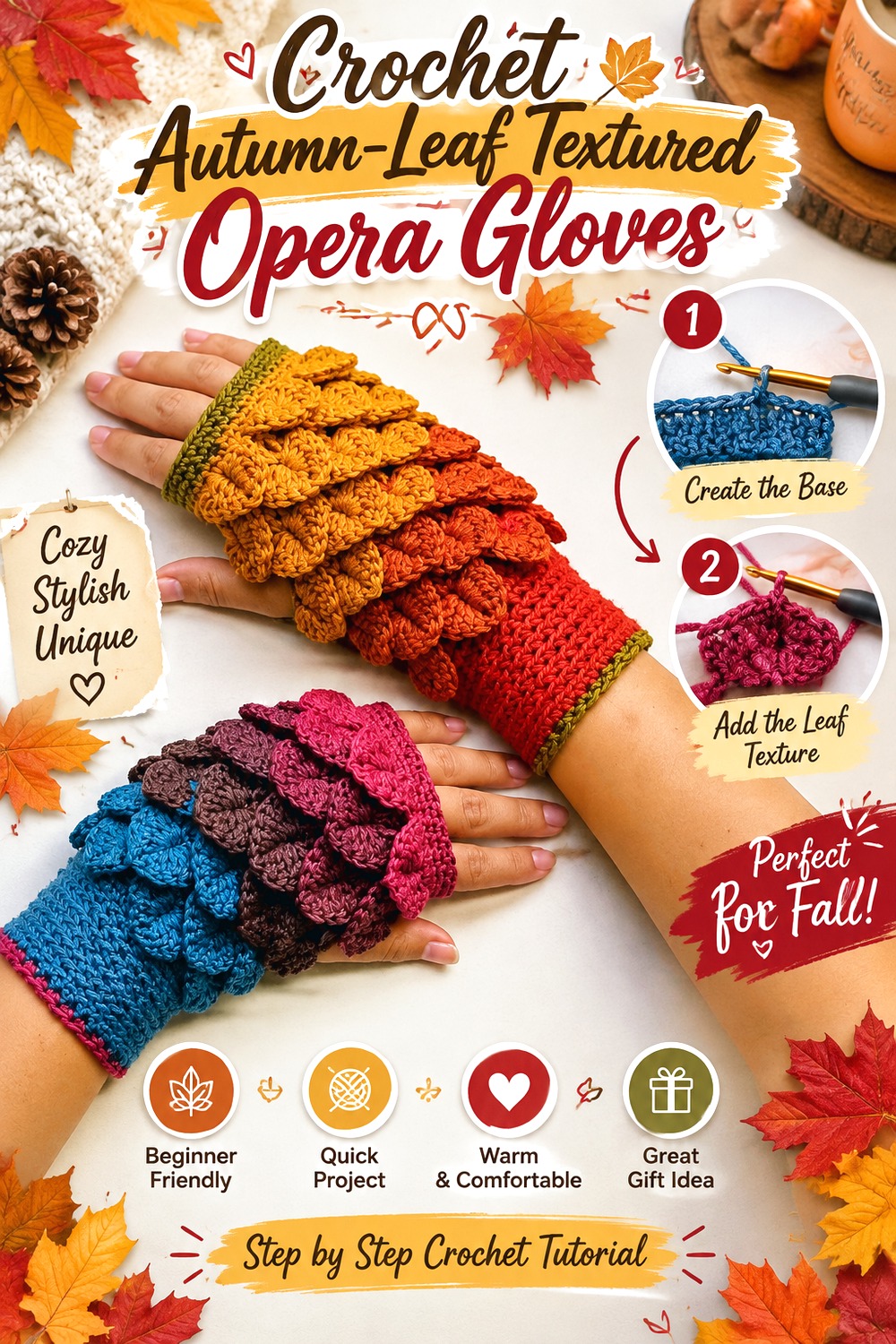
Bag-O-Day Crochet’s Autumn Leaves fingerless-wrister tutorial provides a directional botanical texture that is very different from flowers sewn onto the surface. The source specifically identifies the project as Autumn Leaves fingerless wristers.
For an opera-length version, the leaf-inspired section can remain concentrated near the hand or become a controlled decorative panel along the forearm. That may be more visually effective than repeating a strong texture everywhere. Because the source is a wrister rather than an elbow-length glove, any extended section should be planned independently.
Choose a Specific Zone for the Leaf Detail
A directional motif can become more effective when it has room around it.
Consider keeping the strongest leaf texture around the back of the hand, lower forearm, or one vertical section rather than automatically filling the entire glove. A calmer surrounding fabric can frame the motif and reduce visual crowding.
Make the Leaf Direction Deliberate on Both Arms
Organic motifs often have an obvious direction.
Before finishing the second glove, put both pieces in their worn positions and compare the orientation. Decide whether you want identical direction or a mirrored pair; either can work better than an accidental mismatch.
Do Not Let Decorative Density Override Stretch
A textured hand section may behave differently when repeated over the fuller forearm.
Check the actual extension before committing to a long field of motifs. If the stitch loses definition or becomes uncomfortable when stretched, a compatible simpler section can preserve the decorative idea without forcing it beyond its useful range.
Original Tutorial and Creator Credit
Creator: Bag-O-Day Crochet
Crochet Fishnet Evening Opera Gloves
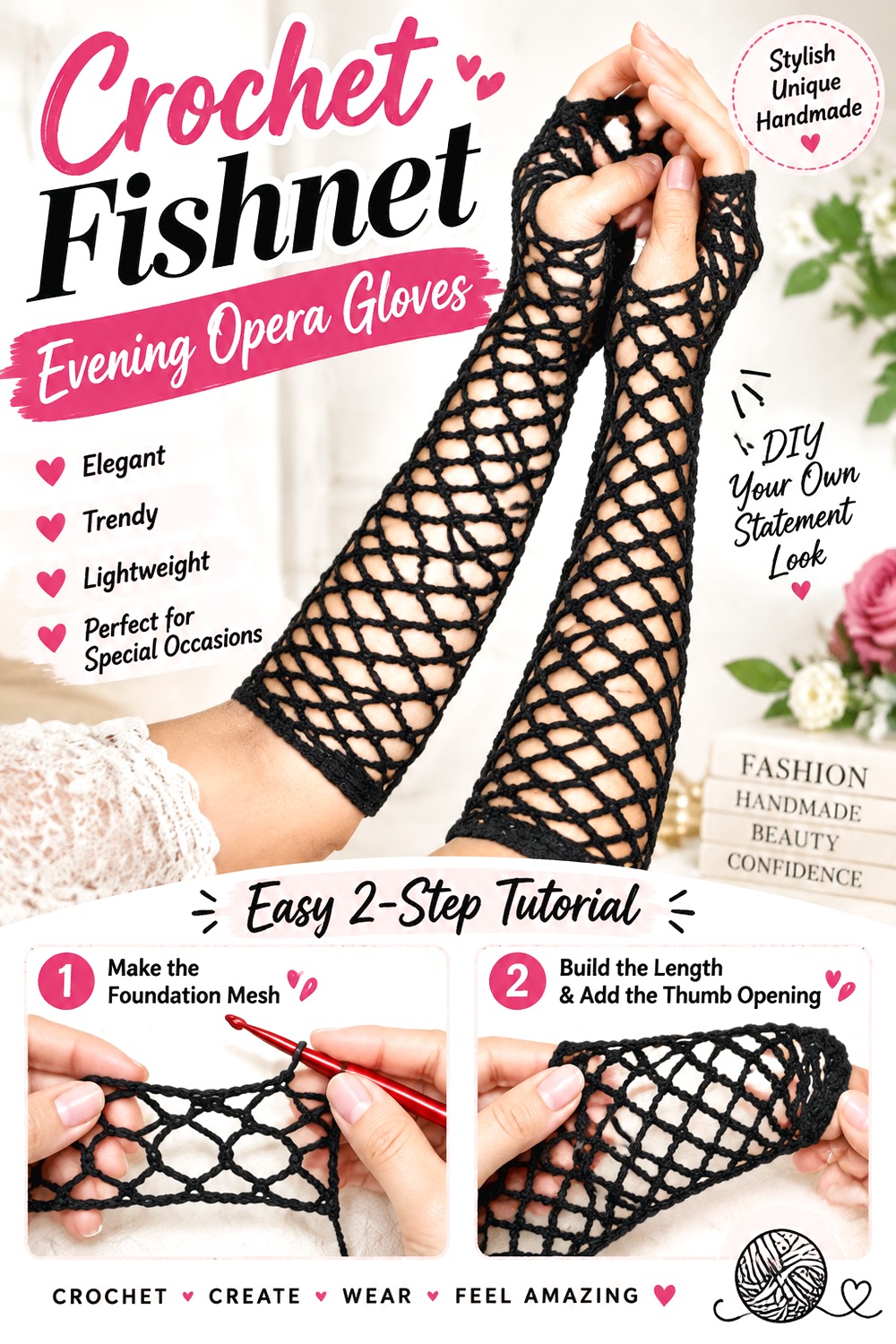
Diving Ducks Crochet’s fishnet fingerless-glove tutorial is one of the strongest direct matches for a fashion-focused opera glove because the creator describes the project as long fingerless gloves in a fishnet pattern.
Compared with lace, ribbing, or raised texture, fishnet places much more emphasis on negative space and the shape of the arm underneath. It can suit evening outfits, alternative styling, costumes, festival clothing, or any look where coverage is less important than a dramatic open silhouette. Because mesh openings visibly expand with tension, fit should be judged on the arm rather than from flat measurements alone.
Watch the Size of the Openings at Different Circumferences
Fishnet mesh can expand noticeably as it moves from wrist to forearm.
Try the glove at several heights and compare the openings. Ideally, the mesh should still look deliberate rather than compressed at the wrist and dramatically stretched higher up.
Let the Whole Forearm Support the Glove
A tight upper edge should not be the only thing preventing a long mesh glove from slipping.
If the body is excessively loose, tightening the top can create a harsh band without solving the underlying shape. Check taper and general fit before relying on the finish for stability.
Keep the Two Mesh Patterns Visually Consistent
Long fishnet fabric gives the eye many openings to compare.
Periodically place the gloves together and check relaxed length, thumb location, opening distribution, and upper width. Small tension changes that might disappear in dense crochet can be much easier to see in a repeated open grid.
Original Tutorial and Creator Credit
Creator: Diving Ducks Crochet
Which Crochet Opera Glove Direction Fits Your Style?
| If you want | Ideas to compare | Main decision |
|---|---|---|
| A clean long silhouette | 1, 2, 4, 5, 6 | Forearm taper, recovery, and final length |
| Strong dimensional texture | 3, 14, 15 | Bulk, repeat placement, and stretch |
| Soft decorative details | 7, 8, 12 | Trim or embellishment placement |
| Romantic or vintage openwork | 9, 10, 11 | Lace distortion, edging, and visual density |
| More complete hand coverage | 13 | Finger fit before forearm adaptation |
| Dramatic open mesh | 16 | Even mesh expansion and upper-edge stability |
Already-long tutorials are the simpler choice when you want the source proportions to address more of the forearm from the beginning. Shorter decorative gloves make sense when a particular lace, botanical motif, flower, shell, or vintage hand treatment matters enough to justify extra sizing work.
Conclusion
The most useful crochet opera glove choice starts with construction rather than decoration. Choose long ribbed or minimalist arm warmers when you want the extended silhouette to be the main feature. Lace, shells, flowers, bows, Victorian details, and botanical textures offer more visual character but require closer attention to repeat placement and how the fabric changes as the arm widens. Full-finger mesh gives more hand coverage, while fishnet provides the most open, fashion-driven result.
When adapting a shorter source, establish the hand and thumb fit first and treat the extra forearm as a separate sizing decision. Use the original tutorials near the end of your planning process for their exact construction details rather than trying to recreate those instructions from a roundup.
Frequently Asked Questions
How long should crochet opera gloves be?
There is no universal required length for a crochet opera glove. The upper edge can finish along the forearm or approach the elbow depending on the silhouette you want. Decide where it should sit while wearing the clothing you plan to pair with it, then test your elbow and wrist movement. The most useful length is one that creates the intended look without causing excessive bunching or restricting normal arm movement.
Can I extend any fingerless-glove tutorial to opera length?
Not automatically. A short glove may provide a workable hand, thumb opening, cuff, or decorative stitch, but the forearm introduces changing circumference. Check whether the stitch pattern can accommodate that change without severe stretching or obvious distortion. Decorative repeats may also limit where width adjustments can be made. Treat the added forearm as a new sizing problem rather than simply continuing the original project indefinitely.
How do I stop long crochet gloves from sliding down?
Start by checking the fit of the entire forearm instead of tightening only the upper edge. A glove that is very loose through the body may still slide even with a tight border. Fabric recovery, gradual taper, and the upper circumference all influence stability. Try the glove while moving your arm before finishing. Avoid creating an excessively tight top band just to compensate for an otherwise loose construction.
Which is better for opera gloves: ribbing, lace, or fishnet?
They serve different goals. Ribbing is useful when stretch and a closer silhouette matter. Lace creates decorative coverage with visible skin showing through, while fishnet makes negative space an even stronger part of the design. None is automatically better. Compare how the fabric stretches, whether the stitch retains its shape at the fuller forearm, and how much visual or physical coverage you actually want.
Should I block crochet opera gloves before wearing them?
Blocking may help even out stitches or open decorative lace, but the correct method depends on the yarn and construction. Check the yarn’s care information before using water, steam, heat, or aggressive stretching. For fitted opera gloves, avoid stretching the fabric so much during finishing that it loses the recovery needed to remain comfortably positioned on the arm.
How can I make two long crochet gloves match more closely?
Compare the second glove directly with the first throughout the project instead of relying only on remembered counts or visual guesses. Useful physical checkpoints include overall relaxed length, thumb position, wrist level, upper width, motif alignment, and the point where decorative sections begin and end. For lace, fishnet, flowers, leaves, or shells, compare the pieces in their worn orientation because directional details can look different when one glove is turned over.
Can I add bows, flowers, beads, or other embellishments to crochet opera gloves?
Yes, but placement matters more on a long wearable. First make sure the undecorated glove fits properly. Then position embellishments away from high-friction areas or places where they interfere with thumb, wrist, or sleeve movement. Added decoration can also affect the drape of soft fabric, so a few focused accents may work better than covering a lightweight glove with heavy attachments.