Plum Noir and Ivory create a fall curtain tieback palette with enough contrast to make delicate crochet lace visible without introducing several competing colors. Plum Noir can give the tieback its dark vintage anchor, while Ivory can open up shells, floral motifs, picots, medallions, and scalloped edges so their shapes remain easier to read against gathered curtains.
Curtain tiebacks are small projects, which makes color placement particularly important. A narrow Plum Noir border can influence the whole piece, while one Ivory flower may become the primary focal point once the band wraps around the curtain. The visible front section, closure ends, dangling tassels, and portions hidden behind the curtain should therefore have different color priorities.
The tutorial sources below teach curtain ties, floral tiebacks, holders, and related wraparound constructions. The Plum Noir and Ivory vintage-lace arrangements are independent color adaptations rather than claims about the creators’ original yarn colors or styling.
Quick List
- Plum Noir Lace Band with Ivory Flower Crochet Curtain Tieback
- Ivory Rose and Plum Noir Vine Crochet Vintage Curtain Tieback
- Ivory Openwork Band with Plum Noir Crochet Curtain Tieback Edging
- Plum Noir Floral Medallion and Ivory Lace Crochet Curtain Tieback
- Ivory Scalloped Lace with Plum Noir Flower Crochet Curtain Tieback
- Plum Noir Center Flower and Ivory Petal Crochet Curtain Tieback
- Plum Noir Wide Band with Ivory Lace-Edge Crochet Curtain Tieback
- Ivory Rose Cluster and Plum Noir Crochet Vintage Curtain Tieback
- Ivory Flower Chain with Plum Noir Cord Crochet Curtain Tieback
- Plum Noir Lace Wrap with Ivory Crochet Picot Curtain Tieback
- Ivory Floral Panel and Plum Noir Cord Crochet Curtain Tieback
- Plum Noir Accent Motifs and Ivory Crochet Lace Curtain Tieback
- Ivory Vintage Lace with Plum Noir Tassel Crochet Curtain Tieback
- Plum Noir Clasp Band with Ivory Crochet Lace Curtain Tieback
- Ivory Floral Vine and Plum Noir Crochet Lace Curtain Tieback
Decide Whether Plum Noir or Ivory Should Lead the Lace
For the strongest vintage contrast, decide which shade should occupy the largest continuous area. Plum Noir works well as the main band when you want Ivory shells, flowers, or scallops to stand forward. An Ivory-led band creates a lighter result in which smaller Plum Noir motifs can become surprisingly prominent.
Equal amounts are not necessary. On a small curtain accessory, a Plum Noir flower, border, and closure loop may supply enough dark color even when most of the lace remains Ivory.
Place Plum Noir and Ivory Where the Tieback Stays Visible
A curtain tieback changes shape once it wraps around gathered fabric. The center front is usually more noticeable than the portion hidden behind the folds, so reserve the strongest Plum Noir/Ivory contrast for the visible area.
Before finishing a pair, wrap one sample around the actual curtain. Check whether a flower rotates toward the side, whether an Ivory lace border disappears into pale fabric, and whether Plum Noir becomes too concentrated near the fastening point.
1. Plum Noir Lace Band with Ivory Flower Crochet Curtain Tieback

Use Plum Noir for the main wraparound band and place one substantial Ivory flower on the front-facing section. The dark background makes the lighter floral shape the immediate focal point while keeping the functional part of the tieback visually quiet.
Plum Noir Should Give the Crochet Lace Band a Continuous Base
Keep most of the band Plum Noir rather than alternating colors every few stitches. A continuous dark field lets openwork, shells, or textured sections read as one piece after the band curves around the curtain.
If the gathered curtain is already dark, test the Plum Noir against it before making the pair. The band may need a wider Ivory edge to remain distinct.
Ivory Flower Placement Should Stay Visible Against Plum Noir
Position the Ivory flower where it sits on the outer face of the gathered curtain. A flower attached too close to the end may rotate behind the fabric once the tieback is fastened.
Let Ivory repeat once more in a small edge or loop if the single flower looks disconnected from the rest of the band.
Creator Credit: zhaia croche
2. Ivory Rose and Plum Noir Vine Crochet Vintage Curtain Tieback
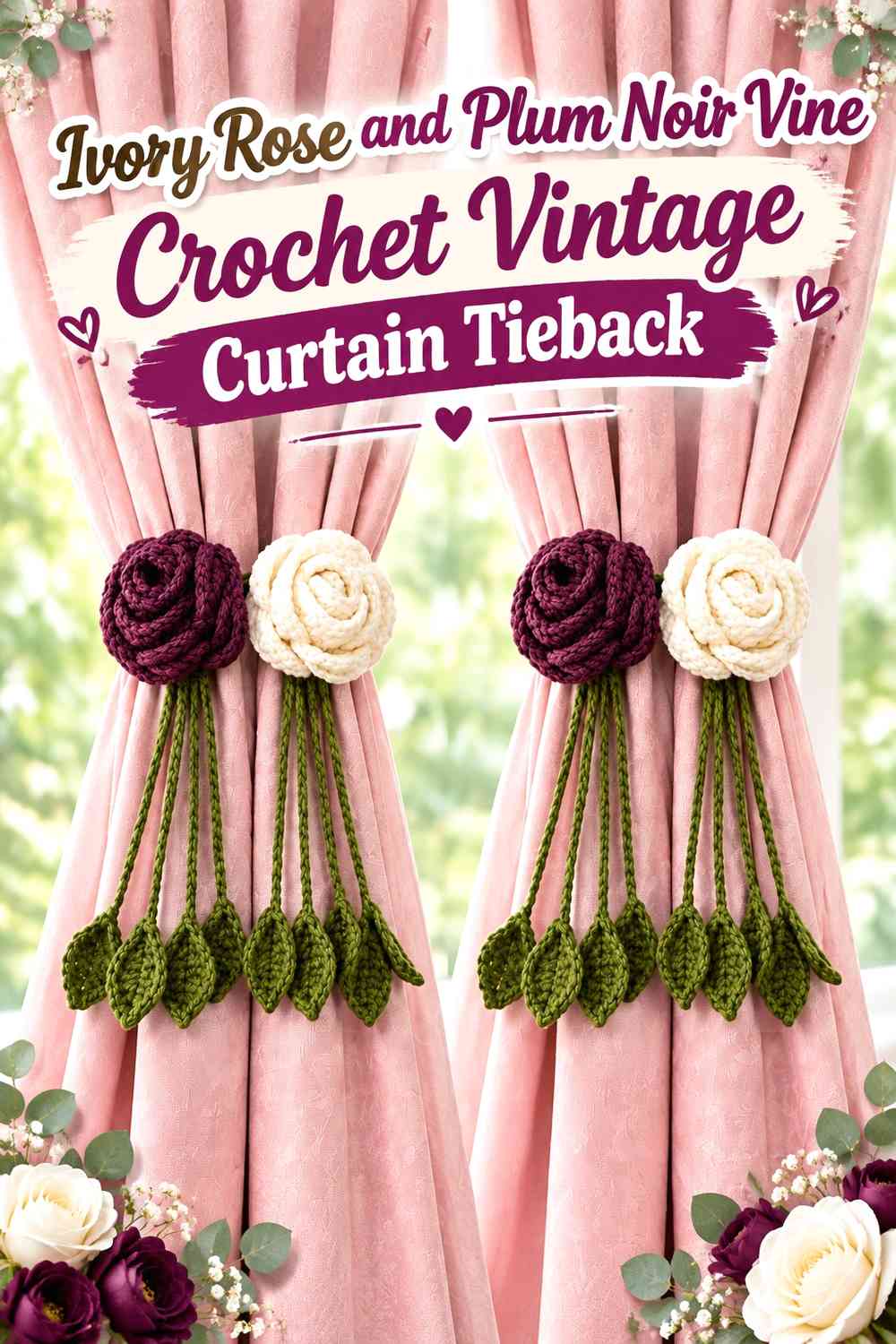
Make the floral portion Ivory and use Plum Noir for a vine-like connector, leaves, or narrow wrapping band. The result keeps the rose light while giving the surrounding structure enough darkness to create a vintage botanical effect.
Ivory Roses Need Plum Noir Separation in the Crochet Tieback
Several Ivory petals can visually blend when layered closely. A Plum Noir center, leaf, or small space between flowers helps define individual shapes without changing the basic two-color palette.
Avoid surrounding every Ivory petal with dark edging, which can make a delicate rose look more graphic than lacy.
Plum Noir Vine Details Can Link Separate Ivory Flowers
If the tieback contains more than one flower, let Plum Noir form the visual connection between them. The darker line can continue into the wraparound portion so the botanical decoration and functional band feel related.
Keep the vine narrow enough that Ivory remains the dominant floral color.
Creator Credit: 𝐊𝐧𝐢𝐭𝐭𝐢𝐧𝐠 𝐛𝐲 𝐖𝐚𝐣𝐢𝐝𝐚
3. Ivory Openwork Band with Plum Noir Crochet Curtain Tieback Edging
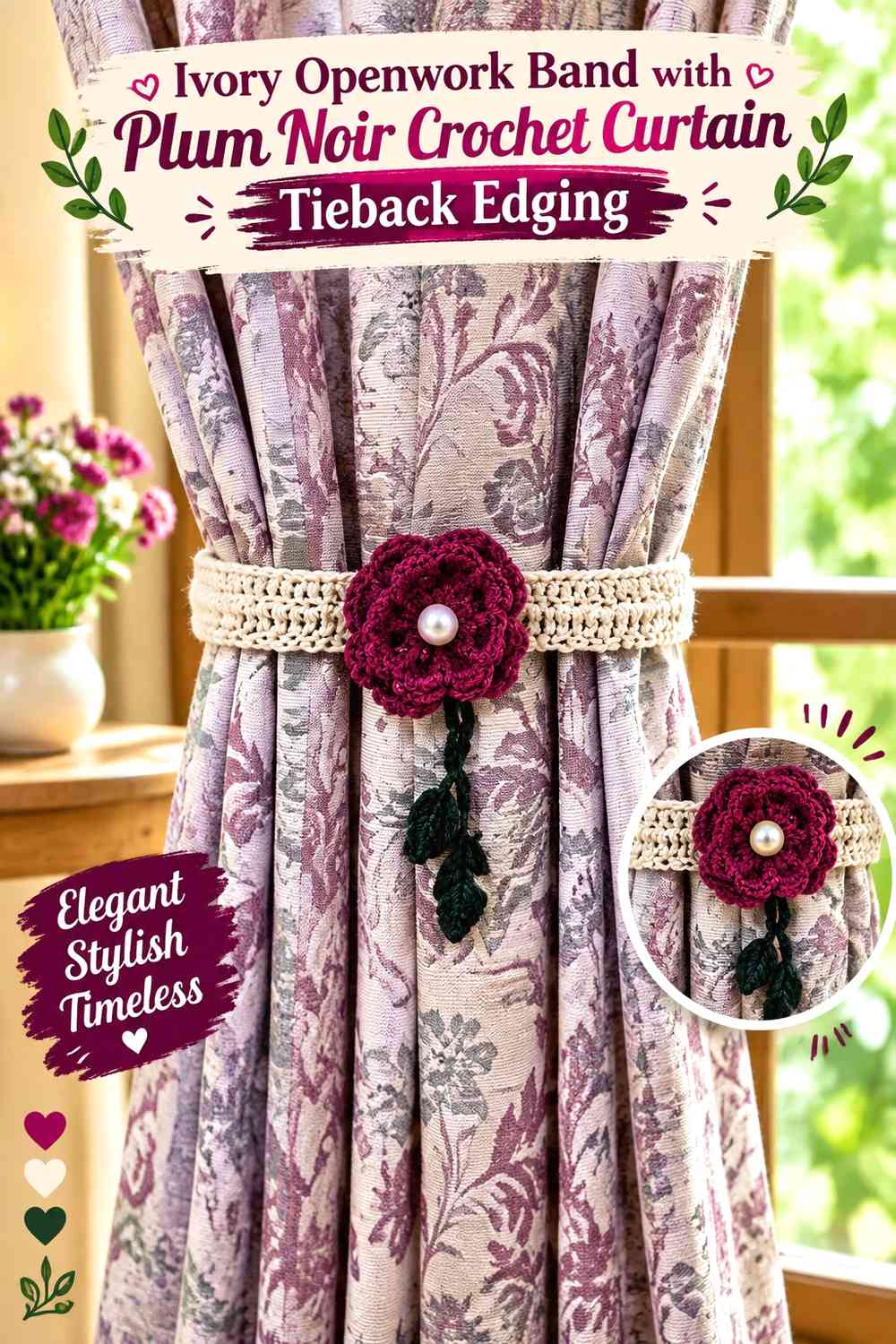
Let Ivory form the complete openwork center and reserve Plum Noir for the two long edges. This puts the light color inside the lace spaces while the darker shade gives the narrow band a defined outline.
Ivory Openwork Needs Enough Width Between Plum Noir Edges
If the Plum Noir borders are too wide, the Ivory center can shrink into a thin stripe. Leave enough central lace area for shells, mesh, or repeated openings to remain recognizable after the tieback wraps around the curtain.
A sample held around the gathered fabric will show whether the lace collapses visually when curved.
Plum Noir Edging Can Keep the Ivory Crochet Band Defined
Use the same dark shade on both long edges if you want a balanced vintage frame. An uneven border can be intentional, but a symmetrical treatment generally keeps the emphasis on the Ivory lace rather than the outline itself.
The closure loops can also be Plum Noir to connect function with the darker border.
Creator Credit: Seekhna seekhana
4. Plum Noir Floral Medallion and Ivory Lace Crochet Curtain Tieback

Place one Plum Noir floral medallion at the center of an Ivory lace band. This reverses the light-flower arrangement and gives a small amount of Plum Noir considerable visual weight.
Plum Noir Medallion Should Anchor the Ivory Crochet Lace
Keep the dark motif large enough to register once the curtain folds surround it. A very small Plum Noir center can disappear into the detailed lace instead of acting as the focal point.
Position the medallion only after determining which section of the Ivory band faces forward when wrapped.
Ivory Lace Should Stay Quieter Around the Plum Noir Flower
Use relatively consistent Ivory stitchwork immediately beside the medallion. Highly dimensional lace competing with a dimensional flower can make the small tieback visually crowded.
The Ivory band can become more decorative toward its ends, where those details sit farther from the focal motif.
Creator Credit: Kushi Crochet & embroidery
5. Ivory Scalloped Lace with Plum Noir Flower Crochet Curtain Tieback
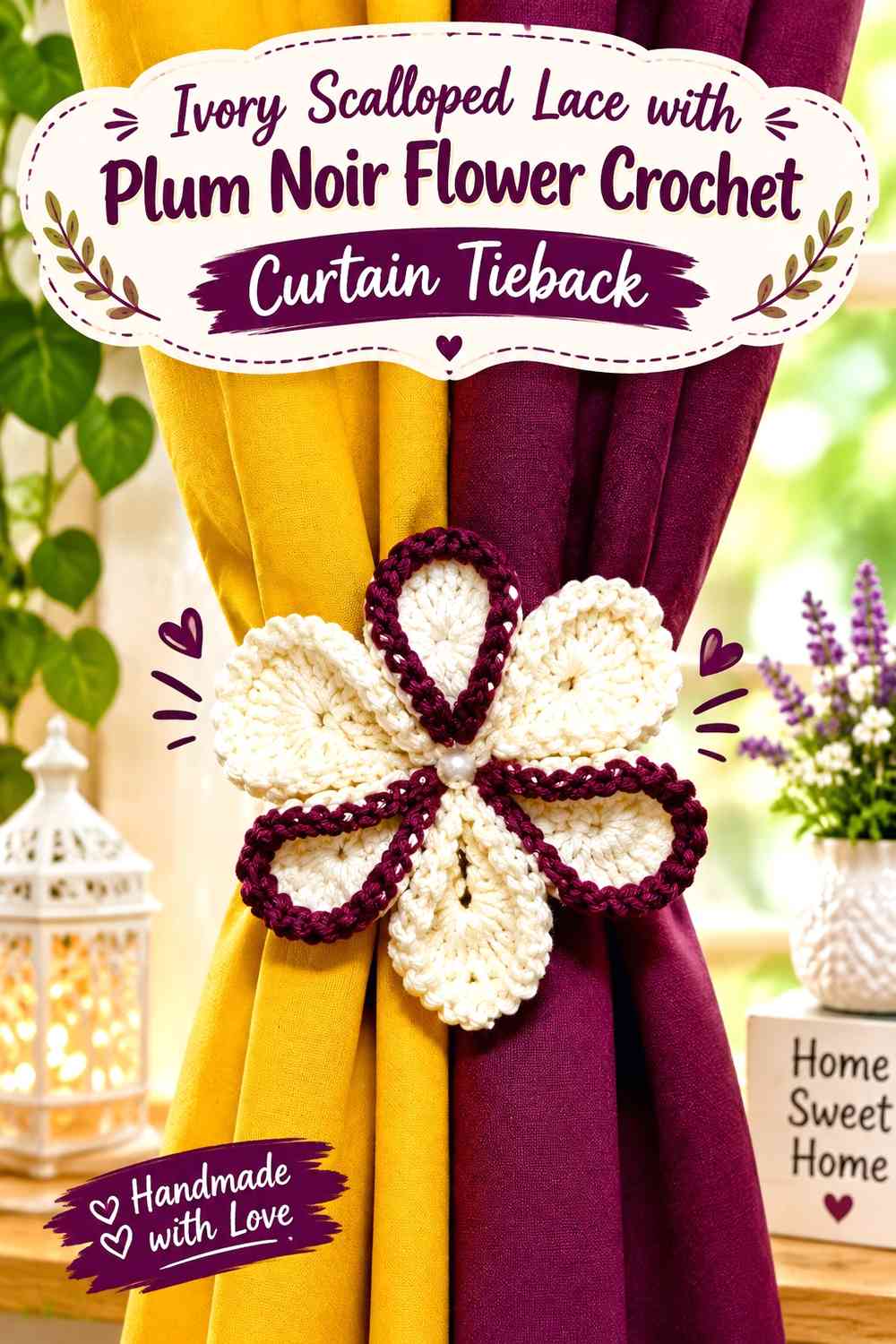
Use an Ivory band with a scalloped lower edge and one Plum Noir flower near the front. The light scallops create the antique-lace direction, while the dark flower prevents the tieback from becoming visually flat.
Ivory Scallops Should Remain Visible Around the Curtain Fold
Large scallops can curl inward when the band bends around thick fabric. Check their position on the gathered curtain and keep the decorative edge on the side where it remains visible.
If the curtain itself is Ivory or cream, Plum Noir outlining on selected scallops can add separation without darkening the whole band.
Plum Noir Flower Placement Can Balance the Ivory Crochet Scallops
Place the dark flower slightly above the decorative edge so the motif does not hide several scallops at once.
One Plum Noir flower may be sufficient. Adding several more dark motifs can shift attention away from the lace border that makes this version distinct.
Creator Credit: Crochetnook
6. Plum Noir Center Flower and Ivory Petal Crochet Curtain Tieback

Create a two-tone flower with a Plum Noir center and Ivory outer petals, then place it on a restrained Plum Noir or Ivory band. The small dark center gives the flower definition while leaving most of the motif light.
Plum Noir Centers Can Give Ivory Crochet Petals More Definition
Keep Plum Noir concentrated near the middle so the petals remain the dominant area. This is especially useful when Ivory petals overlap or contain several layers.
A broad dark center can make the motif look more like a colorblock flower than vintage lace, so compare the two areas before attaching it.
Ivory Petals Should Repeat Somewhere Beyond the Plum Noir Flower
An Ivory edge, loop, or narrow lace insertion can connect the flower petals to the rest of the tieback. Without that repetition, the Ivory flower may look like a separate embellishment attached to an unrelated band.
Use repetition sparingly so the two-tone flower remains the focus.
Creator Credit: Hooksy
7. Plum Noir Wide Band with Ivory Lace-Edge Crochet Curtain Tieback
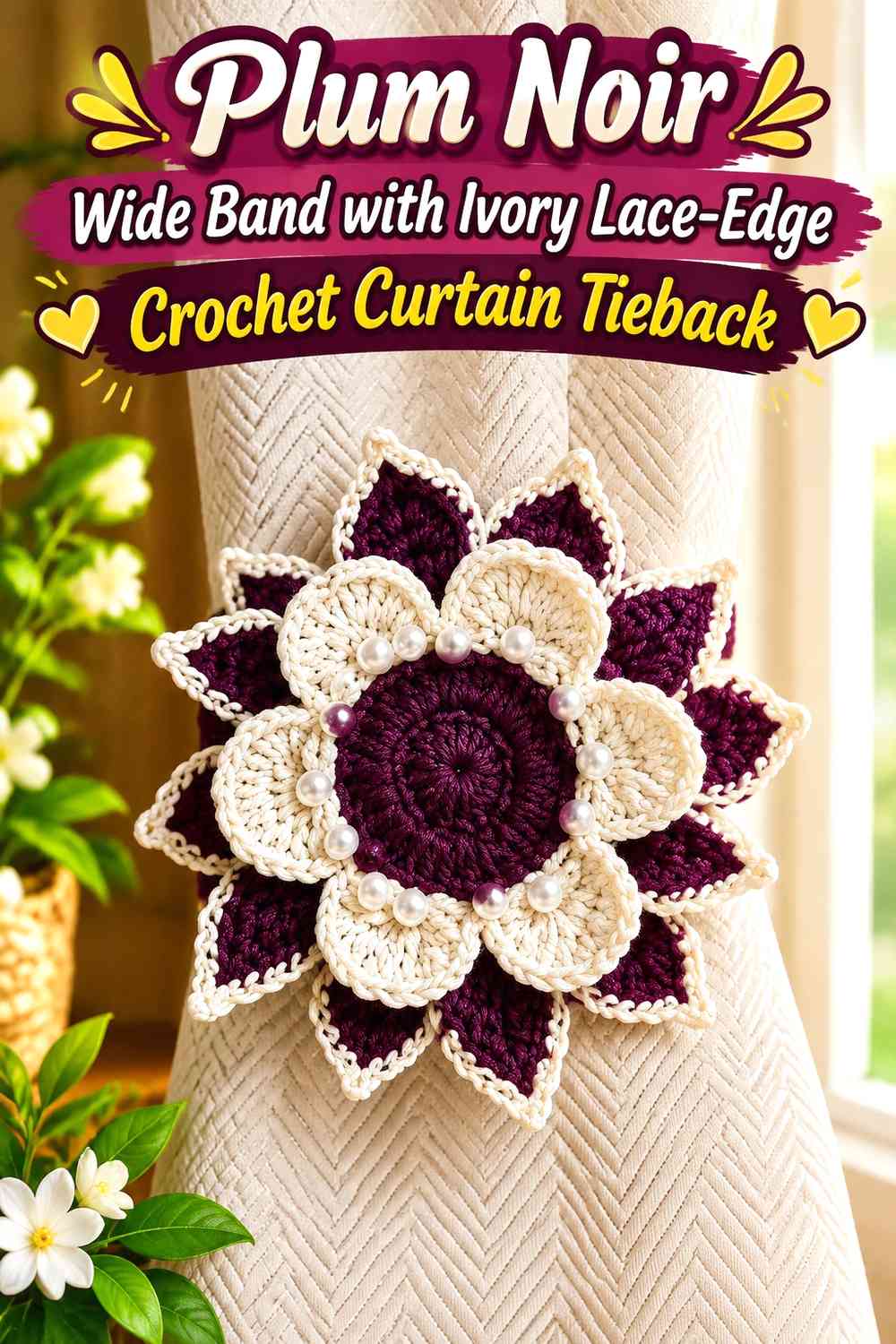
Give Plum Noir most of the surface and reserve Ivory for a narrow lace trim along one edge. This is one of the darkest options and works when you want the vintage effect to come from a refined finishing line rather than a large floral motif.
Plum Noir Should Remain Broad Behind the Ivory Crochet Lace Edge
The dark band needs enough uninterrupted width to act as the main visual field. If Ivory edging expands too far inward, the project will shift toward an evenly divided two-color tieback.
This broad Plum Noir area can also showcase subtle stitch texture without additional color changes.
Ivory Edge Placement Should Face Outward from the Plum Noir Band
Attach or work the lace edge where it remains visible after wrapping. If the Ivory trim falls into the deepest folds of the curtain, much of its contrast will be lost.
Mark the outward-facing side before completing both tiebacks so the pair mirrors properly.
Creator Credit: Sanjs Aasha
8. Ivory Rose Cluster and Plum Noir Crochet Vintage Curtain Tieback

Group two or three Ivory roses over a Plum Noir band instead of using one oversized flower. The cluster creates a fuller vintage look while the dark base separates the individual light motifs.
Ivory Rose Clusters Need Plum Noir Space Between Crochet Flowers
Do not pack the flowers so tightly that their petals become one large Ivory mass. Small glimpses of Plum Noir between the roses help each motif retain its outline.
Varying the position of the flowers can create depth without requiring another color.
Plum Noir Band Width Should Support the Ivory Crochet Rose Cluster
A very narrow band can look visually weak beneath several flowers. Give the Plum Noir base enough width near the cluster to look intentional, then taper or simplify it toward the fastening ends if desired.
Keep the opposite side of the tieback relatively plain so the rose grouping remains the main decorative feature.
Creator Credit: Hopeful Turns
9. Ivory Flower Chain with Plum Noir Cord Crochet Curtain Tieback

Instead of one central motif, repeat smaller Ivory flowers along a Plum Noir cord or narrow band. The dark connector becomes visible between the blossoms and prevents the light motifs from merging into a continuous strip.
Ivory Flowers Should Repeat Evenly Along the Plum Noir Crochet Cord
Consistency matters more than exact mathematical spacing. The viewer should be able to follow a clear flower rhythm around the gathered curtain without one end becoming overloaded.
Lay the tieback flat first, then test it wrapped because the apparent spacing will compress on the inner curve.
Plum Noir Cord Needs Enough Visibility Between Ivory Crochet Motifs
Leave sections of the dark connector exposed. If Ivory flowers cover the complete cord, the Plum Noir role will be reduced to nearly invisible attachment points.
The closure end can remain solid Plum Noir to reinforce the connector color.
Creator Credit: Silvana Gloria tejidos
10. Plum Noir Lace Wrap with Ivory Crochet Picot Curtain Tieback

Make Plum Noir the main lace color and use Ivory only in small picot-like or pointed edge accents. This creates a lower-contrast vintage treatment than large Ivory flowers while still keeping the two-color palette visible.
Ivory Picot Accents Should Repeat Along the Plum Noir Crochet Edge
Small Ivory details need repetition to register as a deliberate color decision. Place them at consistent intervals rather than using only one or two isolated light points.
If the picots are extremely small, add one slightly broader Ivory closure detail so the color remains noticeable from normal viewing distance.
Plum Noir Lace Should Stay Continuous Behind Ivory Edge Details
Avoid changing the main band color between individual accents. A continuous dark background gives the small Ivory features enough consistency to create a refined border.
This version is particularly useful when you want color contrast without making flowers the primary decorative element.
Creator Credit: CROCHET Y TEJIDOS abrayo
11. Ivory Floral Panel and Plum Noir Cord Crochet Curtain Tieback
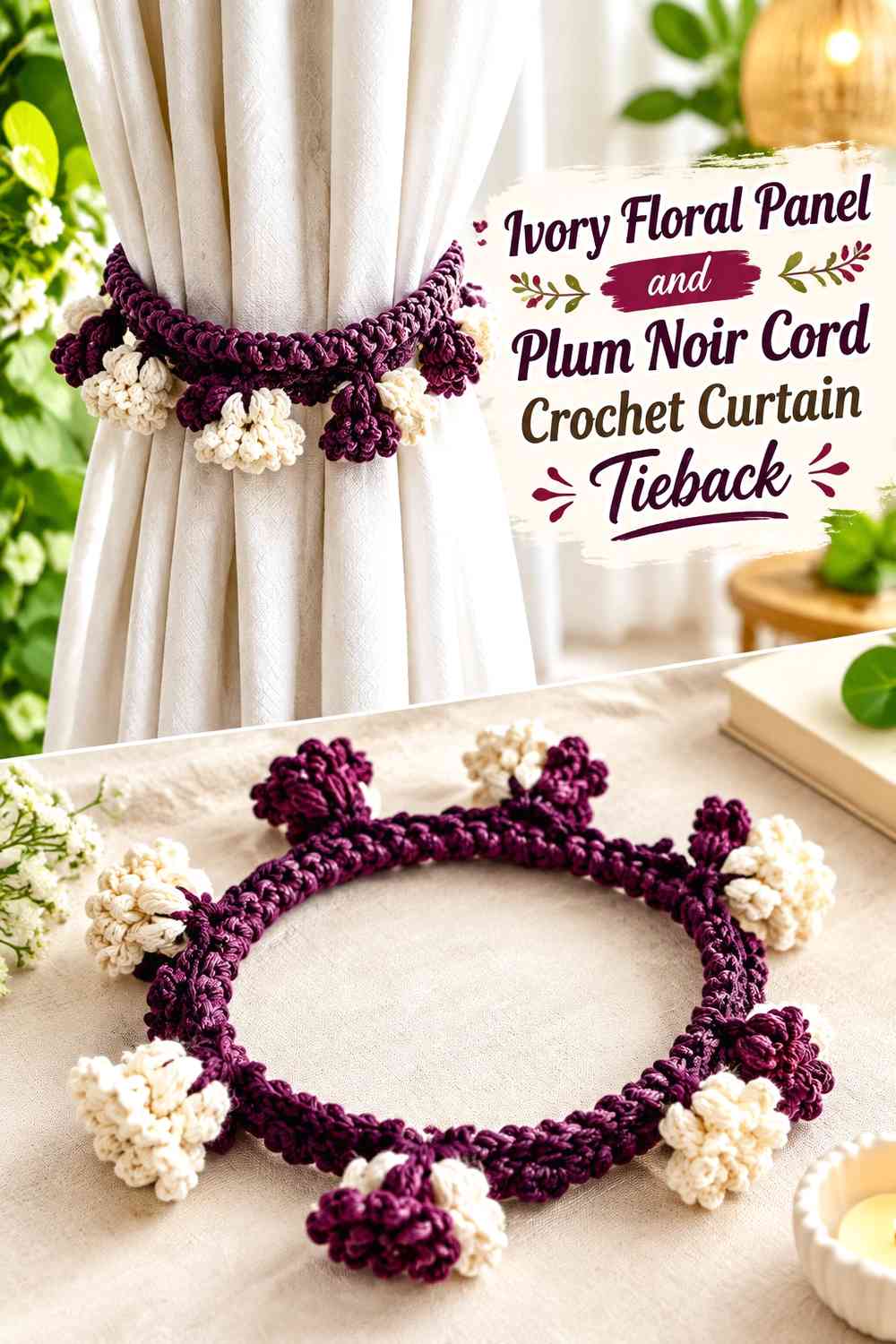
Create a decorative Ivory floral section only across the front of the tieback and use Plum Noir cords or narrower bands to wrap behind the curtain. This concentrates the lace where it can actually be seen.
Ivory Floral Crochet Should Stay on the Visible Tieback Panel
There is little visual benefit in placing the most detailed Ivory motifs on sections hidden behind heavy curtain folds. Keep the decorative panel near the center front and transition to simpler Plum Noir ends toward the back.
This also creates a clear distinction between ornament and fastening structure.
Plum Noir Cords Can Frame the Ivory Crochet Panel
Let a dark cord emerge from both sides of the lighter lace section. The Plum Noir transition defines the boundaries of the decorative panel and prevents the Ivory portion from visually extending around the entire curtain.
If the front panel already has a dark center motif, keep the cords narrow so Plum Noir does not overwhelm it.
Creator Credit: Handmade by Derya
12. Plum Noir Accent Motifs and Ivory Crochet Lace Curtain Tieback
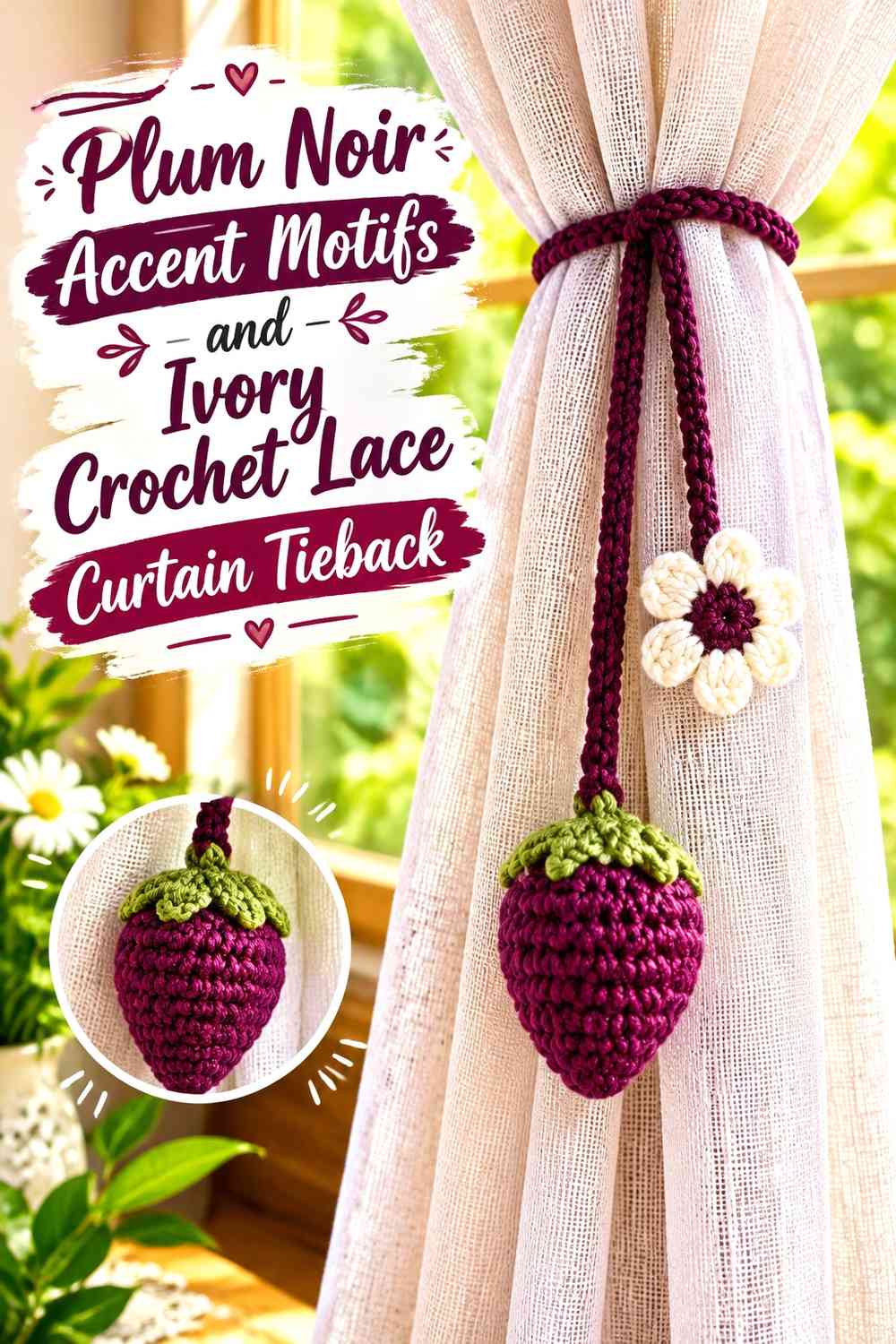
Use Ivory for the complete tieback base, then add several small Plum Noir motifs across only part of it. These can be floral, leaf-like, or geometric details as long as they repeat enough to create an intentional vintage pattern.
Plum Noir Motifs Should Not Crowd the Ivory Crochet Lace
The Ivory background needs visible open space between dark motifs. Too many Plum Noir details can turn the tieback into a dense patterned strip and reduce the airy lace effect.
Concentrate the motifs near the center or one decorative end rather than covering every inch.
Ivory Should Remain the Largest Crochet Area Around Plum Noir Accents
Continue Ivory through the main band, edge, and at least one closure element. That larger light field ensures Plum Noir acts as an accent rather than becoming an equal second background.
Check the finished tieback against the curtain color; a pale curtain may require a slightly stronger Plum Noir repeat to keep the shape visible.
Creator Credit: Crafty fingers
13. Ivory Vintage Lace with Plum Noir Tassel Crochet Curtain Tieback
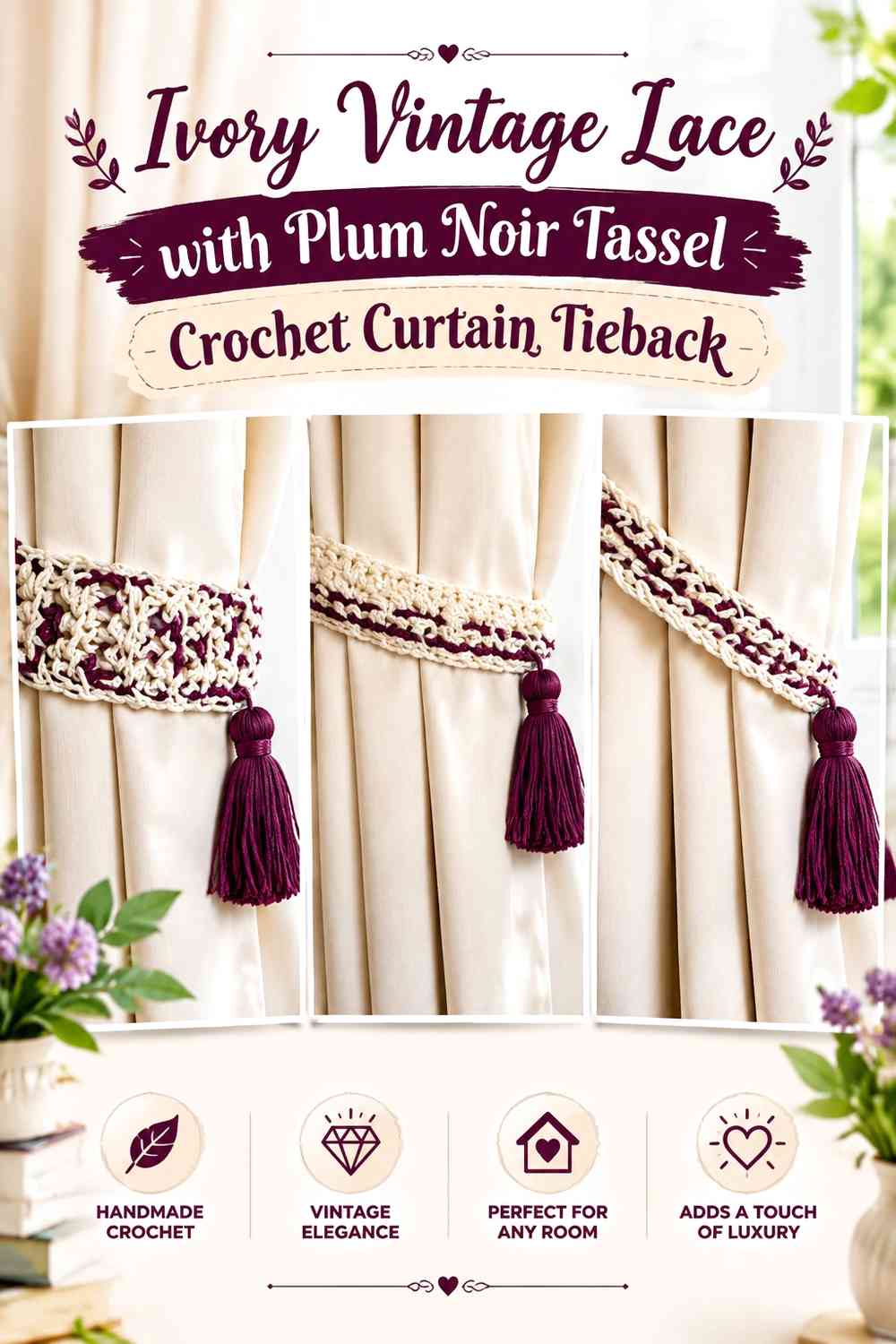
Keep the wraparound band predominantly Ivory and add Plum Noir tassels or dangling end details. The dark color gains movement below the gathered curtain while the lace itself stays light.
Plum Noir Tassels Can Give Ivory Crochet Lace a Dark Finish
Tassels occupy more visual area when they hang freely than when they are bundled against the tieback. Start with fewer Plum Noir tassels than you think you need and assess them on the curtain before adding more.
A large cluster at each end can quickly become the dominant feature.
Ivory Lace Should Remain Visible Above the Plum Noir Tassels
Do not let long dark fringe obscure the scalloped or openwork lower edge. Keep enough separation that the viewer can distinguish the Ivory band from the dangling Plum Noir details.
Repeating one narrow Plum Noir line along the band can connect the tassels back to the main body.
Creator Credit: Hectanooga1
14. Plum Noir Clasp Band with Ivory Crochet Lace Curtain Tieback

Use a more structured tieback band with a clasp or ring closure, keeping the main band Plum Noir and inserting an Ivory lace panel through the visible center. The hardware-based construction gives the delicate palette a more tailored shape.
Ivory Lace Panel Should Sit Between Plum Noir Crochet End Sections
Keep the lighter openwork away from the highest-handling points at the closure if you want the center to remain the decorative focus. Plum Noir end sections visually frame that panel and make the transition to rings or clasps less abrupt.
The Ivory area should be long enough to remain visible after the curtain is gathered.
Plum Noir Closure Areas Can Anchor the Ivory Crochet Center
Using Plum Noir around both ends gives the tieback a balanced dark boundary. It also prevents a small clasp or ring from appearing visually disconnected from the rest of the piece.
If the hardware itself is visually strong, keep the adjacent Plum Noir stitches simple so the closure does not become overly decorative.
Creator Credit: Jess Crafting
15. Ivory Floral Vine and Plum Noir Crochet Lace Curtain Tieback

Finish with a more botanical vintage design: an Ivory floral vine winding across or along a Plum Noir lace base. The flowers can remain relatively small while their repeated light color creates movement across the darker tieback.
Ivory Floral Vine Should Travel Clearly Across Plum Noir Crochet Lace
Give the vine a recognizable direction rather than scattering flowers randomly. A gentle progression from one end toward the center makes the Ivory motifs feel connected even if their exact positions vary.
Leave areas of Plum Noir visible between flowers so the darker lace base still contributes to the design.
Plum Noir Can Define the Ends of the Ivory Crochet Floral Vine
Stop the decorative vine before the fastening area and let the ends become mostly Plum Noir. This keeps delicate floral details away from sections that may twist behind the curtain.
The shift also creates a useful visual signal between decorative center and functional ends.
Ivory Flowers Should Stay Secondary to the Plum Noir Crochet Band Shape
The vine can be decorative without covering the complete band. Keeping the Ivory motifs relatively small allows the overall curved tieback silhouette to remain clear once it wraps around the curtain.
Creator Credit: Mumsy Makes Crochet
Comparing the Plum Noir and Ivory Vintage Lace Directions
For the darkest vintage look, Ideas 1, 7, 10, and 14 give Plum Noir most of the band surface and use Ivory for flowers, edges, picots, or a center panel. These arrangements work well when you want the tieback itself to remain visually substantial around pale curtains.
Ideas 3, 9, 11, 12, and 13 make Ivory more dominant. Plum Noir becomes the border, cord, tassel, or repeated motif color, creating a lighter lace-forward result.
For a stronger floral focal point, Ideas 2, 4, 6, 8, and 15 use roses, medallions, layered petals, or vine motifs. If you prefer the vintage effect to come mainly from edging and openwork rather than flowers, Ideas 3, 7, 10, and 14 keep the color structure simpler.
Curtain color should influence the final balance. Ivory lace may visually soften into cream or white fabric, while Plum Noir may blend into very dark drapes. Adjust the width of the contrasting border or motif rather than automatically adding a third color.
Conclusion
Plum Noir and Ivory suit a vintage crochet curtain tieback because they can separate decorative lace from functional structure with only two colors. Plum Noir can define bands, borders, cords, closure ends, flowers, or tassels, while Ivory can keep shells, scallops, medallions, floral vines, and openwork sections visually light.
Choose a Plum Noir-dominant design for stronger contrast around pale curtains, or let Ivory lead when you want the lace itself to be the main feature. Floral clusters create the most decorative versions, while narrow edging, picots, and framed lace panels offer a quieter vintage direction.
Before making a matching pair, test one tieback around the actual gathered curtain. Check which section faces forward, whether the lace remains visible against the fabric, and whether the Plum Noir/Ivory contrast still reads from normal room-viewing distance. Use the original tutorials for their exact construction methods, then apply the two-color arrangement independently.
Frequently Asked Questions
Should Plum Noir or Ivory dominate a vintage crochet curtain tieback?
Either can lead. Plum Noir gives the tieback a darker, more defined frame, while Ivory makes the lace and floral details appear lighter. Choose the dominant shade according to the curtain color and which part of the crochet you want to emphasize.
How can I keep Ivory crochet lace visible on cream curtains?
Increase the amount of Plum Noir along the lace edge, flower center, or visible band section. You do not necessarily need another color; a strategically placed dark outline can provide enough separation between the Ivory crochet and pale curtain fabric.
Where should Plum Noir be placed on an Ivory curtain tieback?
Useful locations include long edges, flower centers, closure loops, tassels, cords, medallions, or a narrow border around the visible front panel. Repeating Plum Noir in two separated areas generally looks more intentional than using one isolated dark detail.
Can Plum Noir and Ivory work for floral crochet curtain tiebacks?
Yes. Ivory can form petals while Plum Noir defines centers, leaves, vines, or the band beneath them. The reverse also works: a Plum Noir flower can become a strong focal point against an Ivory lace base.
How do I stop a Plum Noir and Ivory lace tieback from looking too busy?
Reduce the number of separate motifs and give one color a clear dominant role. A continuous Plum Noir band with one Ivory flower, or an Ivory lace band with a single Plum Noir border, will usually read more clearly than many small alternating details.
Should both Plum Noir and Ivory appear on the closure?
Not necessarily. A single-color closure is often visually cleaner because part of it may sit behind the curtain. Reserve the strongest two-color contrast for the front-facing section unless the fastening area is intentionally decorative.
How can I substitute different Plum Noir or Ivory yarn colors?
Preserve their relative roles. Choose a very deep plum or purple-black shade for the dark anchor and a soft warm off-white for the light lace role. Compare the actual yarns beside your curtain before making the full pair, because the surrounding fabric can change how strong the contrast appears.