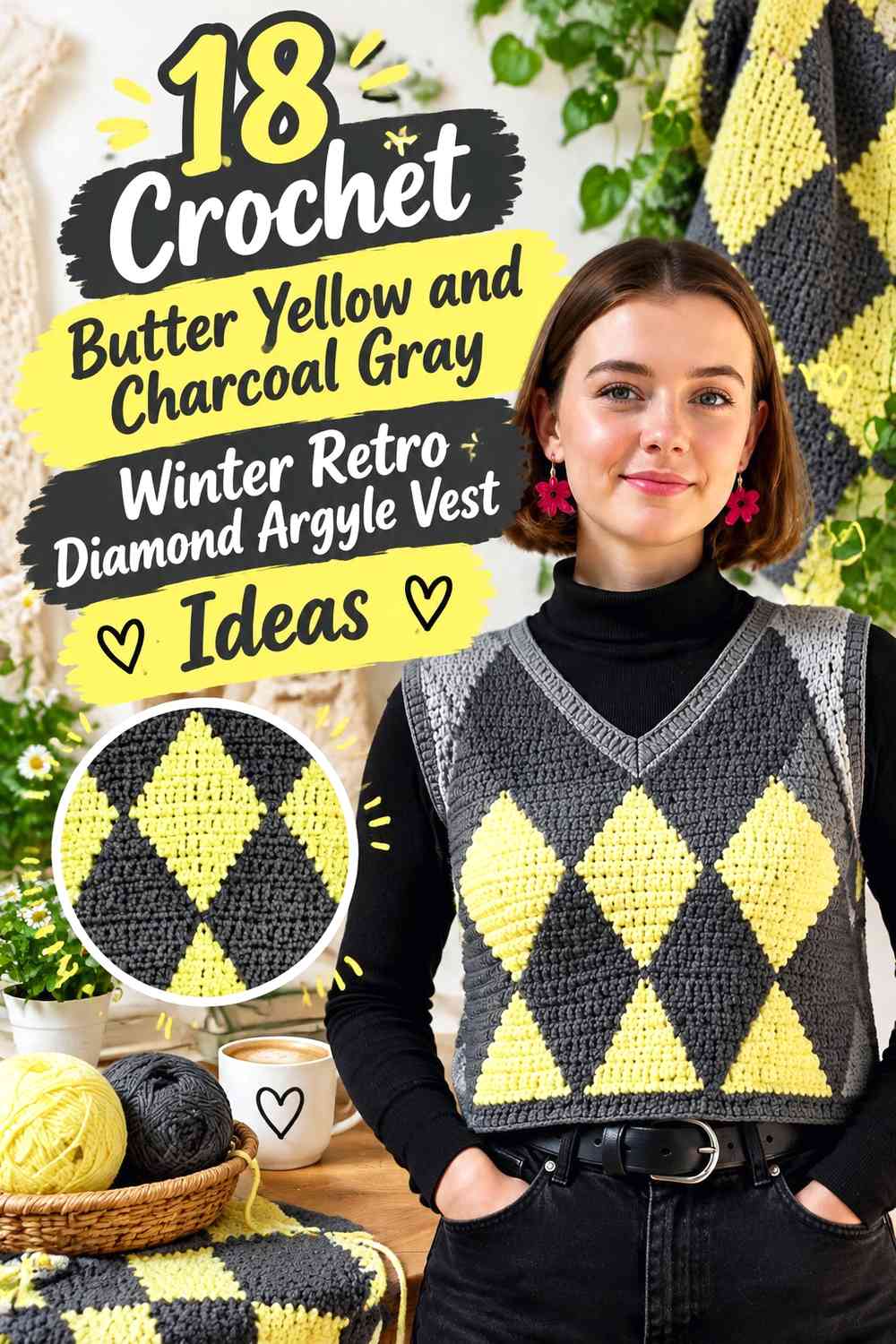

Butter yellow and charcoal gray create a strong retro argyle palette because the two shades can take clearly different jobs. Charcoal gray can provide the vest background, ribbing, neckline, or diagonal lattice, while butter yellow fills the diamonds and keeps the geometric pattern visible without introducing several competing colors.
Reversing the balance changes the effect considerably. A butter-yellow body with charcoal diamonds feels lighter and makes the geometry more graphic, while a charcoal-dominant vest with yellow motifs puts more attention on individual diamonds. The neckline also matters: a V-neck naturally echoes argyle diagonals, while a crewneck leaves more uninterrupted space for one centered motif or a horizontal diamond band.
The tutorials credited below include two sources that directly focus on argyle or diamond vests plus other verified sweater-vest constructions that support independent diamond adaptations. For non-argyle tutorials, use the creator’s original instructions for the vest itself and plan the butter-yellow, charcoal-gray, and retro argyle layout separately.
Quick List
- Charcoal Gray Crochet V-Neck Argyle Vest With Butter Yellow Diamonds
- Butter Yellow Crochet Large-Diamond Vest With Charcoal Gray Lattice
- Charcoal Gray Ribbed Crochet Argyle Vest With Butter Yellow Chest Diamond
- Butter Yellow Cropped Crochet Argyle Vest With Charcoal Gray Diamond Band
- Butter Yellow Boxy Crochet Argyle Vest With Charcoal Gray Graphic Diamonds
- Charcoal Gray Cropped Crochet Argyle Vest With One Butter Yellow Diamond
- Butter Yellow Hooded Crochet Argyle Vest With Charcoal Gray Pocket Diamonds
- Charcoal Gray Collared Crochet Argyle Vest With Butter Yellow Diamond Panel
- Butter Yellow V-Neck Crochet Argyle Vest With Charcoal Gray Lattice Lines
- Charcoal Gray Textured Crochet Argyle Vest With Butter Yellow Oversized Diamonds
- Butter Yellow Button-Up Crochet Argyle Vest With Charcoal Gray Split Diamonds
- Charcoal Gray V-Neck Crochet Argyle Vest With Butter Yellow Tonal Diamonds
- Butter Yellow Striped Crochet Argyle Vest With Charcoal Gray Center Panel
- Charcoal Gray Scalloped Crochet Argyle Vest With Butter Yellow Diamonds
- Butter Yellow Textured-Diamond Crochet Vest With Charcoal Gray Outlines
- Charcoal Gray Simple Crochet Argyle Vest With Butter Yellow Center Diamond
- Butter Yellow Classic Crochet V-Neck Vest With Charcoal Gray Hem Argyle
- Charcoal Gray Checkerboard Crochet Vest With Butter Yellow Argyle Lattice
Decide Whether Butter Yellow or Charcoal Gray Should Control the Vest Background
The background color occupies much more surface than the lattice lines, so choose it before planning the diamonds. Charcoal gray makes butter-yellow motifs appear brighter and gives the vest a darker winter base. Butter yellow produces a lighter garment and turns charcoal diamonds into the strongest graphic feature.
Do not force the colors into equal coverage unless that is the intended effect. Traditional-looking argyle usually benefits from a clear background, a distinct diamond color, and restrained crossing lines rather than two shades competing across every stitch.
Fit the Butter Yellow and Charcoal Gray Diamonds Around the Neckline
Argyle placement should respond to the final vest shape. A V-neck can cut through the upper center of a diamond, a crewneck gives you more chest area, and a button front divides the composition into two separate panels.
Establish the neckline, shoulder width, armhole position, and intended hem before fixing the motif layout. If a full butter-yellow or charcoal-gray diamond will not fit cleanly near shaping, moving or removing the motif is usually clearer than squeezing it into the available area.
Keep Butter Yellow and Charcoal Gray Argyle Readable Over Winter Layers
A vest worn over a shirt, turtleneck, or sweater curves differently around the body than it does when lying flat. Important diamonds close to the side seams may rotate partly out of front view once the vest is layered.
Check the developing front over the type of winter layer you expect to wear. Fit should determine the usable motif area; do not make the vest unnecessarily narrow simply to force an exact number of diamonds across the front.
1. Charcoal Gray Crochet V-Neck Argyle Vest With Butter Yellow Diamonds
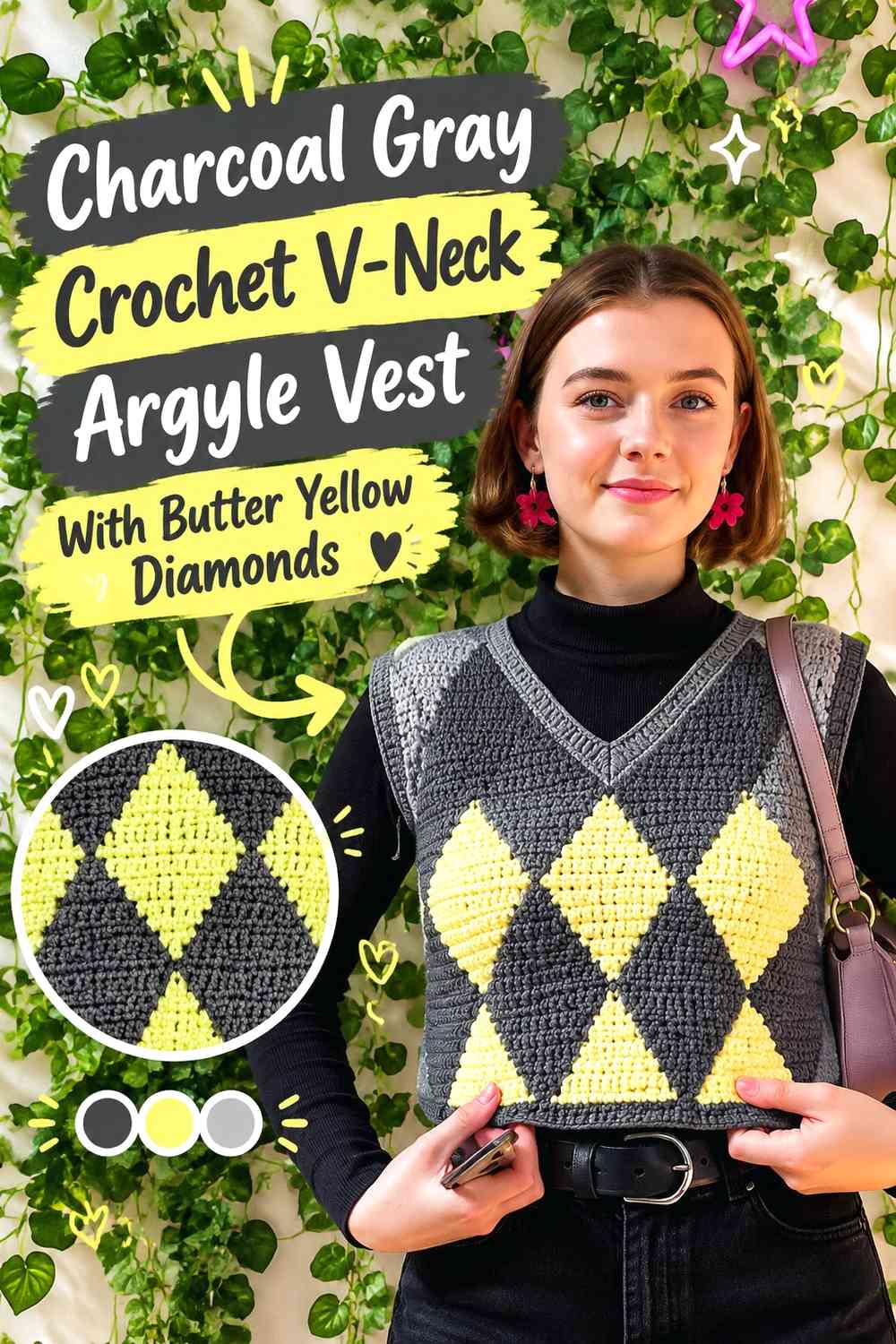
Use charcoal gray across the main vest and fill the repeated argyle diamonds with butter yellow. This is the clearest traditional direction because the dark background establishes the garment while the pale warm diamonds remain visible across the front. The source tutorial already focuses on an argyle sweater vest, so it is a useful reference for how diamond placement relates to a V-neck silhouette.
Butter Yellow Diamonds Should Respect the Charcoal Gray V-Neck
Keep the highest yellow motifs far enough below the neckline that their upper points remain recognizable. A diamond clipped awkwardly by the V can look accidental unless partial motifs are deliberately repeated elsewhere.
If you change the neckline depth from the original construction, reassess the complete upper argyle layout instead of moving only one diamond.
Charcoal Gray Lattice Can Keep Butter Yellow Argyle Controlled
Use charcoal gray for the narrow crossing lines when you want the butter-yellow diamonds to remain the main contrast. Dark lattice on a dark background creates a more restrained traditional effect than adding a third color.
View the front from several feet away before finishing the edges; repeated geometry makes small alignment problems more noticeable.
Creator Credit: flotjetops
2. Butter Yellow Crochet Large-Diamond Vest With Charcoal Gray Lattice
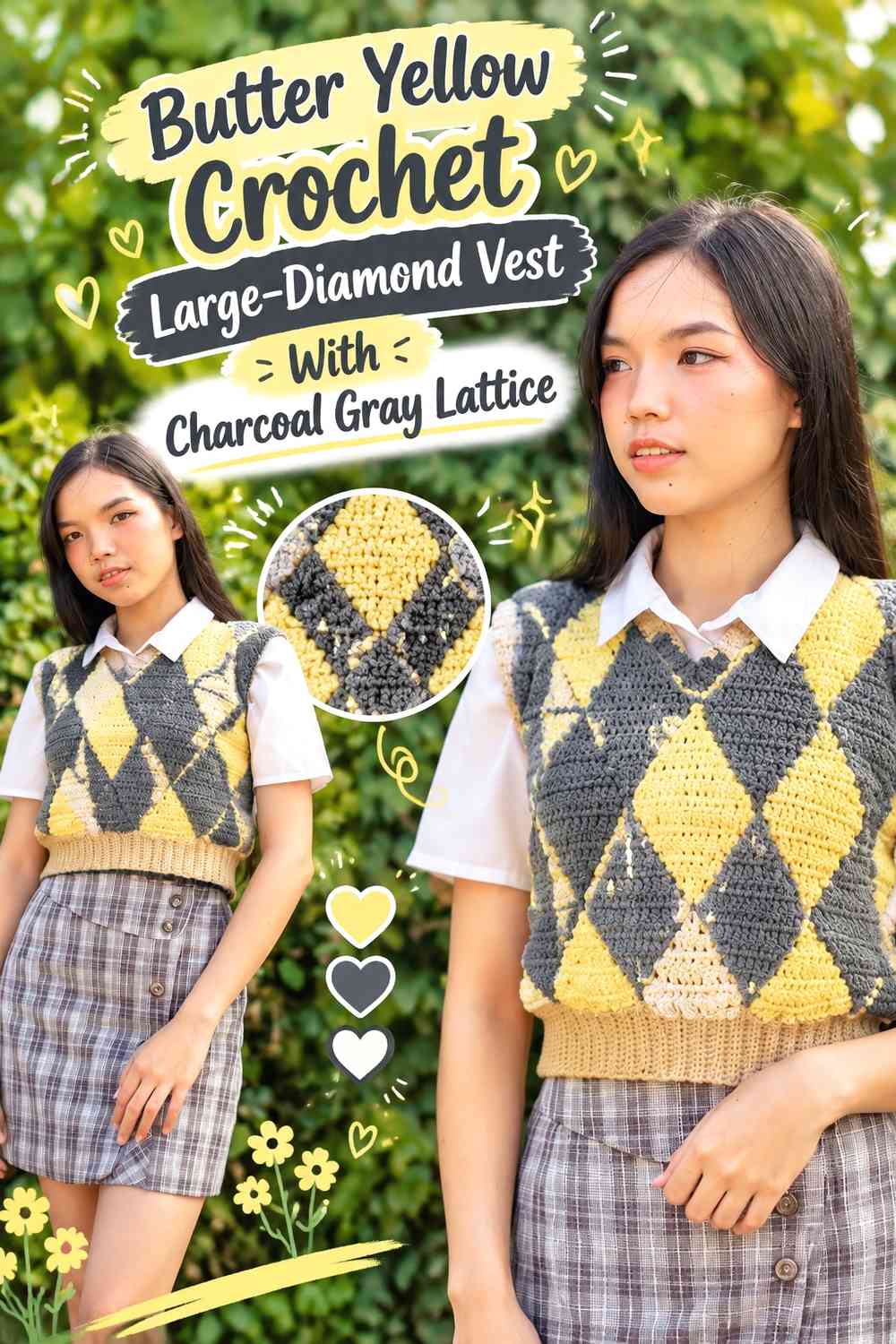
Let butter yellow create the larger garment field and use charcoal gray for oversized diamonds or crossing lines. A large-diamond vest needs fewer repeats, which gives each dark motif more visual importance and makes this direction distinctly bolder than a small traditional argyle grid.
Charcoal Gray Diamonds Need Careful Centering on Butter Yellow
With only a few large motifs, even a small shift can make the whole front look off-center. Compare the diamond position with the neckline and armholes rather than centering it only on the unfinished rectangular panel.
If the vest is intentionally oversized, judge the motif while worn because more fabric may rotate toward the sides.
Butter Yellow Needs Space Around Charcoal Gray Geometry
Leave a noticeable yellow border around the main diamond field. Large charcoal motifs already provide substantial contrast, so covering every available area with additional lattice can make the vest unnecessarily dense.
A simple butter-yellow shoulder or hem area gives the graphic center more room.
Creator Credit: Chenda DIY
3. Charcoal Gray Ribbed Crochet Argyle Vest With Butter Yellow Chest Diamond
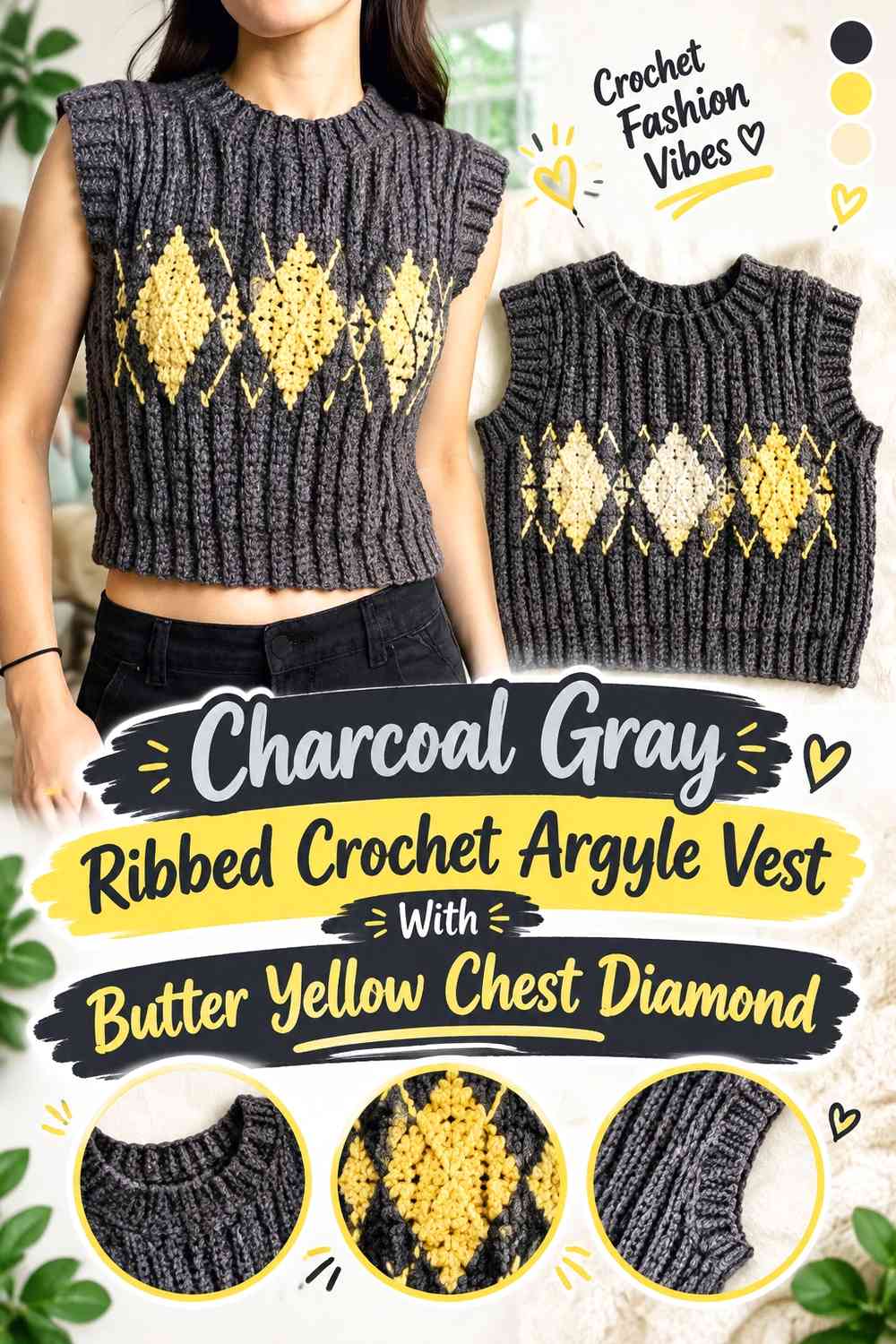
A ribbed crewneck vest already has strong vertical texture, so use charcoal gray across the ribs and place one butter-yellow diamond or short diamond band at the chest. Limiting the colorwork prevents the diagonal argyle geometry from fighting with the ribbed surface.
Butter Yellow Should Stay Focused on the Charcoal Gray Chest
A single central motif works well because the crewneck leaves more uninterrupted upper-front space than a deep V. Position the diamond far enough below the neckline that a complete charcoal margin remains around it.
Avoid repeating small yellow motifs across every rib; one larger shape will usually read more clearly.
Charcoal Gray Ribbing Needs Open Space Around Butter Yellow
Preserve broad dark ribbed sections at the shoulders, sides, and lower body. Those quiet areas keep the vest texture visible and allow the yellow motif to function as an accent.
If you repeat yellow, use a narrow neckline or hem detail rather than another equally strong chest design.
Creator Credit: VivCrochets
4. Butter Yellow Cropped Crochet Argyle Vest With Charcoal Gray Diamond Band
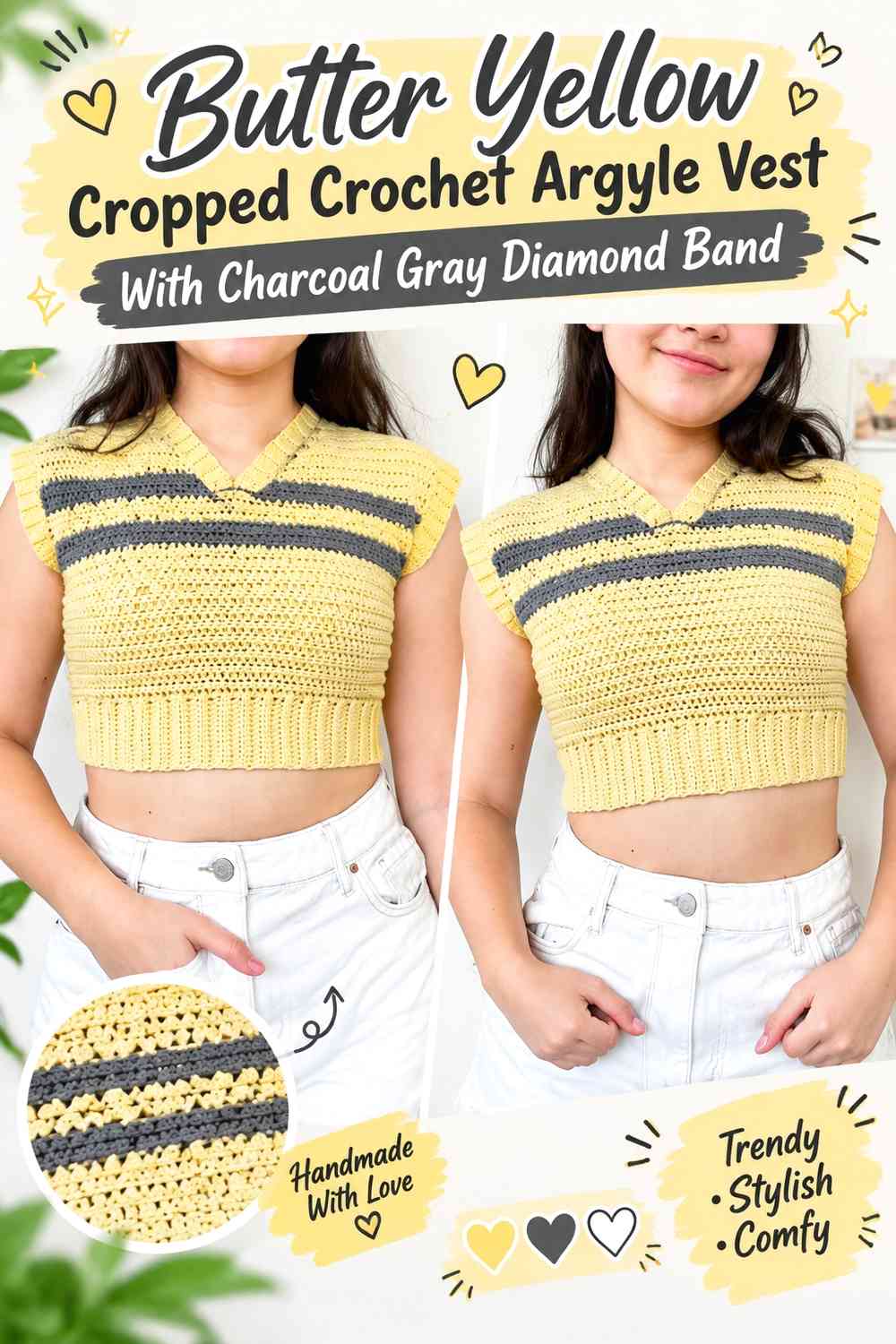
Use a butter-yellow cropped body and place a horizontal charcoal-gray diamond band across the middle or lower chest. Cropping reduces the vertical space available for traditional multi-row argyle, so a single controlled band gives the retro pattern enough room.
Charcoal Gray Diamonds Must Fit the Butter Yellow Cropped Length
Decide where the final hem will sit before choosing the diamond height. If a motif nearly touches both the hem ribbing and neckline shaping, the colorwork may feel compressed.
Reducing the number of repeats is usually cleaner than shrinking every diamond simply to force a traditional arrangement into a short vest.
Butter Yellow Should Separate Charcoal Gray Argyle From the Hem
Leave a band of plain yellow between the lowest diamonds and the finishing ribbing. That negative space keeps the argyle from looking accidentally cut off.
If the source vest includes stripe detail, decide whether stripes or diamonds will lead rather than giving both equal visual weight.
Creator Credit: Yarnalina
5. Butter Yellow Boxy Crochet Argyle Vest With Charcoal Gray Graphic Diamonds
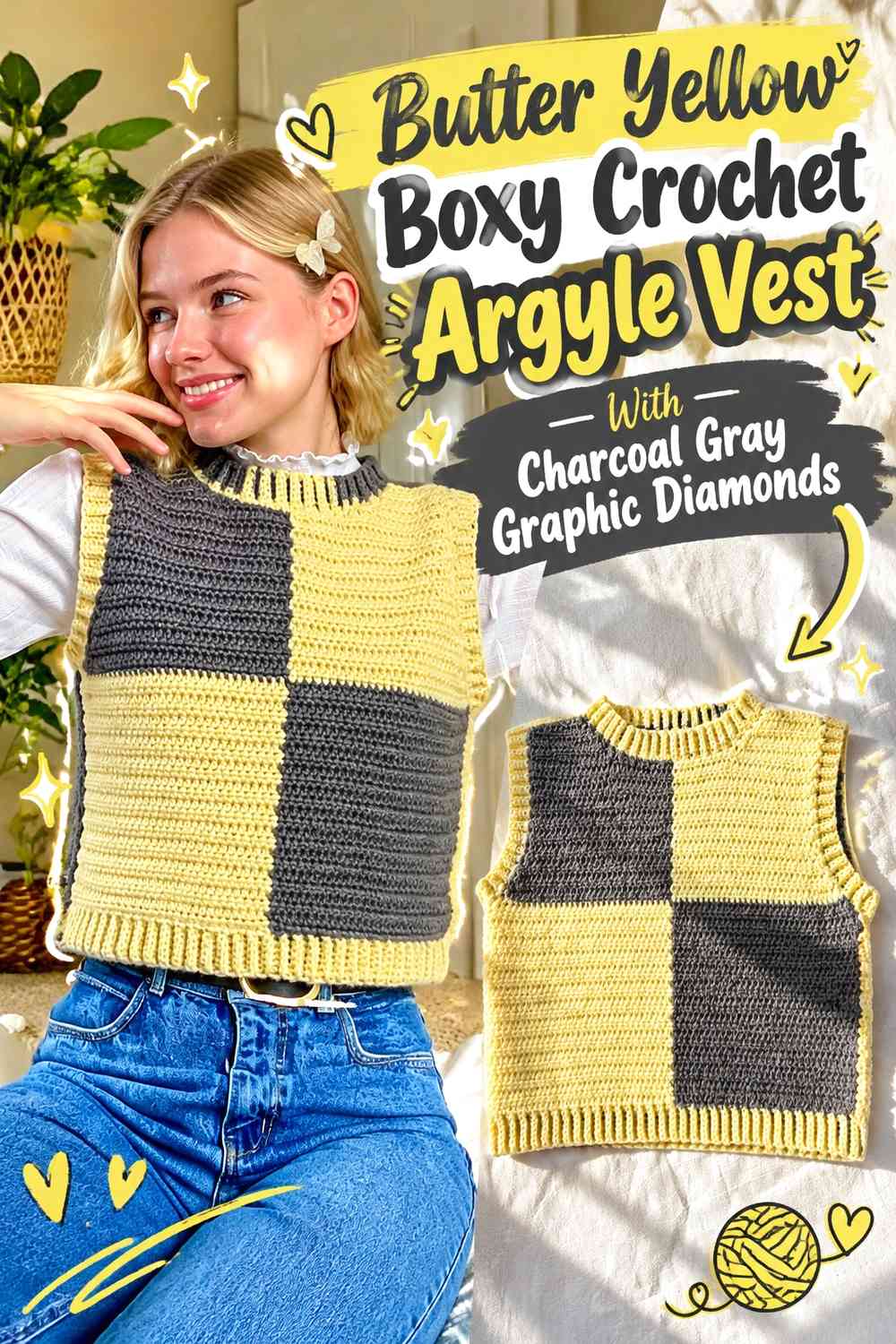
A boxier vest gives large diamonds more horizontal room. Use butter yellow across the broad body and convert the graphic front into a charcoal-gray diamond layout, keeping the strongest motifs comfortably inside the visible front rather than close to the side seams.
Charcoal Gray Diamonds Need Butter Yellow Around the Side Seams
A boxy panel wraps farther around the torso than it appears to when flat. Keep the main charcoal motifs toward the center so they do not disappear toward the sides when the vest is worn.
Leave yellow margins at both edges to frame the argyle deliberately.
Butter Yellow Should Replace Checker Geometry With True Charcoal Gray Diamonds
If adapting a checkerboard vest, changing only the colors does not create argyle. Plan separate diagonal diamond boundaries and optional crossing lines while preserving the original garment fit.
Treat the source tutorial as the vest construction and the diamond layout as a new color-design layer.
Creator Credit: HayHay Crochet
6. Charcoal Gray Cropped Crochet Argyle Vest With One Butter Yellow Diamond
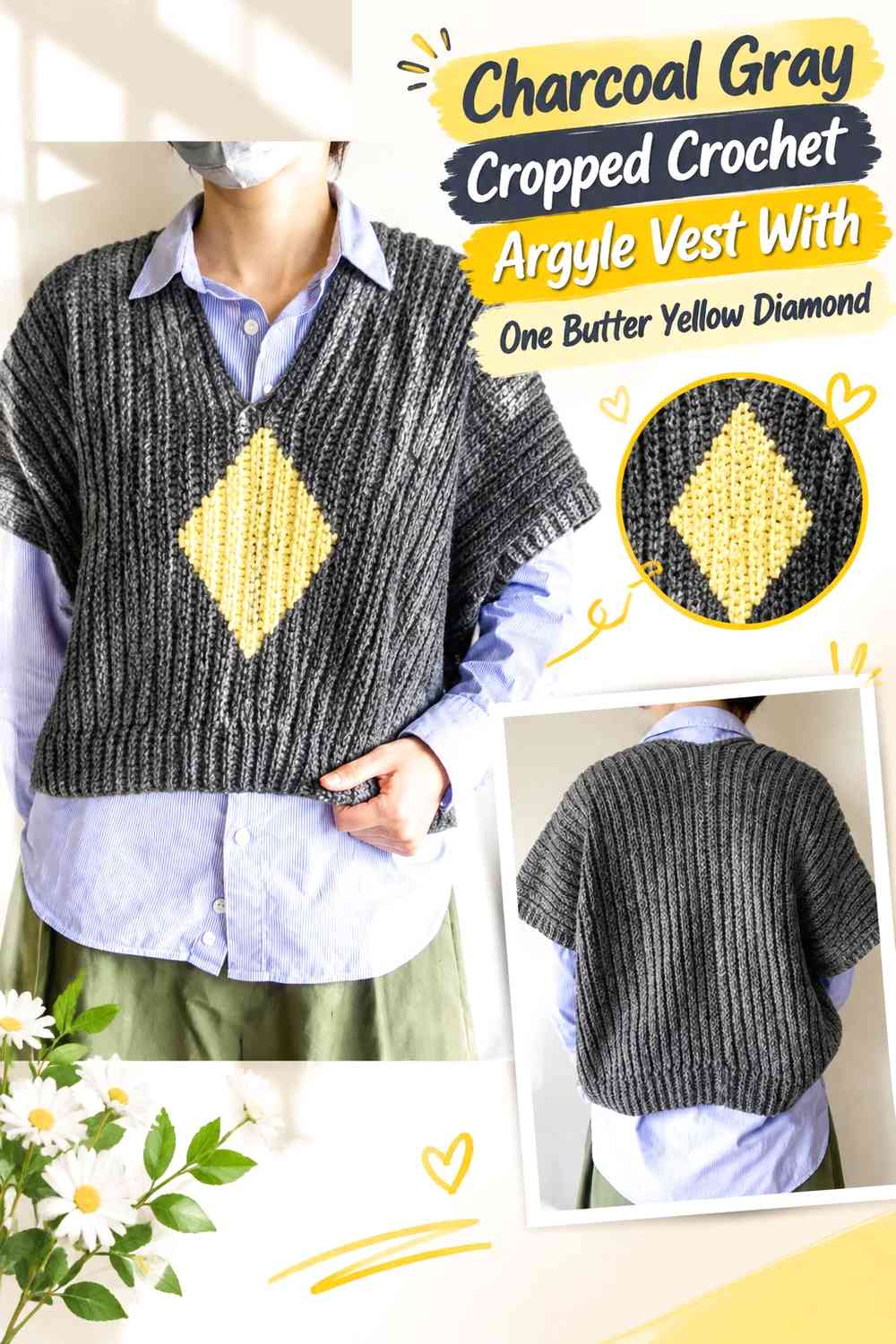
For the most minimal retro interpretation, keep a simple cropped vest charcoal gray and place one oversized butter-yellow diamond at the center front. The limited motif count lets the geometric shape carry the theme without covering the whole garment in colorwork.
Butter Yellow Center Diamonds Need Accurate Charcoal Gray Margins
Mark the vest center before building or adding the motif. On a simple straight-sided garment, even a modest alignment error becomes easy to see because there are few other details to distract from it.
Check the center relative to both shoulders, not merely the lower hem.
Charcoal Gray Should Remain Quiet Around Butter Yellow
Keep the neckline, armholes, sides, and most of the hem dark. The single yellow diamond becomes more intentional when it is surrounded by a generous charcoal field.
If you want a lattice reference, use restrained charcoal-on-yellow surface lines within the motif rather than adding several more diamonds.
Creator Credit: Orinam crochet
7. Butter Yellow Hooded Crochet Argyle Vest With Charcoal Gray Pocket Diamonds
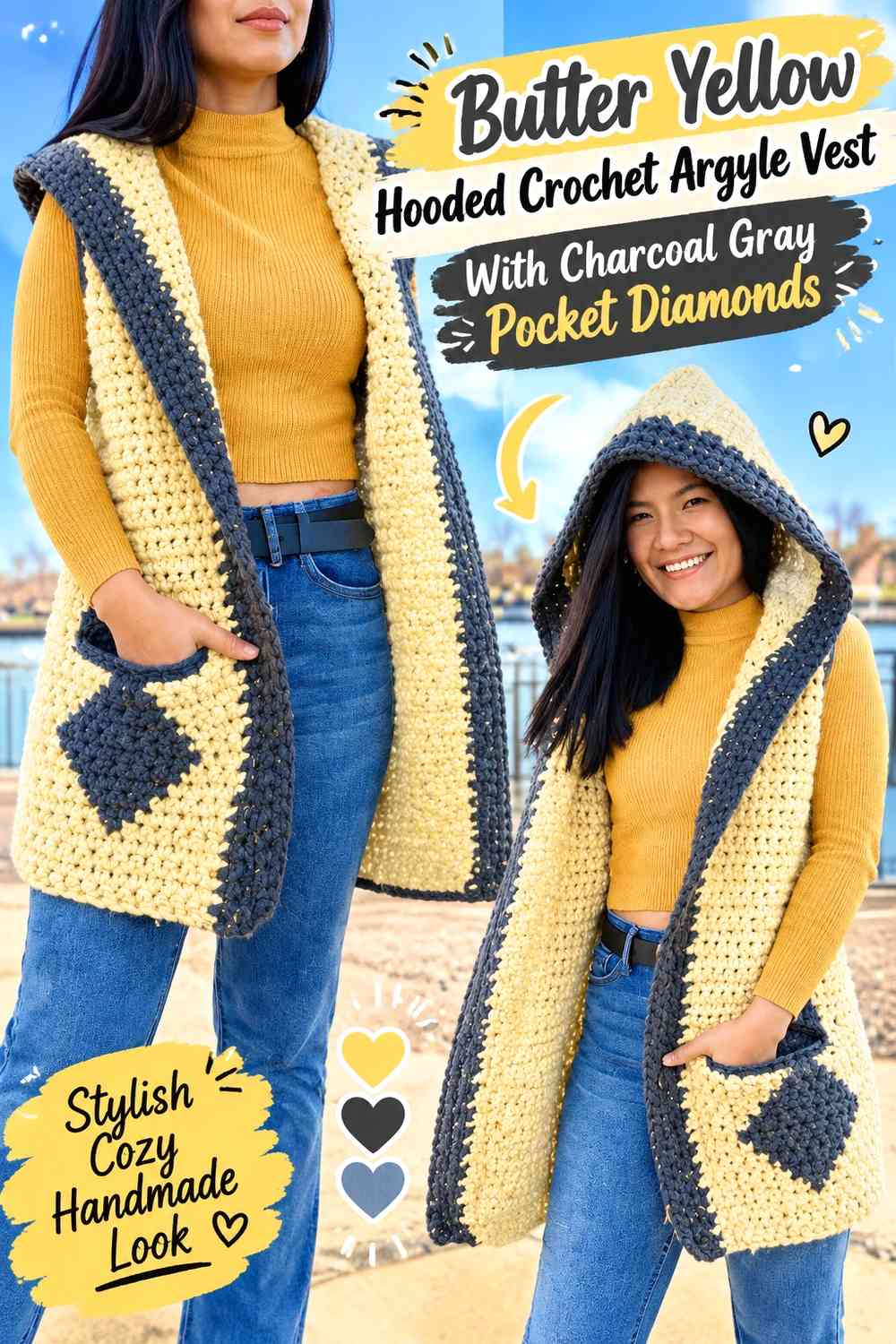
A hooded vest already has more structural detail than a conventional sweater vest, so let butter yellow cover the body and concentrate charcoal-gray diamonds above or around the pocket zones. The argyle should work around the pockets rather than being interrupted by them.
Charcoal Gray Diamonds Should Avoid Cutting Through Butter Yellow Pockets
Mark pocket openings before finalizing the motif arrangement. A recognizable diamond split randomly by a pocket edge can make the design difficult to follow.
A chest-level diamond row or a patterned back can be cleaner than dense lower-front argyle.
Butter Yellow Should Give the Charcoal Gray Hooded Vest Breathing Room
Keep the hood largely butter yellow if the front already contains dark diamonds, pockets, edging, and closures. Adding a second full argyle field on the hood can make the upper garment visually heavy.
A charcoal-gray hood edge is enough to reconnect the accent shade.
Creator Credit: KnitcroAddict
8. Charcoal Gray Collared Crochet Argyle Vest With Butter Yellow Diamond Panel
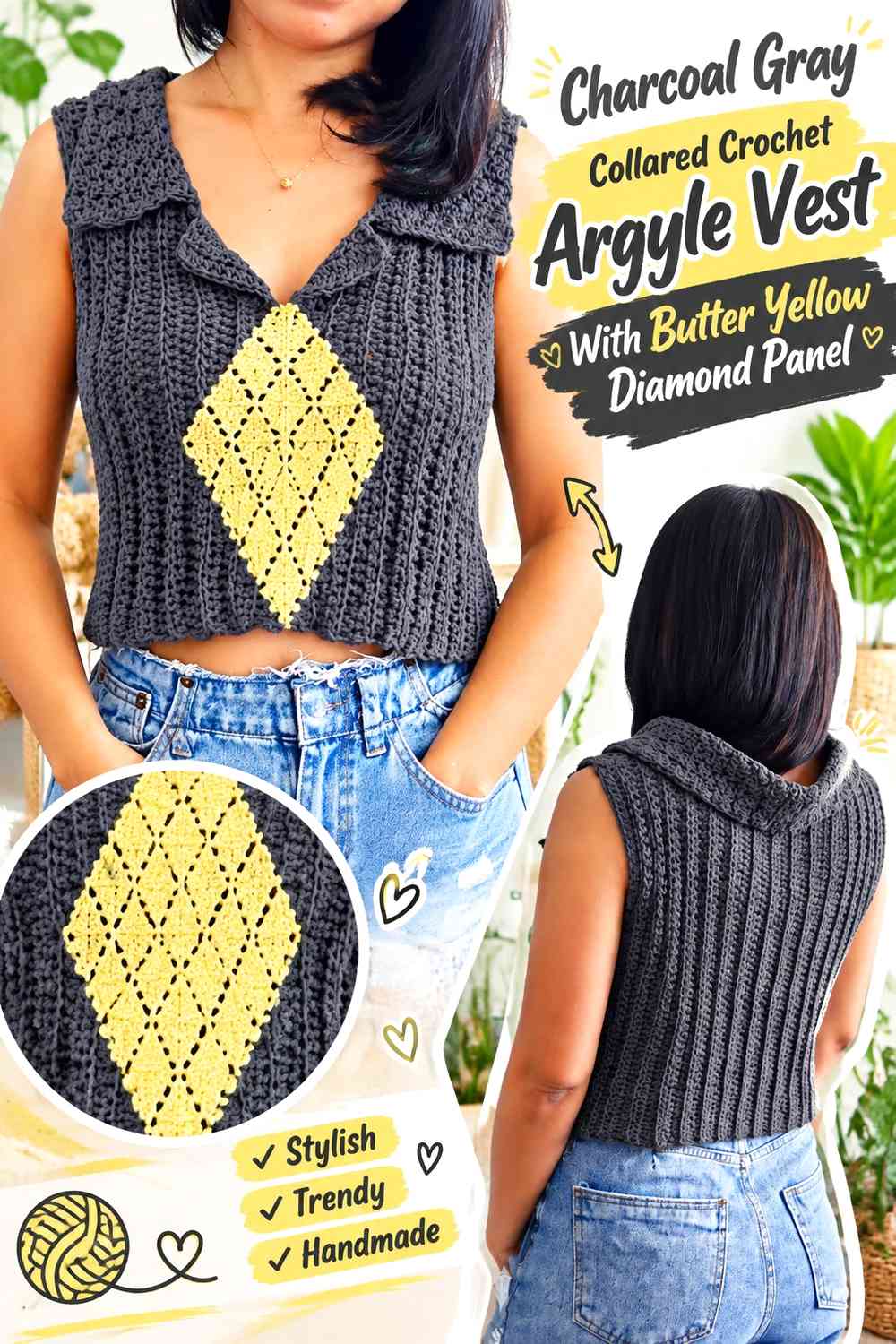
Use charcoal gray for the body and collar, then place a controlled butter-yellow diamond panel below the neckline. A collar already creates a strong upper outline, so leaving plain charcoal immediately beneath it helps separate the garment structure from the argyle.
Butter Yellow Diamonds Need Charcoal Gray Space Under the Collar
Do not push the upper motif directly against the collar edge. A narrow charcoal field allows both features to remain visible and gives you more flexibility if the collar changes the apparent neckline depth once attached.
Keep the strongest yellow motif lower on the chest.
Charcoal Gray Collar Can Repeat Butter Yellow More Sparingly
If the collar feels disconnected from the motif, add only a restrained butter-yellow edge or small repeat rather than recoloring the complete collar.
One repeated yellow detail is enough to link the top to the argyle panel.
Creator Credit: Jennyandteddy crochet.
9. Butter Yellow V-Neck Crochet Argyle Vest With Charcoal Gray Lattice Lines
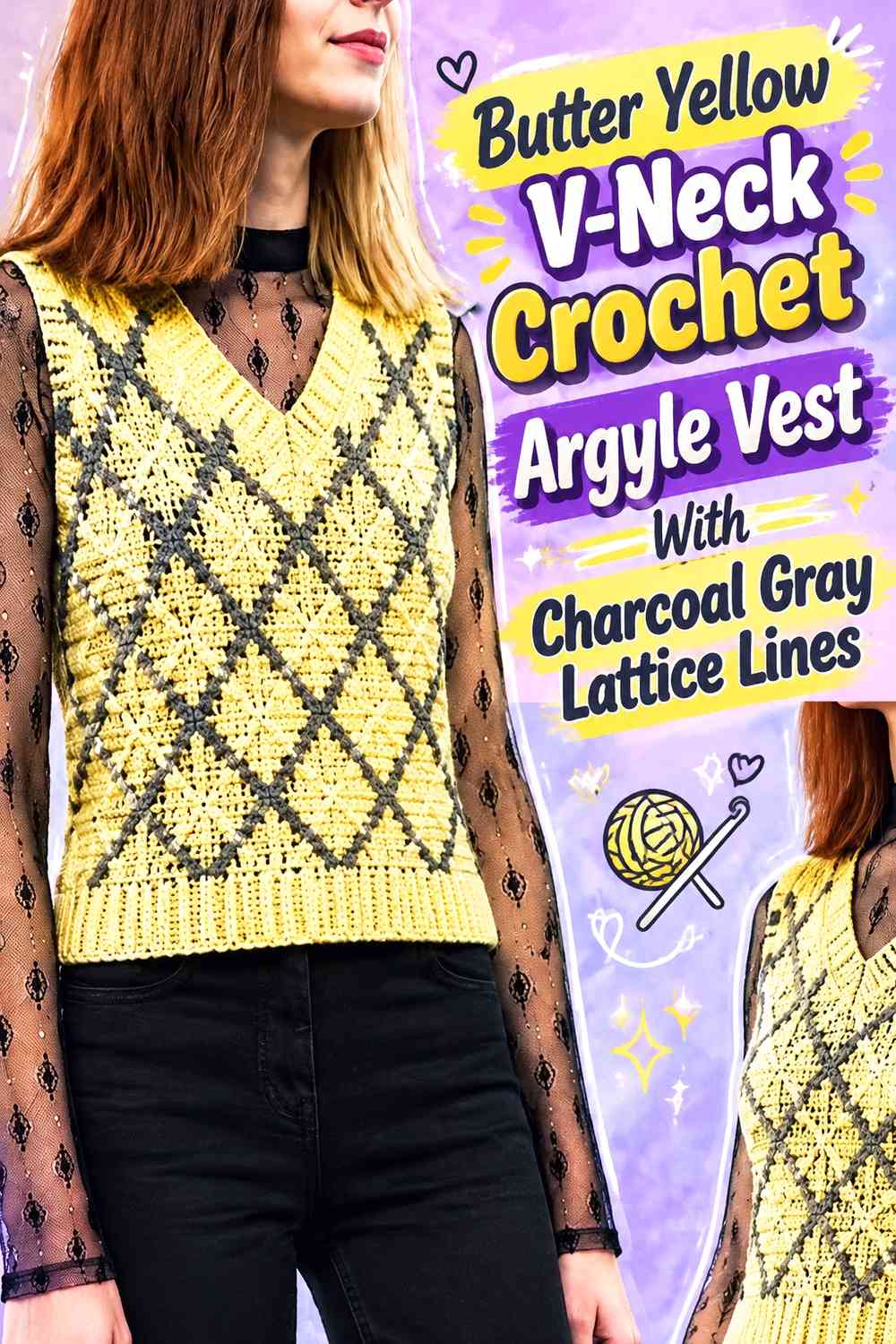
Make butter yellow the entire background of a clean V-neck vest and use charcoal gray primarily for narrow argyle lattice lines. This is a useful option when you want the retro diamond rhythm without filling every diamond with a second dark color.
Charcoal Gray Lattice Should Follow the Butter Yellow V-Neck Carefully
Both the lattice and neckline use diagonals, so crowded intersections near the upper chest can look tangled. Let the final complete lattice crossing sit lower if necessary rather than forcing several lines directly beside the neckline.
Plan the upper motif and neckline together before completing the front.
Butter Yellow Negative Space Can Become the Argyle Diamond
Allow the yellow background itself to form the diamond interiors while charcoal defines their boundaries. This keeps the palette lighter and reduces how much dark color covers the vest.
Solid butter-yellow shoulders also give the lattice a natural stopping point.
Creator Credit: Krafty Station
10. Charcoal Gray Textured Crochet Argyle Vest With Butter Yellow Oversized Diamonds
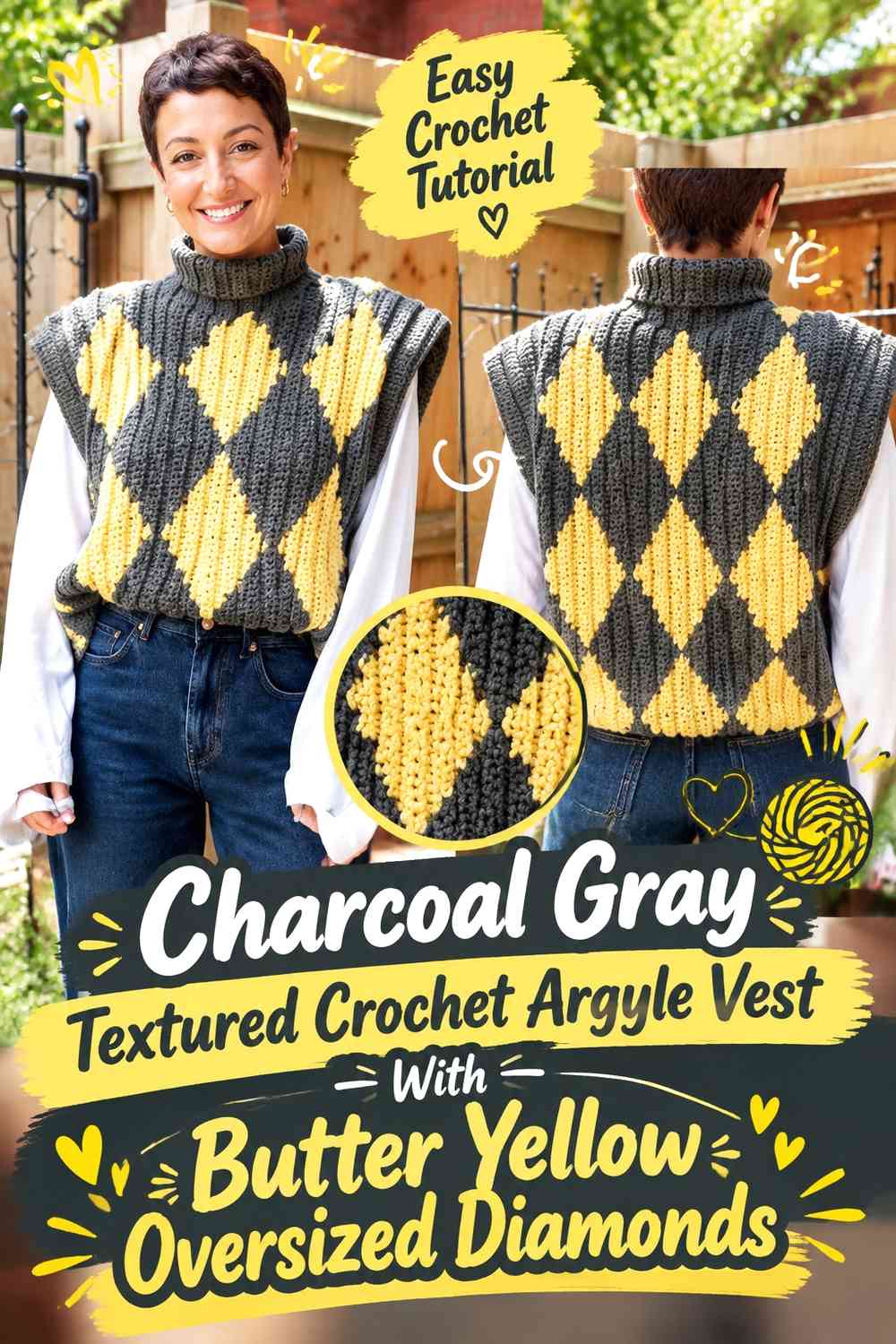
A textured boxy vest can soften crisp geometric edges, so keep charcoal gray across the fabric and use fewer, larger butter-yellow diamonds. Enlarging the motif helps preserve its identity when the underlying stitch surface is more pronounced.
Butter Yellow Diamonds Need Testing on Charcoal Gray Texture
Make a representative color sample before committing to several motifs. Color boundaries that look sharp in smooth crochet can become visually irregular across a more textured stitch.
If the yellow points look broken up, increasing motif scale may work better than adding extra outlines.
Charcoal Gray Should Frame Butter Yellow Instead of Filling Every Space
Leave dark background around the oversized diamonds rather than repeating them edge to edge. The open charcoal areas keep both the texture and the geometric pattern visible.
A boxy silhouette provides enough room for this restrained, larger-scale treatment.
Creator Credit: JeggoCrochet
11. Butter Yellow Button-Up Crochet Argyle Vest With Charcoal Gray Split Diamonds

Use butter yellow across a button-front vest and place charcoal-gray half-diamonds close to—but not directly on—the center opening. When the vest is closed, paired motifs can create a stronger symmetrical composition; when it opens, each front should still look intentional on its own.
Charcoal Gray Diamonds Must Work on Both Butter Yellow Front Panels
Decide whether the vest will usually be worn buttoned or open. Mirrored half-diamonds can form a complete graphic when closed, while independent full motifs behave better when the fronts separate.
Plan the colorwork around the intended wearing style rather than only the flat garment.
Butter Yellow Should Keep the Charcoal Gray Button Band Quiet
Leave the actual closure area mostly solid. Buttons, buttonholes, dark diamonds, and diagonal lattice lines all compete for attention when placed too close together.
A plain butter-yellow center band creates a useful buffer between pattern and function.
Creator Credit: Granny Gaia
12. Charcoal Gray V-Neck Crochet Argyle Vest With Butter Yellow Tonal Diamonds
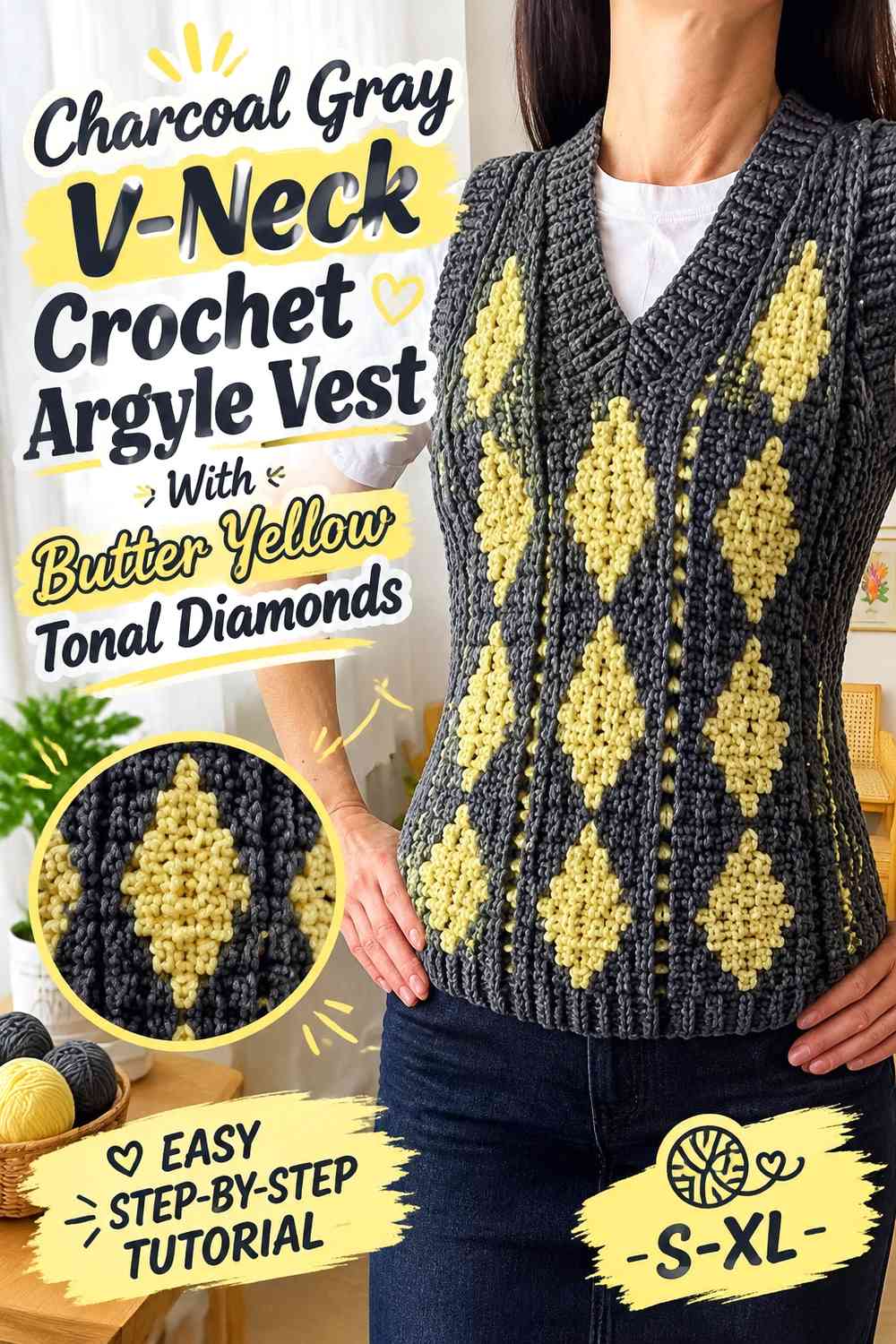
Let charcoal gray cover the vest and make butter yellow the sole diamond shade, omitting extra lattice colors. The simplified two-color treatment preserves the retro geometry while giving the vest a cleaner winter palette.
Butter Yellow Diamonds Need Enough Contrast Against Charcoal Gray
Compare the yarns side by side before starting the colorwork. If the yellow is unusually muted and the charcoal relatively light, the diamonds may appear softer than expected.
A grayscale photo can help you judge whether the light-dark relationship is strong enough for the motif scale you plan to use.
Charcoal Gray Trim Can Contain Butter Yellow Argyle
Keep the V-neck, armholes, and hem charcoal so the geometric center has one consistent dark frame.
Repeating yellow in every border can reduce the distinction between motif and finishing, so reserve it mainly for the diamonds.
Creator Credit: By StellaM
13. Butter Yellow Striped Crochet Argyle Vest With Charcoal Gray Center Panel

Use a butter-yellow vest body with restrained charcoal stripes at the trim, then place a small charcoal-gray argyle panel in the center. This keeps the preppy stripe reference while preventing the vest from becoming equally dominated by horizontal and diagonal patterns.
Charcoal Gray Argyle Should Outrank Stripes on Butter Yellow
Keep the existing stripe idea narrow if the diamonds are the intended focal point. Wide charcoal bands plus large diamonds can divide a sleeveless vest into too many separate graphic zones.
Use stripes mainly to frame the hem or neckline.
Butter Yellow Should Keep the Upper Body Clear Around Charcoal Gray
Tank-style vest constructions expose more of the neckline, straps, and arm openings. Leave those areas mostly yellow so the upper silhouette stays clean.
Concentrating the argyle lower on the front gives the straps and neckline more room.
Creator Credit: TL Yarn Crafts
14. Charcoal Gray Scalloped Crochet Argyle Vest With Butter Yellow Diamonds

Scalloped edging creates curves around a garment dominated by diamond angles. Keep the body charcoal gray and use butter yellow for a restrained central argyle arrangement so the geometric pattern and soft border do not overlap.
Butter Yellow Diamonds Need Charcoal Gray Space Before Scallops
Leave a solid charcoal strip between the outermost motifs and decorative edge. Diamonds touching the scallops can produce too many competing outlines at once.
The quieter dark margin lets each detail remain readable.
Charcoal Gray Scallops Should Not Compete With Butter Yellow
Keep the scalloped edge charcoal if the yellow motifs already provide strong contrast. Making every scallop yellow would spread the accent around the complete perimeter and reduce the importance of the diamond field.
A small yellow button detail can repeat the motif color more subtly.
Creator Credit: Ler Crochet
15. Butter Yellow Textured-Diamond Crochet Vest With Charcoal Gray Outlines
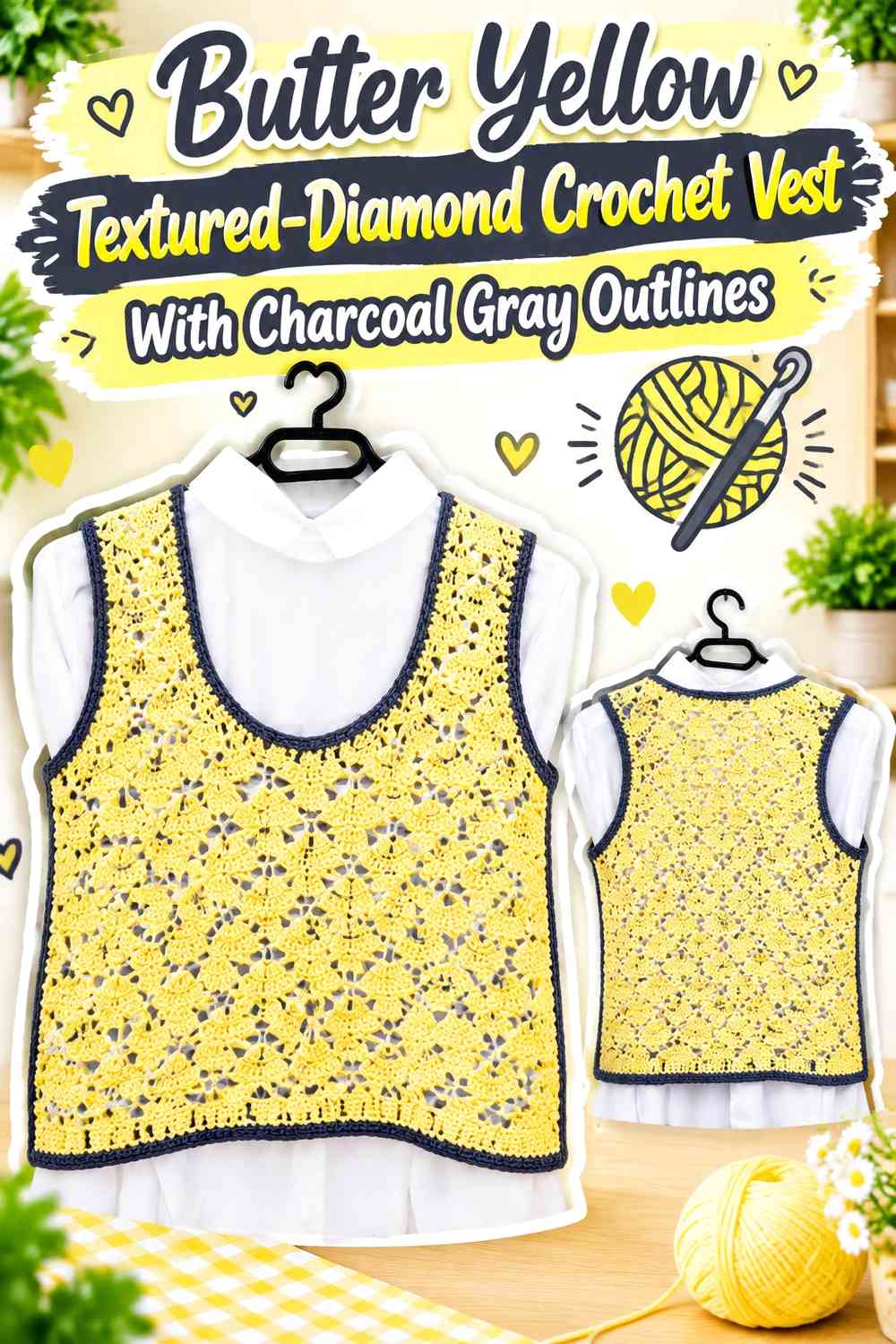
Use a diamond-textured vest as the geometric base, working the body in butter yellow and adding charcoal gray only where you want selected diamond outlines to become more obvious. This reduces the amount of full color-block work while keeping the retro argyle rhythm.
Charcoal Gray Can Emphasize Butter Yellow Diamond Texture Selectively
Do not outline every raised or open diamond automatically. Choose a controlled row, center motif, or front section so the texture still contributes independently.
Too much dark outlining can hide the stitch-based geometry under a second graphic system.
Butter Yellow Texture Should Remain Visible Between Charcoal Gray
Preserve large yellow sections where light and shadow define the diamonds naturally. This makes the vest feel less like flat colorwork and more like a textured interpretation of argyle.
A charcoal hem or neckline can contain the lighter field without adding more motif lines.
Creator Credit: Crocheting Wit Me
16. Charcoal Gray Simple Crochet Argyle Vest With Butter Yellow Center Diamond
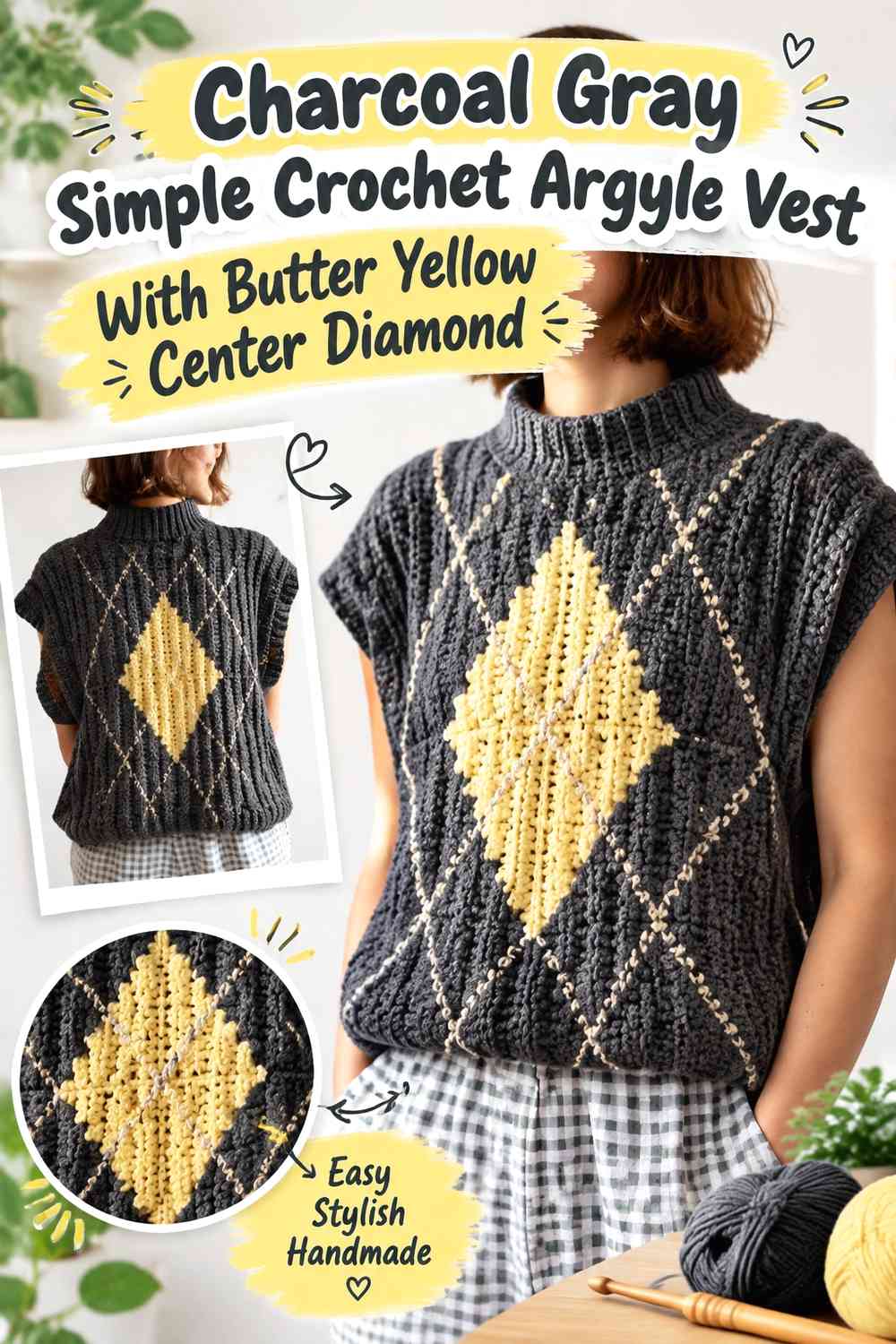
A straightforward panel vest gives one butter-yellow center diamond maximum impact. Keep the construction charcoal gray and treat the front as a blank field for one retro motif rather than forcing a complete traditional repeat.
Butter Yellow Should Sit Precisely on the Charcoal Gray Center Front
Mark the visual center after considering the neckline and shoulder placement. A motif can be mathematically centered on a panel yet appear shifted once the vest is assembled.
Try the vest or hold the front against the body before finalizing the yellow placement.
Charcoal Gray Should Stay Plain Around Butter Yellow
Use the simple body shape to your advantage. Solid charcoal shoulders, sides, back, and trim keep the single diamond purposeful.
If you want a stronger argyle reference, add narrow charcoal crossing lines through the yellow motif rather than creating several additional yellow shapes.
Creator Credit: passtschon
17. Butter Yellow Classic Crochet V-Neck Vest With Charcoal Gray Hem Argyle
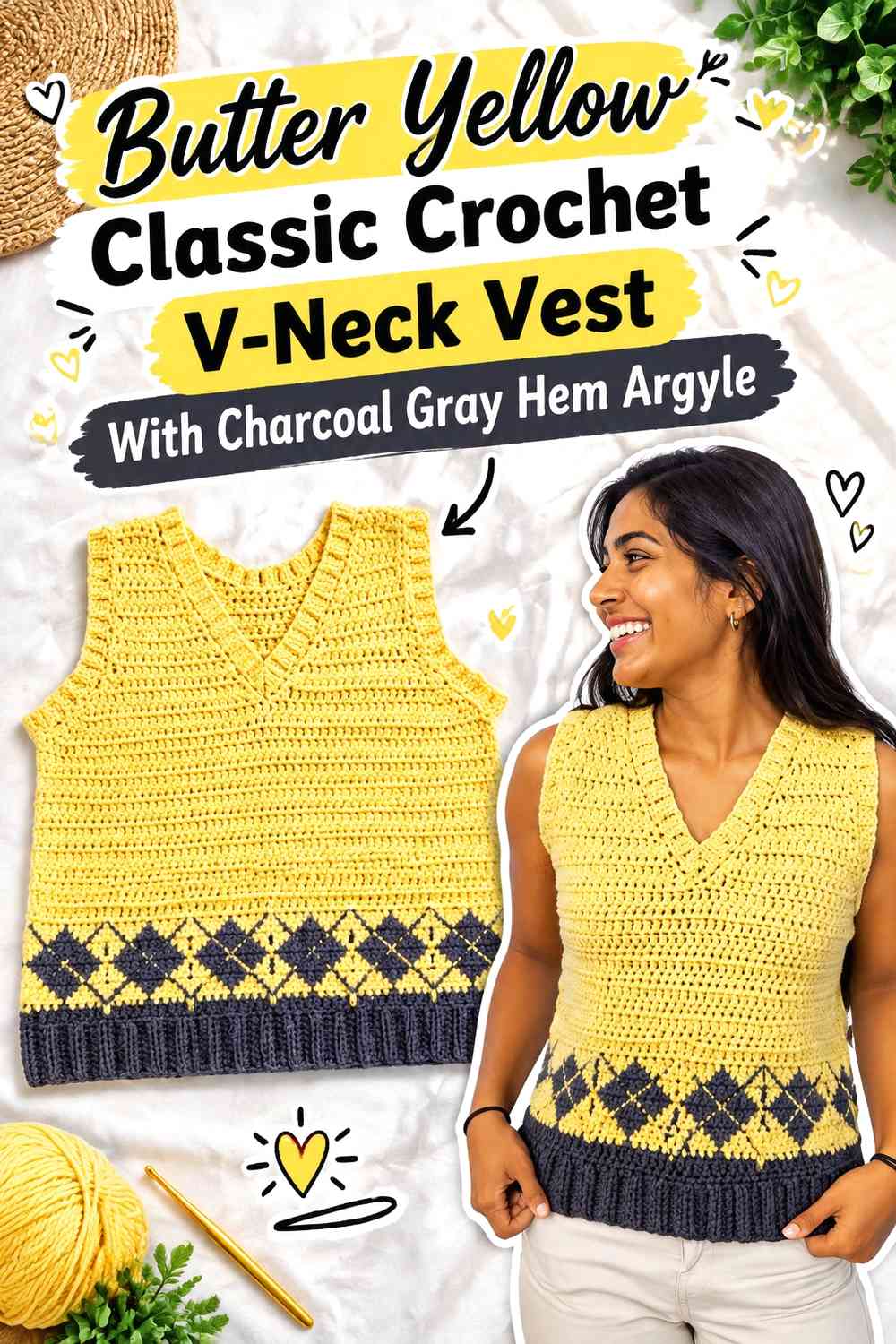
Keep the upper vest butter yellow and place a charcoal-gray diamond band closer to the hem. Moving the pattern downward leaves the V-neck and chest clear, giving the retro motif a less traditional placement while preserving an easy layering area around a shirt collar.
Charcoal Gray Hem Diamonds Need Butter Yellow Below the V-Neck
Leave a substantial yellow field between neckline shaping and the first dark motif. This visually separates the V diagonal from the argyle diagonals.
The result is calmer than extending diamonds from hem to shoulder.
Butter Yellow Should Continue Below or Around Charcoal Gray Diamonds
Do not let the motif touch the final hem unintentionally. A small yellow buffer or clearly planned charcoal finishing band makes the bottom look deliberate.
Check the vest length before deciding how tall the diamond band can be.
Creator Credit: LoopsByLisa
18. Charcoal Gray Checkerboard Crochet Vest With Butter Yellow Argyle Lattice

Use a charcoal-gray vest base inspired by a checked construction, then reinterpret the surface with butter-yellow diamonds and charcoal crossing lines. This final idea gives the strongest graphic retro direction while still keeping the palette to only two colors.
Butter Yellow Diamonds Must Replace the Charcoal Gray Checker Logic
Checkerboard and argyle are different geometries. If adapting a checked vest, plan genuine diagonal diamond shapes rather than simply recoloring existing squares yellow.
Keep the source garment shaping intact while treating the new motif layout as an independent surface plan.
Charcoal Gray Needs Quiet Borders Around Butter Yellow Argyle
Leave solid dark areas around the neckline, armholes, and hem. A full-edge-to-edge diamond field plus contrasting ribbing can make the vest much busier than intended.
Those charcoal borders give the butter-yellow lattice a clear visual boundary and make the retro pattern easier to read over winter layers.
Creator Credit: CROCHET BY BEV
Comparing the Butter Yellow and Charcoal Gray Retro Argyle Vests
For a darker winter vest, Ideas 1, 3, 6, 8, 10, 12, 14, and 16 keep charcoal gray across most of the garment. Butter yellow then becomes the diamond, chest motif, textured accent, or controlled focal color.
Ideas 2, 4, 5, 7, 9, 11, 13, and 17 make butter yellow more prominent. These are useful when you want the vest to feel lighter while charcoal gray provides the retro geometric structure.
Idea 15 uses texture to reduce the amount of conventional colorwork, while Idea 18 gives the two-color graphic treatment its strongest all-over presence.
For a traditional argyle appearance, start with Ideas 1, 2, 9, or 12. For a quieter modern version, Ideas 3, 6, 15, and 16 use fewer motifs. Button-front, collared, hooded, scalloped, and striped constructions already contain other strong details, so their argyle sections generally benefit from more restraint.
Conclusion
Butter yellow and charcoal gray work particularly well for winter argyle vests because one color can establish the garment while the other defines the geometry. Charcoal gray gives a stable dark field for warm yellow diamonds, while a butter-yellow background turns the charcoal pattern into the stronger retro graphic.
Choose small repeated diamonds for a more traditional preppy look, one oversized motif for a cleaner modern vest, or a single horizontal diamond band when the garment is cropped or already has strong texture. V-necks naturally echo the diagonals of argyle, while crewnecks and simple fronts give you more uninterrupted room for centered motifs.
Use the credited tutorials for their original vest construction, sizing, neckline shaping, armholes, closures, and finishing. Where the tutorial does not already contain argyle, plan the diamond layout independently and test it on a representative swatch before committing to a full front. Fit the garment first, then adapt the butter-yellow and charcoal-gray geometry to the usable vest area.
Frequently Asked Questions
Should butter yellow or charcoal gray dominate a winter crochet argyle vest?
Use charcoal gray as the background when you want butter-yellow diamonds to become the strongest focal points. Use butter yellow as the larger field when you want a lighter vest with darker charcoal geometry.
Can I add butter yellow and charcoal gray argyle to a plain crochet vest tutorial?
Yes. Use the tutorial for its original vest construction and plan the argyle separately. Neckline shaping, armholes, texture, and stitch width can affect where complete diamonds fit, so test the motif before committing to the full panel.
How large should butter yellow diamonds be on a charcoal gray vest?
There is no universal ideal size. Compare the diamond width and height with the usable front area after accounting for the neckline, armholes, hem, and any button bands. One oversized motif may work better than several cramped repeats on a short vest.
Should charcoal gray argyle continue onto the back of a butter yellow vest?
It does not have to. A solid back can keep the vest quieter and reduce the amount of colorwork. Repeating charcoal in the neckline, armholes, or hem can connect a patterned front to a plain back.
How can I tell whether butter yellow and charcoal gray have enough argyle contrast?
Place the yarns together and view them from several feet away. A grayscale photo can also help compare their light-dark values. Stronger value separation makes small diamonds and lattice lines easier to distinguish.
Can ribbing and butter yellow argyle work together on a charcoal gray vest?
Yes, but give them a clear hierarchy. Strong ribbing already creates vertical lines, while argyle introduces diagonals. Limit the yellow motifs to one section or increase their scale so the two patterns do not compete everywhere.
How can I keep a butter yellow and charcoal gray argyle vest from looking too busy?
Give one color most of the garment, limit the motif to one or two major zones, and keep neckline and armhole trim comparatively simple. On collared, buttoned, scalloped, hooded, or striped vests, reduce the number of diamonds rather than adding every possible retro detail.