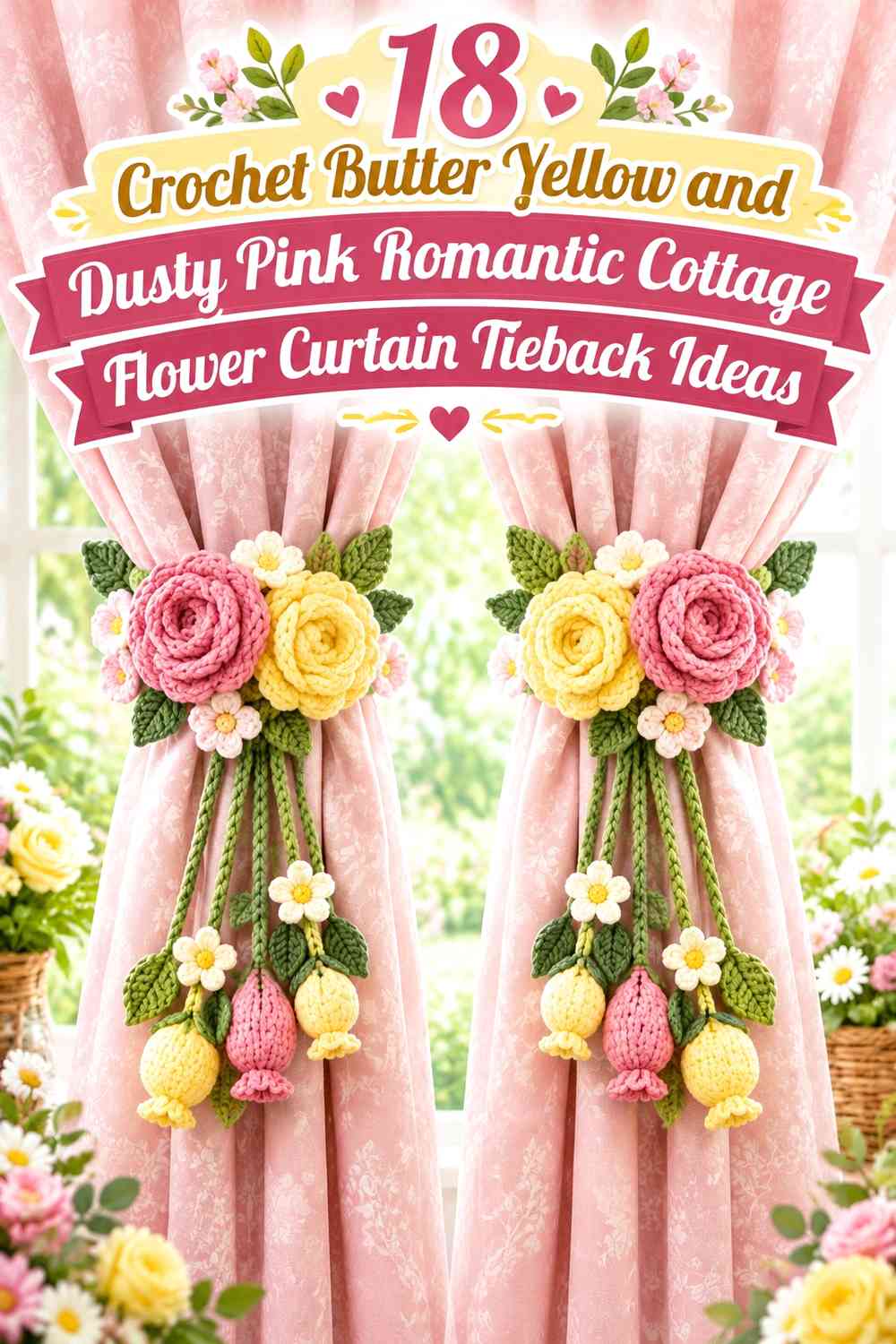
18 Crochet Butter Yellow and Dusty Pink Romantic Cottage Flower Curtain Tieback Ideas

Butter yellow and dusty pink create a soft cottage-style palette that works especially well on crochet flower curtain tiebacks. Dusty pink can carry roses, peonies, bands, and layered petals, while butter yellow can brighten flower centers, smaller blooms, cords, edging, or a contrasting tieback base.
The important decision is how the colors interact with the curtain itself. Against white or cream curtains, both shades can appear relatively soft, so larger flowers or clearer color blocks may be more effective than many tiny details. Against darker curtains, even a narrow butter yellow cord or a small dusty pink blossom can become much more prominent.
Flower placement matters just as much as color. A single oversized bloom can suit a full curtain panel, while a row of small flowers may look more balanced on café curtains or lighter drapes. The tieback also has to gather the curtain comfortably, so decorative flowers should support the functional band rather than replace a construction that actually fits the curtain.
The credited tutorials include complete crochet curtain tiebacks as well as flower-specific tutorials. When a source demonstrates only the flower, use it for that motif and combine it with a properly constructed curtain tieback rather than assuming the flower tutorial supplies the entire holder.
Quick List
- Dusty Pink Rose and Butter Yellow Center Crochet Curtain Tieback
- Butter Yellow Flower and Dusty Pink Band Crochet Curtain Tieback
- Dusty Pink Cottage Rose Cluster with Butter Yellow Crochet Tieback Cord
- Butter Yellow Hydrangea Cluster with Dusty Pink Crochet Curtain Band
- Dusty Pink Tulip Garland with Butter Yellow Crochet Curtain Tieback Cord
- Butter Yellow Sunflower-Style Bloom with Dusty Pink Center Crochet Tieback
- Dusty Pink Peony Crochet Curtain Tieback with Butter Yellow Edging
- Butter Yellow and Dusty Pink Alternating Flower Garland Crochet Curtain Tieback
- Dusty Pink Crochet Curtain Tieback with a Butter Yellow Center Bloom
- Butter Yellow Crochet Curtain Tieback with Dusty Pink Rose Ends
- Dusty Pink Daisy Crochet Curtain Tieback with Butter Yellow Flower Centers
- Butter Yellow Peony Crochet Curtain Tieback with Dusty Pink Center
- Dusty Pink and Butter Yellow Two-Flower Cottage Crochet Curtain Tieback
- Butter Yellow Daisy Row with Dusty Pink Crochet Tieback Base
- Dusty Pink Rose Crochet Tieback with a Butter Yellow Petal Halo
- Butter Yellow Tulip Crochet Curtain Tieback with Dusty Pink Wrap Band
- Dusty Pink and Butter Yellow Color-Block Flower Crochet Curtain Tieback
- Butter Yellow Vine Crochet Tieback with Dusty Pink Carnation Accents
Decide Whether Dusty Pink or Butter Yellow Should Lead the Tieback
Dusty pink works well as the dominant shade when you want a romantic floral focal point. A broad dusty pink rose or peony can carry most of the decorative weight, while butter yellow is kept to flower centers, edging, or the cord that wraps around the curtain.
Butter yellow creates a lighter, sunnier direction. When it covers the tieback band or larger flower petals, dusty pink can become the smaller accent that supplies depth and keeps the palette from looking too pale against white curtains.
Equal amounts of both colors can work too, but the placement should have an obvious pattern. Alternating flowers, a two-color cluster, or a clearly divided band reads more intentionally than scattering small yellow and pink areas without a repeat.
Match Butter Yellow and Dusty Pink Flower Scale to the Curtain
A large dusty pink rose can hold its own visually against heavy or full curtains, while several small butter yellow daisies may be more suitable when you want a lighter cottage-garden effect. Flower size should be judged on the gathered curtain, not while the tieback is lying flat.
Also consider how much fabric the functional tie needs to hold. A narrow decorative garland that looks balanced on a sheer panel may not wrap the same way around thick lined drapes. Use the original tieback tutorials for their construction logic and adjust only when you can verify the finished fit on your curtain.
Keep Butter Yellow and Dusty Pink Details Connected
Two-color cottage florals look more cohesive when each shade repeats with a reason. If dusty pink forms the main rose, repeat it on the tieback edge or a smaller bud. If butter yellow forms the flower centers, it can also appear on the cord or fastening area.
Avoid adding a color to a single tiny location with no visual connection to anything else. Repetition does not have to be equal, but it should make the whole tieback feel designed as one piece.
1. Dusty Pink Rose and Butter Yellow Center Crochet Curtain Tieback
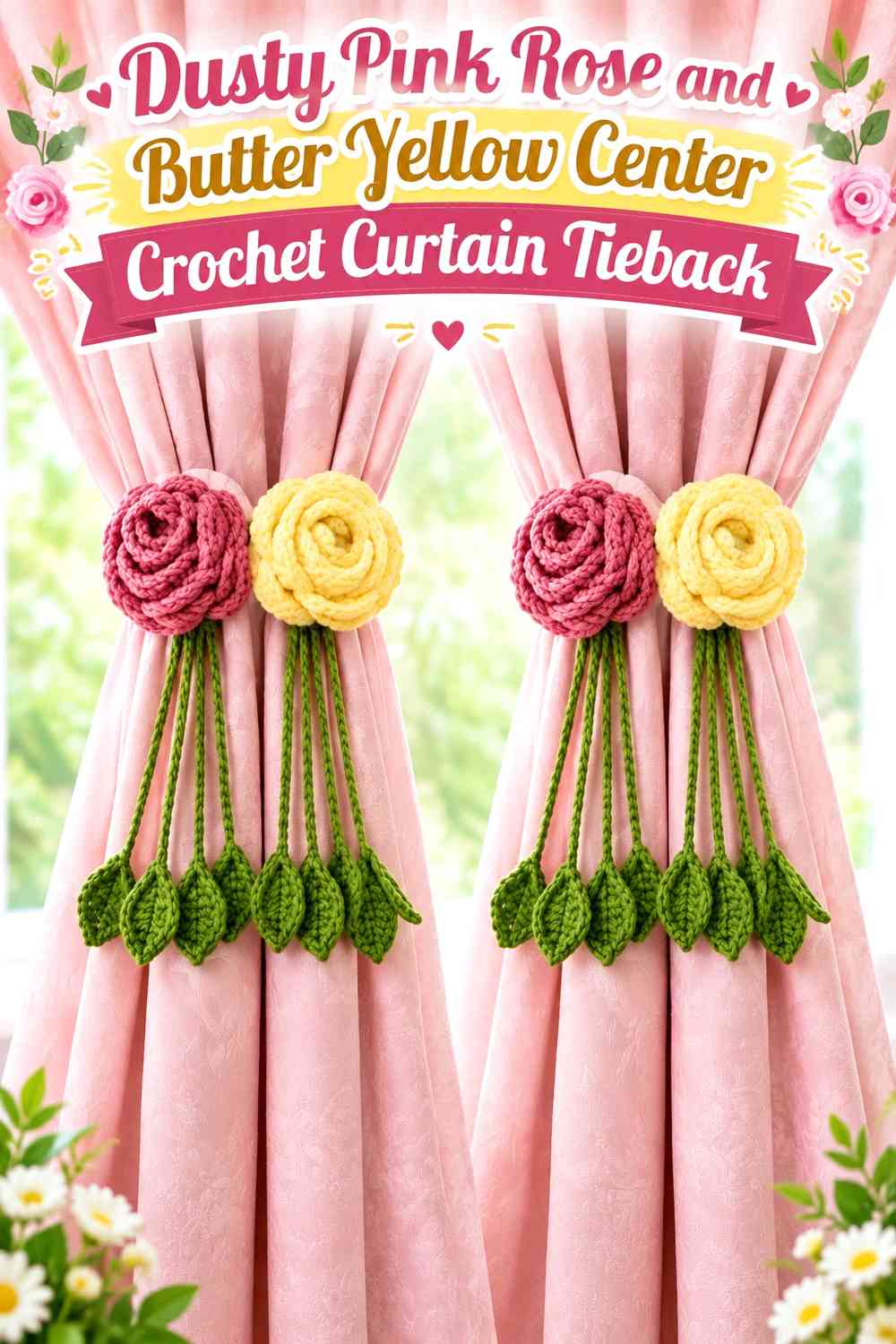
Use dusty pink across the main layered rose and introduce butter yellow only near the flower center. A dusty pink band can then wrap around the curtain so the flower and holder read as one continuous cottage-style accessory.
This is a strongly pink-led scheme, but the concentrated butter yellow center gives the rose a clear focal point without dividing every petal into two colors.
Butter Yellow Center Gives the Dusty Pink Rose More Definition
Keep butter yellow near the center rather than carrying it onto every outer petal. The small light area gives the eye a starting point before it moves through the dusty pink layers.
If your dusty pink yarn is particularly pale, make sure the butter yellow remains sufficiently different when the two yarns are viewed side by side.
Dusty Pink Band Keeps the Butter Yellow Center Secondary
Continue dusty pink through the curtain-holding section so the flower does not appear detached from its functional base.
A butter yellow fastening loop can provide one small repeat, but a full yellow band may shift too much attention away from the rose.
Dusty Pink Rose Size Should Suit the Butter Yellow Accent
On a full curtain, a larger dusty pink flower can support a clearly visible yellow center. On a narrow café curtain, reduce the overall floral mass so the tieback does not visually overwhelm the fabric it is gathering.
Creator Credit: Knitting by Wajida
2. Butter Yellow Flower and Dusty Pink Band Crochet Curtain Tieback
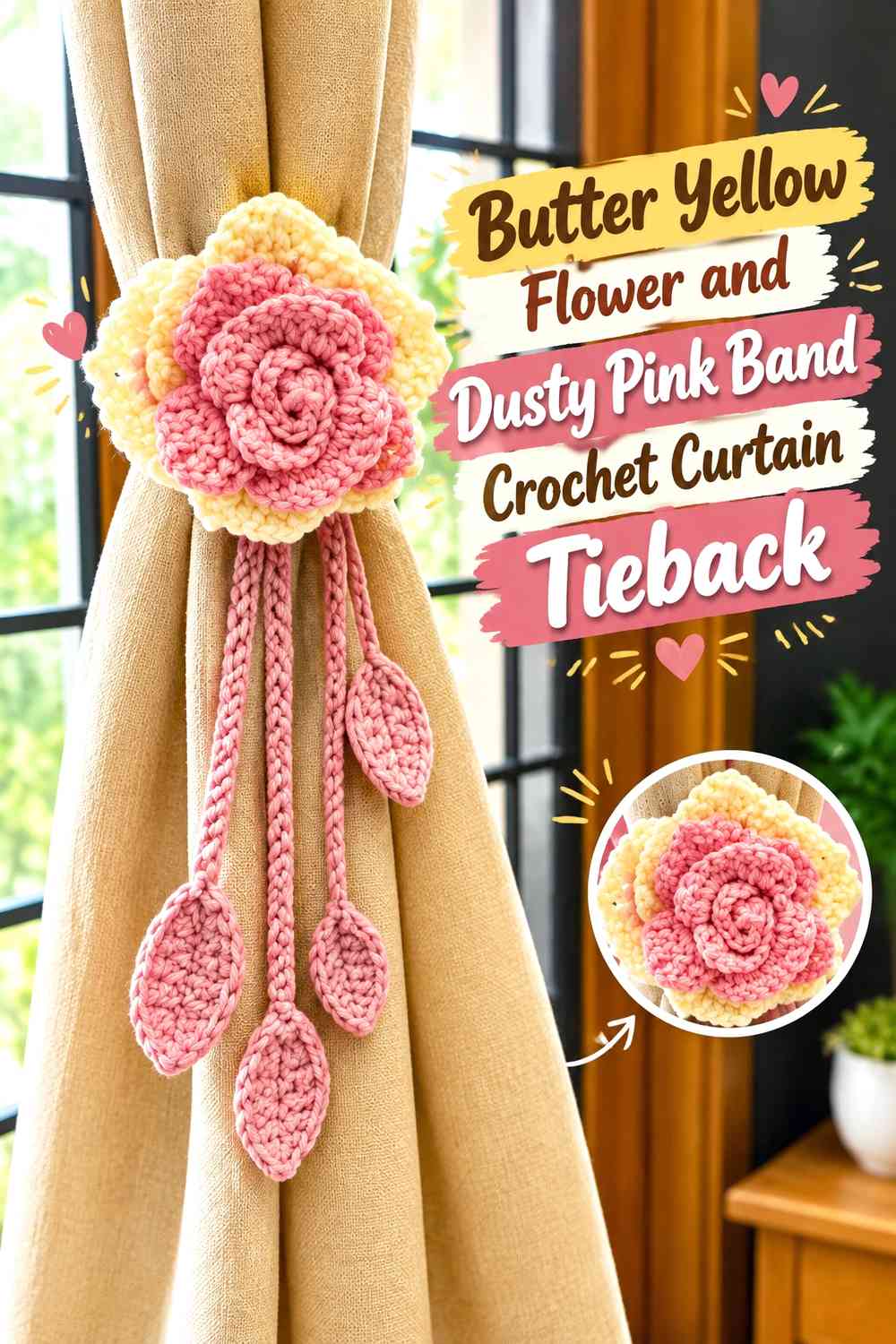
Make butter yellow the main flower color and place it on a dusty pink crochet band. This reverses the usual romantic-pink emphasis and gives the window a lighter cottage-garden direction.
The dusty pink background is important because it separates the yellow flower from pale cream or white curtains, where a butter yellow bloom alone may appear softer than expected.
Dusty Pink Band Frames the Butter Yellow Flower
Leave visible dusty pink around the flower attachment area so the bloom has a clear boundary. If the yellow petals extend across the entire band width, the two pieces may visually merge.
A broad enough pink base also makes the functional tieback easier to distinguish from the decoration.
Butter Yellow Should Stay Dominant on the Dusty Pink Flower Face
Keep most of the petals butter yellow rather than alternating every petal with dusty pink. One consistent flower color creates a stronger cottage-style focal point.
Dusty pink can repeat at the flower center or on a small edge detail if you want more connection to the band.
Creator Credit: Hopeful Turns
3. Dusty Pink Cottage Rose Cluster with Butter Yellow Crochet Tieback Cord
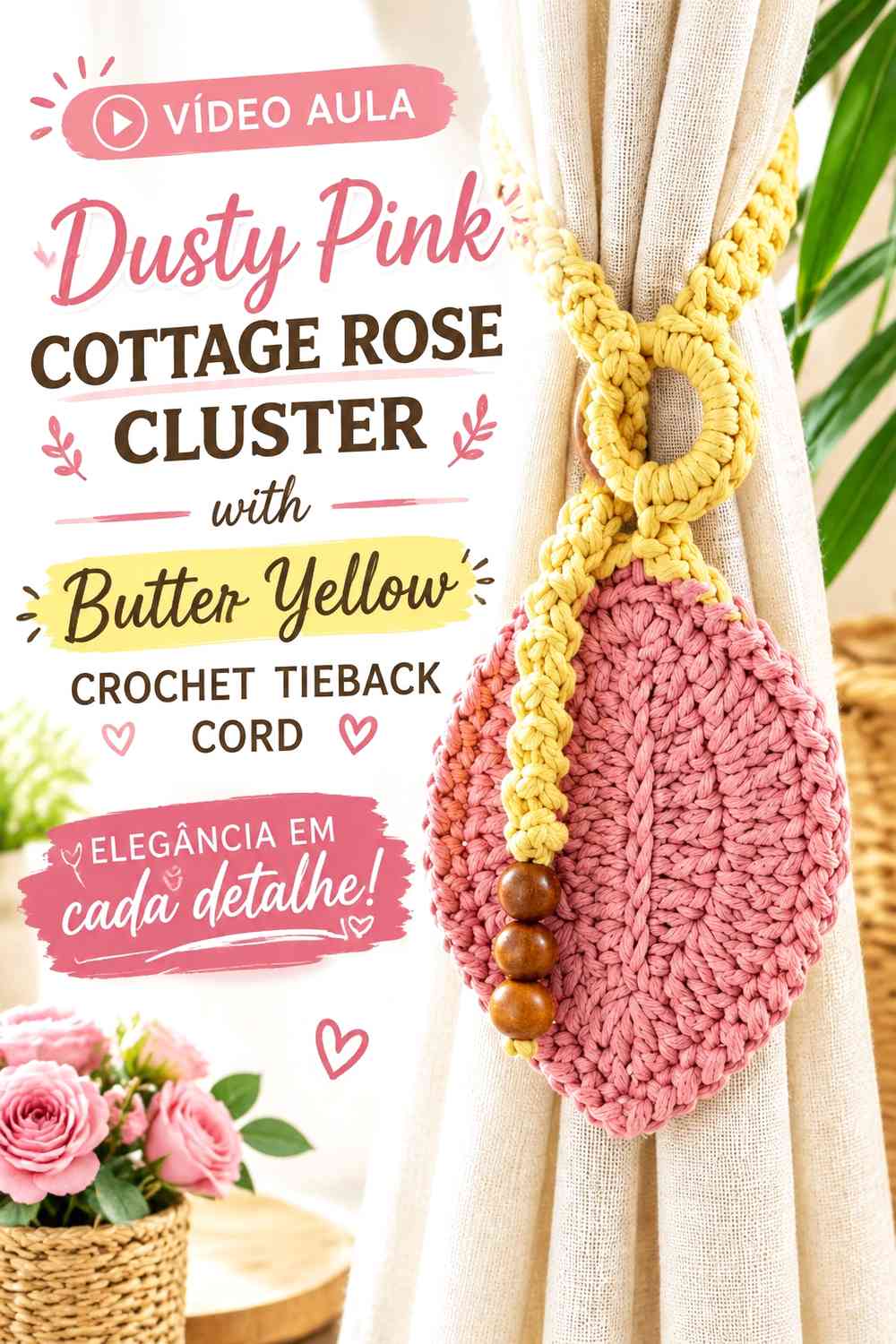
Group several dusty pink roses at the visible side of the curtain and use butter yellow for the cord or narrow tie section. The clustered flowers provide the romantic cottage character, while the yellow keeps the part wrapping around the fabric visually lighter.
This design suits curtains that can support a fuller decorative focal point without the flowers covering too much of the gathered fabric.
Butter Yellow Cord Gives Dusty Pink Roses Breathing Room
A lighter cord separates the flower cluster from the curtain and prevents the entire piece from becoming one continuous dusty pink block.
Keep the cord comparatively simple so it does not compete with the layered roses.
Dusty Pink Roses Need Clear Butter Yellow Gaps Within a Cluster
If several roses sit closely together, a small amount of visible yellow between them can help individual blooms remain recognizable.
That yellow might come from the cord underneath or a compact center detail rather than adding yellow petals to every rose.
Dusty Pink Cluster Should Not Overwhelm the Butter Yellow Tie Function
Test the arrangement on the actual curtain before attaching all the roses. The decorative cluster should remain centered or deliberately offset while the cord still gathers the panel without twisting the flowers out of view.
Creator Credit: Marcelo Nunes Croche
4. Butter Yellow Hydrangea Cluster with Dusty Pink Crochet Curtain Band
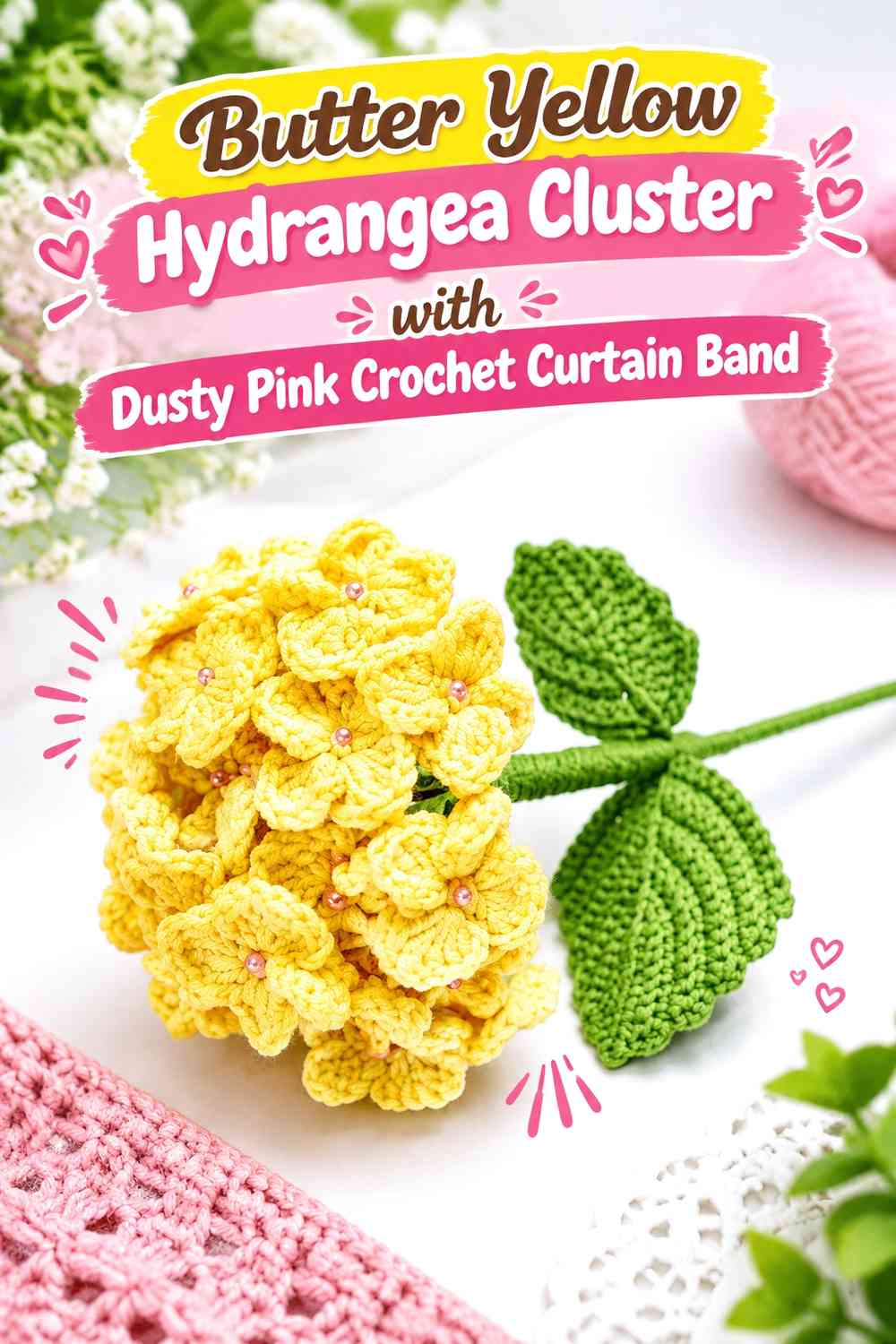
Use several small butter yellow blossoms to create a hydrangea-inspired cluster and mount them against a dusty pink tieback band. The many small flowers produce a softer cottage-garden texture than one oversized rose.
Because the cluster contains repeated petals, keep the color division simple: yellow for the floral group and pink for the main supporting band.
Dusty Pink Background Separates Butter Yellow Hydrangea Blossoms
Leave some dusty pink visible around the outside of the flower cluster. That border prevents small yellow petals from visually dissolving into pale curtain fabric.
The pink field also makes the clustered construction look intentionally attached to the tieback rather than simply resting on the curtain.
Butter Yellow Blossoms Need Consistent Scale Against Dusty Pink
Small differences in handmade flowers can look natural, but very large changes in size may make the cluster feel less unified.
Arrange all the yellow blossoms over the dusty pink band before permanently attaching them so you can balance the visual weight.
Creator Credit: The Crochet Channel
5. Dusty Pink Tulip Garland with Butter Yellow Crochet Curtain Tieback Cord
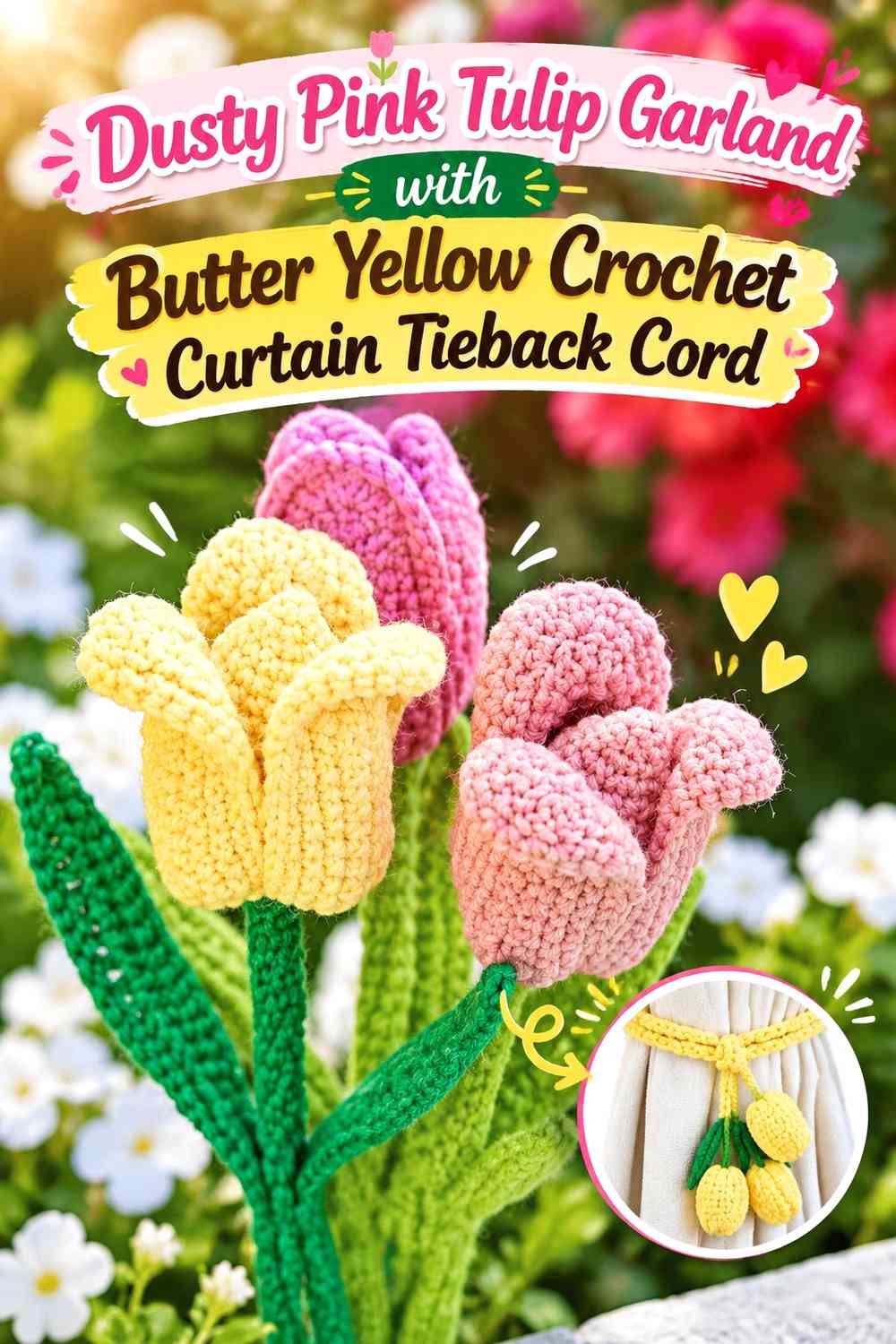
Arrange several dusty pink tulip motifs along a butter yellow cord so the floral detail follows the tieback around the gathered curtain. This creates a more linear cottage-garden look than a single central flower.
The yellow cord should remain visible between the pink tulips so the design still reads clearly as a two-color garland.
Butter Yellow Cord Connects the Dusty Pink Tulips
Let the yellow run continuously underneath or between the tulips. That uninterrupted line helps several separate pink flowers behave visually like one tieback.
If every section between tulips changes back to pink, the garland can lose its clear supporting structure.
Dusty Pink Tulips Need Butter Yellow Space Between Blooms
Do not place the flower heads so close that they merge into one dusty pink strip.
A little visible butter yellow between each bloom preserves the individual tulip silhouettes and gives the garland more cottage-style delicacy.
Dusty Pink Tulips Should Face Consistently Along the Butter Yellow Tie
Before fixing the flowers permanently, wrap the cord around the curtain and check which side remains visible.
Rotate or place the tulips so their strongest faces are directed outward rather than disappearing toward the wall or folds.
Creator Credit: Crocket Crochet
6. Butter Yellow Sunflower-Style Bloom with Dusty Pink Center Crochet Tieback
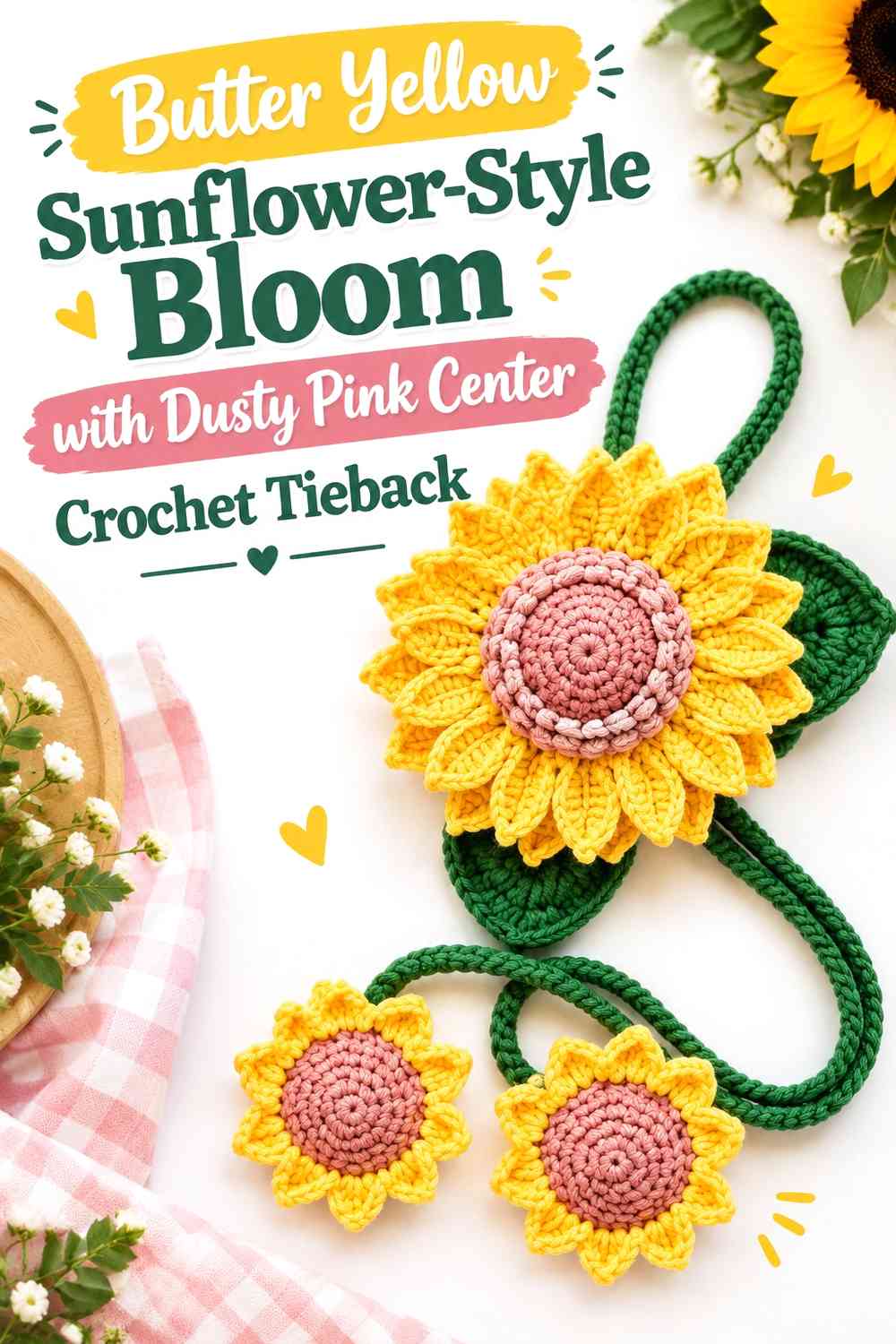
Use butter yellow across a broad petal arrangement and replace the expected dark sunflower center with dusty pink. The color reversal keeps the flower within the romantic cottage palette while still using a bold radial shape.
A dusty pink tieback band can connect the center color to the rest of the piece, or the band can remain yellow for a brighter overall result.
Dusty Pink Center Softens the Butter Yellow Sunflower-Style Bloom
A pink center produces a less graphic contrast than a very dark middle would. That makes the flower easier to coordinate with pale cottage curtains and other soft furnishings.
Keep the dusty pink center clearly contained so the butter yellow petals remain the dominant part of the bloom.
Butter Yellow Petals Need a Visible Dusty Pink Attachment Area
Leave enough pink near the base or center for the flower to connect visually to a dusty pink band.
If the tieback itself is yellow, repeat dusty pink in a small fastening or edge detail instead.
Creator Credit: Lilyrosycrafts
7. Dusty Pink Peony Crochet Curtain Tieback with Butter Yellow Edging
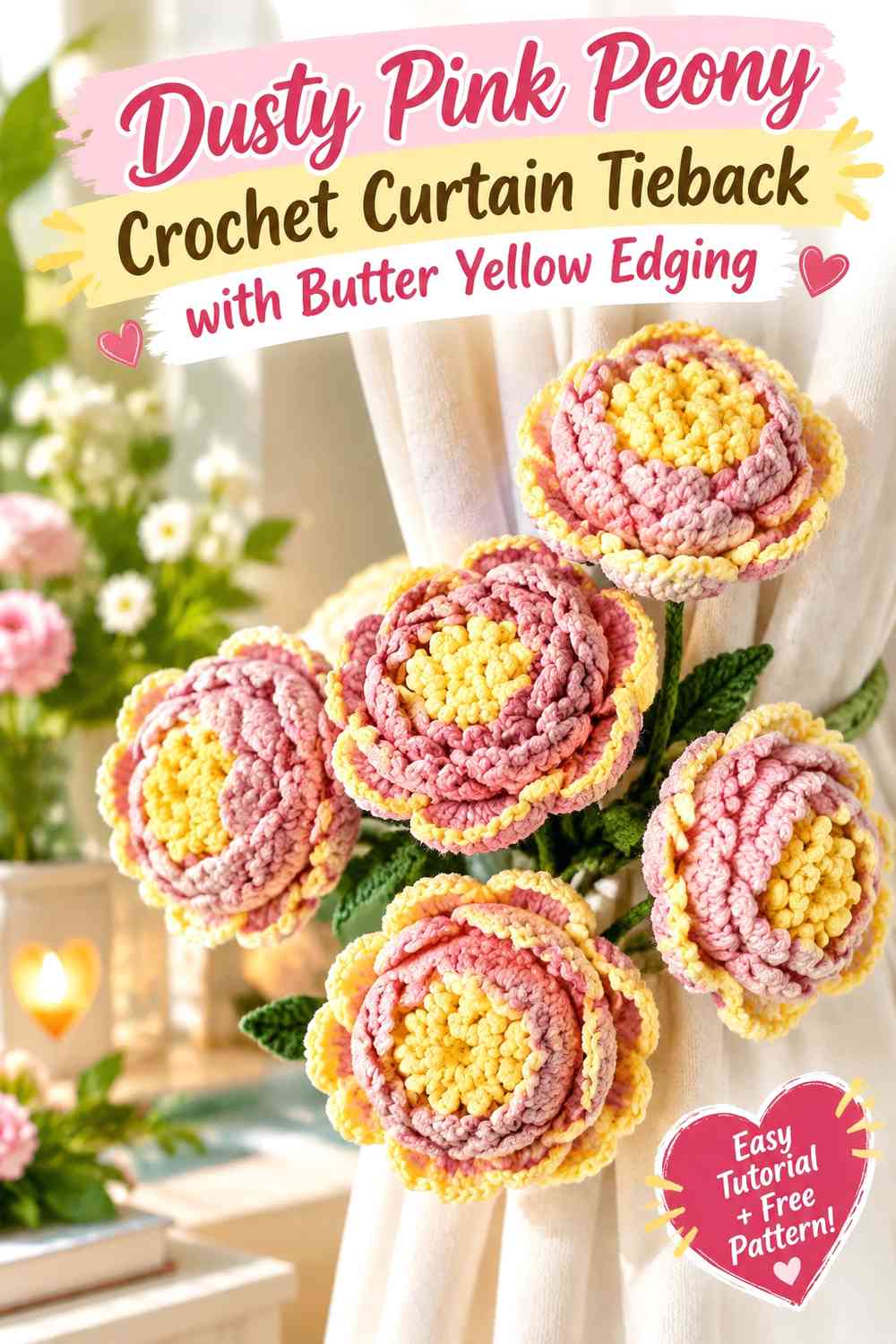
Use a fuller dusty pink peony as the central flower and introduce butter yellow around the outermost petal edge or on the band immediately beneath it. This keeps the romantic flower dominant while adding a light outline.
A dimensional peony already contains a lot of texture, so avoid putting equally elaborate colorwork on the supporting tie.
Butter Yellow Edging Should Clarify Dusty Pink Peony Layers
Use yellow selectively where it helps separate the outer silhouette from the curtain.
Outlining every internal petal may create more visual noise than definition, particularly on a flower with many overlapping layers.
Dusty Pink Peony Needs a Quiet Butter Yellow Support Band
If the band is butter yellow, keep its stitch texture relatively restrained beneath the dimensional flower.
The difference between a smooth yellow tie and a layered dusty pink bloom makes the floral focal point easier to read.
Dusty Pink Peony Scale Should Suit the Butter Yellow Tieback Width
A very full flower can extend beyond a narrow tieback and tilt after repeated handling.
Place the flower on the finished band first and judge how much of its base is actually supported.
Creator Credit: Angela Oei | Fumi’s Studio
8. Butter Yellow and Dusty Pink Alternating Flower Garland Crochet Curtain Tieback
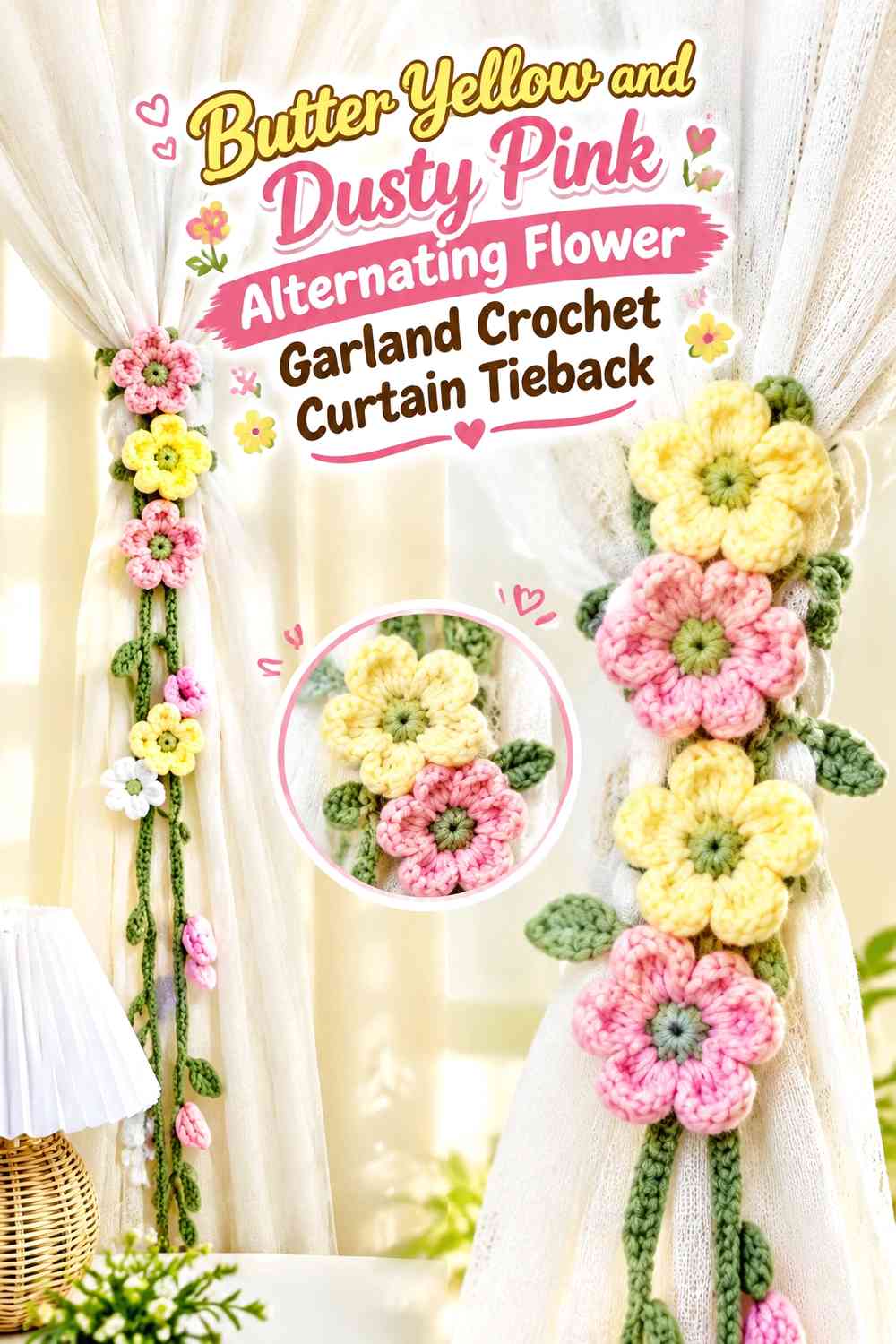
Alternate butter yellow and dusty pink flowers along one continuous garland. This gives both colors similar importance while the repeating sequence keeps the multicolor effect organized.
Use one color for the connecting structure rather than alternating the cord as frequently as the flowers. That gives the eye a stable line beneath the floral rhythm.
Dusty Pink and Butter Yellow Flowers Need Predictable Alternation
Lay out the entire sequence before joining. A clear pink-yellow-pink-yellow rhythm looks intentional, while accidental clusters of one shade can make the pair of tiebacks appear mismatched.
If the number of flowers is odd, choose which color should occupy the central position.
Butter Yellow Cord Can Calm Dusty Pink and Butter Yellow Repetition
A continuous yellow cord makes the garland feel lighter and provides a shared foundation for both flower colors.
If yellow already dominates the blooms, reverse the idea and use a dusty pink connector instead.
Dusty Pink End Flowers Can Frame the Butter Yellow Garland
Using dusty pink at both visible ends can visually close the sequence without requiring a separate border.
This works particularly well when the yellow flowers are slightly brighter than the pink.
Creator Credit: vvw.studio
9. Dusty Pink Crochet Curtain Tieback with a Butter Yellow Center Bloom
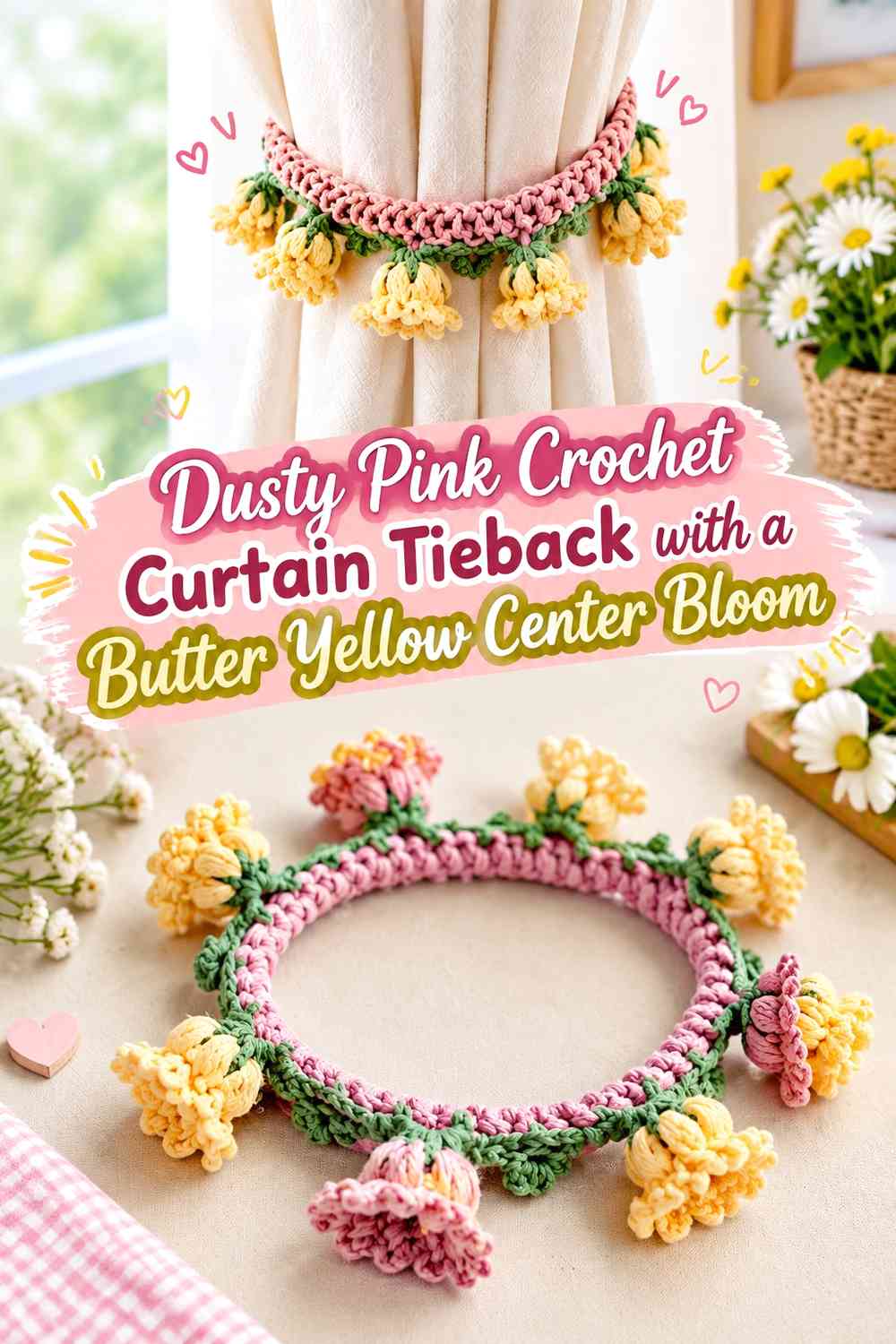
Keep the tieback band almost completely dusty pink and attach one butter yellow flower at the most visible point. This is one of the simplest color hierarchies and suits a romantic room where you want the tieback to coordinate rather than dominate.
The single yellow flower becomes much more noticeable because no other large yellow areas compete with it.
Butter Yellow Center Bloom Needs Broad Dusty Pink Space
Avoid adding several yellow stripes immediately beside the flower. The surrounding pink acts as negative space and gives the bloom a clear outline.
A small yellow fastening loop can provide one secondary repeat without weakening that effect.
Dusty Pink Band Should Fit Before the Butter Yellow Flower Is Positioned
Finish or test the functional part first. Once the band gathers the curtain correctly, identify the area that actually faces the room and place the yellow flower there.
This prevents a well-made floral motif from rotating toward the wall after the tieback is fastened.
Creator Credit: Handmade by Derya
10. Butter Yellow Crochet Curtain Tieback with Dusty Pink Rose Ends
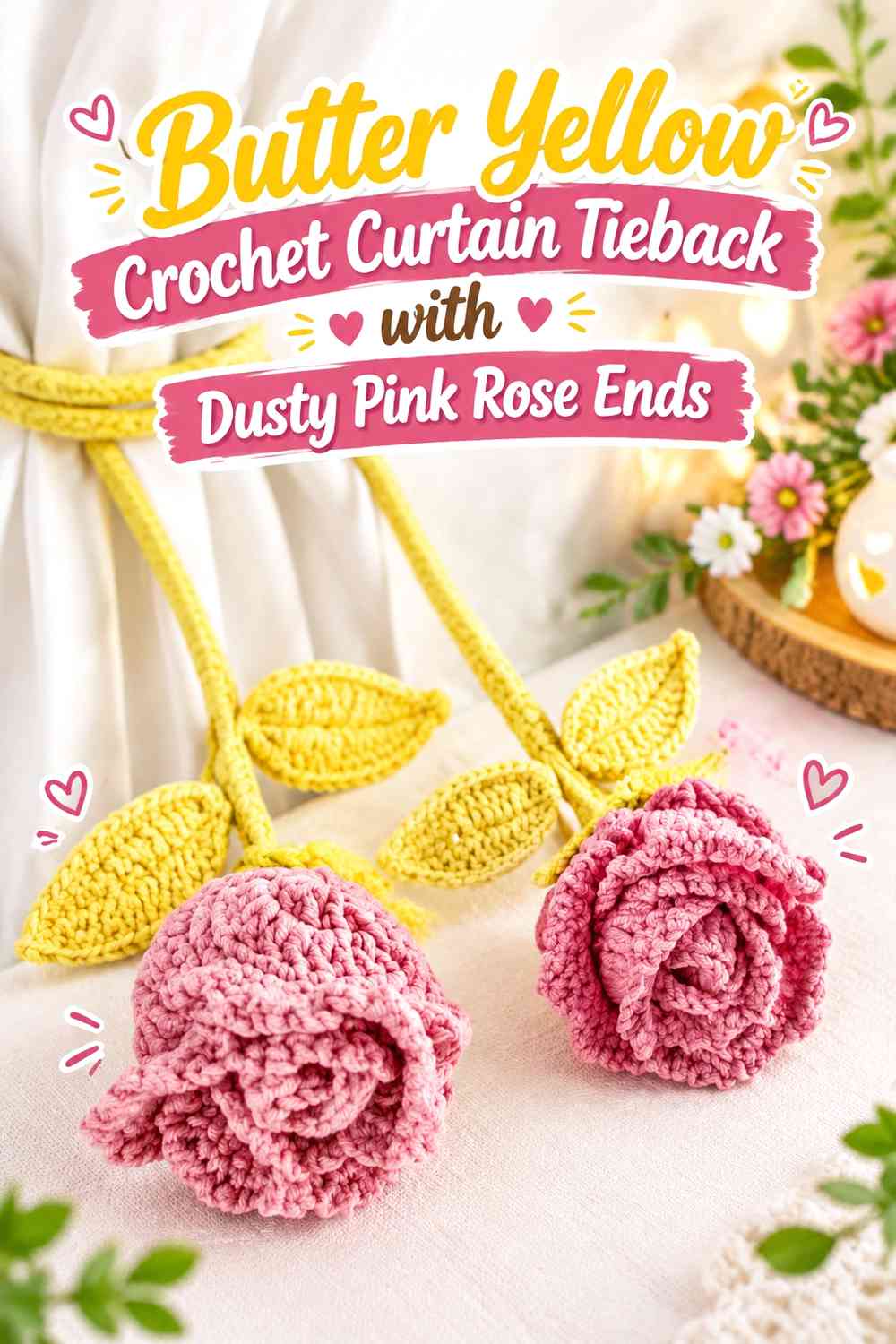
Make the functional band butter yellow and position dusty pink roses near the visible ends or fastening sections instead of at the center. This leaves a quieter middle section around the gathered curtain.
The arrangement works well when you prefer the flowers to frame the curtain folds rather than sit directly on top of them.
Dusty Pink Roses Should Balance Across the Butter Yellow Band
For a symmetrical design, use roses with similar visual size at both ends. One substantially fuller rose can make the tieback look shifted to one side.
Check the flowers after the band is wrapped because the curved curtain changes the apparent spacing.
Butter Yellow Middle Gives Dusty Pink Roses a Lighter Cottage Background
Leave the central band mainly yellow so the end flowers remain distinct focal points.
Adding several dusty pink stripes through the middle can reduce the clear framed effect.
Creator Credit: crafts by miss weave
11. Dusty Pink Daisy Crochet Curtain Tieback with Butter Yellow Flower Centers
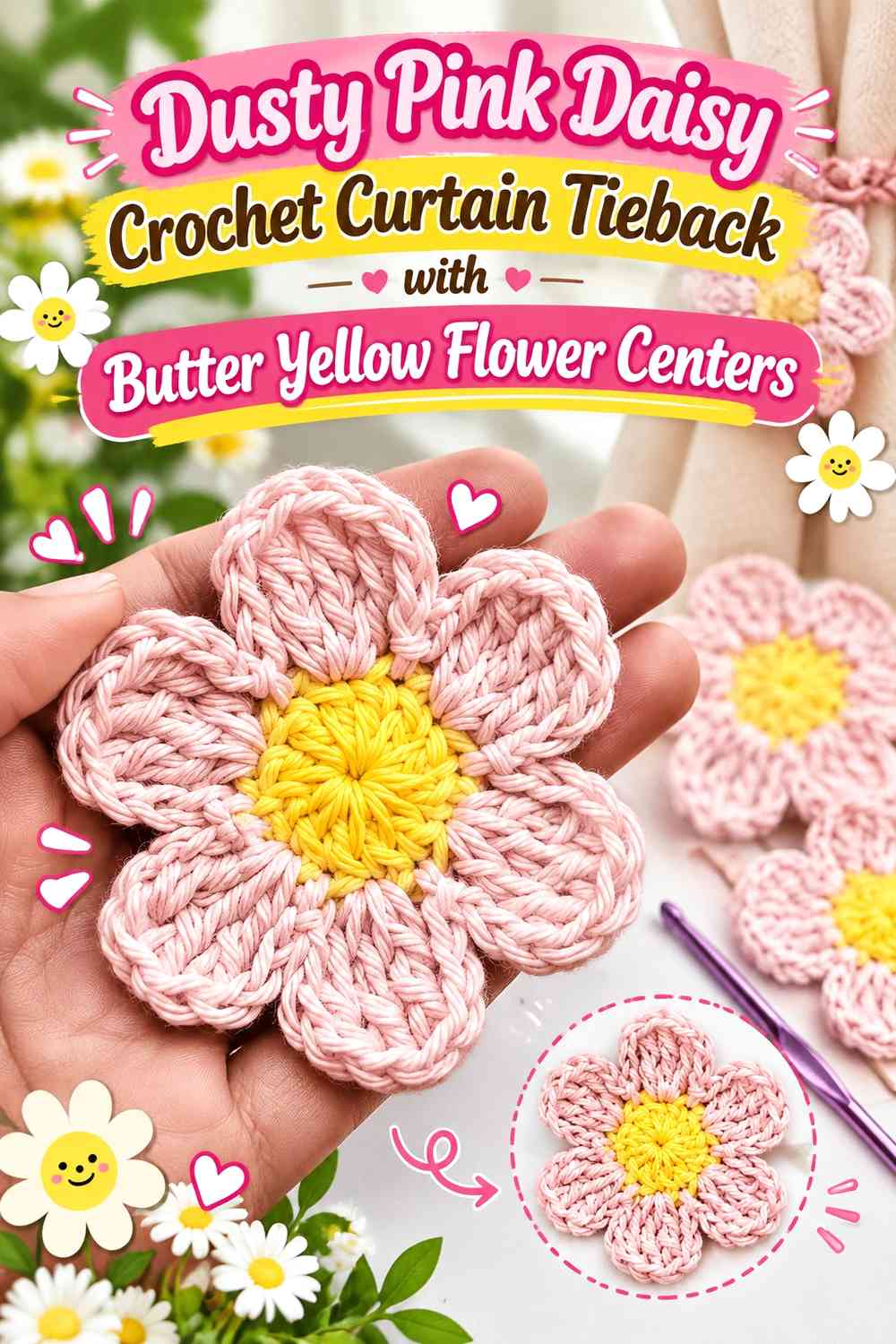
Use dusty pink for daisy-style petals and butter yellow for every flower center. Repeating the same center color across several blossoms can make a small-flower garland feel connected even when the petals vary slightly in shape.
A dusty pink or butter yellow band can work beneath the daisies; choose the color that contrasts more clearly with the curtain.
Butter Yellow Centers Connect Multiple Dusty Pink Daisies
Keep the center treatment consistent from flower to flower. The repeated yellow circles create rhythm along the tieback and make the dusty pink petals read as a coordinated collection.
This is more effective than changing every flower center to a different balance of the two colors.
Dusty Pink Daisy Petals Need Space Around Butter Yellow Centers
Small daisies can visually merge when attached too closely. Leave enough band or cord visible between them to preserve each flower’s outline.
The lighter the curtain, the more important that spacing may become.
Butter Yellow Band Can Brighten Dusty Pink Daisy Repetition
If several dusty pink flowers make the tieback feel too pink-heavy, use butter yellow for the underlying band.
The continuous yellow creates balance without changing the established flower color pattern.
Creator Credit: DIY KraftZ
12. Butter Yellow Peony Crochet Curtain Tieback with Dusty Pink Center
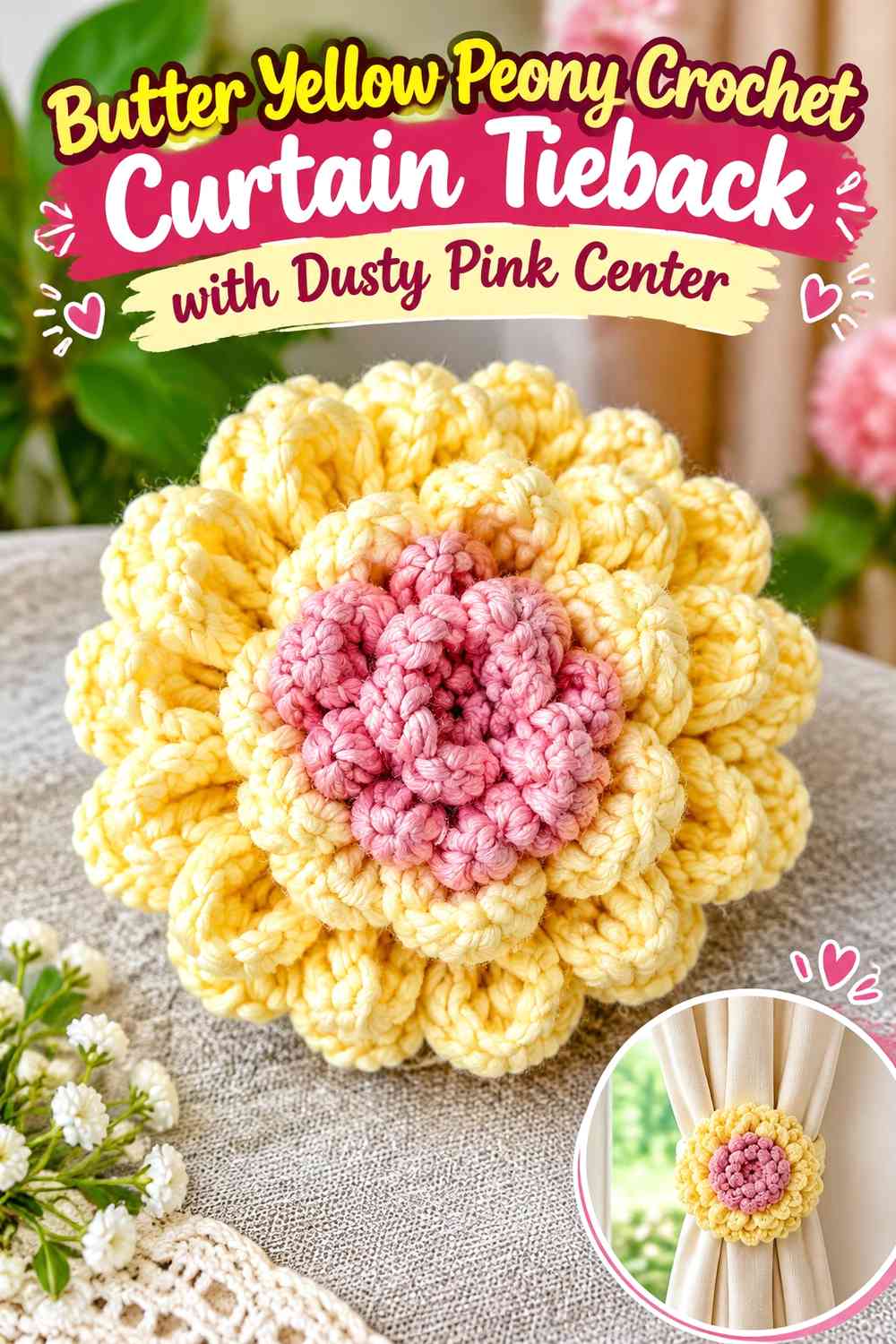
Reverse the peony palette by making the layered petals butter yellow and concentrating dusty pink toward the center. This produces a brighter cottage floral accent while the deeper pink creates visual depth within the bloom.
Use dusty pink again on a small part of the band or fastening area so the center color does not appear only once.
Dusty Pink Center Gives Butter Yellow Peony Layers Depth
Keep the pink concentrated enough that it behaves like the visual core of the flower.
Carrying pink through every outer layer can turn the bloom into an equal two-color flower and reduce the clean yellow-first impression.
Butter Yellow Outer Petals Need a Dusty Pink Background Check
On cream or yellow-toned curtains, the butter yellow outer edge may have limited contrast.
A dusty pink band behind the flower can provide a clearer boundary without recoloring the petals.
Creator Credit: Crochet Bits
13. Dusty Pink and Butter Yellow Two-Flower Cottage Crochet Curtain Tieback
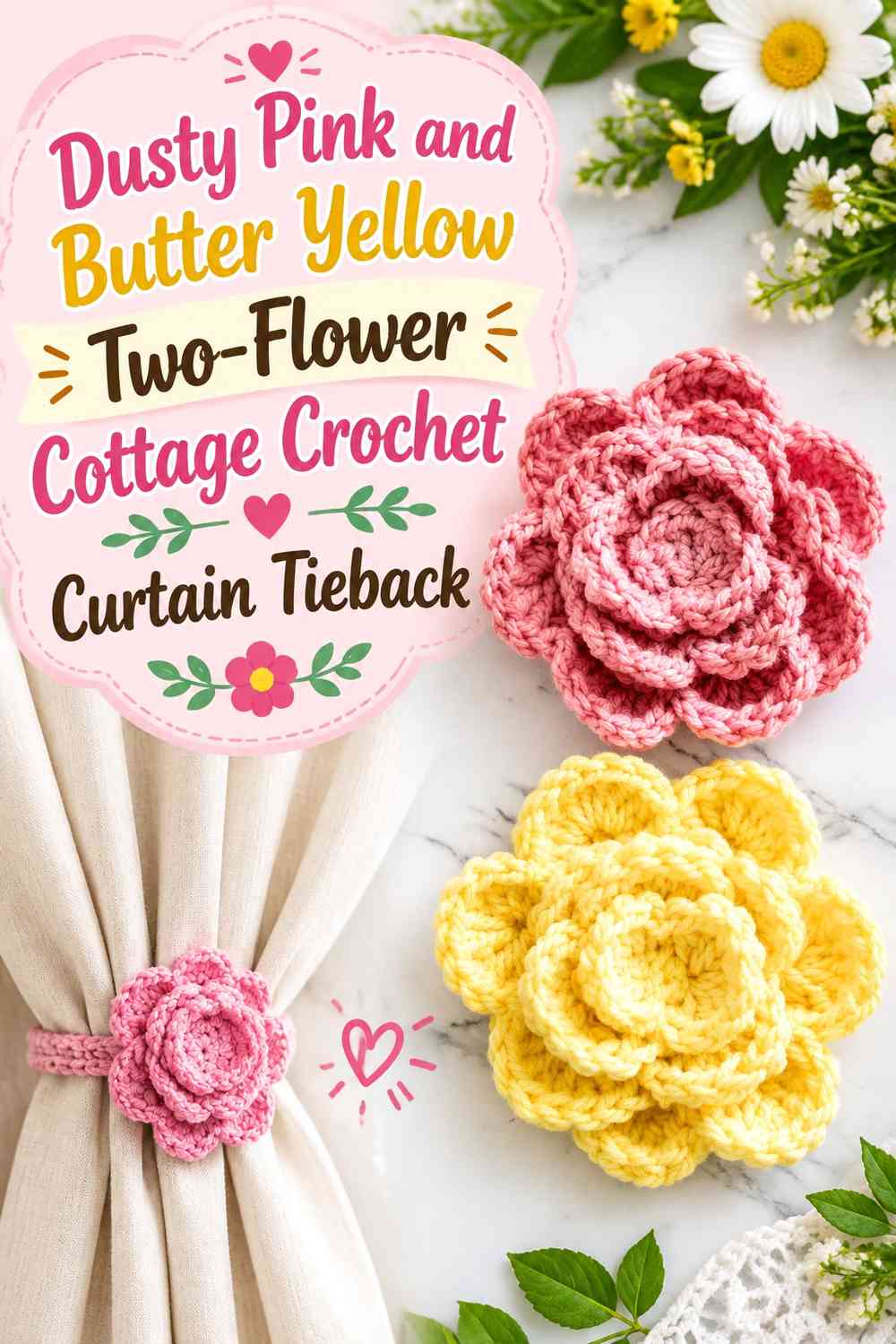
Use two distinct flowers rather than one cluster: a larger dusty pink bloom and a smaller butter yellow companion. Their difference in scale creates hierarchy while keeping both palette colors visible.
Position the flowers close enough to read as one arrangement but not so close that the petals overlap into an indistinct mass.
Dusty Pink Large Flower Should Lead the Butter Yellow Companion
Give dusty pink the larger bloom when you want the tieback to feel more romantic than sunny.
The smaller butter yellow flower then acts like a supporting cottage-garden accent rather than an equal competing centerpiece.
Butter Yellow Flower Needs Visible Dusty Pink Separation
Leave a little band or background space between the two flowers. This helps both silhouettes remain recognizable despite the close arrangement.
If the smaller yellow bloom partially overlaps the pink one, keep most of its outer petals exposed.
Dusty Pink Band Can Unite the Butter Yellow and Pink Flowers
Using dusty pink for the functional tie makes the larger flower feel connected to the structure while the yellow bloom becomes the accent.
Reverse the band color when you want a lighter overall window treatment.
Creator Credit: Bella Coco
14. Butter Yellow Daisy Row with Dusty Pink Crochet Tieback Base
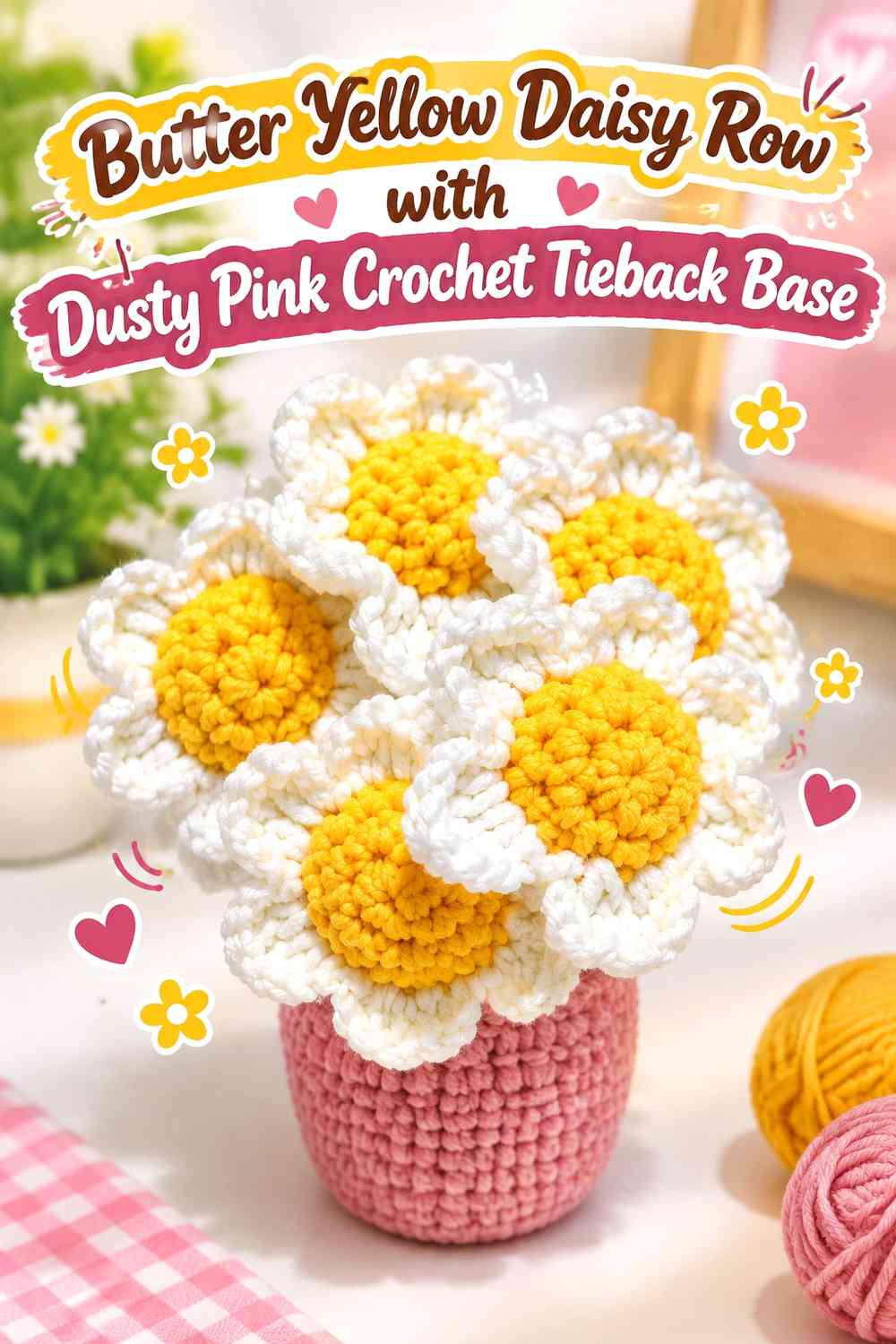
Arrange a neat row of butter yellow daisies across a dusty pink band. Unlike a free-form garland, this idea keeps the blooms close to the functional base and gives the tieback a more structured cottage-border appearance.
It works especially well when you want floral repetition without large dimensional flowers projecting far from the curtain.
Dusty Pink Base Makes Butter Yellow Daisy Shapes Easier to Read
Keep enough pink visible above and below the yellow flowers to frame the row.
If the daisies cover the complete height of the band, the dusty pink can disappear and the tieback may look like a yellow floral strip.
Butter Yellow Daisies Need Consistent Spacing on Dusty Pink
Arrange the flowers on the completed band before sewing them down. Small spacing differences are easier to notice when identical blooms form a straight row.
Check the layout after wrapping the band around the curtain, since the curve can visually compress the flowers near the sides.
Creator Credit: Crochet Musings
15. Dusty Pink Rose Crochet Tieback with a Butter Yellow Petal Halo
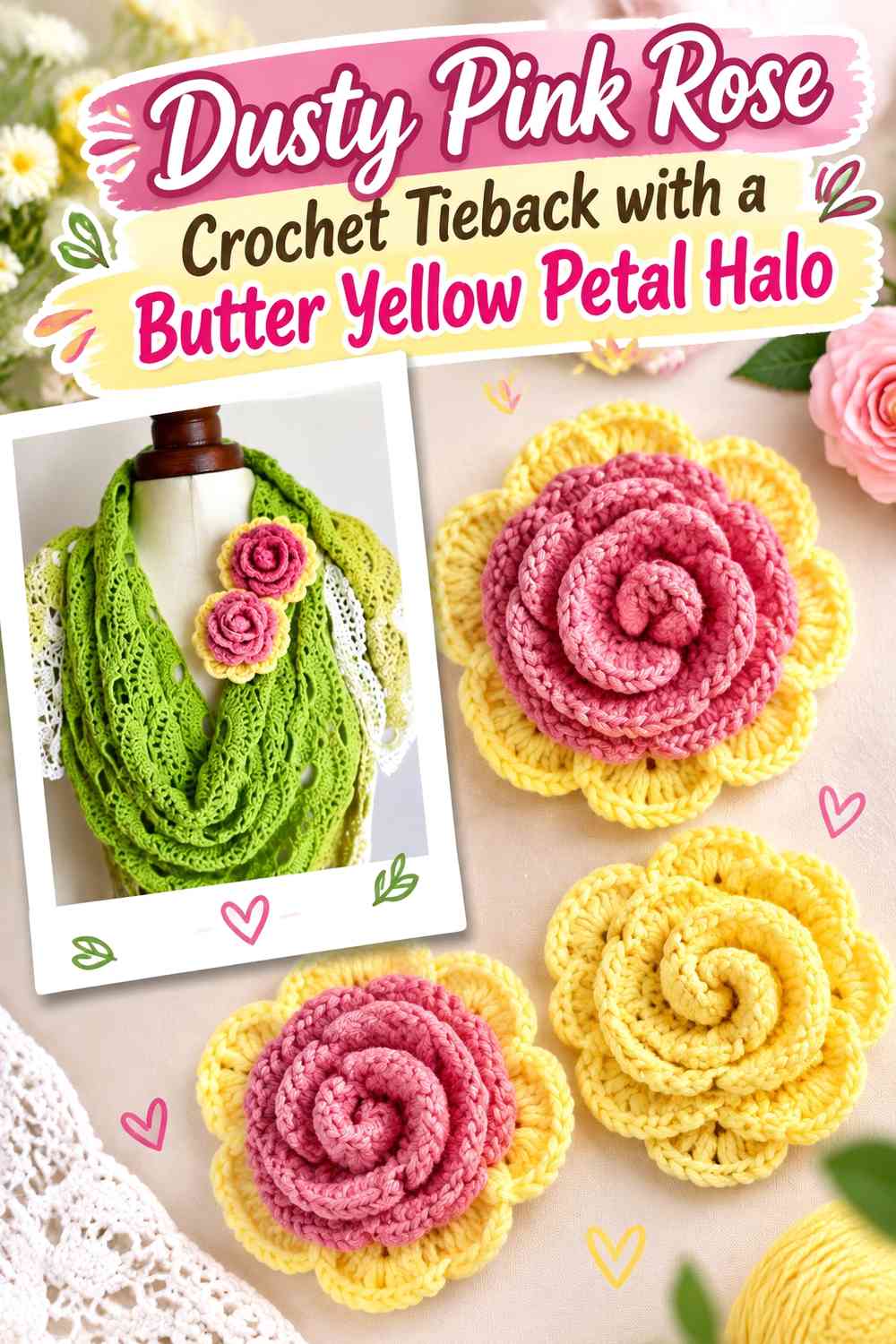
Use dusty pink for the central rose and place butter yellow petals or a secondary flower layer around its outer edge. This creates a framed floral effect rather than simply placing a yellow center inside pink petals.
The halo should remain visibly secondary so the rose still reads as dusty pink first.
Butter Yellow Halo Should Surround the Dusty Pink Rose Evenly
Expose a similar amount of yellow around the main flower where possible. Large yellow sections on only one side can make the motif look off-center when attached to the curtain.
Arrange and shape the layers before securing the flower to the band.
Dusty Pink Rose Needs a Simple Butter Yellow Tieback Connection
If the underlying band is yellow, leave it relatively plain so it connects naturally to the outer petal layer.
If the band is dusty pink, a small yellow edge repeat can link the halo back into the functional part of the tieback.
Creator Credit: Wendy Poole Handmade
16. Butter Yellow Tulip Crochet Curtain Tieback with Dusty Pink Wrap Band
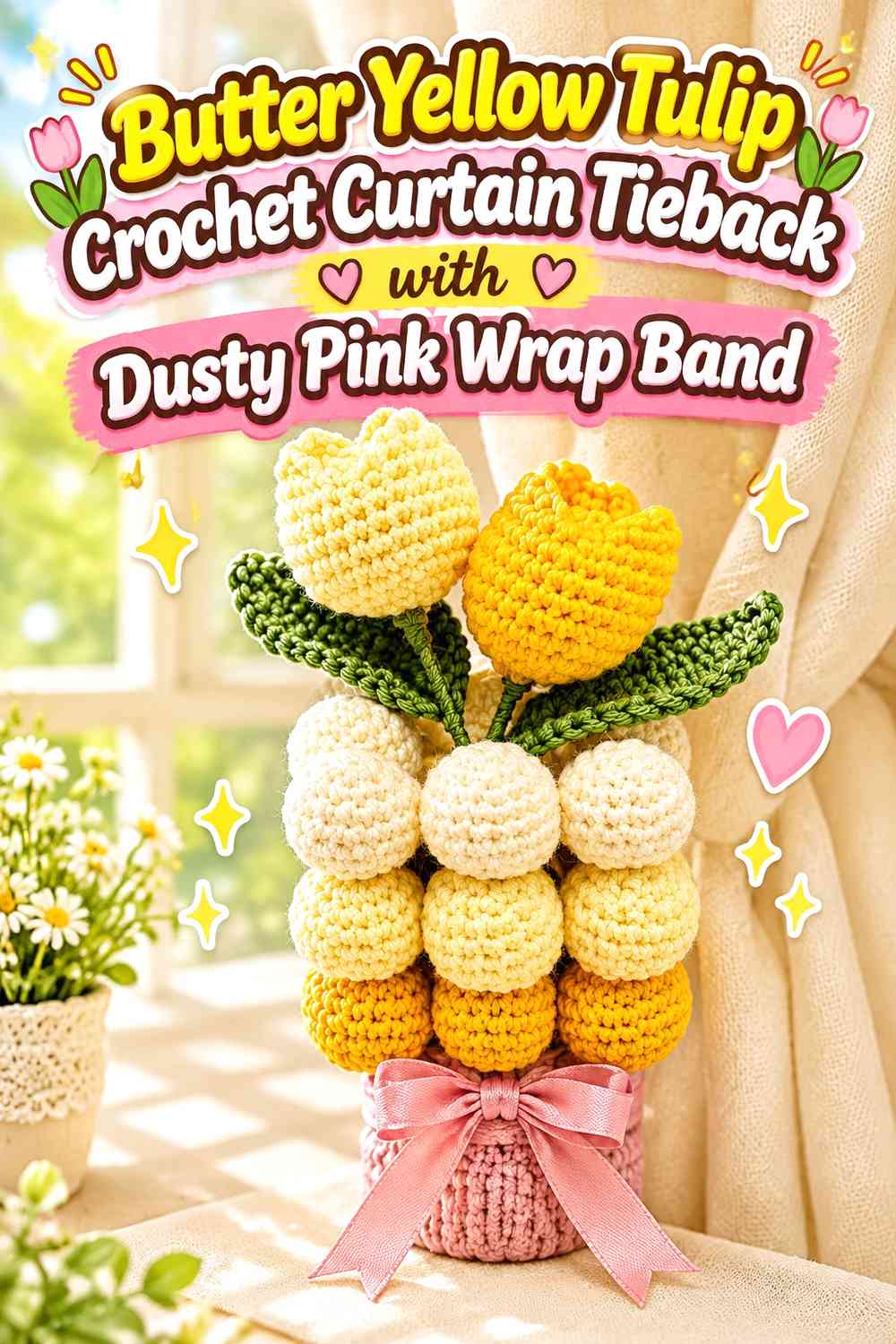
Use butter yellow tulips as repeated motifs and dusty pink as the band that wraps around the curtain. The pink creates a continuous romantic background while the yellow flowers add a brighter cottage-garden rhythm.
This arrangement works particularly well when the tulips are spaced rather than packed into a dense bouquet.
Dusty Pink Band Should Stay Visible Between Butter Yellow Tulips
Leave enough of the band exposed to keep the two-color relationship clear. Closely overlapping yellow flowers can turn the tieback into one bright floral mass.
The visible pink intervals create useful visual pauses.
Butter Yellow Tulips Need Consistent Direction on Dusty Pink
Arrange the flowers so they face outward in a deliberate sequence. Tulips pointing in several unrelated directions can make the band feel less orderly once it is wrapped around gathered fabric.
Temporarily pin or position them before final attachment.
Dusty Pink Can Define the Butter Yellow Tulip Attachment Points
A small pink detail around each base can visually anchor the flowers to the band without introducing another color.
Keep those areas subtle so the yellow flower heads remain the primary motif.
Creator Credit: Crochetnotes
17. Dusty Pink and Butter Yellow Color-Block Flower Crochet Curtain Tieback
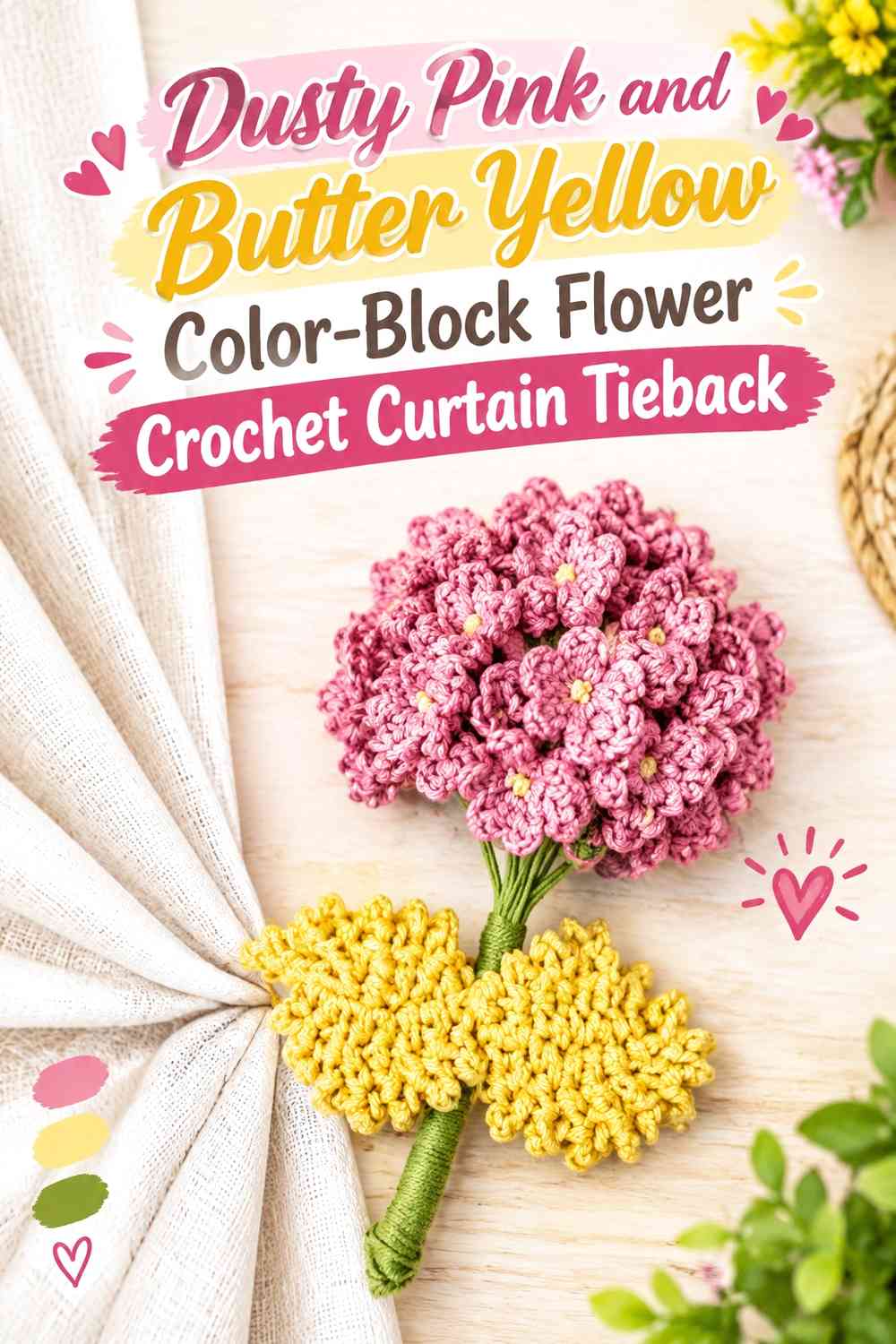
Divide the functional band into two broad color areas, with dusty pink controlling one portion and butter yellow the other. Place a flower at the transition so the color change becomes the focal point rather than looking like an arbitrary yarn switch.
This is more graphic than the floral-garland options but can still suit romantic cottage decor when the flower softens the central division.
Dusty Pink and Butter Yellow Need a Clear Band Transition
Use one obvious change rather than several irregular patches. Broad color blocks are easier to read when the tieback curves around a curtain.
Position the transition where it remains visible after fastening.
Butter Yellow Flower Can Bridge the Dusty Pink Section
A yellow flower overlapping slightly onto the pink block can visually connect the two sides.
If the flower sits entirely inside the yellow section, add a small dusty pink center so the motif participates in the full palette.
Dusty Pink Repeat Keeps the Butter Yellow Side Connected
A small pink edge, center, or fastening detail on the yellow half can prevent the two sections from feeling like separate tiebacks joined together.
Use repetition sparingly so the strong color-block idea remains intact.
Creator Credit: Moara Crochet
18. Butter Yellow Vine Crochet Tieback with Dusty Pink Carnation Accents
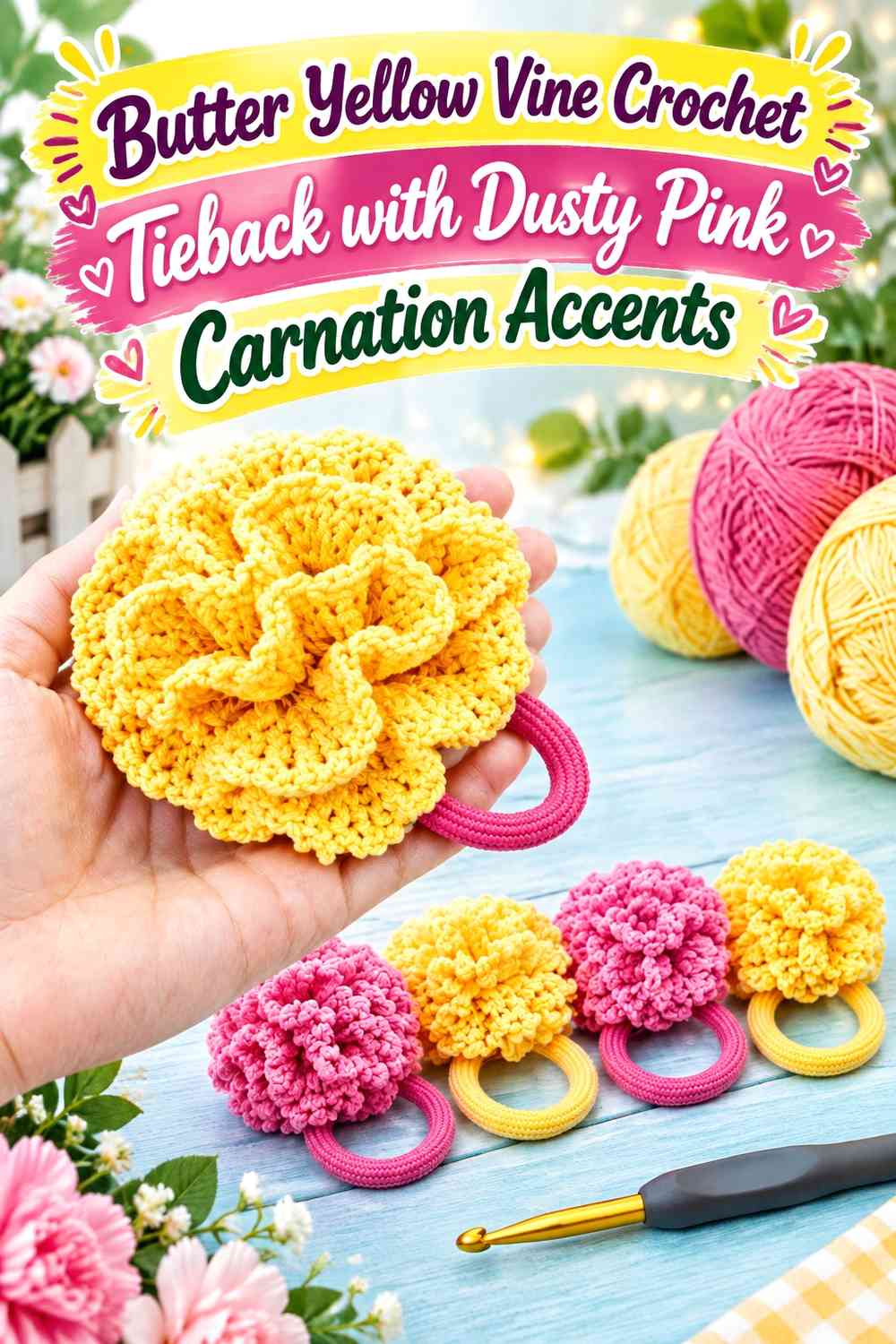
Finish with a more trailing cottage-garden design. Use butter yellow as the continuous vine or wrap structure and add dusty pink carnation-inspired flowers at selected intervals.
The ruffled flower texture makes this option more decorative than a simple daisy garland, so leave larger sections of the butter yellow connector visible between blooms.
Dusty Pink Carnations Need Butter Yellow Space Around Their Ruffled Edges
Full, textured petals can merge when several flowers are packed together. Leave enough yellow visible between them for each carnation shape to retain its outline.
This also keeps the tieback from becoming too bulky around the gathered curtain.
Butter Yellow Vine Should Remain Continuous Beneath Dusty Pink Flowers
A visible connecting line helps the flowers read as one cottage garland rather than individual decorations attached randomly to a curtain.
Keep the vine comparatively simple because the ruffled dusty pink flowers already provide substantial surface texture.
Dusty Pink Carnations Should Be Positioned After Testing the Butter Yellow Tie
Fit the functional tie around the curtain first and mark which areas face outward. Then position the flowers where they remain visible and do not become trapped inside the gathered folds.
This is especially useful for asymmetric floral arrangements.
Creator Credit: Crochet Craftsman
Which Butter Yellow and Dusty Pink Cottage Curtain Tieback Should You Choose?
For the strongest romantic direction, Ideas 1, 3, 7, 9, and 15 give dusty pink the larger floral role while butter yellow provides centers, bands, edging, or supporting contrast.
For a brighter window treatment, Ideas 2, 4, 6, 12, 14, and 16 allow butter yellow to carry the main flower. These work particularly well when dusty pink is used behind the bloom so the yellow does not disappear against cream-colored curtains.
Ideas 5, 8, 11, and 18 create a more garden-like effect through repeated flowers or trailing arrangements. Ideas 13 and 17 are stronger choices when you want the two colors to have visibly different proportions or structural roles instead of repeating the same flower all the way around the curtain.
Conclusion
Butter yellow and dusty pink can produce very different romantic cottage curtain tiebacks depending on which color carries the flowers and which supports the functional band.
Choose dusty pink roses or peonies when you want the strongest romantic focal point. Use butter yellow daisies, tulips, or smaller blossoms when you want a lighter cottage-garden effect. For more visual movement, alternate the two colors along a garland or use a trailing yellow connector with spaced pink flowers.
Before making a matching pair, complete and test one tieback on the actual curtain. Check how much fabric it gathers, which side of the band remains visible, whether the flowers rotate out of view, and whether the chosen yellow and pink still have enough contrast against the curtain. Use complete tieback tutorials for the holder construction and flower-specific tutorials only for the floral motifs they actually demonstrate.
Frequently Asked Questions
Should Butter Yellow or Dusty Pink Dominate a Romantic Cottage Curtain Tieback?
Dusty pink is a good dominant choice when you want roses, peonies, or other romantic flowers to become the main feature. Butter yellow can then brighten the center, cord, edge, or smaller companion flowers.
Butter yellow can dominate when you want a lighter, sunnier cottage look. A dusty pink band or flower center can provide enough contrast to keep the tieback from appearing washed out.
How Can I Keep Butter Yellow Flowers Visible on Cream Curtains?
Place dusty pink behind or around the yellow motif. A dusty pink band, flower center, edge, or connector can create a clearer boundary between a pale yellow bloom and a cream curtain.
Also view the yarns and curtain together in the actual window light, since bright daylight can reduce subtle contrast.
Where Should Dusty Pink Flowers Sit on a Butter Yellow Curtain Tieback?
They can sit at the center, toward each visible end, or at repeated intervals along a garland. The best location depends on which section faces outward once the curtain is gathered.
Temporarily wrap the finished band around the curtain before permanently attaching the flowers.
Can I Mix Different Butter Yellow and Dusty Pink Flowers on One Tieback?
Yes. Keep another feature consistent so the arrangement still feels connected. That might be one continuous band color, repeated butter yellow centers, or a predictable pink-and-yellow sequence.
Using several flower species, different scales, irregular spacing, and different color ratios all at once can make a small tieback look unnecessarily busy.
Should Both Curtain Tiebacks Have Identical Butter Yellow and Dusty Pink Flower Placement?
They can be identical for a formal matched-window look, but mirrored arrangements can also work well. For example, an offset dusty pink flower can face inward toward the window on both sides.
Whichever approach you choose, compare the pair on the window before finishing them so the visual weight feels balanced.
How Do I Substitute Another Yellow for Butter Yellow?
Choose another softened yellow if you want to preserve the gentle cottage palette. A deeper mustard will create more visual weight, while a very pale cream-yellow may have less contrast against light curtains.
Compare the replacement directly with dusty pink and the curtain fabric before committing to several flowers.
How Do I Substitute Another Pink for Dusty Pink?
Choose another softened or muted pink that remains clearly distinguishable from the butter yellow. A brighter pink will make the flowers feel more graphic, while a paler blush will create a lower-contrast result.
Preserve the original color role—dominant flower, supporting band, center, or accent—when substituting the shade.
How Do I Know Whether a Crochet Flower Tieback Will Fit My Curtain?
Curtain panels vary substantially in thickness and gathered circumference, so do not assume one universal tieback length or closure will fit every window.
Use a complete curtain-tieback tutorial for the functional construction, test it around the actual gathered curtain, and only then finalize the position of the butter yellow and dusty pink flowers.